Cryptocurrency holders need to be vigilant, as luxury cars, home addresses, and family members have become key targets for criminals.
Written by: Liam 'Akiba' Wright
Translated by: Saoirse, Foresight News
Key Points Overview
- A man from Missouri pleaded guilty in the Hartford federal court for participating in a robbery conspiracy involving a failed Bitcoin theft and a kidnapping case in Danbury, Connecticut.
- Prosecutors state that the case confirms: Holding cryptocurrency can make one's family, vehicles, and assets targets for personal coercion.
- Saif Faiq will face sentencing on August 28; this "ransom attack" criminal pattern continues to spread from Europe to various courts across the United States.
A 22-year-old man from St. Louis, Missouri, Saif Faiq, pleaded guilty on June 8 in the Hartford federal court to conspiracy to commit robbery affecting interstate commerce. The prosecution stated that the case originated from a conspiracy in August 2024: a group planned to steal Bitcoin from a household involved in another theft case amounting to hundreds of millions of dollars in Bitcoin.
The statutory maximum penalty for the charge is 20 years imprisonment, and Saif Faiq's sentencing hearing is scheduled for August 28.
Prosecutors introduced that the two kidnapped victims were the parents of an individual involved in Bitcoin. Saif Faiq was responsible for recruiting accomplices, coordinating with Adam Iza, and monitoring the movements of the victims at their home.
This Danbury case is yet another testament to the growing personal violence threats triggered by crypto wealth. Prosecutors linked the key elements of this guilty plea: targeting family members, long-term surveillance, luxury vehicles, and the logic of the criminal group attempting to coerce others into surrendering Bitcoin through hostage-taking.
Previous reports from CryptoSlate indicate a surge in leaked personal information of cryptocurrency holders in France, with an increasing number of cases where criminals target their family members; the court records from the Danbury case prove that similar security threats have now surfaced in the U.S. federal justice system.
U.S. Court Records: Real Personal Violence Cases Triggered by Crypto Assets
In September 2024, Danbury police received a report of a Lamborghini Urus carjacking and kidnapping incident, leading prosecutors to charge six residents from Florida. Official reports indicate that two victims were forcibly removed from their vehicle, bound, and locked inside a cargo van, but fortunately, the police intercepted in time and apprehended the involved kidnappers.
The U.S. Department of Justice announced in June 2026 that six additional participants in the carjacking and kidnapping have all pleaded guilty.
Saif Faiq is not the only one in the plea process. The Justice Department identifies his brother Adam Iza as one of the core organizers of the case; Adam Iza pleaded guilty on June 1 to the same charge of conspiracy to commit robbery under the Hobbs Act, which is also connected to the failed Bitcoin robbery and the Danbury kidnapping case.
Prosecutors stated that Adam Iza contacted multiple kidnappers using mobile phones and encrypted communication software, coordinated and arranged resources, and provided financial support for the entire crime.
This federal criminal case includes numerous typical violent crime charges: recruiting accomplices, providing funding, tracking and surveillance, carjacking, kidnapping, and conspiracy to commit robbery. The connection to cryptocurrency lies in the kidnappers' plan to take relatives hostage and coerce Bitcoin holders into surrendering their assets.
This guilty plea records mark the formal inclusion of personal coercion crimes targeting cryptocurrency holders into the category of violent crime prosecution in the U.S. federal courts.
For cryptocurrency holders, this case offers a clear safety warning: as long as criminals identify someone as holding Bitcoin, their family, vehicles, home addresses, or any public clues indicating wealth will be added to the list of crime targets.
All "ransom attack" cases operate under this logic of coercion.
The involvement of a Lamborghini in the case is not incidental – in the prosecution's overview, this luxury car is an intuitive wealth indicator for criminals determining that the victim possesses a significant amount of Bitcoin, making them worth robbing.
Thus, conspicuous luxury vehicles instead sound the alarm for safety, reminding holders to be cautious of the wealth they expose, their close acquaintances, and the risk of leaking access to their digital assets.
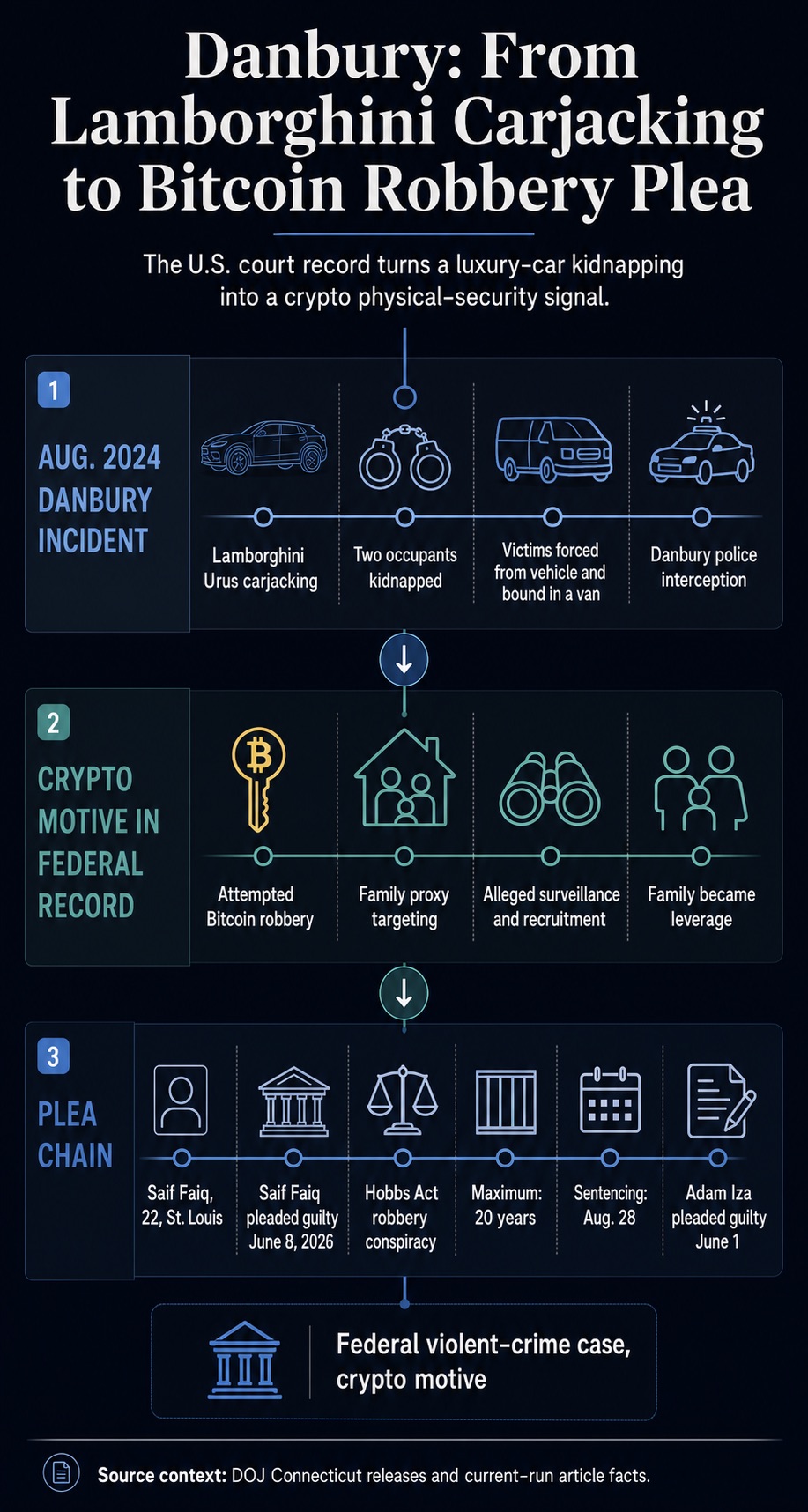
This infographic outlines a violent case from 2024 in Danbury, aimed at seizing Bitcoin, involving the hijacking of a Lamborghini and the kidnapping of its owner, revealing planning details and the legal progress of two suspects pleading guilty in 2026, awaiting sentencing
The Breakthrough Point of Attack Has Always Been People Themselves
The field of security research defines a "ransom attack" as a crime that forces victims to surrender passwords, private keys, or access to digital assets through physical violence and coercion.
CertiK's "2025 Ransom Attack Report" categorizes such crimes as attacks against "human endpoints," reporting 72 verified incidents in 2025, a 75% increase year-on-year.
This is crucial for Bitcoin holders: the security protection of the blockchain protocol itself and the personal safety of the holder are two completely independent protective systems. Even if the blockchain code is difficult to breach and Bitcoin cannot be stolen remotely, the asset-holding individual can easily fall victim to violent coercion.
Once criminals determine that hardware wallets, mnemonic phrases, exchange accounts, mobile devices, or targeted relatives could lead to transferable cryptocurrency assets, all of these items become their means of pressure.
In the Danbury case, the pressure channel identified by the criminals is the victims' relatives. The U.S. Department of Justice clarifies: the two kidnapped parents were not involved in the Bitcoin theft.
The only reason they were targeted was their child's involvement in a robberies of Bitcoin amounting to hundreds of millions of dollars. This also makes the case a robbery crime of "indirect hostage-taking."
Similar cases that have erupted in France prove that this is a widespread personal safety hazard. In March of this year, our publication reported that cryptocurrency holders in France suffering violent attacks are no longer limited to industry insiders or corporate executives; the target group of criminals continues to expand, with ordinary individuals and private residences frequently being invaded.
The Danbury case brings this established criminal template fully into U.S. court records. The conspicuous luxury vehicle acts as a wealth symbol, family members become leverage for coercion, and the ultimate asset the criminals aim to seize is Bitcoin.
The core thinking of the criminals: find someone to apply personal pressure to leverage cryptocurrency assets.
The Danbury case clearly proves that relatives can become indirect hostage targets in cryptocurrency crimes; meanwhile, the series of cases in France shows that as similar attacks repeatedly occur, local public safety guidelines, the travel and protective habits of industry executives, and ordinary holders' self-protection methods will all be forced to adjust comprehensively.

Europe Remains a Core Area for Ransom Attack Cases
Setting aside the Danbury guilty plea case, all existing data indicates that Europe is currently the concentrated outbreak area for "ransom attack" crimes.
CertiK's "2026 Ransom Attack Overview Report" states that between January and April 2026, 34 attack cases were verified, with estimated total property losses of approximately $101 million.
Of the 34 cases, 28 occurred in Europe, accounting for 82% of all recorded cases, with France having the highest incident rate among the countries.
CryptoSlate’s May analysis of ransom attacks reached the same conclusion: the wave of offline violent extortion against cryptocurrency holders continues to accelerate, with the core area of incidents remaining in Europe, especially severe in France.
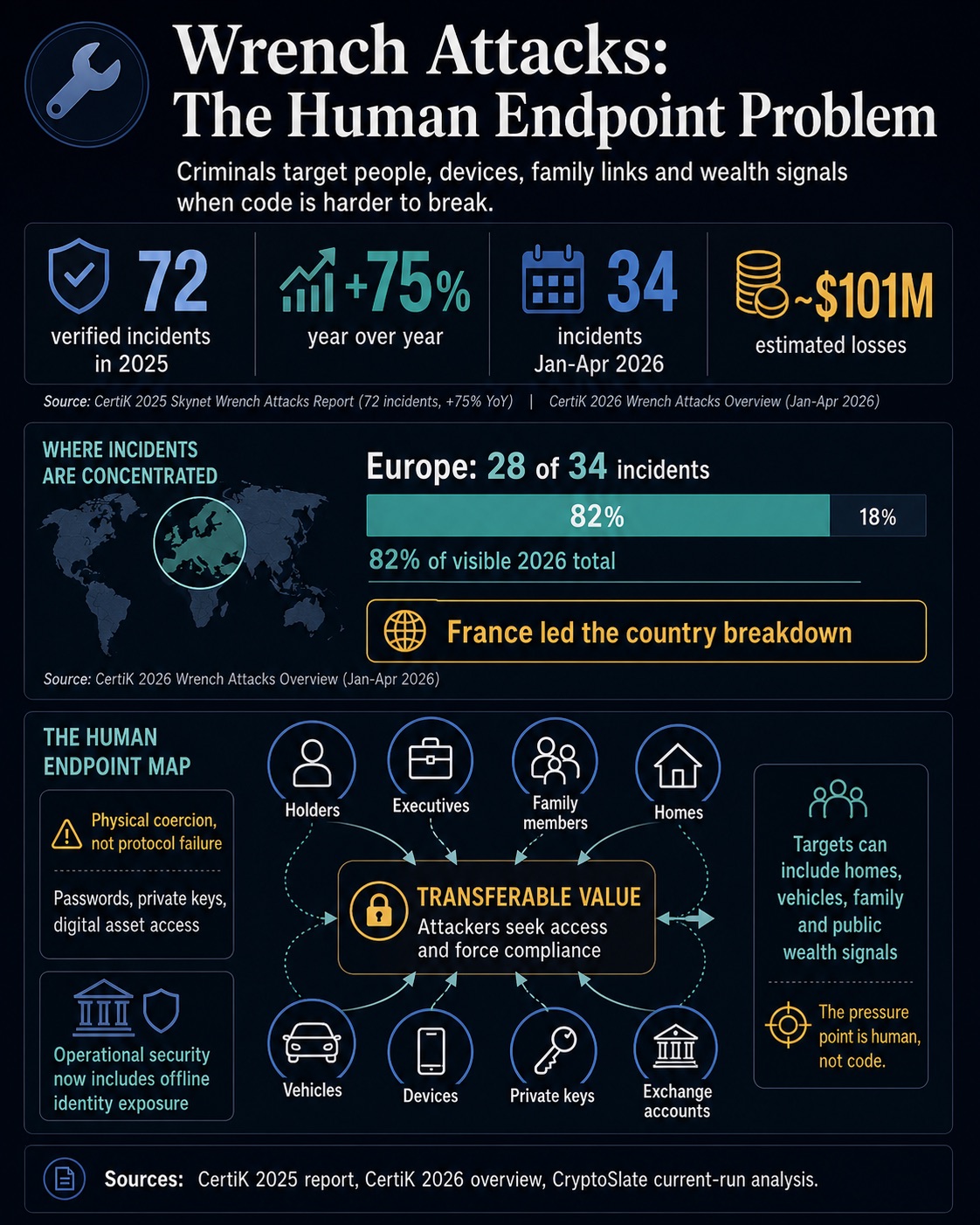
CertiK data shows that in the cryptocurrency field, "ransom attacks" target holders, family members, devices, etc., with 72 incidents confirmed in 2025, a 75% increase year-on-year; in the first four months of 2026, 34 incidents, 82% of which occurred in Europe, with estimated total losses of around $101 million. The core risk lies in human endpoint rather than code vulnerabilities.
The Danbury case confirms that this attacking pattern targeting cryptocurrency holders has now become a judicial challenge for U.S. prosecutors and federal courts.
The court records fully restore how the offline safety crisis brought by crypto assets integrates into the enforcement process of routine violent crimes: gang recruitment, cross-regional operations, tracking and surveillance, hostage-taking of family members, luxury vehicle targeting, coercing Bitcoin through hostage-taking – the entire criminal chain is clear and complete.
For cryptocurrency holders and industry companies, the scope of operational security protection has expanded significantly: in addition to online risks like phishing attacks, wallet theft, exchange account hacking, and smart contract vulnerabilities, they must also pay attention to the personal exposure risks brought by offline personal information, home addresses, electronic devices, and family.
The next key judicial signal will be the sentencing outcome. Saif Faiq's hearing on August 28 will visually reflect how the federal court will define and penalize his responsibility in this robbery conspiracy.
In the long run, all noteworthy cases share a commonality: criminals lock onto cryptocurrency holders through relatives, homes, vehicles, and public social data, accessing offline clues. It is these types of cases that transform the originally France-centered safety crisis into a social issue that law enforcement agencies across the United States must confront; a court record serves as a risk alert.
免责声明:本文章仅代表作者个人观点,不代表本平台的立场和观点。本文章仅供信息分享,不构成对任何人的任何投资建议。用户与作者之间的任何争议,与本平台无关。如网页中刊载的文章或图片涉及侵权,请提供相关的权利证明和身份证明发送邮件到support@aicoin.com,本平台相关工作人员将会进行核查。


