Author: Axis
Translated by: Wu Says Blockchain
TL;DR: Major Shock in the Korean Crypto Market and Core Points of Information Asymmetry
· Deep Impact of Bithumb's Suspension: The second-largest exchange in Korea, Bithumb, faces a six-month partial business suspension, an event severely underestimated by the global market. It is not merely a compliance adjustment, but rather is dismantling the competitive price discovery mechanism of the Korean crypto market (with Upbit and Bithumb holding 96% market share).
· Deadly Structural Information Gap: Influenced by language barriers and capital controls, local political or regulatory shocks in Korea (for instance, the military rule at the end of 2024 led to a 30% plunge in local BTC, while the global drop was only 2%) often trigger local tremors first. The delayed reaction in the English trading circles creates brief and lucrative opportunities for arbitrageurs who possess first-hand information.
· Re-evaluating the "Kimchi Premium": The premium is not merely a sentiment indicator for retail investors, but rather a "thermometer" for cross-border capital friction. Under capital controls, Bitcoin shows a structural non-zero floor of about 1.24%, and a contraction of the premium often indicates a transition of deep capital pressures, rather than a simple return to normality.
·Oligopolistic Liquidity Risk: The suspension of Bithumb's operations has led to a rapid concentration of funds towards Upbit. Over-concentrated liquidity can easily trigger extreme market conditions (for example, a severe operational error at Bithumb in February 2026 resulted in a 17% flash crash of BTC/KRW), making future market distortions more concealed and destructive.
· Core Conclusion: As the return of institutional funds prompted by the new government's "pro-crypto" policies conflicts with the tightening infrastructure for retail investors, this structural "information asymmetry" in the Korean market will persist in the long term, continually giving rise to fleeting excess arbitrage (Alpha) opportunities.
A Market-Shaking Event Just Occurred, Yet It Was Seriously Underrated by Most Global Traders
On March 15, Korean financial regulators imposed a six-month partial business suspension on the country's second-largest crypto exchange, Bithumb. English media generally regarded this as a routine compliance news, assuming it only involved anti-money laundering (AML) enforcement and regulatory adjustments. However, most reports overlooked the deeper impacts behind it.
In fact, this was a structural market event occurring within the deepest fiat liquidity pool in the on-chain financial sector, the impact of which extends far beyond Korea. Upbit and Bithumb collectively account for about 96% of the trading volume in the Korean cryptocurrency market. The suspension of Bithumb's operations not only reshapes the domestic market landscape but also undermines the quality of price signals that the market has conveyed to global traders for years.
In short, Korean crypto users are extremely active, but the system they are in is constrained by factors such as capital controls, high concentration of exchanges, and longstanding language barriers. This unique environment means that key information affecting prices often ferments first in the local market before being transmitted globally. This creates a brief window of time, leading to a disconnection between local and global markets.
Global Traders Are Always a Step Behind: The Reason Lies in Structural Differences, Not Coincidence
Korea is by no means a marginal market in the crypto sector; it is one of the most valuable markets for understanding the sources of global on-chain opportunities. The Korean won (KRW) is the second largest fiat currency by trading volume in the global crypto market, with around $663 billion in trading volume this year to date, accounting for nearly 30% of the total fiat-to-crypto trading volume globally. Additionally, nearly one-third of Korean adults hold digital assets, which is twice the proportion in the United States.
The current government in Korea assumed office in June 2025, with its campaign platform regarded as one of the clearest "pro-crypto" declarations in political history. Since the president took office, nearly half of the 30 best-performing constituent stocks in the Korea Composite Stock Price Index (KOSPI) are related to digital assets. The traditional stock market quickly digested this positive signal, but the vast majority of the crypto community reacted sluggishly.
This market dislocation is not an isolated case. Local political and regulatory dynamics in Korea usually ferment first on Korean-language media and local crypto Twitter (CT), triggering movements in KRW pairs on Upbit and Bithumb, while English media often follow up with reports hours or even days later. The reverse transmission of this information gap also exists: macro changes in the global context from English-speaking environments also take time to price into local trading pairs. Typically, by the time the information is translated and disseminated, the initial market fluctuations have already ended.
One of the most obvious examples occurred on December 3, 2024, when Korean President Yoon Suk-yeol announced martial law. This singular shock from a domestic political event caused BTC prices in the Korean market to plummet approximately 30%, while the global market's decline was only about 2% — an astonishing price gap of up to 28 percentage points. The total scale of this sell-off amounted to about $33.3 billion, pushing the Korean domestic market to set a record for the highest trading volume globally at one point.
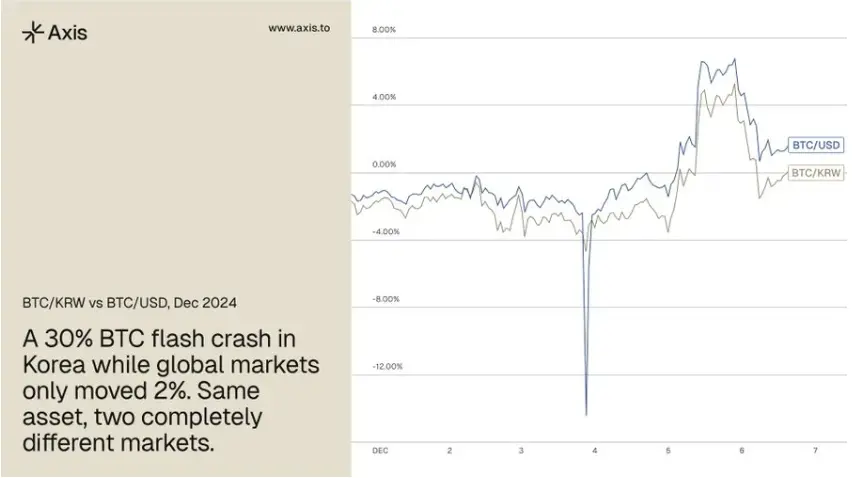
This event is a classic reflection of the dislocation phenomenon in the Korean market. At that time, buying liquidity instantly dried up, selling pressure surged, and the selling pressure was almost entirely concentrated in the KRW trading pairs. Even stablecoins experienced severe de-pegging, with the price of USDT on Korean exchanges briefly dropping to $0.75, while BTC and altcoins saw discounts of over 50% compared to global market prices.
Korean domestic users mistakenly believed they were vying for the last liquidity escape route, thus they continued to sell at market prices frantically, even when global market prices barely budged. On-chain data shows that arbitrageurs sprang into action, moving millions of USDT across to capture the price spread. The huge influx of trading volume caused front-end systems of major exchanges to crash, preventing retail investors from logging in to buy the dip; during this brief window, only API traders could successfully execute trades. From any perspective, this was an extremely valuable "earthquake-level" market movement, but the arbitrage window quickly closed within just a few hours.
The suspension of Bithumb's operations is also repeating the same script. Related news has been circulating in Korean information circles for several weeks, while most traders in English-speaking contexts are only just becoming aware of it.
"Kimchi Premium" Receives Attention, Yet Is Often Misinterpreted
For traders lacking Korean information channels, the "kimchi premium" has always been viewed as the most direct observation indicator of Korean market dynamics. This premium measures the price difference between cryptocurrency assets priced in Korean won and those priced in global dollars. Because of this, experienced traders have long closely monitored trade volumes in the won market. The trading volume of South Korean spot altcoin markets ranks among the highest globally and has historically been a reliable leading indicator for predicting market trends.
The crux is that most traders misinterpret this signal. The market generally views this premium purely as a sentiment indicator for South Korean retail investors. Indeed, retail sentiment is one factor, but in a market facing regulatory frictions on cross-border capital flows, this premium more deeply reflects the intensity of structural capital pressure. When such regulatory frictions intensify, price distortions tend to amplify accordingly.
Historical data makes this point tangible. Looking back to 2017, when the USD/KRW exchange rate was around 1060, the "kimchi premium" surged to a peak of 40%, implying that its actual USDT/KRW implied exchange rate had risen to around 1480. By December 2024, the real-world USD/KRW exchange rate indeed broke above 1480. In other words, this premium had pre-priced this foreign exchange trend years in advance. These signals have long been hidden in publicly available data, but only with access to local Korean information channels can one make accurate interpretations.
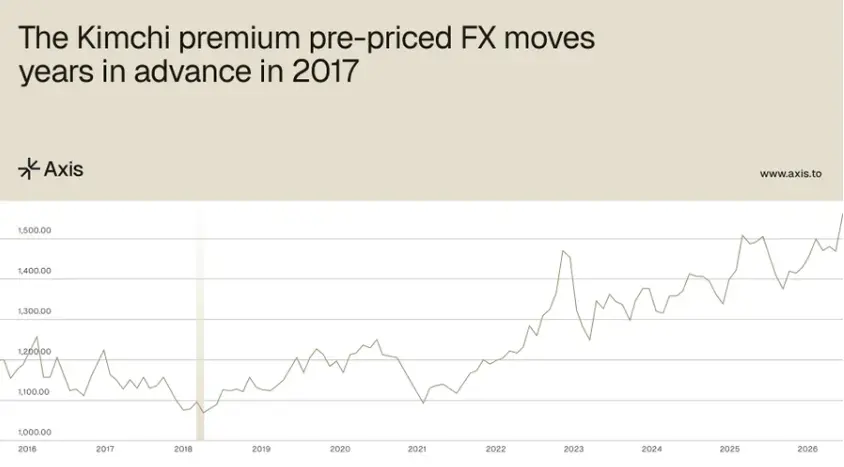
One constant feature is that this premium does not naturally decline to zero. Studies show that as long as capital controls remain in effect, the bitcoin premium will maintain a structural non-zero floor of about 1.24%. This means that when the premium contracts toward this level, it typically reflects a transition of deep capital pressures rather than a simple regression to normal data.
Looking back to 2025, whenever the premium approaches zero, bitcoin recorded positive returns in the following week and month: the average return over seven days was 1.7%, and over thirty days, it was 6.2%. For traders, the truly critical signal is not the absolute value of the "kimchi premium," but its dynamic trend over time.
Bithumb's Business Suspension Makes It Harder to Predict Dislocation in the Korean Market, Intensifying Information Asymmetry
The validity of the premium as a reference signal depends on how price discovery is conducted between major exchanges in Korea. When multiple trading platforms compete to price equivalent capital flows, the resulting price differences often contain richer information. However, as liquidity increasingly concentrates towards an oligopoly, the clarity of such signals begins to diminish. Hence, Bithumb's suspension is dismantling the competitive price discovery mechanism upon which this premium relies.
After the announcement of the penalty, funds began to rapidly migrate to Upbit, further exacerbating market concentration. In February 2026, Bithumb experienced a severe operational error, mistakenly crediting 620,000 BTC to user accounts, which directly led to a 17% flash crash of the BTC/KRW trading pair before the price rebounded. This episode vividly demonstrates the extreme conditions the market presents when the price discovery mechanism heavily relies on a single platform operating under pressure.
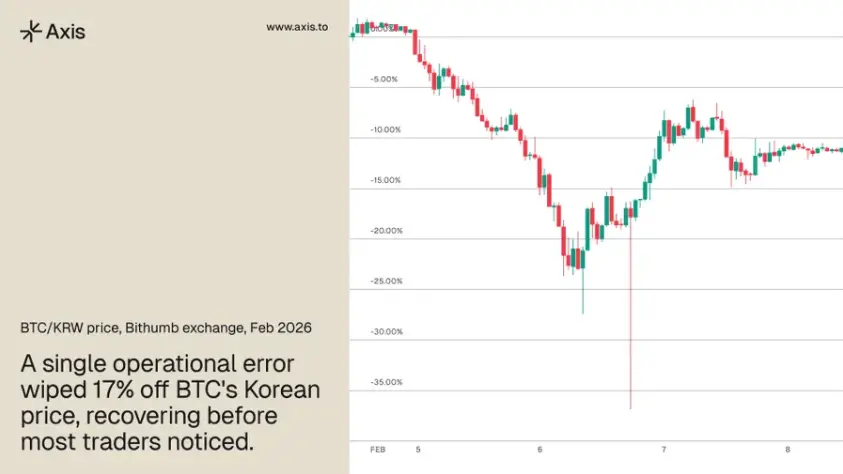
The diminishing reference value of the premium indicator does not mean the dislocation phenomenon in the Korean market has ended. On the contrary, it indicates that such distortions become more difficult to predict before they erupt, further widening the information gap between participants closely tracking the Korean market and those relying solely on English-language information.
The deep environments fostering these distortions are also becoming increasingly acute. In 2025, under strict trading rules, as much as $110 billion in crypto assets flowed out of Korea. Under the governance of the new administration, previously structurally squeezed capital is being reintroduced through new institutional channels; but at the same time, the trading infrastructure relied upon by retail capital is tightening. Historically, this severe policy divergence often serves as a breeding ground for the most violent and fleeting price distortions in the market.
The Structure of the Korean Market Creates Replicable Information Asymmetry for Global Traders
The "kimchi premium" is by no means a unique phenomenon of the Korean market. In every place where cryptocurrency is developed as a parallel financial channel and capital controls are implemented, such mechanisms function to varying degrees, and the Korean market is simply the most widely observed example.
The martial law incident in December 2024 and this recent business suspension of Bithumb both confirm the same evolutionary logic. The price distortions in this market always erupt unexpectedly, rewarding only those participants who possess first-hand information channels, quickly smoothing them before the broader market reacts. Those traders who decisively acted on December 3 were not inherently faster or smarter than others. They simply focused on the right signals and profoundly understood how domestic political events in Korea were transmitted to the price mechanism at the exchange level before the wider market detected any abnormalities.
As the infrastructure for stablecoins continues to deepen globally, more markets will likely release similar signals of capital pressure as those generated in Korea over the past decade. The real challenge lies not in discovering the existence of these signals, but in establishing the infrastructure and trading discipline capable of consistently capturing these opportunities.
免责声明:本文章仅代表作者个人观点,不代表本平台的立场和观点。本文章仅供信息分享,不构成对任何人的任何投资建议。用户与作者之间的任何争议,与本平台无关。如网页中刊载的文章或图片涉及侵权,请提供相关的权利证明和身份证明发送邮件到support@aicoin.com,本平台相关工作人员将会进行核查。


