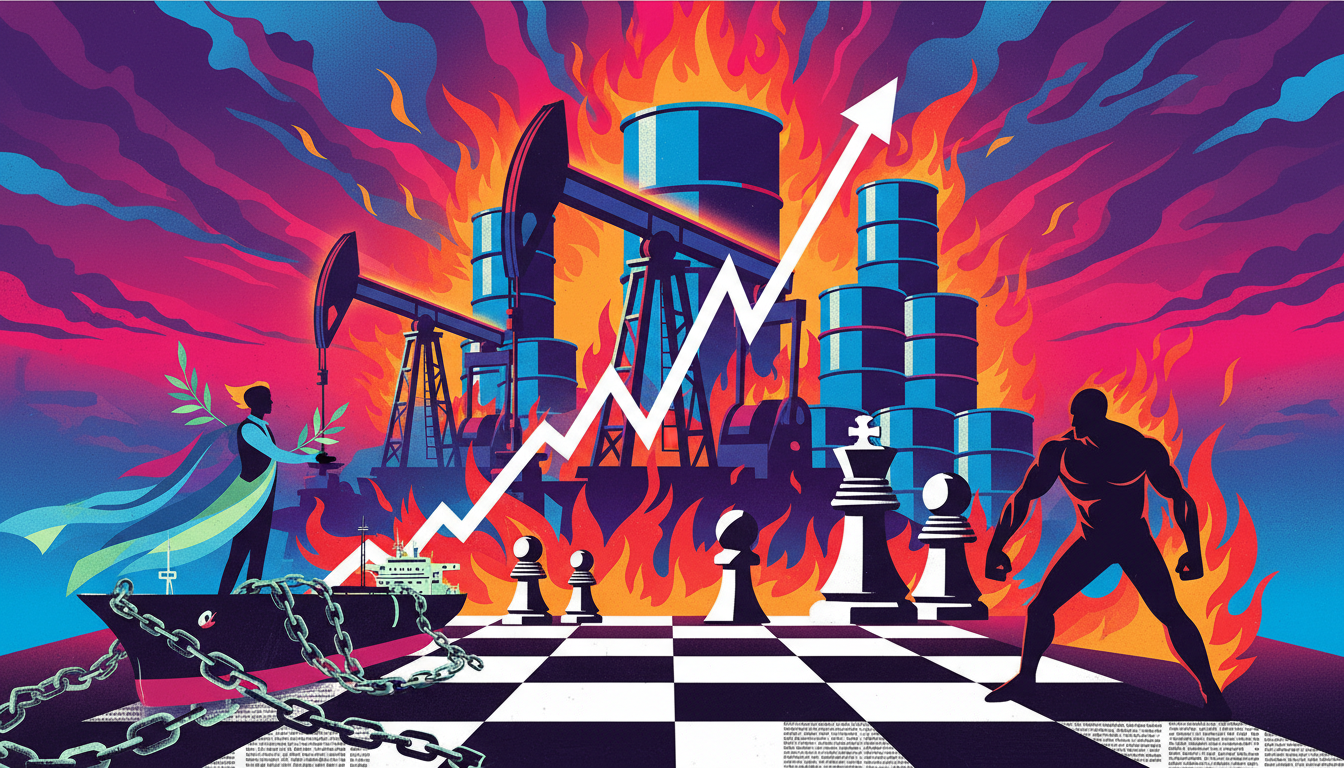
This week, in East 8 time zone, Bitcoin experienced significant pressure and retreat after peaking at about 73,000 USD, frequently dropping below 71,000 USD during trading, with a low around 70,900 USD (according to a single source). The decline over 24 hours was approximately in the range of 2.5%–2.65% (HTX market data). This round of adjustment coincided with the escalation of tensions in the Strait of Hormuz, the failure of US-Iran negotiations to extend the ceasefire, and the departure of the US delegation from Islamabad, reflecting shifts in the geopolitical landscape. A piece of news circulating on channels like Telegram about President Trump allegedly announcing the blockade of the Strait of Hormuz (content pending further verification) became a direct trigger for market sentiment. In the face of real impacts, the so-called "digital gold" this time appears more like a high beta asset sold off alongside risky assets, rather than a new asset still possessing some hedging attributes, raising fundamental questions during this round of turmoil.
Tensions in Hormuz: Prices Drop Instantly
Before this round of adjustment, Bitcoin's price had been consolidating around the high of 73,000 USD for several days, with bulls and bears engaged in a tug-of-war at elevated levels. As geopolitical tension continued to accumulate, BTC gradually retreated from the highs, first dropping below the psychological threshold of 72,000 USD, and then further probing down to 71,000 USD. The bullish defense line was continuously breached, and the technical "high-level volatility" quickly evolved into a "downtrend."
Market quotes from exchanges like HTX showed that amidst relatively ample market liquidity, selling pressure was released, pushing Bitcoin down to around 70,900 USD (according to a single source), refreshing the low point of this adjustment. Meanwhile, the news of "President Trump announcing the blockade of the Strait of Hormuz" began circulating in the market, although this claim currently appears only in a few Telegram channels, and governmental verification is still pending. However, the proximity in timing to when the price reached its low created a clear "news-price" resonance impression.
In terms of magnitude, HTX market data shows that Bitcoin's drop in 24 hours roughly falls within the range of 2.5%–2.65%. Although not a historic-level crash, it amplified perceived volatility in an environment with heavy leverage at high levels. It is important to emphasize that details regarding the tactical aspects of "maritime blockade," duration, and the so-called concentrated forced liquidation scale currently lack multi-source evidence and remain in the realm of unverified claims, necessitating a high level of caution from investors when interpreting such news.
Whale Bets Downward: 2567 Short Positions and Amplified Sentiment
During the price's retreat from high levels, a particularly representative whale position surfaced in the derivatives market. According to public screenshots and information from a single source, an account named "Set Ten Big Goals First" established a short position of 2567.49 BTC in the futures market, with an opening price of approximately 71,554.61 USD. Rough estimates based on current price ranges indicate that this short position corresponds to an unrealized profit of about 1.185 million USD (also from a single source), reflecting a clear stance of large capital choosing to position itself on the downside at high levels.
The sheer size of the short position implies significant leverage: on one hand, with each descent in price, the account's paper gains escalate; on the other hand, it has invisibly reinforced market perceptions of "heavily pressurized resistance above" and "large funds shorting." Amplified by social media and community dissemination, many retail investors are inclined to view whale movements as "directional guidance," ultimately following suit to liquidate their long positions or actively open shorts, further intensifying localized selling pressure.
These whales' short positions do not directly "decide" prices but amplify market volatility through emotional pathways: seeing substantial profits from large short positions, some investors may offload holdings from spot and perpetual futures to "exit and wait"; while high-leverage bulls may be passively forced to reduce their positions during price corrections, resulting in additional selling pressure in the market. In the absence of reliable data on forced liquidation amounts and settlement scales, we can only confirm the direction and the effect of enhanced sentiment but cannot provide a detailed depiction of specific liquidation figures.
Hedging or Risk? Price Chains Under Geopolitical Impact
Traditionally, geopolitical tensions often heighten the allure of classical safe-haven assets like gold: in contexts of war risk, threatened shipping security, and tightening expectations of oil supply, capital usually withdraws from risky assets, flowing into precious metals and sovereign bonds viewed as "ultimate collateral." However, in this round of Hormuz crisis narratives, Bitcoin has retreated alongside high beta sectors in stocks and commodities, contrasting sharply with the expectation that "safe-haven assets rise amid chaos."
This contrast arises from how geopolitical news transmitted through multiple chains has influenced Bitcoin prices. Firstly, the tensions in the Strait of Hormuz raised market concerns over oil price increases and import-related inflation, subsequently leading to a repricing of the global liquidity environment: if inflation rises, the Federal Reserve and other central banks may adopt a more cautious approach to cutting interest rates, suppressing overall risk appetite. Secondly, within cryptocurrency, high-leverage bulls had already piled up at high levels, and any marginal increase in macroeconomic bearishness would trigger a top-down leverage cooling, including active position reductions and passive deleveraging. Thirdly, the decline in risk appetite in the derivatives market has made short-term speculative players more willing to close positions and observe rather than continue "catching falling knives" at high levels.
In such an environment, the fragility of the "digital gold" narrative is painfully obvious. On one hand, Bitcoin possesses attributes of "value storage" due to its relatively inelastic supply and long-term scarcity; but on the other, the transaction structure reflects that short-cycle, high-leverage, cross-market arbitrage funds are extraordinarily sensitive to volatility and liquidity than to considerations of whether it will be scarce in "ten years." When macroeconomic and geopolitical shocks occur, traders treat their BTC as a "risky asset": first reducing positions to lock in profit or stop losses, then discussing long-term allocations. This makes the short-term trading attributes overshadow its theoretical hedging properties at critical moments.
Breakdown in US-Iran Negotiations and Market Repricing
Parallel to the risk in the Hormuz corridor, information has emerged regarding the failure of US-Iran negotiations to extend the ceasefire and the departure of the US delegation from Islamabad. This development did not trigger new military actions, but symbolically declared the end of the previously hopeful expectations of "gradually easing tensions through negotiations." For the market, this means that the geopolitical risks once viewed as "manageable" are evolving toward more uncertain directions.
When investors price this change, they will naturally link the negotiation failure to potential risks in the Hormuz corridor, the probability of oil supply disruptions, and their impact on global inflation and growth prospects. Higher oil price expectations correlate with greater global cost pressures, leading to the potential limitation of monetary policy easing, which in turn compresses the valuations of risk assets. In this repricing chain, the stock market, high-yield bonds, and high-volatility assets including Bitcoin are easily categorized as "risk exposures" that need to be moderately reduced.
In the process of reordering safe-haven and growth assets, Bitcoin is viewed by many as a typical "high beta risk asset" : when risk appetite rises, it is expected to amplify positive news and outperform traditional assets; conversely, when risk aversion intensifies, it will also amplify negative news and be among the first to suffer from position reductions. The unmet expectations from the breakdown in US-Iran negotiations make Bitcoin's performance this time more aligned with "high beta risk exposure" rather than serving as a "last safe haven" like gold.
Quantum-Safe Bitcoin Concept: Long-Term Narrative Background Noise
Contrasting with the price turbulence instigated by geopolitical factors is a long-term technical narrative that has been almost drowned out by emotions. Recently, a StarkWare researcher proposed a “Quantum-Safe Bitcoin (QSB)” trading solution, claiming it can withstand future quantum computing attacks through specific cryptographic design (according to a single source). This concept attempts to respond to the question of whether Bitcoin can maintain its security boundaries and immutability of ledger when quantum computing capabilities become sufficient to threaten existing public key cryptosystems.
From a temporal perspective, the Hormuz crisis triggers short-term fluctuations on a "daily to weekly" scale; whereas technological visions like QSB target security evolution on a "multi-year to decade" scale. The former affects current leverage structures, funding costs, and sentiment premiums, while the latter relates more to whether Bitcoin can sustain its credibility as the "ultimate collateral for on-chain assets" over longer periods. The two are clearly misaligned in focus and participant composition: traders watch candlestick charts and liquidation prices, while developers discuss post-quantum algorithms, protocol upgrade paths, and other engineering issues.
This misalignment brings about a question: can long-term security narratives like QSB enhance Bitcoin's "value storage" attributes in the future? If quantum-safe proposals prove technically viable, gain community consensus on governance, and are compatible with the existing Bitcoin ecosystem in implementation, it could indeed become an important supplement to the "digital gold" story. However, in the current environment where such proposals remain in research and conceptual stages, and the market's primary narrative is driven by geopolitical volatility, QSB is more a topic of discussion within specialized circles, with limited immediate impact on prices; in the eyes of most traders, it appears more as background noise rather than the main narrative for trading.
How Will Bitcoin Prove Itself After the Hedge Halo Fades?
From this downturn, we can observe several clear signals: firstly, falling from 73,000 USD to a low of about 70,900 USD, combined with a 24-hour decrease of 2.5%–2.65%, Bitcoin has displayed amplified volatility characteristics similar to traditional risk assets amidst geopolitical shocks; secondly, the whale account "Set Ten Big Goals First" shorted 2567.49 BTC and gained approximately 1.185 million USD in unrealized profits (according to a single source), reinforcing the market's perception of "large funds betting downward at high levels," further amplifying retail panic and trend-following sell-offs; thirdly, the "digital gold" narrative has been temporarily unable to persuade the market to regard BTC as the preferred safe haven under the pressures of the Hormuz crisis and breakdown in US-Iran negotiations.
In the short term, Bitcoin is likely to continue being driven by macro and geopolitical risk sentiment: every adjustment regarding the safety of the Hormuz corridor, the direction of the US-Iran situation, and expectations surrounding oil and interest rates will repeatedly transmit through liquidity and risk appetite channels to BTC's pricing. In the medium to long term, Bitcoin's fate will still be shaped by multiple variables: including the clarity of global regulatory frameworks, the evolution of macro interest rate cycles, and the underlying technological safety evolution akin to QSB, all of which will determine whether it resembles "digital gold" or is permanently tagged as a "super high beta risk asset."
In this highly fragmented information landscape, investors particularly need to distinguish between the hard facts that have been corroborated by multiple parties and the news still awaiting verification: for instance, regarding the specific status of "blockade in the Strait of Hormuz," maritime operational details, and claims circulated on social media about "$XX million forced liquidation within XX minutes," currently lack authoritative multi-source data support and should not serve as core decision-making bases. Whether chasing the "hedging halo" or fearing the "forced liquidation stampede," making extreme positional adjustments based on a single narrative could magnify one’s risks in a high-volatility market. What truly matters is to find matching positions and rhythms based on one’s risk tolerance and time horizon against the tension of understanding Bitcoin's short-term trading properties and long-term value storage narratives.
Join our community, let’s discuss and get stronger together!
Official Telegram community: https://t.me/aicoincn
AiCoin Chinese Twitter: https://x.com/AiCoinzh
OKX welfare group: https://aicoin.com/link/chat?cid=l61eM4owQ
Binance welfare group: https://aicoin.com/link/chat?cid=ynr7d1P6Z
免责声明:本文章仅代表作者个人观点,不代表本平台的立场和观点。本文章仅供信息分享,不构成对任何人的任何投资建议。用户与作者之间的任何争议,与本平台无关。如网页中刊载的文章或图片涉及侵权,请提供相关的权利证明和身份证明发送邮件到support@aicoin.com,本平台相关工作人员将会进行核查。