Author: RWA Research Institute
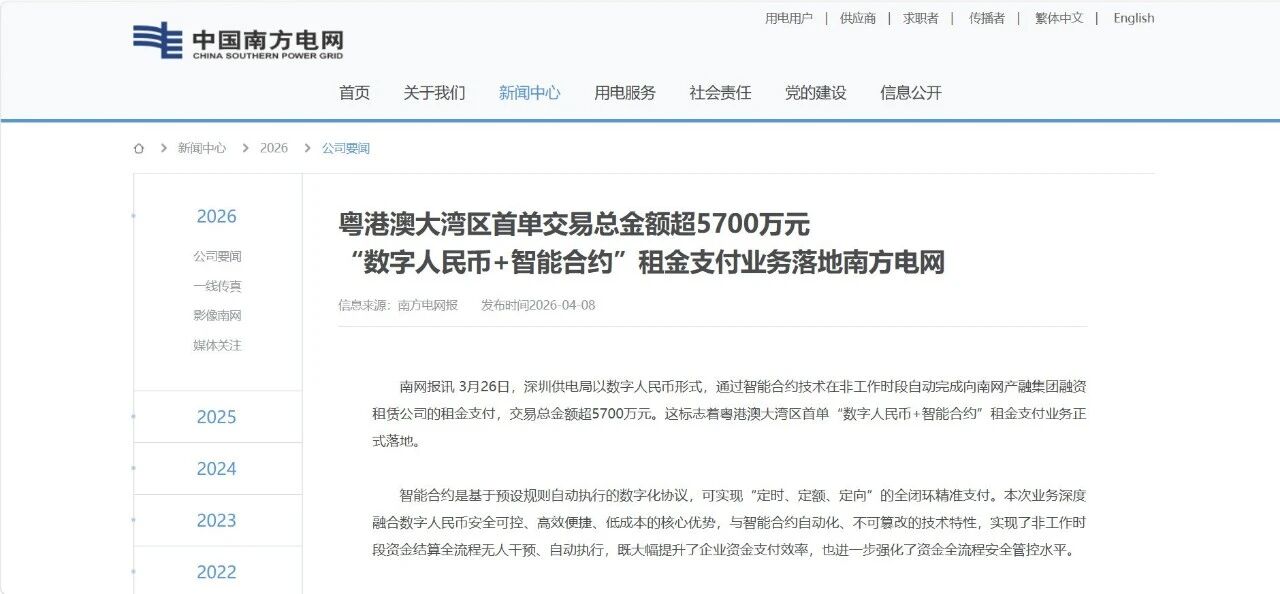
According to Xinhua Finance's report on April 7, on March 26, the Shenzhen Power Supply Bureau of Southern Power Grid successfully completed a rent payment of over 57 million yuan in the form of digital renminbi through smart contract technology, marking the official launch of the first "digital renminbi + smart contract" rent payment business in the Guangdong-Hong Kong-Macau Greater Bay Area. This transaction, quietly completed in the middle of the night, appears to be merely an expansion of the application scenario for digital renminbi, but on a deeper level, it points to a structural change that is happening: the logic of corporate fund management is shifting from being "manual process-driven" to "technology protocol-driven."
This is not just a simple upgrade of the payment tool, but a fundamental reconstruction of settlement logic.
1. The "Long March" of a Rent Payment
To understand the significance of this payment of 57 million yuan, we must first look at the convoluted path a large rent payment must take without smart contracts.
Taking a large group company as an example, the rent settlement at the end of the quarter usually goes like this: financial personnel first need to retrieve the lease contract from the enterprise resource planning system and verify core elements such as rent amount, payment time, and receiving account one by one; once verified, they initiate a payment request in the OA system, which goes through multiple approval levels including department heads, financial supervisors, and responsible leaders; after approval, they log into the bank-enterprise direct connection system or corporate online banking, manually enter the payee information and payment amount, and finally complete the fund transfer through multiple reviews. If the approver at any step is on a business trip, or if there are manpower shortages near holidays, the entire process may get stuck. Once a delay causes the rent to be overdue, the company not only faces late fees but might also leave a negative record in the credit system.
"In the past, during the peak payment season at the end of the quarter, finance personnel had to manually initiate payment requests and complete settlements after multi-level approvals," described a financial staff member from the Shenzhen Power Supply Bureau regarding previous operational procedures. This is not an exceptional dilemma for a single company, but a systemic friction commonly found in the field of large public payments—payment behavior itself is wrapped in a highly procedural management structure, with each level of approval increasing time costs and each step accumulating operational risks.
Philosopher Heidegger posed a famous question: Is technology fundamentally a tool of humanity, or does it in turn shape the way humans exist? Projecting this question onto the field of corporate fund management, it can perhaps be understood this way: in traditional payment processes, humans are the active initiators, and payment systems are passive execution tools; at the same time, however, humans are also constrained by the processes, consuming a lot of energy in the cycles of approval, verification, and confirmation. A relationship of mutual restraint forms between humans and tools.
The emergence of smart contracts precisely breaks this relationship.
2. When Payment Actions Are Written in Code
So, how did this rent payment of 57 million yuan "self-execute" in the middle of the night? The answer lies in three keywords: timed, fixed amount, directed.
According to Xinhua Finance's report, this business deeply integrates the core advantages of digital renminbi—being secure and controllable, efficient, convenient, and low cost—along with the automation and immutability of smart contracts, achieving a full-process fund settlement without human intervention or manual execution during non-working hours. Specifically, the Shenzhen Power Supply Bureau and the cooperating bank preemptively wrote the core terms of the rent payment (payment time, amount, receiving account) into a piece of executable code, deployed on the digital renminbi smart contract ecological service platform. When the system clock reaches the agreed payment time node, the smart contract is automatically triggered, requiring no manual initiation and no multi-level approvals, with funds transferring directly from the payer’s wallet to the payee’s wallet.

It is necessary to provide a simple explanation of what a "smart contract" is. It is essentially a piece of pre-written code in the digital renminbi system that defines the rights and obligations between transaction parties and automatically executes when specific conditions are met. It can be likened to a "digital automatic performance agreement": traditional contracts specify "what both parties should do," whereas smart contracts implement "what the system will automatically complete." Once the conditions are met, the execution is irreversible and immutable, eliminating the possibility of human delays or interventions.
This mechanism is particularly well-suited for financing leasing business. Financing leases naturally involve multiple parties and multiple links—lessees, lessors, equipment suppliers, and even guarantors, with each party having its own settlement nodes and approval processes. In the traditional model, any delay in any step can slow down the efficiency of fund circulation in the entire chain. The involvement of smart contracts effectively establishes a "code-level" trust channel among multiple parties: no need for repeated confirmations among parties, no need for multi-level approvals, the code is the consensus, and execution is performance.
The evaluation of this by the personnel of the Southern Power Grid Financing Leasing Company is: "The ‘digital renminbi + smart contract’ model not only smooths out the settlement process and enhances business efficiency but also strengthens the financial safety net through the rigid constraints of technology."
Trust does not require repeated confirmations; code is performance.
3. The Fruits of a 65 Billion Yuan Test Field
If this payment of 57 million yuan is viewed as an isolated, exemplary "potted innovation," its significance might stop at being a successful pilot. But this is not the case.
According to reports from China Energy Network, Southern Power Grid has currently promoted digital renminbi pilot work in 24 scenarios, with a cumulative transaction scale exceeding 65 billion yuan. As early as June 2025, Southern Power Grid promoted innovative applications of digital renminbi in 24 scenarios including cross-border payments and green bonds, with a total transaction volume exceeding 38.6 billion yuan. From 38.6 billion yuan to 65 billion yuan, the digital growth behind this reflects a shift in application scenarios from consumption to industry and from domestic to cross-border.
This set of data reveals a key fact: the rent payment made by the Shenzhen Power Supply Bureau is not an experimental initiative from a specific department, but a mature application that naturally emerged based on large-scale, multi-scenario practices. It validates not only the feasibility of a technical solution but also a replicable and scalable path.
Any technology needs a sufficiently large test field to move from the laboratory to the production line. 65 billion is the area of this test field.
It is worth noting that Southern Power Grid has made solid institutional preparations for this. The company has laid out and strategically planned in advance, formulating standardized smart contract templates suitable for multiple business scenarios, significantly simplifying business processing procedures and lowering the threshold for implementation. The significance of this detail should not be overlooked: the promotion of smart contracts often faces difficulties not in the technology itself, but in how to help personnel from various business scenarios understand, accept, and use this tool. Standardized contract templates essentially serve as a "low-threshold access plan," transforming smart contracts from a technical concept into an enterprise-level service that can be quickly adopted.
Looking at the broader policy landscape, the implementation of this case has solid institutional support. In December 2025, the People's Bank of China issued an "Action Plan for Further Strengthening the Management and Service System of Digital Renminbi and Related Financial Infrastructure Construction," clearly stating the digitalization plan of "account system + currency string + smart contract." This plan proposes to upgrade the existing account system, promote the application of emerging technologies based on digital renminbi wallets, enhance digital and intelligent levels of renminbi issuance, circulation, and payment, and upgrade the digital renminbi smart contract ecological service platform to support the construction of an open-source ecosystem for smart contracts. On January 1, 2026, a new generation of digital renminbi measurement framework, management system, operational mechanism, and ecological system officially launched, marking a historic leap from the "cash-like version 1.0" to the "deposit currency type version 2.0."
In terms of smart contract applications, the data also illustrates the trend. By the end of January 2026, digital renminbi smart contracts have been piloted in fields such as prepaid fund management, supply chain finance, corporate group financial management, and subsidy distribution, with a cumulative number of signed contracts reaching 486,400 and a cumulative transaction amount of 316 million yuan. While these figures may not seem large compared to the trillions involved in the retail sector, they represent a qualitative change in smart contracts from being "usable" to "user-friendly." Behind each contract is a practice of "code replacing process."
From a macro perspective, the overall advancement of digital renminbi is also accelerating simultaneously. By the end of November 2025, digital renminbi has processed a cumulative 3.48 billion transactions, with a cumulative transaction value of 16.7 trillion yuan, and 230 million personal wallets have been opened via the digital renminbi app, with 18.84 million corporate wallets opened. In April 2026, the number of digital renminbi operating institutions further expanded to 22, with city commercial banks entering the fray for the first time. The ecosystem is expanding, the infrastructure is being solidified, and the stage for smart contracts is rapidly being constructed.
4. Looking at the Future of the Industry Chain Through a Rent Payment
A rent payment of 57 million yuan is but a drop in the bucket of the total transaction of 16.7 trillion yuan in digital renminbi. However, if viewed as a starting point, the possibilities it opens are far more noteworthy than the amount itself.
Southern Power Grid stated that it will actively promote this model's extension to new energy scenarios such as photovoltaics and energy storage in the future. The logic behind this directional choice is not complicated. Financing leases for new energy projects often involve larger asset scales, more complex settlement structures, and more participants—suppliers of photovoltaic station equipment, EPC contractors, power grid connection parties, and operational maintenance parties… Each party’s fund flow needs precise time control and strict path locking. The characteristics of smart contracts—timed, fixed amount, directed—precisely match the demands of such scenarios.
Continuing to extend along the power grid’s industry chain, the imaginative space will further open up. In the procurement side of the supply chain, power grid enterprises can use smart contracts to achieve "payment upon acceptance" when paying suppliers, eliminating uncertainties in traditional settlements and human delays; on the new energy subsidy issuance side, government electricity subsidies for distributed photovoltaics and energy storage projects can be automatically verified via smart contracts based on generation data and disbursed on time, ensuring that subsidy funds reach specified recipients; in cross-border electricity transactions, the digital renminbi combined with a multilateral central bank digital currency bridge is expected to achieve more efficient and lower-cost cross-border settlements. These scenarios are not mere castles in the air; the accumulated transaction value of 16.7 trillion yuan in digital renminbi and the accumulated 387.2 billion yuan in cross-border payment business through the multilateral central bank digital currency bridge have already laid a solid foundation for them.

Of course, any technology has its boundaries. Smart contracts can solve the certainty of "execution phases," ensuring that funds are automatically transferred and paths cannot be altered once conditions are met. However, they cannot replace the financial health of the enterprise itself nor can they remedy inherent unreasonable contract terms. Technology addresses the certainty of execution, not the correctness of decision-making. From this perspective, smart contracts are more like an "amplifier": if a company’s fund management is already orderly, it can push efficiency to higher levels; if a company’s management is chaotic, it can at most ensure that funds do not go astray, without fundamentally turning the situation around.
From a broader macro perspective, the promotion of digital renminbi smart contracts is highly aligned with the current policy direction of deepening the integration of the digital economy with the real economy and developing new productive forces. According to reports from Economic Reference Daily, the "14th Five-Year Plan" proposal suggests "steadily advancing digital renminbi" and includes it as an important part of perfecting the central bank system and building a scientific and sound monetary policy system under the overall goal of "accelerating the construction of a strong financial nation." Smart contracts, as the core carriers of the programmability of digital renminbi, are precisely the precise tools for promoting financial services to the real economy.
5. The Evolution of the Identity of Financial Personnel
When a rent payment of 57 million yuan can be automatically settled in the middle of the night without anyone on duty, a natural question arises: what should those financial personnel, who once worked overtime, repeatedly verified, and went through layers of approval for this payment, do next?
The practice of the Shenzhen Power Supply Bureau provides a preliminary answer. "Effectively freeing financial personnel from high-frequency repetitive tasks allows for more focus on high-value financial management and value creation work." This statement reveals an important identity transformation: as payments shift from "manual operations" to "code execution," the role of financial personnel will also change from "operators of fund transfers" to "designers and managers of settlement rules."
This is not a simple job adjustment, but an upgrade of the professional core. In the past, the value of financial personnel was largely reflected in "not making mistakes," ensuring that every payment was completed accurately, timely, and in compliance. However, in the era of smart contracts, accuracy and timeliness will be guaranteed by code; the core value of financial personnel will shift to rule design, process optimization, risk assessment, and strategic decision-making—areas that genuinely require human judgment and creativity. This is similar to the early days of computing, when many feared "machines would replace humans," yet the final outcome was that machines took over the tedious calculation tasks, freeing humans to engage in more creative thinking.
Of course, such a transformation will not happen overnight. It requires the adaptability of enterprise organizational structures, the upgrading of talent capabilities, and the iterative evolution of the entire industry's awareness. But the direction is already clear.
In a broader sense, digital renminbi smart contracts are embedding an entirely new trust mechanism into the foundational layer of commercial activities. Traditional commercial trust is built upon institutions, contracts, and interpersonal credit—our trust in a company to pay on time relies on legal constraints, the costs of breach, and the accumulation of credibility from long-term cooperation. Smart contracts provide a supplementary path: using the verifiability of code to lower the trust threshold. When payment conditions can be precisely defined by code, automatically executed, and are immutable, transaction parties do not need to establish deep trust relationships with each other; they can also confidently collaborate.
Code trusts no one, nor does it need anyone's trust. It simply executes faithfully.
This may be the deepest value of digital renminbi smart contracts.
In the middle of the night, in an empty office, money is flowing. This sounds like a somewhat chilling technological fable, but from another perspective, it is precisely when trust is least emphasized. Because trust has already been written into the code.
Code replacing trust is the greatest trust.
This article is based on public information for industry observation and technical analysis and does not constitute any investment advice.Digital renminbi and smart contract related applications are still in the promotion stage; the specific implementation effects need to be evaluated in conjunction with actual scenarios in various industries.
免责声明:本文章仅代表作者个人观点,不代表本平台的立场和观点。本文章仅供信息分享,不构成对任何人的任何投资建议。用户与作者之间的任何争议,与本平台无关。如网页中刊载的文章或图片涉及侵权,请提供相关的权利证明和身份证明发送邮件到support@aicoin.com,本平台相关工作人员将会进行核查。


