Original author: danny (X: @agintender)
The financial market has seen three hundred years of a repeatedly verified rule: bull markets are never ignited by a narrative, but rather through upgrades in trading mechanisms. Whether it's ICOs, perpetual contracts, AMMs, DeFi, NFTs.... these are all mechanisms that drive competition, and competition circulates funds. It is the upgrading of mechanisms that brings prosperity.
Looking back at the starting points of every major market movement, you'll find their commonality is not "a good story emerged," but "market participants suddenly gained a new way to compete."
The next round of prosperity is always ignited not by narratives, but by the evolution of trading mechanisms.
This rule has never failed, from Wall Street to Binance, from spot trading to contracts, from the DeFi summer to Hyperliquid.
You can short it, you can go short — aka the equalization of shorting rights is the opportunity for the next altcoin bull market.
1. In 1609, a Dutch merchant changed financial history
In 1609, Amsterdam.
The Dutch East India Company (VOC) was the largest publicly traded company in the world at that time, having a monopoly on Asian spice trade, with stock prices that only rose. Everyone was buying in, and everyone was making money. The market had only one direction — up.

Then a merchant named Isaac le Maire did something that everyone at the time thought was crazy: he borrowed VOC shares, sold them, betting they would fall.
This was the first recorded short sale in human history.
The Dutch government was furious. Parliament considered this a malicious attack on a pillar of the national economy and legislated to prohibit short selling. Le Maire was publicly condemned. But the story did not end there — despite repeated bans, short selling never truly disappeared from Amsterdam. Market participants discovered an undeniable fact: with short selling, prices became more real. Those overvalued stocks could no longer maintain false prosperity indefinitely.
Four hundred years later, the crypto market is repeating the same script. In the market of thousands of altcoins, there is only buying, no short selling. Prices only reflect the optimistic half, while pessimistic voices are forcibly silenced. Every market cycle follows the same loop: FOMO pushes up prices, bubbles burst, and chaos ensues, waiting for the next narrative to restart.
But history has already taught us — every introduction of shorting rights has not marked the end of the market; rather, it has been the market's starting point.
2. Two hundred years of Wall Street: How short selling transformed from "enemy of the state" to "market cornerstone"
1792-1840s: The Savage Era — A Primitive Market of Only Going Long
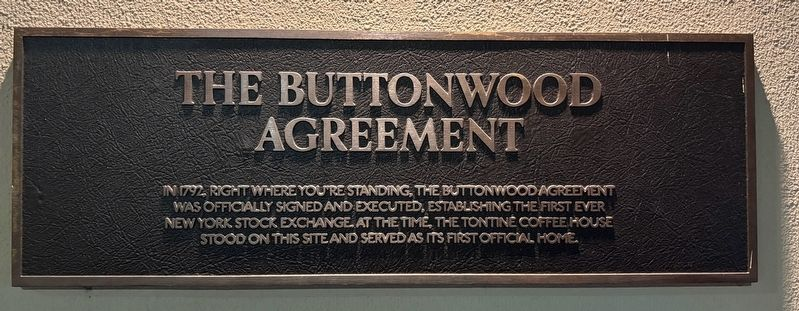
On May 17, 1792, 24 brokers signed the Buttonwood Agreement under a sycamore tree on Wall Street, agreeing to trade stocks with each other. This was the precursor to the New York Stock Exchange (NYSE).
The market back then was similar to today’s altcoin market: buying was the only option, holding, waiting for dividends, waiting for the new year. There was no leverage, no short selling, no standardized delivery procedures. Average daily trading volume might have been less than $500,000, with only a handful of participants. The market was tiny because there were too few actions to take.
Price fluctuations were entirely driven by bullish sentiment. Good news arrived, everyone bought in, and prices soared. Bad news came, everyone wanted to sell, but due to the shallow market, they couldn't sell, prices crashed. There were no shorts to buy back during the downturn, so the market had no natural support, and the bottom completely depended on when the last bullish trader would capitulate.
Does this resemble the meme, high FDV, low float altcoin market of 2024-2025?
1850-1860s: Short Selling Takes Center Stage — Fear and Prosperity Arrive Simultaneously
In the 1830s and 1840s, a trader named Jacob Little made a fortune by short selling and was known as the "first great short seller on Wall Street." However, it was the decade surrounding the Civil War that short selling truly became mainstream.
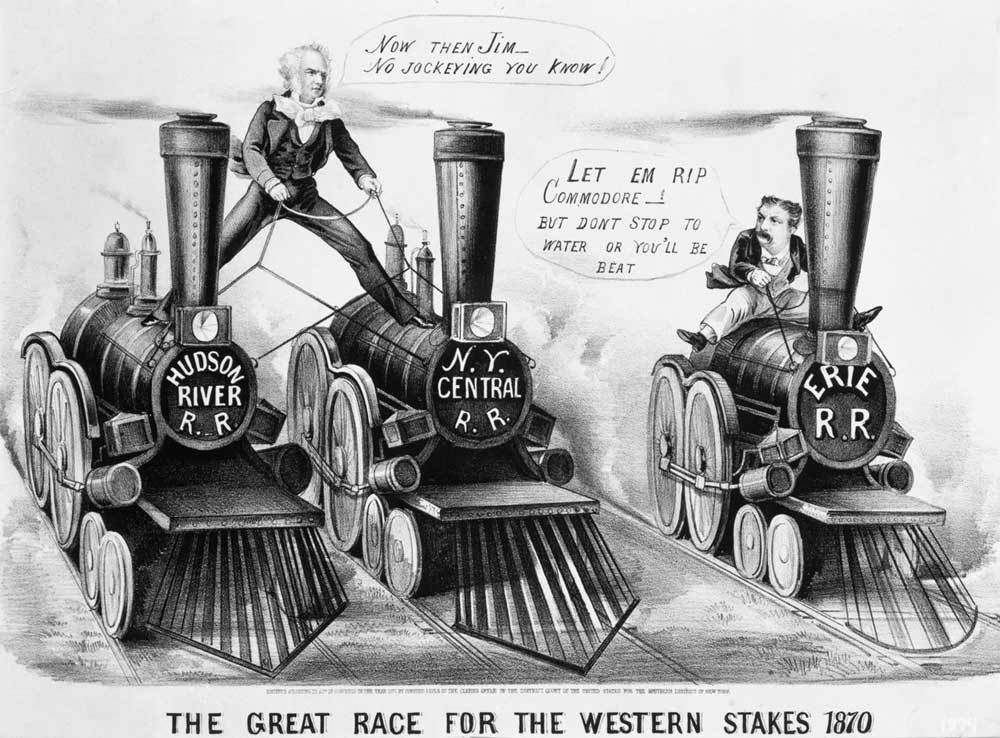
Daniel Drew, Jay Gould, Cornelius Vanderbilt — these names defined Wall Street in that era. They engaged in epic battles over railroad stocks: Drew shorting Erie Railroad, Gould and Fisk teaming up to attack Vanderbilt’s long positions. These battles were bloody, chaotic, and full of deception, but the objective result was — short selling transitioned from a secret weapon of the few to a standard tool of Wall Street.
The public reaction was just as it was in the Netherlands in 1609. Congress labeled short sellers as “enemies of the state,” and newspapers proclaimed they were “profiting from the misfortunes of others.” The public's fear of short selling has hardly changed in four hundred years.
But the market's response was the same as four centuries ago, active and vigorous:
Every short sale created a sell order, while simultaneously creating a future inevitable buy order (short covering). Trading volume increased, spreads narrowed, and more participants were willing to enter the market. Wall Street transitioned from a small circle of dozens to a true capital market.
1929 Crash → 1938 Uptick Rule: The Apex of Fear and the Turning Point
In October 1929, Wall Street crashed. The Dow Jones Index fell nearly 90% in two years. The public's anger needed an outlet, and shorts became the most convenient target — even though the real culprits were the mad leverage bubble and the systemic collapse of the banks.
In 1934, the U.S. Securities and Exchange Commission (SEC) was established. Short selling faced a renewed threat of total prohibition. But the SEC made a historic choice: in 1938, it did not ban short selling; instead, it introduced the "uptick rule" (Rule 10a-1) — short selling could only be executed when the stock price was rising, preventing shorts from continuously hammering the price down.
The significance of this choice cannot be overstated. It established a principle still in effect today: short selling should not be eradicated; rather, it should be regulated. The rules are not the enemy of short selling; rather, they are the prerequisite for its legitimacy.
With the rules in place, short selling was no longer a gray area. Institutional funds, which had previously harbored concerns over short selling, now had legal protection and dared to participate on a large scale. Regulation did not kill short selling; it made short selling safer and more trustworthy, attracting more capital into the market.
This lesson has yet to be truly learned by the crypto market.
1973: Standardization of Options — From One Direction to Four Directions
On April 26, 1973, the Chicago Board Options Exchange (CBOE) opened. On the first day, only call options for 16 stocks could be traded. Put options were added in 1977. That same year, Fischer Black and Myron Scholes published the Black-Scholes option pricing model, which changed the course of financial history by providing a mathematical foundation for option trading.
The significance of options lies in their ability to expand the dimensions of market competition from two (buy/sell) to four (buy up/buy down/sell up/sell down). For the first time, investors could express their market judgments in very precise ways — not just "up or down," but "at what time, at what pace, and how much up or down."
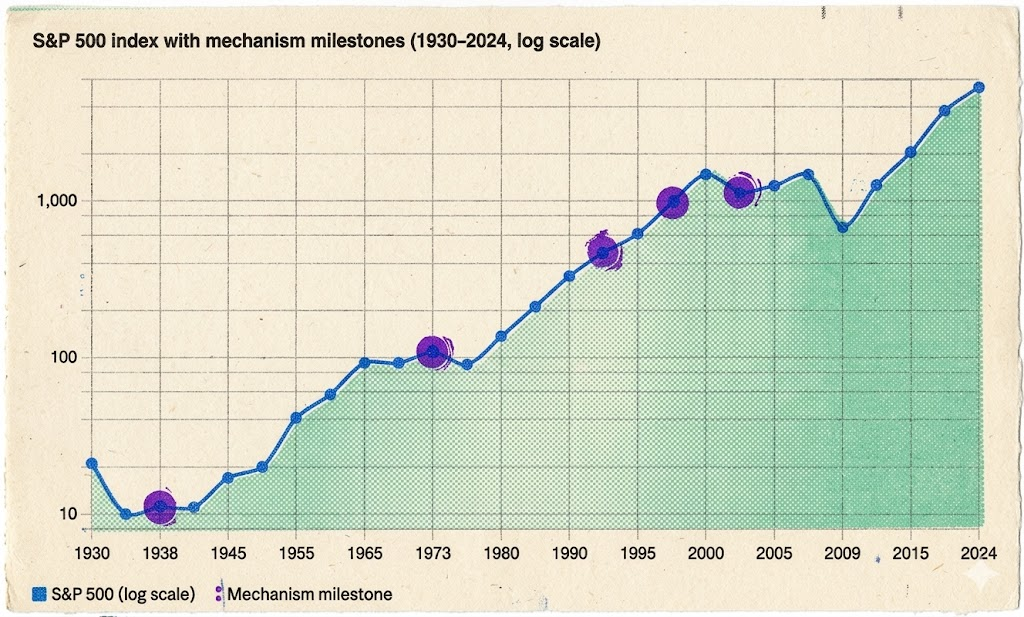
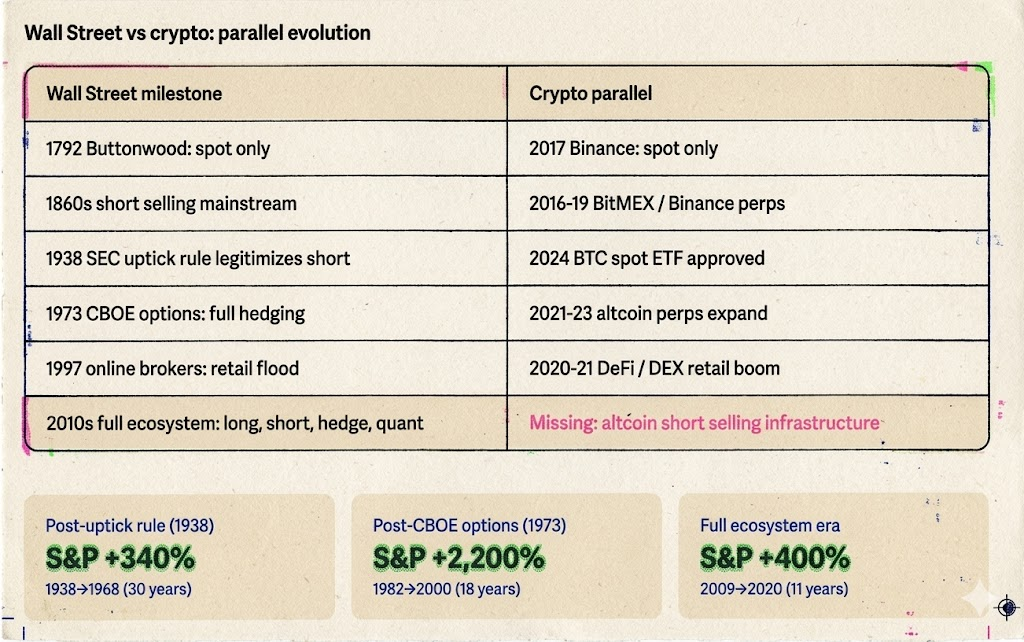
More crucially, options provided institutional investors with a comprehensive hedge arsenal. The bull market of the 1980s (when the S&P 500 rose over 2200% between 1982 and 2000) was directly ignited by Volcker controlling inflation, Reagan’s tax cuts, and deregulation, but options provided the risk management infrastructure that allowed institutions to enlarge their positions. When they could hedge, they were willing to take larger positions; as more people took larger positions, more capital flowed in, and the bull market followed.
For the wealthy and institutions, how to control drawdowns is more important than how much they can make — uncontrollable risks mean large capital cannot enter.
1996-1997: Retail Investors Break In
NASDAQ has been an electronic exchange since its establishment in 1971 — the first of its kind in human history. The true transformation that happened in 1996-1997 was twofold: the SEC's Order Handling Rules broke the market makers' monopoly on quotes; and online brokers (E*Trade, Ameritrade) drastically slashed trading commissions from $50-100 to below $10.
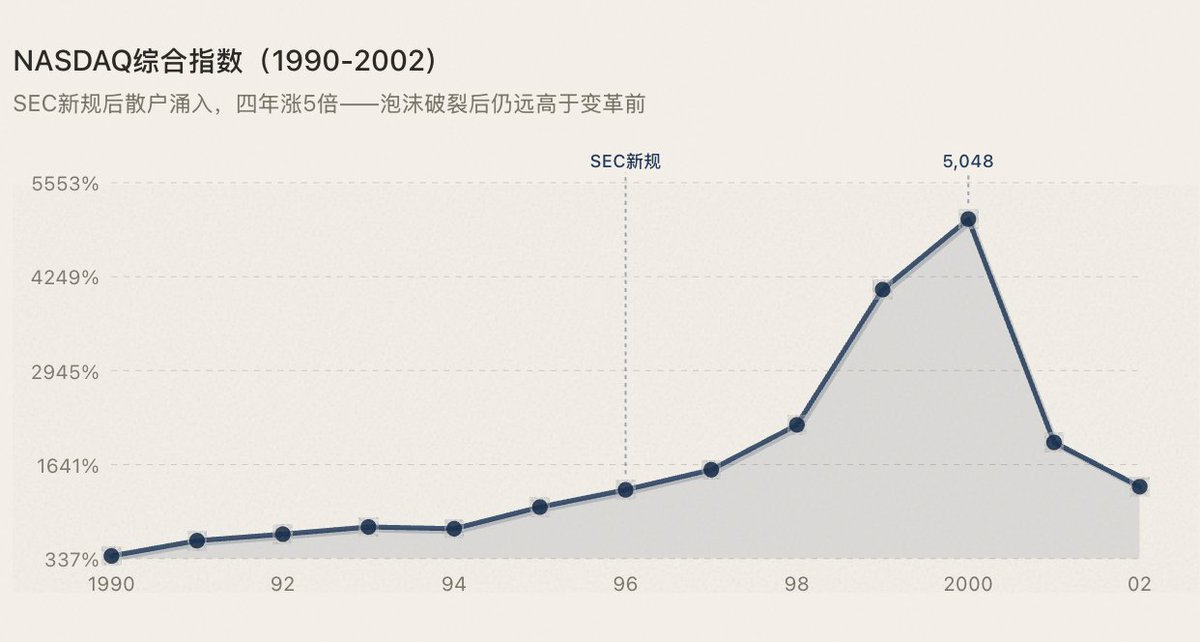
The bubble eventually burst, but NASDAQ's market value remained significantly above that of the pre-reform period — because the increase in participants driven by the infrastructure upgrade was irreversible.
1993-2010s: The Maturity of a Complete Ecosystem
Many people think that ETFs are a product of the past decade, but the first ETF — SPY (tracking the S&P 500) — was listed on the American Stock Exchange in 1993. In 2001, the SEC mandated decimal pricing (Decimalization), reducing the bid-ask spread from $0.125 to $0.01, significantly lowering trading costs. Between 2005 and 2010, high-frequency trading (HFT) emerged, at one point accounting for over 60% of daily trading volume in the U.S. stock market. Quantitative strategies, ETF arbitrage, long-short hedging — all directional strategy types had standardized tools supporting them.
At this point, the U.S. stock market's competitive tool system was fully mature. Long positions, short positions, hedging, arbitrage — funds of every strategy type could find suitable entry methods. The result:

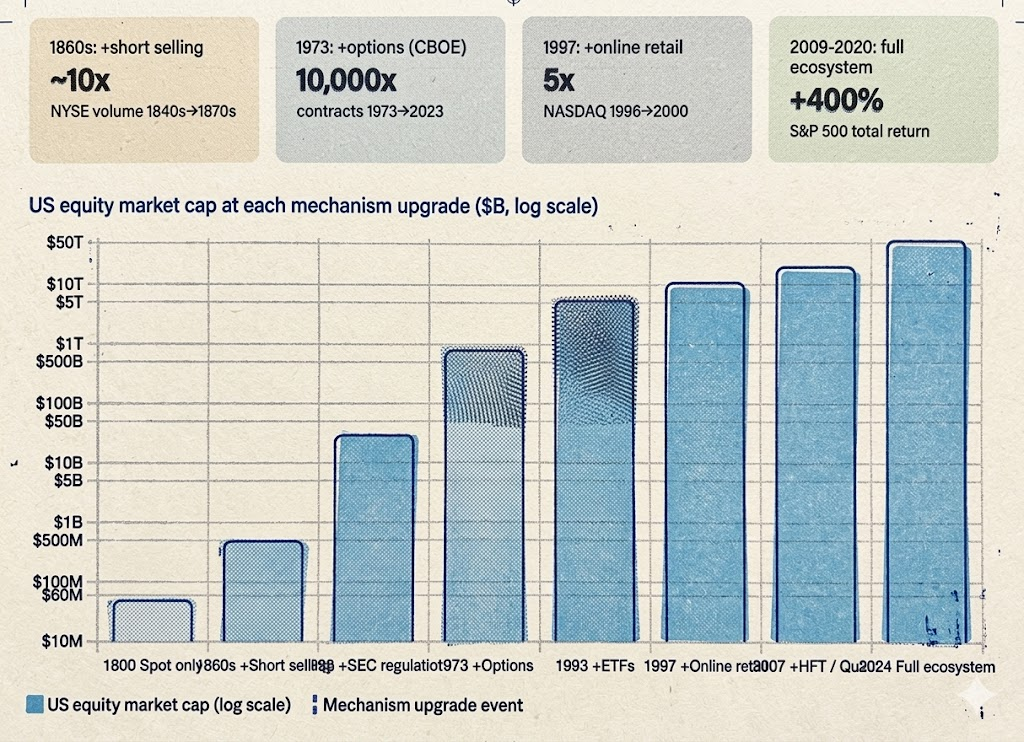
The rule is crystal clear: whenever a new trading mechanism enables more people to engage in the market in more ways, prosperity follows. (See the image below)
3. Eight Years of the Crypto Market: Two Hundred Years of Evolution Completed in Eight Years
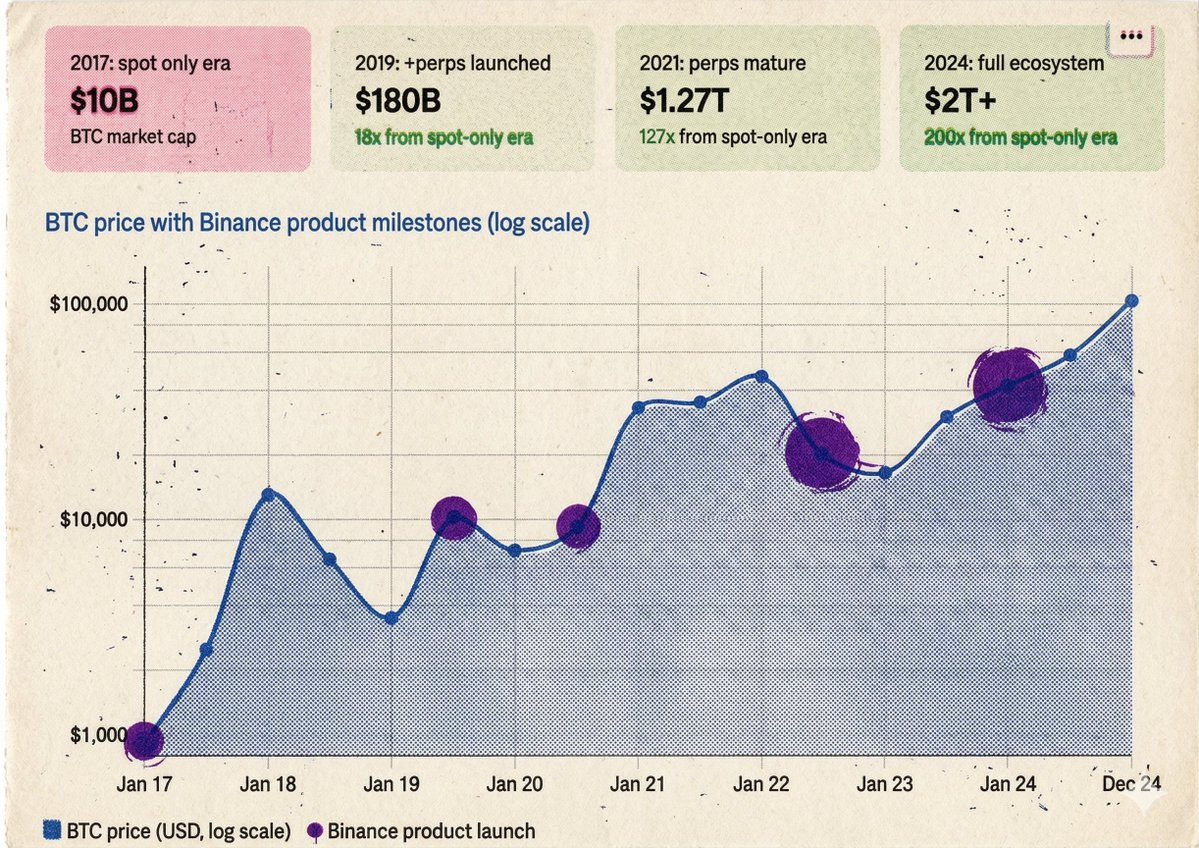
The mechanism upgrades completed by Wall Street in two hundred years took less than eight years from Binance's 2017 launch to the maturation of perpetual contracts. But at the layer of altcoins, evolution has stalled.
2017 — The Sycamore Tree Moment
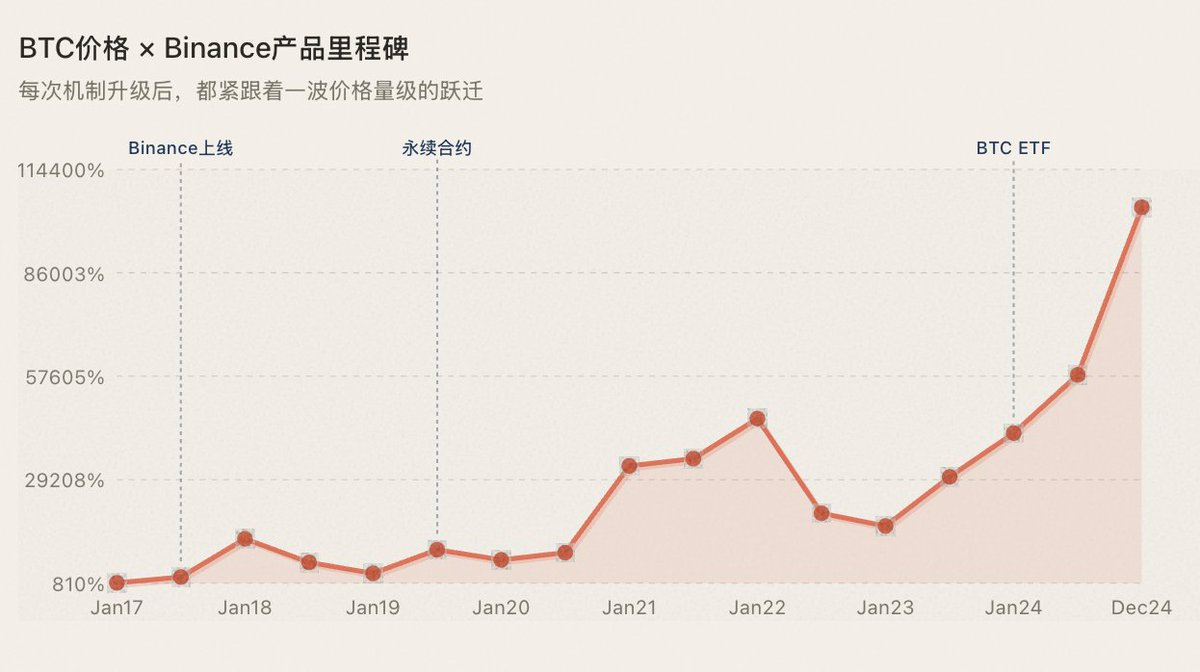
Binance launched with only spot trading. The actions possible were the same as those of the brokers in 1792: buying, holding, waiting for the price to rise.
The ICO bubble was the best mirror. Everyone was buying, prices could only rise. Then buying dried up — in a market without shorts, with no short covering, there was no natural support, and prices free-fell. The bottom depended on when the last bullish trader would give up. Altcoins collapsed. This was exactly the characteristic of the market during the sycamore tree era of 1792.
2016-2019 — The Emergence of Short Selling Tools
In May 2016, BitMEX launched the XBTUSD perpetual contract — the first short selling tool for the crypto market. In September 2019, Binance launched the BTC/USDT perpetual contract, bringing short selling into the mainstream.
What happened? Exactly the same thing that occurred after short selling was introduced on Wall Street in the 1860s: liquidity soared, price discovery became two-way, and volatility structurally decreased.
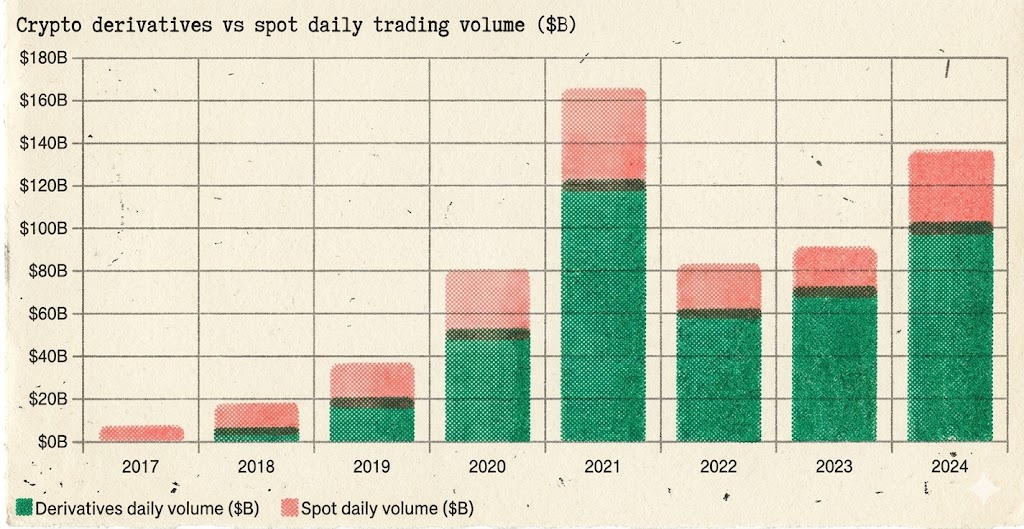
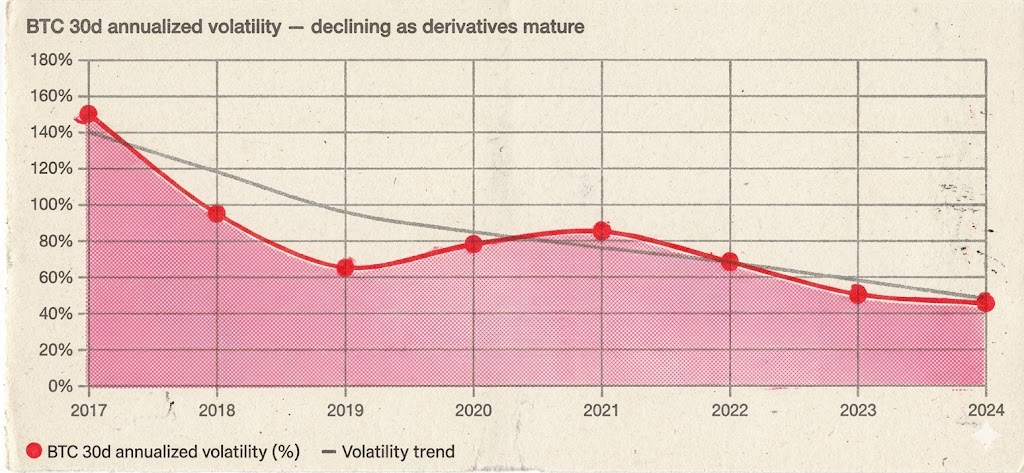
The 30-day annualized volatility of BTC dropped from over 150% during the 2017 bull market to 60-90% during the 2020-2021 bull market — price increases were larger, but price movements were more ordered. Although there were still sharp rises and falls, instances of "prolonged declines with low volume" significantly decreased, as shorts would cover at certain price levels, forming natural support.
More importantly, the volume of capital experienced a leap. With hedging tools in place, institutional funds were willing to enter on a large scale. You can't expect a fund manager managing billions of dollars to throw money into a market that can only go long with no way to hedge. Perpetual contracts did not just give retail investors the right to short; they provided an infrastructure for the entire market — "institutions can enter."
The proportion of derivatives in total trading volume rose from less than 10% in 2017 to about 90% by March 2026 — derivatives have completely dominated the pricing power in the crypto market:
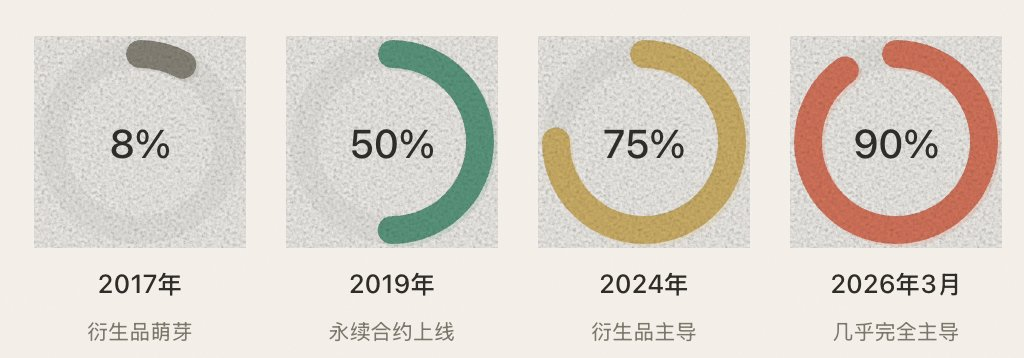
Short selling did not kill BTC. Short selling transformed BTC from a $10 billion speculative asset into a $2 trillion asset class.
2020-2021 — DeFi Summer: Not Just a Narrative, But an Evolution of Mechanisms
The options markets for BTC and ETH rapidly matured during 2020-2021 (mainly Deribit). This was the crypto market's "1973 CBOE moment" — institutions were able not only to short but also to precisely hedge and construct structured positions. The dimensions of strategies expanded from two-dimensional to higher dimensions.
Additionally, many people classify DeFi Summer as a "narrative" — like the NFT craze, the concept of the metaverse, just another wave of hype. But this is a fundamental misinterpretation. The essence of DeFi Summer is not a narrative, but a structural leap in trading mechanisms.
AMM (Automated Market Makers) rewrote the underlying logic of trading. Before Uniswap, trading required an order book, market makers, and centralized matching. AMM overturned all of this — anyone could create a liquidity pool with two tokens, anyone could trade instantly, without needing counterparties to post orders or any permission from anyone. This is not a narrative; it is a paradigm shift in trading infrastructure. It allowed thousands of long-tail tokens that previously could not have a trading market to gain liquidity for the first time.
Lending protocols created on-chain leverage and cyclical strategies. Aave and Compound allowed users to collateralize one asset to borrow another — this essentially represents on-chain margin trading. More critically, it birthed "loop loans": collateralizing ETH to borrow stablecoins, using stablecoins to buy more ETH, then re-collateralizing... This strategy is known in traditional finance as leveraged long, but in DeFi, it's packaged as "yield farming"; the underlying logic is exactly the same — it offers a new way of competing, allowing participants to engage with more dimensional strategies in the market.
Composability allows for exponential layering of innovative mechanisms. AMM + lending + liquidity mining + cross-protocol arbitrage — these combinations of "money legos" created a strategy space that had never existed in traditional finance. Each new combination represents a new way to participate, each new way to participate introduces new capital and new users.
Thus, the super bull market of 2020-2021 was not just the sum of two factors, but three: the perpetual contracts/options for BTC and ETH created entry and exit channels for institutions, DeFi's AMM and lending protocols led to qualitative changes in on-chain trading mechanisms, and narratives were merely the surface packaging for the evolution of these two mechanisms.
It once again verified the same rule: every evolution of trading mechanisms catalyzes the next round of prosperity.
2021-2023 — The Perpetual Expansion of Altcoins
Binance began to list perpetual contracts for an increasing number of altcoins. Every new coin that has a perpetual contract listed sees a jump in trading volume — not because "listing on perp" is good news, but because the introduction of shorting tools allows for participation from more types of capital. Quant funds can begin market making, hedge funds can begin arbitraging, trend traders can short. The diversity of participants directly translates to the depth of liquidity.
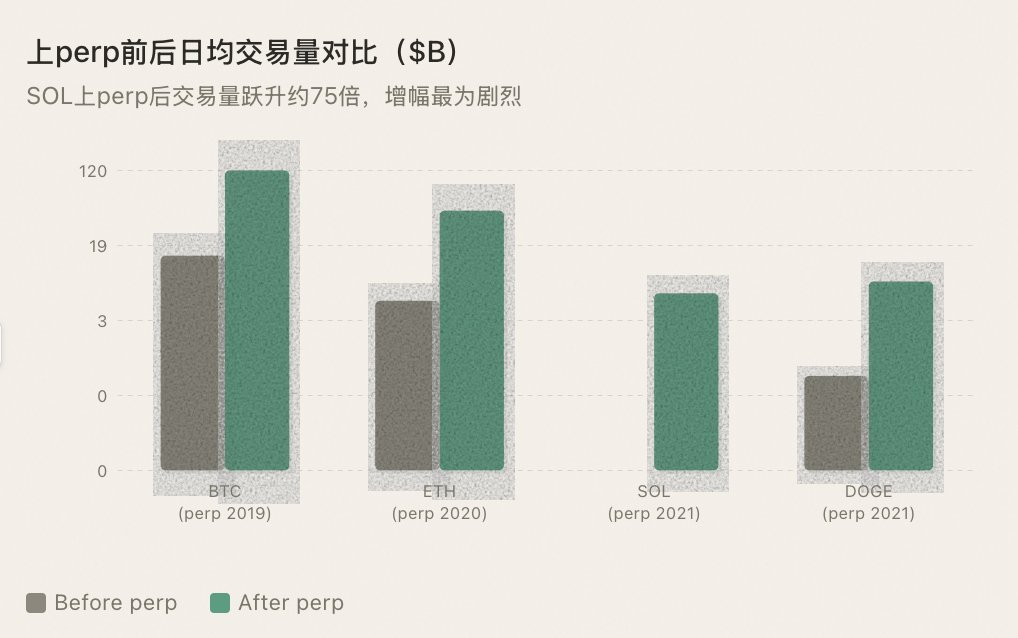
The rule continues to hold: BTC has become bullish with the introduction of perp, so has ETH, so has SOL, and every altcoin that has been listed on perp has experienced a liquidity leap.
2023-2025 — The Moment of Failure of the Rule
Then, without unexpected events, unexpected events are about to happen; just like in an idol drama, turning the corner meets the "obstacle," which is merely the obstruction.
From the second half of 2023 to Q3 2025, Binance listed perpetual contracts for altcoins at unprecedented speed. Almost every week, new perpetual trading pairs were launched — from mainstream public chain tokens to AI concept coins, from GameFi to memes, and even some projects worth only tens of millions were granted perpetual contracts.
On the surface, this appears to be a continuation of historical rules: providing shorting tools for more assets, creating more liquidity, attracting more participants. And objectively speaking, these perps indeed created liquidity out of thin air — a project with a tens of billions FDV but a circulating market value of only a few million could not sustain reasonable trading depth with just the spot market. The perpetual market makers provide dual-sided quotes with stablecoins, effectively injecting a layer of synthetic liquidity into these paper-thin markets.
But this time, the rules did not work.
The problem lies in the disconnection between "liquidity" and "confidence." The premise for creating liquidity is that someone is willing to engage in competition. However, the reality from 2024-2025 is — everyone is scared. The current market views listing on perp as a finish line, an exit signal, or news trading.
Retail investors are afraid. After experiencing the fallout from FTX, the collapse of Luna, and countless rug pulls, trust in altcoins has plummeted to freezing levels. What's more fatal is that numerous new projects listed on perp exhibited distorted token economics: tens of billions FDV paired with extremely low circulating supply meant there would soon be a massive amount of tokens ready to unlock and dump. Retail investors are not foolish — you give me shorting tools, but the underlying asset is a designed chronic blood-draining machine, why would I participate? Whether longing or shorting, I don't want to touch it.
Market makers are scared. This is the most critical aspect. Providing perpetual contracts for a project with an average daily trading volume of only a few hundred thousand dollars poses high risks. The liquidity is too thin, prices are easy to manipulate, and the inventory risk for market makers is hard to hedge. When faced with extreme market conditions, market makers simply cannot exit the trades they get. After encountering several missteps, market makers began to tighten quotes, widen spreads, reduce depth, and even exit entirely. Without market makers willing to provide perp, liquidity becomes an empty shell.
Worse still, those altcoin perpetual contracts that are still operational have become private casinos for market makers.
Coins with small circulating supply and concentrated chips allow market makers to operate freely in the perp market. Pumping does not require much capital — controlling supply in the spot market raises prices, coincidentally harvesting a wave of short-liquidated profits in perp. Dumping is just as easy — first going short in perp and then dumping in the spot market means shorts profit. Back and forth, the high leverage of perp has become a tool for market makers to amplify their profits, rather than a weapon for retail investors to hedge risks.
The destructiveness of this method far exceeds that of market manipulation in the spot market. In the spot market, market makers deceive the retail investors who are buying; in the perp market, they harvest both sides of the bullish and bearish positions — regardless of whether you are long or short, as long as you are on the opposite side of the market maker, your margin becomes their profit. Experienced traders dare not touch these altcoin perps, while inexperienced traders who come in are endlessly harvested and subsequently depart.
In principle, shorting tools should be a power that constrains market makers. But in the extremely thin altcoin perp market, the relationship is reversed: shorting tools have become another knife in the hands of market makers. What is undermined is not just the ecology of a single coin but the trust of the entire crypto market. Every trader who is wrecked in an altcoin perp represents a permanently lost user in the crypto market.
A paradox arises: Binance is launching more and more perps, but the trading volume and activity in the altcoin market are shrinking.
What does this indicate? The mechanism upgrades provided by perpetual contracts for altcoins have reached their limits. Perp is a heavy infrastructure that requires market makers, oracle services, funding rates, and centralized approvals to function. BTC and ETH can afford this machine, but thousands of long-tail altcoins cannot — the machine is running, but it has run out of fuel. And those machines that barely keep running have instead become cash cows for market makers.
4. Why Perpetual Contracts are Bound to Fail for Altcoins
The experiment during 2023-2025 has already yielded results; here is an explanation from a mechanistic perspective.
The death spiral of liquidity. Perps need market makers to provide dual-sided quotes with stablecoins. Who is willing to provide market-making services for an unknown project with a daily trading volume of a few hundred thousand dollars? Without market makers, there is no liquidity; without liquidity, there are no traders; without traders, market makers are even less inclined to participate. Spot leverage shorting does not need to construct a derivatives market from scratch — just borrow tokens and sell them in an existing DEX pool. Lending protocols provide the supply; AMM provides execution, decoupling the two.
Two prices, two worlds. Perps and spots are two independent pools; when the pools are thin, a single transaction can pull the spread to an absurd level. You think you're shorting this project, but you are actually gambling in a parallel universe disconnected from spot. Spot leverage has only one market all along; there is no chance of decoupling.
Funding rates are manipulated. Market makers drive up perp prices to create extreme funding rates; shorts are bled every few hours, and even if they have the right direction, they can still be worn down. What’s worse is that market makers operate both spots and perps simultaneously — pumping in the spot and liquidating the shorts in perp. Spot leverage only has borrowing interest rates, determined by supply and demand, not distorted by the bull/bear ratio.
Synthetic positions do not create real selling pressure. This is the most critical point. Shorting on perp does not bring any selling orders in the spot market. Market makers can easily operate shifting from one hand to the other in the market, while shorts pose zero threat to them. In spot leverage shorting, you borrow real tokens to sell on the spot — real selling pressure directly impacts prices, and market makers must genuinely absorb orders to maintain high prices.
Approval + Oracles. Perps require exchange approval and reliable oracles, neither of which small tokens have. On-chain lending for short selling does not require approval, and the liquidation price depends on AMM’s real-time price.
Perpetual contracts represent a heavy infrastructure whose operating costs exceed the value it can create for long-tail assets. What altcoins need is the lightest way to short — borrowing tokens, selling them, and buying them back when the price drops. This is what spot leverage lending for short selling represents.
5. Fear of Shorting, or Fear of No Price Discovery?
From Amsterdam in 1609 to Wall Street in the 1860s to crypto Twitter in 2024, the fear of shorting has never changed. "Shorting will drive prices down." "Shorting is a malicious attack." "Shorting leads to market crashes." — Four hundred years have passed, and the phrasing remains almost unchanged.
Yet four hundred years of history repeatedly demonstrates the same fact: the cost of fearing shorting far exceeds the act of shorting itself.
When criticism is not allowed, praise becomes meaningless. When shorting is not allowed, going long loses meaning.
Because in a market where you can only buy, prices only reflect the optimistic half. The pessimistic half of information — doubts, bad news, fraud — is forcibly silenced. Everyone can only "like," and no one can give a "dislike."
Such prices are distorted, fragile, and unsustainable. They do not represent price discovery; they represent price illusion.
The ability to go long and to short is the most basic respect for price discovery.
With real price discovery, the market has a chance for lasting possibilities. Institutions are willing to participate because prices are credible; market makers are willing to come in because both sides can engage; long-term investors are willing to enter because current prices have survived the scrutiny of bears, not mere lines drawn by market makers.
Conversely, a market without price discovery can only survive on narratives. Each round of hype ends up in chaos, and then waits for the next narrative to attract another wave of players to take the bait. This cycle continues, forever unable to accumulate.
The greatest tragedy of the altcoin market is not "too many market makers," but rather that it lacks even the most basic conditions for price discovery. If prices are not real, how can one talk about long-term value?
6. Short Selling is not a Bearish Tool, but a Catalyst for Bull Markets
The most counterintuitive rule in history: every introduction of short selling mechanisms, in the long run, does not lower prices but raises them.
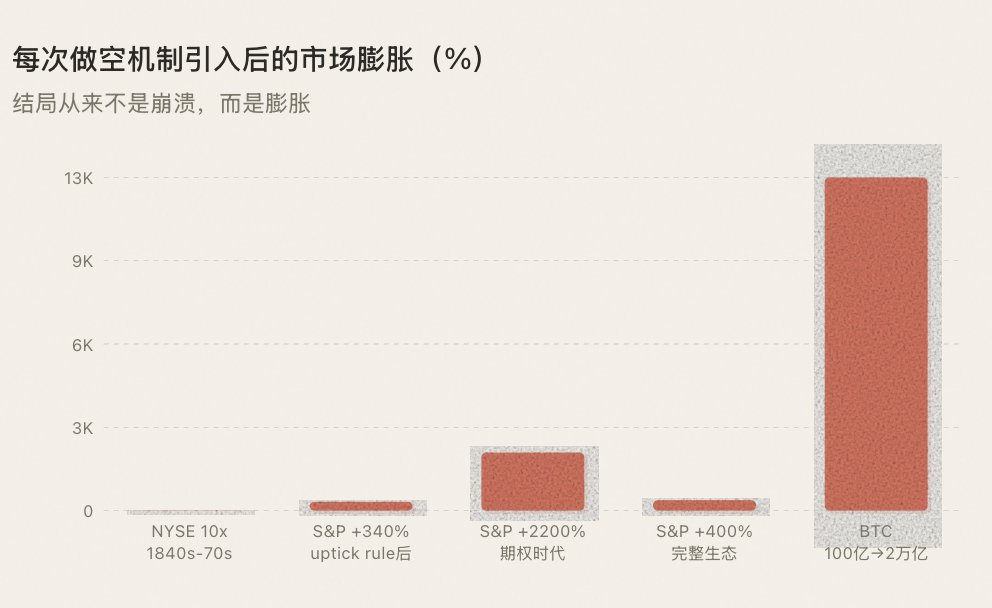
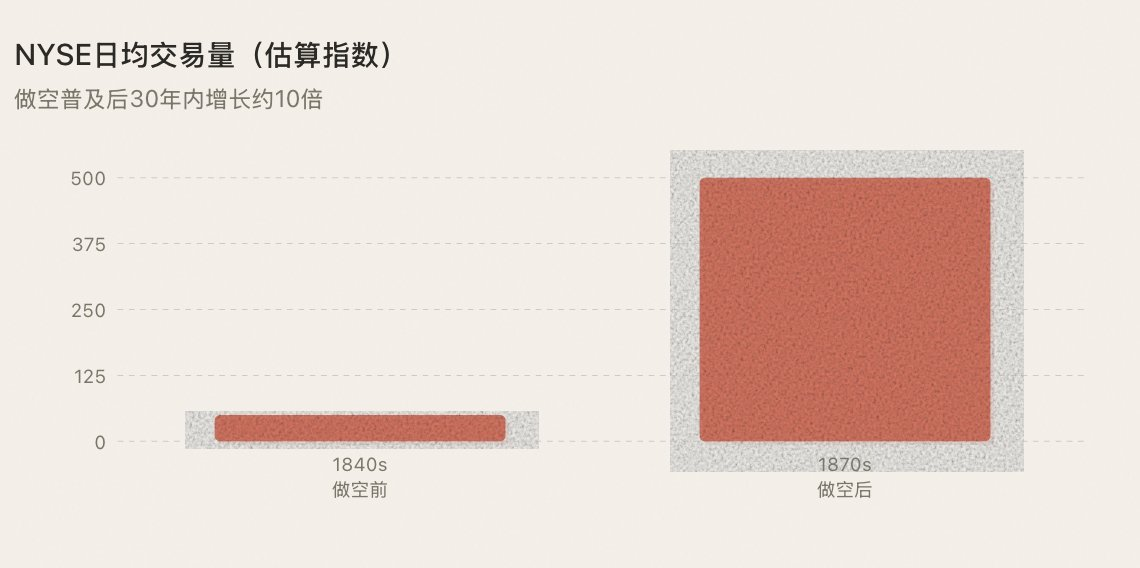
After the popularization of short selling in the 1860s, the NYSE's trading volume grew tenfold in a decade, and Wall Street transformed from a small circle into a true capital market. After the legalization of short selling by the uptick rule in 1938, institutional funds flowed in on a large scale, leading to a 340% rise in the S&P 500 over the following 30 years. Following the birth of options at CBOE in 1973, options trading volume increased ten thousand times in 50 years, and the U.S. stocks entered a decades-long sustained expansion. After the launch of BTC perpetual contracts in 2019, BTC's volatility fell from 150% to 50%, while its market cap surged from $10 billion to $2 trillion.
Each time, the outcome was not a market collapse but market expansion. The reasons are threefold:
Short selling creates liquidity — each short sale is a sell order + an inevitable future buy order (covering); the more active short selling is, the deeper the liquidity.
Short selling attracts new participants — market makers, quant funds, hedge funds, and arbitrageurs do not come in to bring the market down; they come to provide liquidity, and liquidity is the oxygen of a bull market.
Short selling establishes trust — prices that have been tested by bears are credible prices, and credible prices attract real funds, which push real price increases.
A complete set of competitive tools does not destroy confidence, but builds it.
7. Pathways to the Next Bull Market
From Amsterdam in 1609 to the crypto market in 2025, four hundred years of financial history repeatedly validates the same rule: mechanism evolution comes before prosperity. This order cannot be reversed.
The current altcoin market is trapped in a death spiral: only going long → single model → fewer and fewer people making money → fewer and fewer people trading → liquidity drying up → market stagnation. Even gambling can bet on sizes and play dealer's hands; why can altcoins only buy and not short?
Perpetual contracts cannot solve this problem — the experiments of 2023-2025 have proven this. Perps are heavy infrastructure that long-tail altcoins cannot afford. "Listing on perp" itself has also devolved into another narrative trigger, just like "listing on spot" or "listing on alpha," becoming the basis for news trading, detached from the act of trading and real competition. Trading tools, which are meant to support trading, have now ironically become the objects of trading — for long-tail assets, perp is structurally the wrong tool.
The correct path is on-chain "native spot leverage shorting" — through over-collateralized lending, borrow real tokens, sell them in the spot market to create real selling pressure, engage in real price discovery. No market makers are needed to build markets from scratch, no oracles are needed to maintain peg, no funding rates are needed to flatten spreads, and no one needs to approve anything.
This aligns with every instance of the birth of short-selling mechanisms throughout history. The short selling by le Maire in 1609 was not approved by the Amsterdam exchange. The short-selling by borrowing on Wall Street in the 1850s was not designed by the NYSE. They were all spontaneously created by market participants — tools first, then rules. What the SEC did in 1938 was not invent short selling but establish a regulatory framework for practices that had been in operation for nearly a century.
On-chain shorting protocols follow the same path.
When this happens — when an altcoin is no longer just a one-way game of "buy and wait for an increase," but rather a proper confrontation between bulls and bears on the spot market with real money at stake — the quality of the market will fundamentally change. Liquidity will return, participants will come back, capital will flow back. Not because there is a new story to tell, but because there is a new way to play.
If historical rules continue to be upheld — and we have no reason to believe they won't — then the ignition point for the next altcoin bull market will not be a new narrative, a celebrity endorsement, or a halving event.
It will be an upgrade in infrastructure: providing thousands of long-tail altcoins with on-chain native shorting tools — this is where the crypto space holds its pricing power.
This time, it will be the opposite direction — rather than BTC liquidity spilling over to altcoins, it will be the altcoins’ turn.
8. Conclusion
In 1609, the Dutch government banned short selling, and le Maire was publicly condemned. In the 1860s, the U.S. Congress labeled short sellers as enemies of the state. After the crash of 1929, the public called for the complete abolition of short selling. In 2024, "shorting" is still a dirty word in the crypto community.
Four hundred years have passed, and the fear of short selling has not changed.
But four hundred years of history also repeatedly prove the same truth: every time this fear was overcome and short selling rights were introduced into the market, the market did not collapse — it expanded. Amsterdam became the global financial center. Wall Street transformed from sycamore tree to trillion-dollar capital market. Binance became the universe's exchange. BTC grew from $10 billion to $2 trillion.
Now, thousands of altcoins are locked in the cage of "only going long." Without shorting, there is no price discovery; without price discovery, there is no trust; without trust, there is no lasting prosperity. The entire market has devolved into betting solely on what is "expected," leading to fewer and fewer people making money, fewer and fewer willing to participate, and an increasingly quiet market. Meanwhile, those altcoins that barely have perpetual contracts see shorting tools turn into new harvesting tools for market makers, causing trust in the market to dwindle rapidly.
When criticism is not allowed, praise loses its meaning. When shorting is not allowed — or when shorting is merely a privilege of the dealers — prices will never be real.
More terrifying than the fear that short selling brings is a market without price discovery.
Bull markets are never just awaited; they are spawned from the evolution of mechanisms. And at the core of every mechanism evolution, from 1609 to today, remains the same truth —
Return the right to short sell back to the market.
Who is willing to walk with us and proclaim that “regardless of how you feel about it, you can short it”? (inspired by @heyibinance)
免责声明:本文章仅代表作者个人观点,不代表本平台的立场和观点。本文章仅供信息分享,不构成对任何人的任何投资建议。用户与作者之间的任何争议,与本平台无关。如网页中刊载的文章或图片涉及侵权,请提供相关的权利证明和身份证明发送邮件到support@aicoin.com,本平台相关工作人员将会进行核查。


