Author: Kuri, Deep Tide TechFlow
The person who built that little fox doesn't want to build anymore.
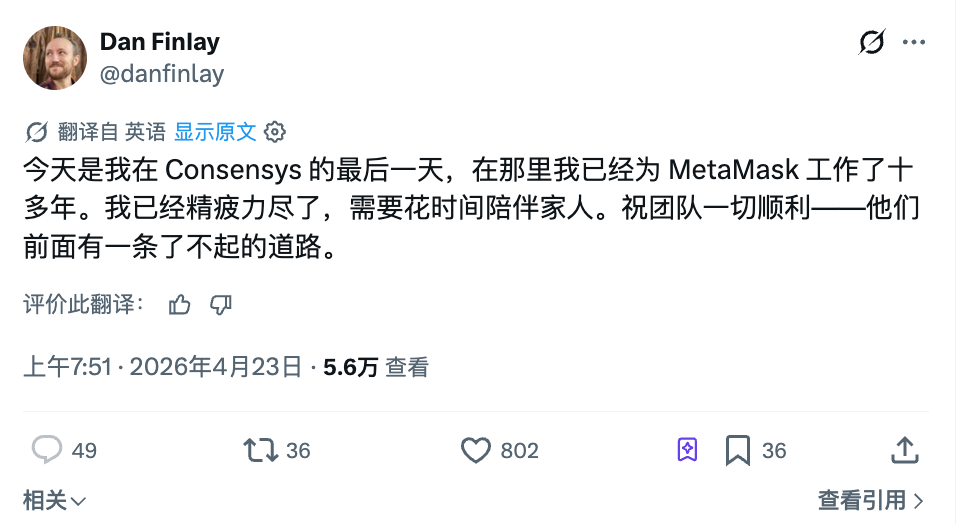
On April 23, MetaMask co-founder Dan Finlay officially announced his departure from Consensys, ending a ten-year development career. The reason is professional burnout and a desire to spend more time with family.
MetaMask may be the most recognizable product application in the crypto world. That orange little fox logo is recognized by almost everyone who has installed a crypto wallet. In 2016, Finlay and another co-founder, Aaron Davis, created this browser plugin within Consensys, allowing ordinary people to interact with Ethereum without running a full node.
Over ten years, according to statistics from several third-party platforms, the global installation has surpassed 100 million, with approximately 30 million monthly active users, and the swap feature has generated over $325 million in fee revenue.
Looking through public information, I found that Finlay has hardly accepted interviews in the past decade. Previously writing code at Apple, he probably still has the essence of an engineer, not someone who comes out to create a persona.
When such a person says they are tired, it often means they are truly tired. However, the timing of his departure is hard not to think more about.
Just a few months ago, Consensys brought in JPMorgan and Goldman Sachs as IPO advisors, aiming for a listing as soon as this year, according to Axios.
The company's last financing round was in 2022, when its valuation was $7 billion, followed by at least two rounds of layoffs. Meanwhile, the $MASK token has been rumored to be coming out since 2021, but has remained silent for five years.
The token issuance for the wallet doesn't seem so necessary, and more frighteningly, the little fox doesn't seem so necessary for everyone anymore.
It is the default little fox, but not a must-have
In the past, many dApp development documents started with "Please install MetaMask first." It is the default wallet in this industry, just like that blue IE browser on your desktop after installing Windows ten years ago.
The problem is, default values and preferred options are no longer the same.
The company Phantom initially only created a Solana wallet, later expanding to Ethereum and Bitcoin. In January 2025, it raised $150 million in Series C funding, with a valuation of $3 billion.
According to whales.market, which cited on-chain data estimates, Phantom's annual revenue is approximately $108 million; in comparison, MetaMask's is about $46 million. That's more than double the difference, and Phantom was born five years after MetaMask.
Phantom started on Solana in 2021, capturing the entire process from the recovery to the explosion of the Solana ecosystem. According to Helius statistics, in 2024, Solana's DEX trading volume had already surpassed Ethereum, and the total on-chain application revenue reached $2.39 billion in 2025, a year-on-year increase of 46%. 725 million new wallets completed their first Solana transaction in 2025. When these users came in, Phantom was waiting at the door.
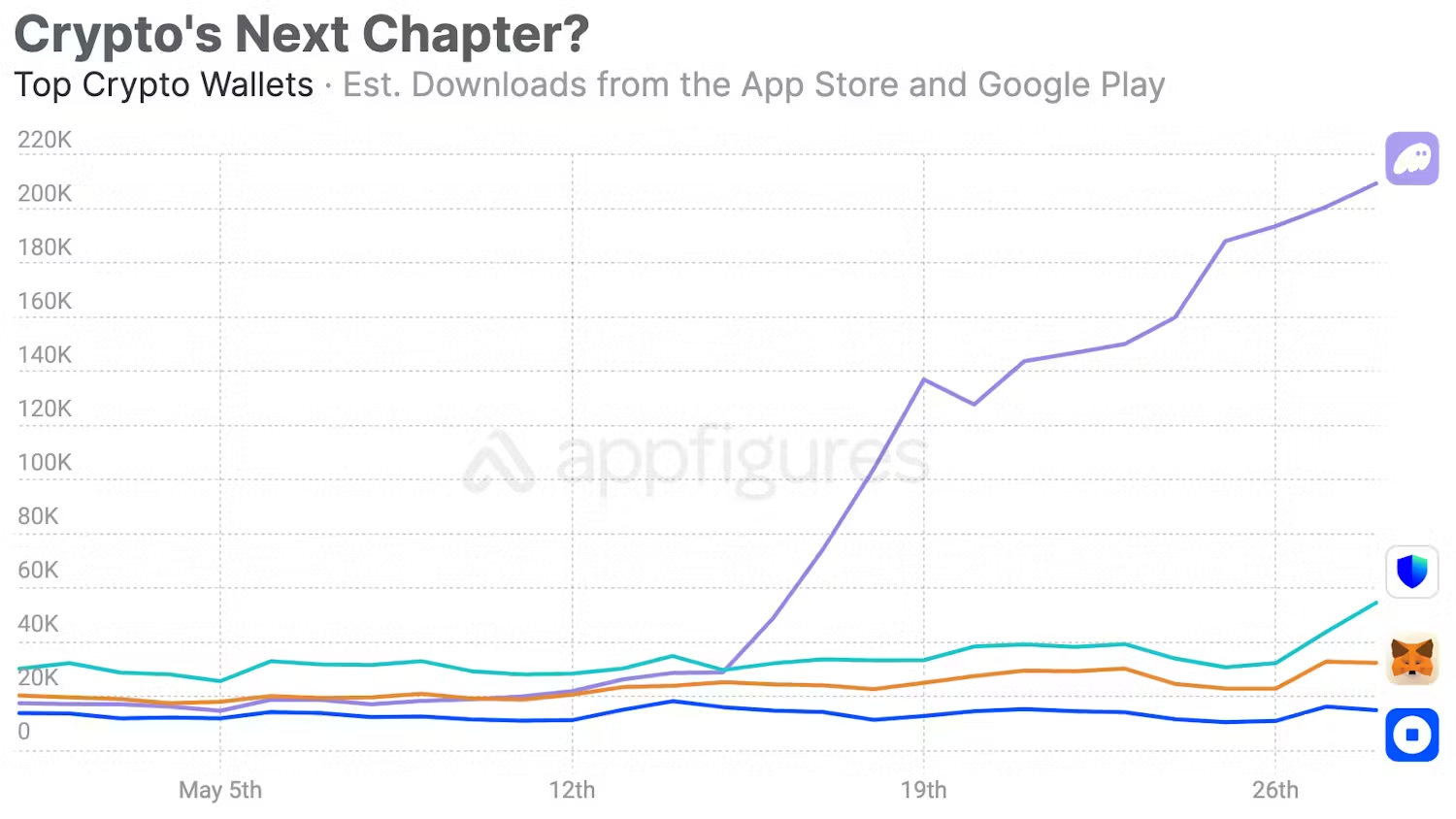
What about MetaMask? It only launched native Solana support in May 2025. Before that, users wanting to interact with Solana through MetaMask had to install a third-party plugin called Snaps, which was akin to installing the Chrome engine on an IE browser...
In these five years, Solana transformed from a chain that almost died due to the FTX collapse to the chain with the largest trading volume. Phantom also saw its valuation rise, securing $150 million in Series C funding at the beginning of 2025, with a valuation of $3 billion.
I believe MetaMask's slowness isn't due to technology but stems from an identity issue. MetaMask is Ethereum's darling, and the founder of its parent company Consensys is Ethereum co-founder Joe Lubin.
Supporting Solana represents expansion for Phantom, but it feels like betrayal for MetaMask. By the time the growth rate of the Ethereum ecosystem really slows down and it has to cross-chain, the window of opportunity has long passed.
Of course, MetaMask's compatibility within the Ethereum ecosystem is still the strongest, with almost all dApps on EVM chains treating it as the default option for testing; 30 million monthly active users is not a lie.
But this stickiness doesn’t come from product strength; it comes from switching costs. And switching costs can only prevent old users from leaving; they cannot stop new users from not coming.
A person who just started engaging with the chain in 2025 is likely to be recommended a wallet that is not MetaMask by their friends.
The little fox waiting for a price
The product is falling behind, people are leaving, but Consensys is going for an IPO.
According to Axios, in October 2025, Consensys invited JPMorgan and Goldman Sachs as IPO advisors, with the goal of going public as soon as this year. If successful, it will be the first company deeply connected with Ethereum core infrastructure to land in the US stock market.
But in the same year they hired investment banks, Consensys underwent at least two rounds of layoffs.
In October 2024, 20% of the employees, around 160 people, were laid off, with CEO Joe Lubin citing macroeconomic pressures and regulatory uncertainties as the reason. In mid-2025, another round of layoffs occurred, this time the reasoning shifted to "driving profitability."
In the well-known foreign job-seeking community Glassdoor, employee reviews are much harsher than the layoffs themselves.
Some wrote that the company lays off at least two rounds a year, only targeting front-line contributors, while management is never laid off. Others claimed that after sharing their promotion intentions with superiors, their names appeared on the next round of layoffs.
It's unclear how much of this feedback is emotional and how much is factual. However, a company making significant layoffs before a public offering while employee morale is at rock bottom is itself a signal.
Then there’s the story of the MASK token.
In 2021, Lubin tweeted "Wen $MASK?", which caused a stir in the community. In 2022, he further explained that they wanted to create a token plus DAO to promote "progressive decentralization." By May 2025, when Finlay was interviewed by The Block and asked when the token would arrive, his answer had turned into maybe.
For users, the MASK token is a carrot dangled in front to encourage continued use, continued interaction, and continued contribution of on-chain data to MetaMask. For Consensys, the token is a card they haven't played before the IPO.
If released too early, it dilutes the valuation narrative; if released too late, the community loses patience. Now the co-founder has left, the token hasn’t been issued, but the IPO is coming.
MetaMask's product competitiveness is declining, and it is very difficult to reverse this trend in the short term. However, MetaMask's brand recognition still exists; that little orange fox remains the most recognizable crypto logo in the world.
The rate of decline in brand value and product value is not the same; brand deterioration occurs more slowly.
For crypto companies, IPOs often sell not the product but the brand plus narrative. "Ethereum infrastructure," "Web3 gateway," "the world's largest self-custody wallet"... These labels were still effective a few years ago on pitch decks. Lubin himself being the co-founder of Ethereum carries a halo in front of traditional investors.
So Consensys’ choice is to take advantage of the brand still being valuable, while the regulatory window is still open, and while Wall Street still has enthusiasm for crypto infrastructure, to wrap MetaMask in a publicly traded shell to let the secondary market price it.
Silence is not golden
When co-founder Finlay left, the reaction in the CT circle was very muted. There were no farewell essays going viral, no sentiments of "the end of an era," and most people didn't even care about the news.
The departure of a MetaMask co-founder generated less buzz than some KOL lamenting the shrinkage of the surroundings at a conference in Hong Kong.
This itself indicates some issues.
MetaMask is a rare case in the crypto industry. It possesses the largest brand in the industry, but its founders have almost no personal brand.
In an industry where the founder is the biggest marketing resource, the two founders of MetaMask chose to remain invisible. The product spoke for them until the product could no longer speak.
I believe the story of MetaMask is essentially a story about "defaults."
In the tech industry, becoming the default option is the most powerful competitive advantage, as well as the most dangerous anesthetic. When you are the default, user growth requires you to do nothing; it will come by itself.
But this kind of growth can mask the fact that the product itself is aging. By the time you realize users are leaving, the loss has often been ongoing for quite some time.
IE was the default browser and lost to Chrome. Nokia was the default phone and lost to the iPhone.
Windows Media Player was the default player and lost to everyone. These products had high market share and strong brand recognition when they lost, but new users no longer chose them.
MetaMask now stands at this position. Existing users are still there, the brand is still ringing, but the incremental users have gone elsewhere. Consensys’ IPO plan is, after all, to monetize the existing stock.
At this stage, where brand value exceeds product value, selling is indeed a rational choice.
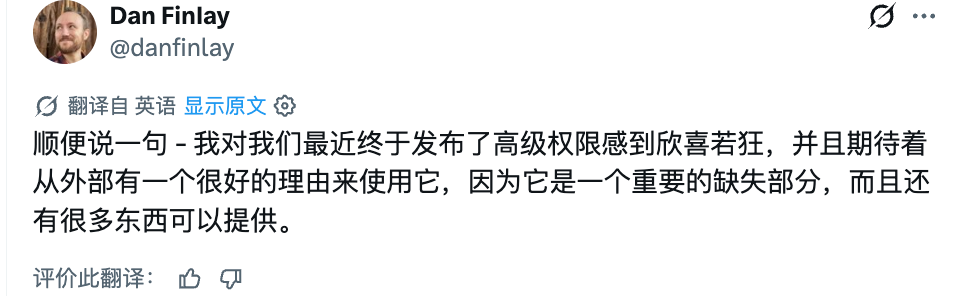
On the day Finlay left, MetaMask had just launched an advanced permission feature called ERC-7715. He said he looked forward to experiencing it as an ordinary user in the future.
A creator of a product becoming an ordinary user of it is probably the simplest and quietest farewell in the crypto industry.
But for MetaMask, how many ordinary users will still click on that little fox every day next year? Are you still using it?
免责声明:本文章仅代表作者个人观点,不代表本平台的立场和观点。本文章仅供信息分享,不构成对任何人的任何投资建议。用户与作者之间的任何争议,与本平台无关。如网页中刊载的文章或图片涉及侵权,请提供相关的权利证明和身份证明发送邮件到support@aicoin.com,本平台相关工作人员将会进行核查。


