Video Title: An Unfiltered Conversation with Cobie - Crypto, Markets, AI, Coinbase
Video Author: Thread Guy
Translated by: Peggy, BlockBeats
Editor's Note: This article is translated from a long conversation between crypto trader Cobie and content creator Thread Guy.
Cobie (@cobie) is one of the representative market narrators in the crypto community and was a co-host of the well-known podcast UpOnly. He is known for his understanding of market cycles, trading experience, and relatively restrained yet penetrating expression style, which has established a stable opinion influence in the industry. In 2025, his platform Echo was acquired by Coinbase.
Thread Guy is active in the crypto ecosystem that intersects content and products, running multiple projects including CounterpartyTV, Phantom, and Polymarket, embodying both content creator and builder roles.
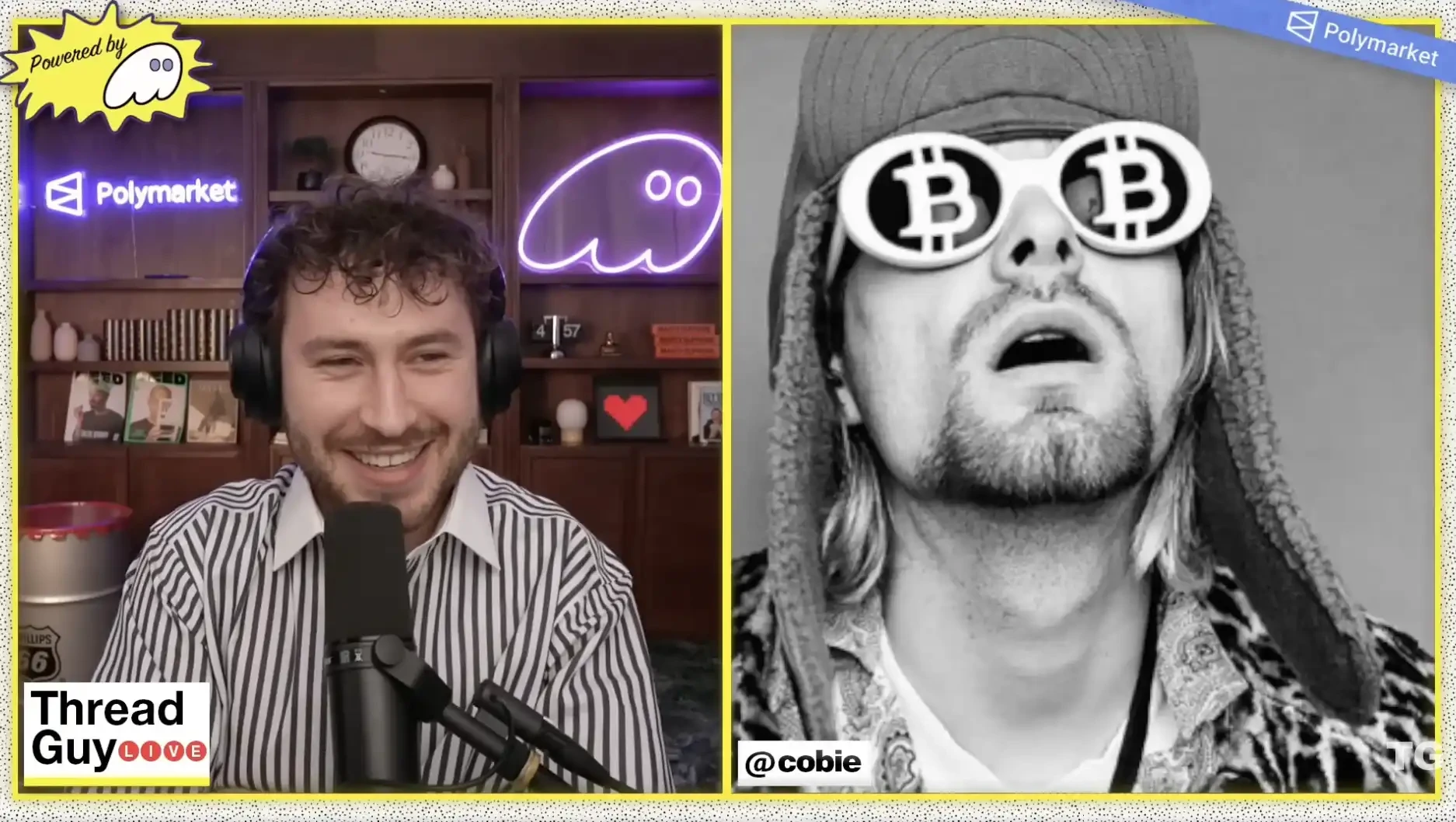
This conversation has garnered significant attention in the community, being described multiple times as a "long-awaited high-quality interview." The discussion did not stay on market conditions or short-term trading judgments but shifted to a more fundamental question: why does the market still lack growth momentum when the technological capabilities and institutional expectations of the crypto industry are gradually realized? Moreover, how should individuals reposition their paths under this structural misalignment?
This conversation can be understood on three levels.
The first is structural divergence. Cobie proposed a pervasive judgment throughout the dialogue: the crypto industry is experiencing a noticeable "K-shaped divergence." On one hand, applications like stablecoins, prediction markets, and on-chain trading are entering the real economy, with usage scenarios and user scales continuously expanding; on the other hand, the token assets that ordinary investors can participate in are showing weakness and declining demand.
This dislocation of "applications are growing, yet assets are failing" has caused a separation between the industry's fundamentals and market perception, becoming the core source of current gloomy sentiment. For investors, the question is not "is there progress," but "does the progress belong to them."
The second is path repetition. Looking back at the expansion path of the crypto market over the past decade, a highly consistent cycle can be observed: from altcoins in 2013, ICOs in 2017, to DeFi and NFTs in 2021, and then to the recent meme coins, every surge in user concentration relies on the same mechanics. Ordinary people gain significant profits in a short period, leading to diffusion.
Narratives constantly change, but the driving force remains stable. From this perspective, the current rise of AI is not a competitive relationship with crypto, but more like a continuation of the same mechanics: new technology narratives + lower thresholds + the imagination of "getting rich quickly." The migration of funds and talent is essentially a natural cycle movement, rather than the failure of a single track.
The third is the reconstruction of distribution. Compared to fluctuations in cycles and sentiment, deeper changes are happening in the value distribution structure. As companies like OpenAI and SpaceX have completed large-scale value accumulation in private equity stages, it has become increasingly difficult for ordinary investors to participate in the real wealth creation process. The public market is gradually degenerating into a liquidity outlet, rather than a value starting point. Against this backdrop, the narrative of "open participation" that crypto once held is starting to face the risk of being absorbed or even reconstructed by traditional systems.
At the same time, Cobie pointed out a potential path: if the current airdrop mechanism on-chain is expanded into a more general "user value return" method, where users gain equity distribution by participating in products and contributing to growth, crypto could still become a form of institutional experimentation against this trend.
Beyond all structural discussions, Cobie's conclusion is surprisingly straightforward: if one no longer believes in the long-term value of the industry, they should leave; if they still see its importance in the next five to ten years, then they should allocate based on that judgment, rather than being repeatedly consumed by short-term fluctuations.
The crypto market has never been a stable wealth generation system but is more akin to a series of continuously repeated experiments. Each narrative cycle, each wave, will reconstruct the way participants and returns are distributed. When short-term paths no longer appear clear, the question is no longer "what will happen next," but: do you still believe that this system is worth participating in at some point in the future?
Below is a整理 of the conversation (for ease of reading, the original content has been slightly rearranged):
TL;DR
- The current crypto is in a "dislocation state." Truly valuable applications (stablecoins, prediction markets, on-chain trading) are rapidly developing, yet ordinary investors cannot gain corresponding profit exposure, leading to extreme low sentiment.
- Historically, every surge of user influx fundamentally comes from the same mechanism—ordinary people making money in a short time. From 2013 altcoins, 2017 ICOs, 2021 NFTs to meme coins, narratives differ, but the underlying logic is consistent.
- The market has shown "K-shaped divergence": one side sees applications and infrastructure becoming more real and important; the other side shows weak performance in token, meme, and governance tokens, with investor sentiment declining.
- The most overlooked risk is: the value of crypto may be "taken over" and privatized by traditional financial systems, making it difficult for ordinary people to participate in genuine wealth creation (e.g., OpenAI, SpaceX).
- Counter-intuitively, crypto often performs best "at the worst times," while it tends to feel more like a phase peak when all positives realize (regulation, ETFs, institutional entry).
- For individuals, if you no longer believe in the long-term value of crypto, you should leave instead of continuing to exhaust yourself here; if you believe it will still be important in 5-10 years, then you should allocate assets based on this judgment instead of trying to get rich quickly.
- Truly long-term successful individuals are not the most aggressive traders but those with independent judgment, continuously iterating cognition, and a sense of "contentment."
- Crypto still has a potential long-term value: it may become a new distribution mechanism, allowing users to receive returns while creating value (similar to "on-chain equity/airdrop economy").
- The final conclusion: crypto is not a short-term wealth tool but a cyclically repeated system experiment. As long as it can still create wealth and narratives, people will return.
Interview Content
Thread Guy:
Hey, how's it going lately?
Cobie:
I actually messed up a bit. I was scrolling through Twitter, still thinking you were opening a Space (maybe I’m getting old), and wanted to jump in to listen. Then I clicked in and found you were live streaming. I didn't even know Twitter could be done this way. At that moment I thought, oh my god, I'm a nearly 40-year-old watching Thread Guy's live stream.
Thread Guy:
Many people are watching, not just you. The wealthy are watching too. So how have you been? You've been pretty quiet for a while.
Cobie:
I've not been very funny (laughs). But overall, it's fine, pretty good.
Thread Guy:
Everyone is asking when UpOnly will return. What have you been doing in these past few months?
Note: UpOnly is a crypto podcast co-hosted by Cobie and Ledger from 2020 to 2022. The show mainly features interviews, focusing on market narratives, trading experiences, and industry views, becoming one of the essential discussion platforms in the crypto community during the 2021 bull market.
Cobie:
Working, real work.
Thread Guy:
That means working at Coinbase?
Cobie:
To be honest, I’m working more now than I have in a long time. Actually, I wanted to join Coinbase years ago and even said I could work for free, but they didn’t want me. From my perspective, there are some "high-leverage" things in this industry that can change the overall trajectory, and getting Coinbase right is one of them, so I want to give it a try.
And think about it, I've been on Twitter for 10 years, so I should do something more challenging and stimulating, not just coming up with jokes every day.
Note: Cobie tried to join Coinbase in the early years but re-entered this core institution after his platform Echo was acquired by Coinbase in 2025.
Thread Guy:
I have a bunch of questions to ask you, but let’s talk about the crypto market first. This state is honestly not too interesting; the recent issues with Arbitrum, Aave, LayerZero, and Drift have led to sentiment basically hitting rock bottom. How do you view the current crypto, especially DeFi? How will it move next?
Cobie:
I think we might be on the edge of DeFi 2.0.
What worries me the most right now is that models similar to Anthropic (or that kind of AI) seem to be starting to "participate" in these systems. This is turning DeFi into a sort of "financial hunting ground." But looking at it the other way, once these models get more widely distributed, not just attackers can use them, but also those building the systems, then the situation will be completely different. So, I feel this is a turning point, and the future version of DeFi is actually quite exciting.
Right now the sentiment in DeFi is indeed very low; aside from a few projects like Hyperliquid and Trade.xyz, there’s really not much interesting going on. But those examples themselves are really cool—truly cool.
Thread Guy:
You’ve started trading oil now, right?
Cobie:
Are you trading oil? That’s great; I'm happy for you if you can make money.
Thread Guy:
Did you see the bear behind me?
Cobie:
You’ve started decorating; it’s got some American flavor now.
Thread Guy:
Yeah, oil trading.
Cobie:
So, you’ve moved to New York to be an oil trader? That’s an interesting life path.
K-shaped Divergence: Applications are Growing, Assets are Failing
Thread Guy:
You just talked about DeFi 2.0 and AI; now many people even think you are AI (laughs). But back to the point, why are you still willing to invest in Coinbase? Haven't you become very cynical about the future of crypto? Many people actually feel this way, including me—I’m trading oil, looking at stocks, doing various traditional assets.
Cobie:
You are actually using crypto infrastructure to trade non-crypto assets, right?
I think crypto is currently undergoing a "K-shaped divergence." On one side, "crypto-native applications" are exploding and are more successful than ever, but these successes are not reflected in the asset prices available to ordinary investors.
For instance, Polymarket is doing very well, and prediction markets have become a real track, now even forming a dual oligopoly structure of Kalshi and Polymarket; stablecoins are starting to be truly widely used, like Doordash even starting to settle drivers with stablecoins. These things are happening in the real world and are important.
But the problem is that, as an investor, you cannot buy these things. You can’t buy shares of Stripe, it’s still a private company; you can’t buy Polymarket; you can’t buy these genuinely good things. Meanwhile, the demand and attention for crypto assets themselves are declining. So you feel frustrated because you ask yourself: "What should I actually buy?"
In fact, crypto is doing a lot of what it promised to do initially. For example, Hyperliquid, Trade.xyz, and various on-chain markets are really cool; they can even predict Monday's opening price with an error of just a few basis points. This already qualifies as a "real market," and it operates on-chain.
But the problem is the disconnect between market performance and real progress. Meme coins don’t rise, governance tokens don’t rise, and so everyone feels everything is bad. But it’s actually just because you can't get "exposure" to those genuinely good things.
From a broader perspective, I still hold a bullish view on crypto. If more and more capital enters on-chain, then there will inevitably be another round of frenetic cycles, excitement, and some "foolishness." But that is unavoidable.
Thread Guy:
You sound increasingly optimistic, which is a bit unusual (laughs).
Cobie:
I have always been relatively optimistic. To be honest, I’ve had my share of pessimistic periods in life, but I’ve never really benefited from them.
Perhaps if I had been more pessimistic about FTX back then, I wouldn’t have lost so much; maybe if I had been more pessimistic about those NFTs in 2021, I wouldn’t have bought in.
But overall, pessimism has not made me more successful.
Thread Guy:
Good, so let me ask a more realistic concern. The performance of Bitcoin compared to assets like gold is actually not that strong. Originally, everyone should be discussing its value and risk resistance, but now the market is just discussing how much Bitcoin Saylor and MicroStrategy own.
Do you see this as a real risk?
Cobie:
I wasn’t worried at all until one day I went to the dentist. My dentist asked me, "Do you invest in stocks?" I said I didn’t really understand investing. He said, "Have you heard of MicroStrategy?" I got a bit nervous at that moment (laughs).
He’s probably in his 70s and said he only owns two stocks: 80% MicroStrategy; 20% Palantir. I thought to myself: oh no, I might need to change dentists.
That was when I first realized this had "broken through the circle." Previously, the people concerned about MicroStrategy were basically those in the crypto or Twitter circles. But now, it’s entered the real world.
Sometimes I even doubt if crypto really exists, as if it’s just a world I imagined in my head. It was only at that moment that I realized, no, it does exist, and others know it too.
Of course, it’s also possible that my dentist is just a figment of my imagination (laughs).
Thread Guy:
So now you do have a bit of concern about Saylor and his strategy?
Cobie:
Not particularly worried, but it does feel like it’s becoming something "hanging over our heads." People used to think Saylor was a buyer, a positive factor; but now he’s more like an element that needs to be cautious.
However, this sentiment really depends on price. When prices drop, people say, "Oh, Saylor is bottom fishing," but when prices rise, it becomes "Bullish on Saylor." Just think back, for instance, to the last peak, about six months ago, right? The market sentiment back then was completely different from now.
I’ve always found that one of the magical elements of crypto is: the current sentiment feels particularly real, even making you think "there can’t be any other feelings." But when you look back three months ago, you find that the sentiment was completely the opposite.
Personally, I always feel that pessimism hasn’t helped me, so I prefer to look at problems over a longer time frame and stay a bit optimistic. I might be wrong, but at least that’s been my approach.
Thread Guy:
Have you met Saylor in real life?
Cobie:
I’ve recorded a podcast episode with him, about two and a half hours long. Before recording, a friend messaged me asking, "What are you going to ask?" I said, "We’ll just ask one question—Is Bitcoin good? Then Saylor will talk for three hours on his own."
And that’s what happened; we barely spoke, he talked for several hours. But it was enjoyable (laughs). I even tried to invite him to my New Year’s party, but I didn’t make it myself.
Thread Guy:
Haven't you been going out much these days?
Cobie:
To be honest, I hardly go out now. If I do go out, I might go, but most of the time I just stay at home.
Thread Guy:
Are you the kind of person who’s completely "terminally online"?
免责声明:本文章仅代表作者个人观点,不代表本平台的立场和观点。本文章仅供信息分享,不构成对任何人的任何投资建议。用户与作者之间的任何争议,与本平台无关。如网页中刊载的文章或图片涉及侵权,请提供相关的权利证明和身份证明发送邮件到support@aicoin.com,本平台相关工作人员将会进行核查。


