Original author: Sleepy.md
On April 24, 2026, the preview version of DeepSeek V4 was officially released.
This domestic large model, which includes the Pro version with 1.6 trillion parameters and the Flash version with 284 billion parameters, has launched its core selling point into the market: one million contexts, becoming the standard free offering for all official services. Almost at the same time, across the ocean, OpenAI also unveiled GPT-5.5, which has even greater computing power and richer agent functions, but at a much higher price.
"One million contexts," translated into plain language, means that AI is no longer a "goldfish" that can remember only your previous few sentences, but has transformed into a "superbrain" capable of consuming three books of "The Three-Body Problem," understanding a two-hour movie in a second, and also helping you point out typos.
For a direct example, you can throw all contracts, emails, and financial reports from the past three years at V4 and have it help you find that breach of contract clause hidden in the appendix on page 47. In the past, this would have required a team of lawyers; now, it is free.
GPT-5.5 has openly priced this superbrain, charging $5 per million input tokens and $30 for output for the standard version; while the Pro version targeting higher-level tasks is even more exorbitantly priced at $30 per million input and $180 per output.
However, according to DeepSeek's official pricing, the input for cache-hitting on V4-Flash is only 0.2 yuan per million tokens and 2 yuan for output; even for V4-Pro, which rivals top proprietary models, cache-hitting input is 1 yuan and cache-missed input is 12 yuan, while the output price is merely 24 yuan.
People often assume that the AI competition between China and the United States is a race for model capability; in reality, it has long become a divergence in business models.
OpenAI was once that dragon-slaying youth shouting "benefit all humanity," but now they are selling expensive deluxe housing; while DeepSeek is using almost free computing power to turn AI into utilities like water and electricity.
When OpenAI turned into a savvy contractor, why is DeepSeek incurably committed to making top-tier AI a free utility? What hidden currents lie behind this transfer of pricing power?
The Cold Wind of Ulaanqab
The decisive battle for large models is taking place in a server room in Inner Mongolia at minus 20 degrees.
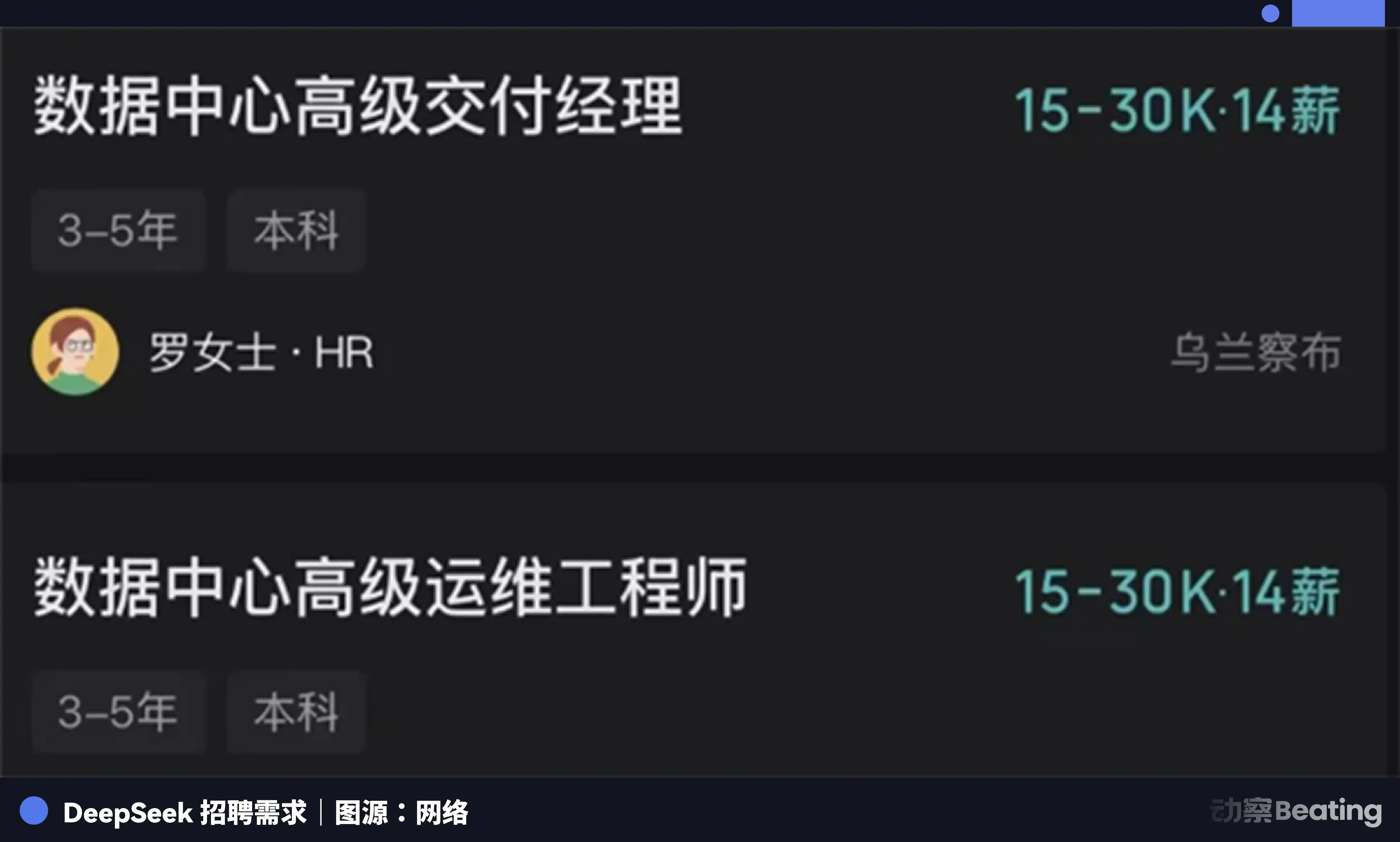
Just before the release of V4, DeepSeek added an unexpectedly new position in its job listing: Senior Delivery Manager and Senior Operations Engineer for the data center, with a maximum monthly salary of 30,000 yuan, 14-month salary, stationed in Ulaanqab, Inner Mongolia.
This was a light-asset company that once branded itself as "minimalist, pure, only doing algorithms." Over the past two years, their proudest label was "using light weights to move heavy weights," having produced DeepSeek-R1 with a training cost of less than $6 million, causing a drop in the AI sector of the US stock market.
However, the massive computational demands of V4, combined with the tightening constraints on computing power from the US, completely shattered this pastoral vision of light assets.
In 2025, the US Department of Commerce further tightened export controls on AI chips to China; Nvidia’s H100 and H800 have been cut off, and even the downgraded H20 was placed on the control list. This means that DeepSeek's future computational expansion must fully pivot to Huawei’s Ascend ecosystem. In the release notes for V4, the official stated that the new model received "Huawei Ascend support," and disclosed that due to mass market launch of Ascend 950 super nodes in the second half of the year, the Pro price will also be significantly reduced.
This pivot is not something that can be completed by simply altering a few lines of code; it requires starting from scratch to build a complete domestic computing power infrastructure on a physical level.
The trillion parameter scale of V4 (with pre-training data reaching 33 trillion tokens) along with the massive computational demand for one million contexts means that you need thousands of Ascend chips, server rooms capable of housing these chips, a power grid to supply these server rooms, and an operations team to maintain these machines without downtime in the cold wind at minus 20 degrees.
Liang Wenfeng took the methodology from the realm of bits to the realm of atoms. Computational power ultimately has to take root in rebar, concrete, and power transmission lines.
On one side are the AI elites in plaid shirts coding in Silicon Valley while drinking hand-brewed coffee; on the other side are operations personnel wrapped in military coats guarding server rooms deep in the Inner Mongolian grasslands. This disparity constitutes the current backdrop of China’s AI resistance against computing power blockades. The cold wind of Ulaanqab has become the strongest physical backing for Chinese AI.
Transforming from a pure algorithm company to a self-built data center "heavy asset" player means that DeepSeek has bid farewell to the guerrilla warfare era of "small strength performing miracles" and formally donned the armor of heavily armed infantry. The cost of this transformation is enormous; building server rooms, buying chips, laying network cables—each item is an endless pit. More importantly, this heavy asset model means operational costs will rise exponentially, while DeepSeek's commercial revenue remains extremely limited. This pricing strategy is fundamentally about using losses to exchange for ecology and using free offerings to gain foundational bargaining power.
How much longer can a once-hardcore figure who rejected all giants and relied on quantitative trading to subsidize AI sustain in front of this endless pit?
The $20 Billion Compromise
In April, there were rumors that DeepSeek initiated its first external financing, aiming for a valuation as high as 300 billion yuan (approximately $44 billion) and planning to raise 50 billion, including 30 billion from external funding. Rumors of Tencent and Alibaba vying to get involved ran rampant.
Many believed this was because building data centers is too costly. However, the core driving force behind DeepSeek's financing, aside from buying graphics cards, is also due to a "pure technological ideal," which has become untenable in the face of the talent extraction machine operated by giants.
During the critical sprint phase of V4 development, major domestic companies began a frenzied targeted poaching of DeepSeek talent. From the second half of 2025 to now, at least five key R&D members from DeepSeek have confirmed their departure. Wang Bingxuan, the core author of the first generation model, went to Tencent, core contributor Luo Fuli was lured to Xiaomi with a multi-million salary by Lei Jun, while core author Guo Daya joined the Seed team at ByteDance.
This is the most naked mode of operation in a market economy; when your competitors have infinite ammunition while you persist on operating with your own funds, the talent market becomes your weakest point. You can demand geniuses to reduce pay and work overtime for the ideal of changing the world, but when the giants slap a check with millions in cash and options on the table and promise unlimited computational resources, the pricing power of idealism is no longer in your hands.
Liang Wenfeng's predicament is actually one that every entrepreneur trying to create a "slow company" in China will encounter. In a market where the big firms can buy anyone with money, the route of "no financing, no commercialization, only technology" is extremely luxurious. The price of this is that you must accept that your team could be wiped out by competitors with money at any time.
This financing with a valuation of 300 billion isn’t Liang Wenfeng’s compromise with capital; rather, it is a "human redemption war" he initiated to preserve the R&D formation of V4 against the giants. He must sit at the capital table, using the same real gold and silver to give those who remain enough reasons to continue staying.
The possible entry of Tencent and Alibaba means that DeepSeek is no longer that lonely, pure technological idealist. It has transformed into a company with external shareholders and commercialization pressures. The cost of this transformation is that Liang Wenfeng’s previously proud "research freedom unperturbed by external pressures" will inevitably be diluted.
But he had no choice.
When idealism is forced to don the armor of capital, what supports the continued operation of this massive machine and the roaring server room in Ulaanqab comes from where?
Another Kind of "Miracle through Great Effort"
The answer lies not in algorithms, but in the power grid.
The greatest anxiety in Silicon Valley now is not about insufficient chips, but about insufficient electricity. Elon Musk is crazily building super data centers in Memphis, Tennessee, OpenAI has even begun to discuss investing in nuclear power plants, and Microsoft announced rebooting the Three Mile Island nuclear power plant in Pennsylvania to supply electricity to AI data centers. The endpoint of computing power is electricity; this is an extremely cold piece of physical knowledge.
In the United States, the daily power consumption of a large AI data center is equivalent to that of a medium-sized city. Yet, the US power grid, built in the 1950s, is an outdated network, expanding slowly, with regional fragmentation, and cannot keep up with the speed of computational expansion in the AI era.
What supports China’s AI in catching up with the US is not only those algorithmic geniuses earning millions but also those inconspicuous ultra-high voltage transmission lines.
The data center in Ulaanqab was able to rise because of Inner Mongolia's abundant green electricity and China’s world-leading power grid scheduling ability. Public data shows that Ulaanqab's green electricity installed capacity reaches 19.402 million kilowatts, accounting for about 65.9%; local low-cost green electricity is almost 50% cheaper than in the eastern regions. Additionally, with an average annual temperature of only 4.3°C, the natural cooling period approaches 10 months, allowing equipment to save 20% to 30% of energy.
When DeepSeek V4 operates, the real support comes from China’s vast and extremely cheap electric power infrastructure. This is another dimension of "miraculous achievement through great effort."
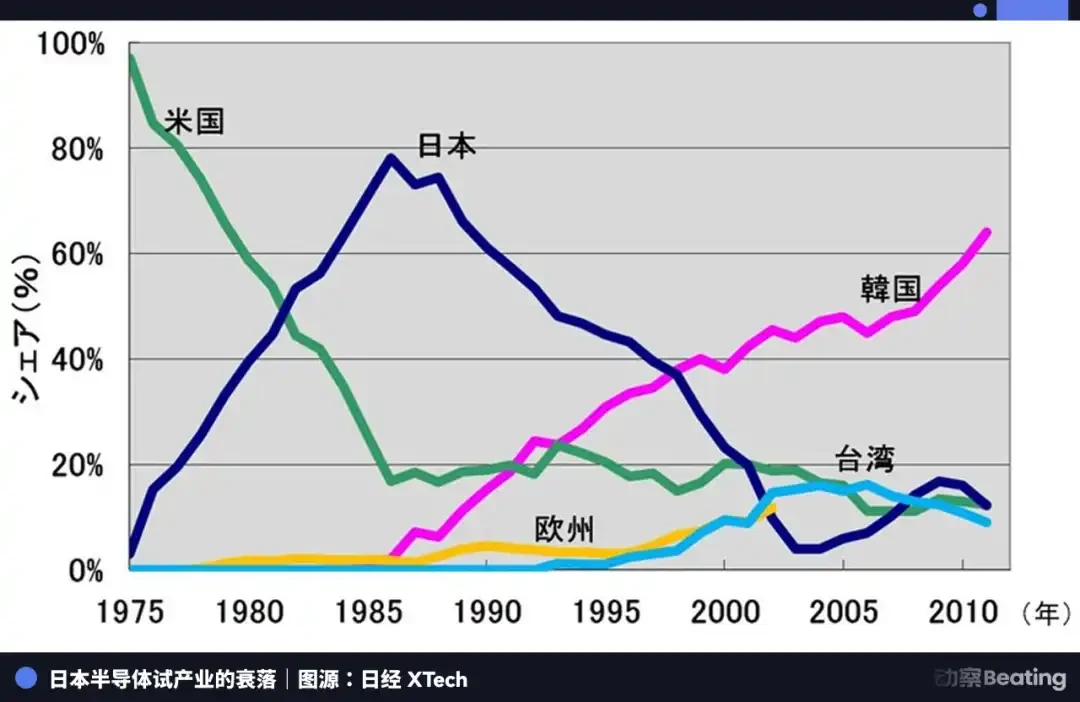
There’s an extremely interesting yet cruel historical comparison. In 1986, the US brought down Japan’s semiconductor industry with the "U.S.-Japan Semiconductor Agreement," forcing Japan to open its market and accept price controls; Japan’s global market share in semiconductors plummeted from 40% in 1986 to 15% in 2011. Japan spent thirty years unable to recover.
Today, the US is attempting to lock China’s AI using the same logic, blocking chips, limiting computing power, and cutting off technological supply chains. However, China’s counterattack path is entirely different from Japan’s. Japan’s failure back then rested on its semiconductor industry’s high dependency on US technology licensing and market access; once cut off, it lost the ability to survive independently. In contrast, China’s AI counterattack begins reconstructing from the very bottom of physical infrastructure—self-manufacturing chips, self-building data centers, self-laying power grids, and self-opening models.
This is a highly cumbersome, extremely costly path, yet also one that is very hard to be "strangled." While Silicon Valley builds gorgeous towers in the cloud, China is digging trenches in the dirt.
If the battle for computing power in the cloud is an extremely fierce heavy asset consumption war, is there another way for us to escape the hegemony of cloud computing besides building data centers and laying power lines in Inner Mongolia?
Escaping the Cloud
As Silicon Valley giants build larger and larger data centers, even planning trillion-dollar computing clusters like OpenAI, China's counterattack line has quietly shifted underground.
The ultimate weapon against the US blockade of computing power is not to create chips stronger than the H100 but to embed large models into everyone’s smartphones.
Since we cannot compete against heavy artillery in the cloud data centers, we will pull the battlefield back to 1.4 billion smartphones and edge devices. This is a typical guerrilla warfare strategy that is extremely hard to blockade; you can prohibit the export of high-end GPUs, but you cannot confiscate every smartphone in every Chinese person's pocket.
In 2026, along with the computational anxiety sparked by DeepSeek, Chinese smartphone manufacturers Xiaomi, OPPO, and Vivo began a mad "edge transfer." They are no longer satisfied with merely using smartphones as a display for invoking cloud APIs; instead, through extreme model distillation and compression, they are forcefully embedding a miniaturized superbrain into domestically manufactured smartphones costing a few thousand yuan.
The core of this technological route is "distillation." In simple terms, it uses a super large model (teacher) to train a small model (student), allowing the small model to learn the "thinking method" of the teacher instead of memorizing all the "knowledge" of the teacher. After extreme distillation and quantization compression, a large model that originally required hundreds of GPUs to run is reduced to only 1.2GB to 2.5GB in size, capable of running smoothly on a mobile chip.
Mobile AI applications like MNN Chat can already enable users to run the DeepSeek R1 distilled model locally on their smartphones. The significance of edge AI is that you do not need to maintain a constant connection to 5G; you do not have to pay $100 a month in subscription fees to Silicon Valley giants. The large model is in your pocket, can operate offline, and does not spend a penny on cloud computing power.
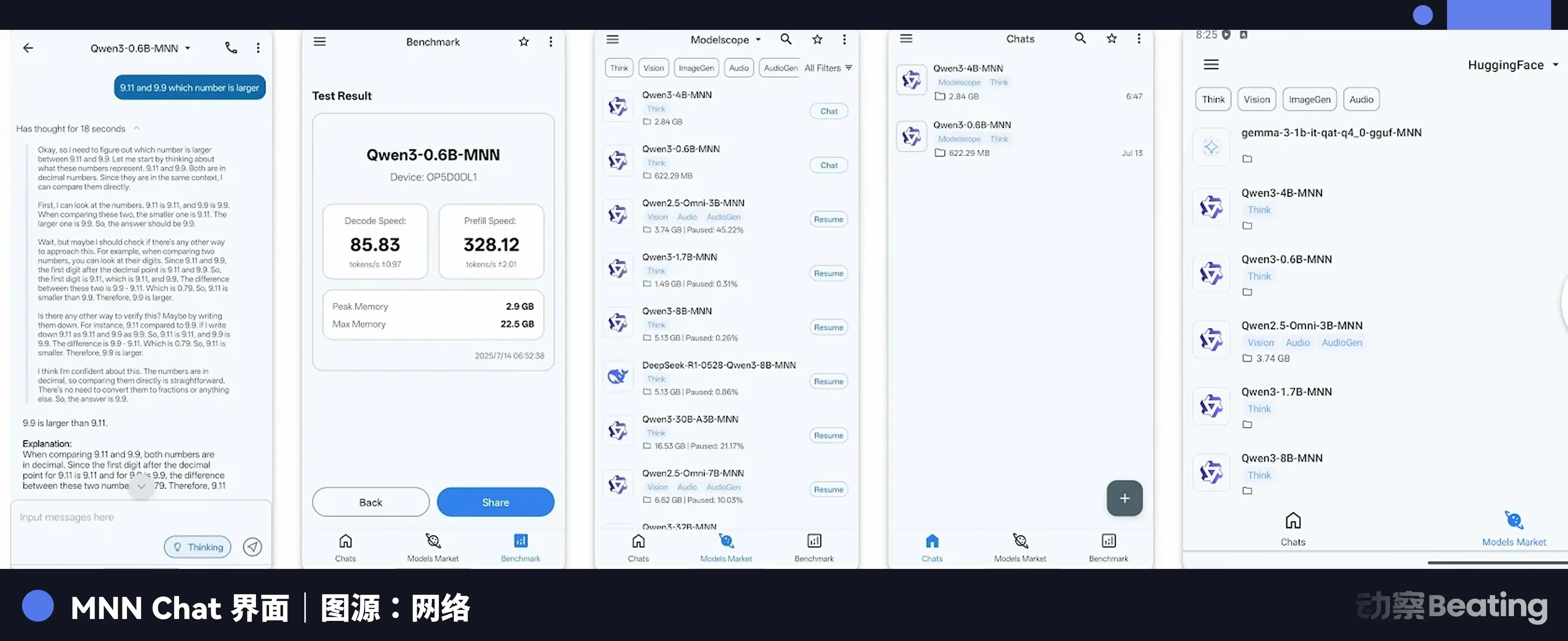
Since I cannot afford the super boiler room for centralized heating, I will provide each household with a small stove.
Of course, edge AI is not perfect. Limited by the computing power and memory of mobile chips, the capability ceiling of edge models is far below that of cloud ultra-large models. It can help you write an email, translate a piece of text, or summarize an article, but if you want it to help you derive a complex mathematical theorem or analyze a multi-hundred-page legal contract, it will still be powerless.
But this is enough. Because for the vast majority of ordinary people, the AI they need has never been a superbrain that can derive mathematical theorems, but a "personal assistant" that can help them handle daily chores.
When large models become extremely inexpensive and can even fit into pockets, how will this change the corners forgotten by Silicon Valley?
Digital Equality in the Global South
If you are sitting in a panoramic glass office in Manhattan, you will probably think that the price increase of GPT-5.5 to $100 is justified because it can help you write a perfect merger report in a second.
But if you are standing in a cornfield in Uganda facing crops wilting due to abnormal weather, no one can afford the $100 subscription fee because Uganda’s per capita monthly income is less than $150.
While Silicon Valley giants discuss how to use AI to rule the world, farmers in Uganda and poor students in Southeast Asia, thanks to DeepSeek’s open source, have stepped into the digital age for the first time.
GPT-5.5 serves those who can afford to pay, and its corpus is almost entirely in English. If you ask it a question in Swahili or Javanese, not only does it stammer in response, but the token consumption is several times that of English. Silicon Valley giants give up these marginal markets due to "low commercial returns."
In contrast, China's open-source models have become the digital infrastructure for the Global South.
In Uganda, the local NGO Sunbird AI has expanded the supported local languages from 6 to 31 using the Sunflower system fine-tuned based on the Chinese open-source model Qwen. This system is now deployed in the Ugandan government's agricultural promotion system to send planting advice to farmers in Swahili.
In Malaysia, technology companies have fine-tuned AI models that comply with Islamic law from the open-source base, supporting not only Malay and Indonesian but also ensuring that the output content adheres to the religious and cultural standards of the Muslim market. From Indonesia's digital identity system to Kenya's Swahili medical Q&A, Chinese technology is penetrating into the societal底层架构 of these countries.
At the beginning of 2026, data released by the world’s largest AI model API aggregation platform OpenRouter showed that Chinese AI models consumed more tokens on the platform than their American competitors for the first time. During a certain statistical week, the top 10 popular models worldwide consumed a total of 87 trillion tokens, with Chinese models accounting for approximately 61%.
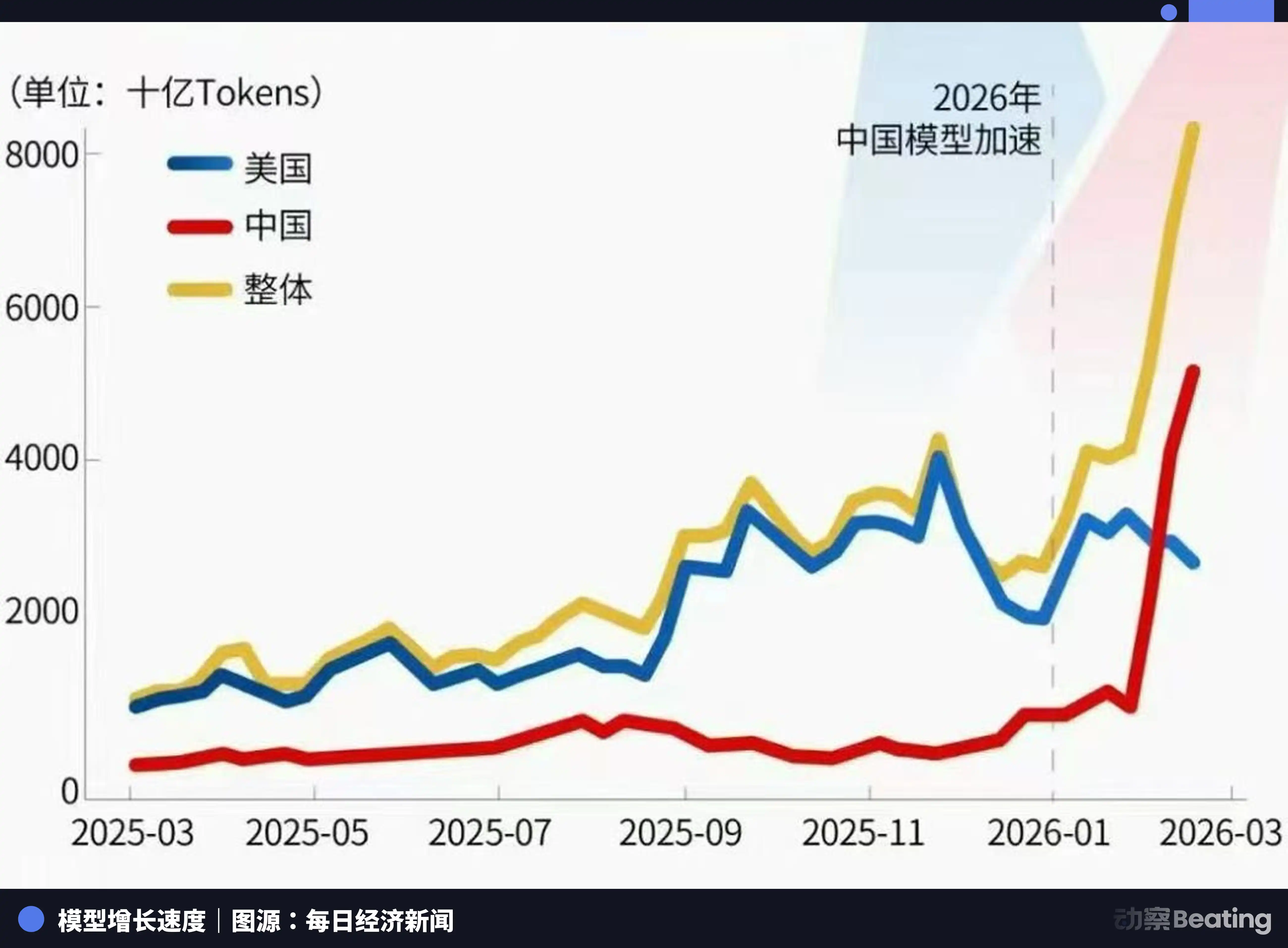
Open source has broken the monopoly of the US over the discourse power in AI, enabling resource-poor developing countries to leap over the digital divide. This is not a grand narrative of China-US rivalry; this is the true "rural encircling cities" of the AI era.
China's AI open-source strategy is objectively becoming an extremely effective form of "soft power" export. When Silicon Valley's giants erect high walls in the cloud, attempting to become the digital landlords of the new era, those "tech refugees" who cannot afford the rent are finally finding their own spark in the soil of open source and edge.
Tap Water
Technology should never be a luxurious item that is out of reach.
Silicon Valley has produced exquisitely crafted luxury homes, with strict access, only open to VIPs. But we have built a water pipe leading to every household.
The starting point of this water pipe is in a server room in Inner Mongolia at minus 20 degrees, amidst the roar of ultra-high voltage transmission lines, in the war marked by a 300 billion valuation. Every segment of it is heavy, expensive, and filled with compulsion and compromise. Liang Wenfeng once wanted to create a purely technological company, but reality forced him to build server rooms, seek financing, and compete for talent with giants. He had no choice because he chose a harder path, not to make AI a luxury but to make it tap water.
And the endpoint of this water pipe is on a domestically produced phone costing a few thousand yuan, between the rough fingers of a farmer in Uganda, in the lives of every ordinary person longing to cross the digital divide.
No matter how high the walls of computing power are built, they cannot stop the flow of water flowing to lower places.
免责声明:本文章仅代表作者个人观点,不代表本平台的立场和观点。本文章仅供信息分享,不构成对任何人的任何投资建议。用户与作者之间的任何争议,与本平台无关。如网页中刊载的文章或图片涉及侵权,请提供相关的权利证明和身份证明发送邮件到support@aicoin.com,本平台相关工作人员将会进行核查。