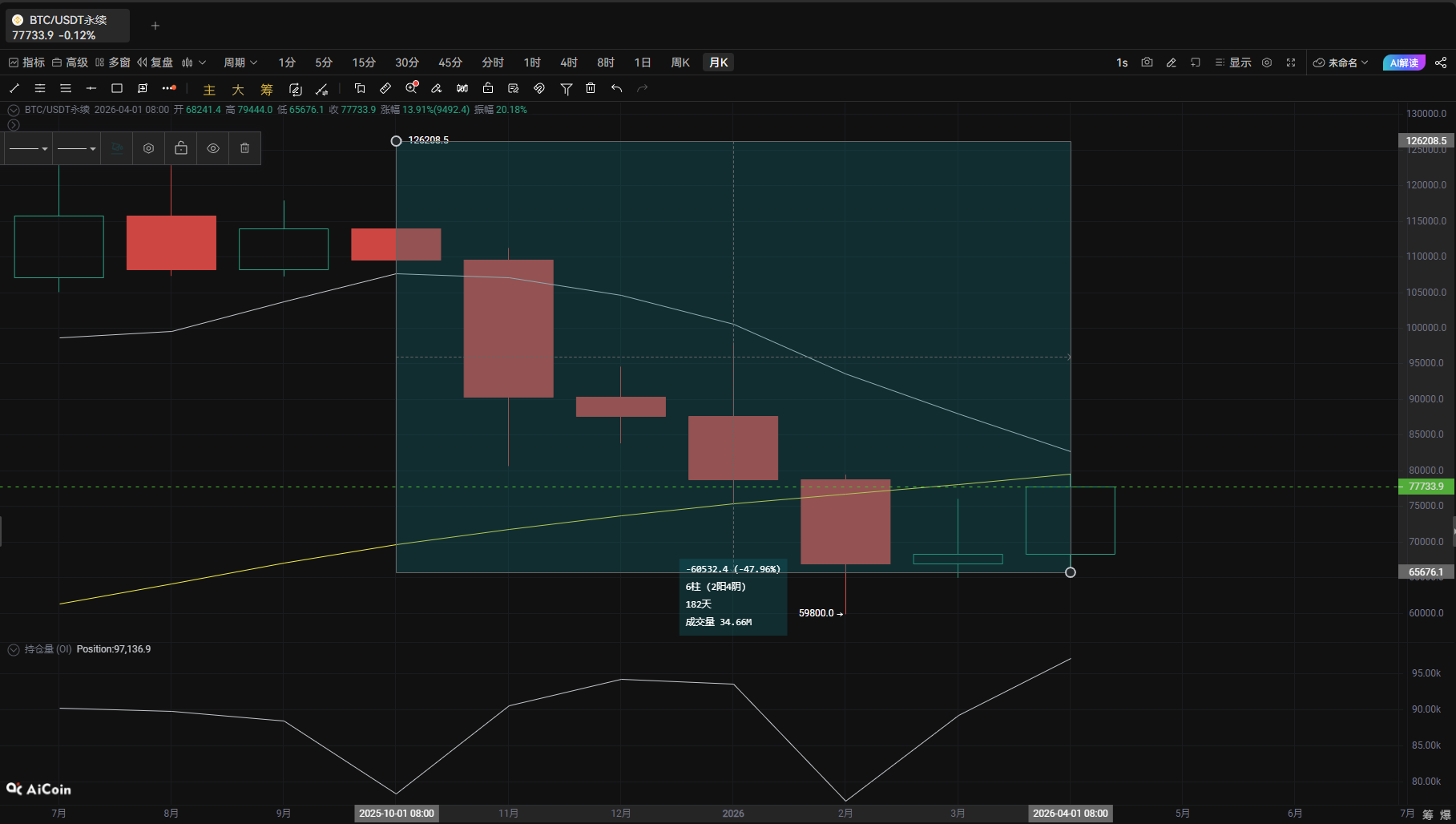
In the past 24 hours, the leveraged market was pressed to the "liquidation button." As of April 24, 2026, according to CoinGlass statistics, the total liquidation amount across the network reached 171 million USD, including 101 million USD from long liquidations and 70.4366 million USD from short liquidations, with a total of 82,120 accounts being forced out. By variety, the liquidation amount for BTC was approximately 2.0702 million USD and for ETH it was approximately 1.7111 million USD, while the largest single liquidation occurred on the BTC-USD trading pair on Hyperliquid, with a single liquidation value reaching as high as 3.5809 million USD, directly pushing this derivative platform to the forefront.
In contrast to this sudden and intense washout, Glassnode pointed out that over the past two months, whales on Hyperliquid have been consistently betting on bullish breakouts, with long positions continually increasing and a strong bullish sentiment among large perpetual contract traders—meaning that while short-term price fluctuations triggered the liquidation of high-leverage positions, they did not alter the mid-term plans of significant funds to continue increasing long positions.
In such high-leverage speculation, an unavoidable question is: Who exactly is bearing the ultimate risk in this round of 171 million USD liquidations? Is it the passive retail investors who are hit hard by chasing prices, or the institutions and whales that are rhythmically out of sync? And who on the other side absorbed these passive liquidations, quietly turning unrealized gains into real cash? More importantly, does this combination of "whales continuously increasing long positions, short-term violent liquidation" indicate that they are preparing for the next round of market movements, or does it suggest that the leverage structure has reached a critical point that needs to be cleared?
171 million in liquidations: largest single in Hyp
Structurally, this round of 171 million USD liquidations resembles a typical "scanning leverage" in a range-bound market, rather than a panic outflow from a unidirectional trending market.
In the past 24 hours, long liquidations amounted to 101 million USD, and short liquidations were 70.4366 million USD, with a long-short ratio of approximately 6:4, with significant losses on both sides. In other words, there was no significant unidirectional and sustained price displacement; rather, it oscillated back and forth within a range, repeatedly piercing through both sides' stop-loss and forced liquidation lines, resulting in bilateral liquidations.
In terms of variety distribution, the liquidation amount for BTC was 2.0702 million USD and for ETH it was 1.7111 million USD, representing a very low proportion of the total 171 million USD liquidation, indicating that most of the passive liquidations came from other varieties with higher volatility. Clearly, leveraged funds were not primarily concentrated on relatively stable top assets like BTC or ETH, but rather inclined towards more elastic targets, which itself reflects that short-term funds are in a risk-seeking state.
The breadth of participation in leverage is also noteworthy: 82,120 traders were liquidated within 24 hours, with an estimated average single liquidation scale of only several thousand dollars, but among them, the largest single liquidation reached 3.5809 million USD, occurring on the BTC-USD trading pair on Hyperliquid, far exceeding the market average. This scale is closer to the position size handled by institutions or large funds, indicating that Hyperliquid is bearing considerable volumes and high leverage directional bets, further amplifying the concentration of high-leverage funds on the platform.
Considering the dimensions where both long and short were liquidated, the low proportion of top assets, and the large number of participating addresses yet extreme variability in individual positions, this round of 171 million USD liquidations better illustrates that the overall leverage usage rate is not low, and that short-term funds are generally willing to increase their multiple in the range to bet on small volatility returns. The price itself may not be experiencing an extreme correction, but under this high-leverage, heavily speculative structure, any slight, unexpected volatility is enough to trigger a wave of "market-wide" liquidations in a short time.
Whales Increasing Long Positions for Two Months: Betting on Breakout
In parallel with the short-term commotion of 171 million USD bilateral liquidations in the past 24 hours, Glassnode provides the perspective that a group of continuously increasing whale long positions is truly influencing the mid-term structure on Hyperliquid. They publicly stated on platform X that over the past two months up to April 24, 2026, large accounts on Hyperliquid "have been consistently betting on bullish breakouts," with long positions steadily increasing, and this behavior is clearly interpreted as a "strong bullish sentiment among large perpetual contract traders," rather than a few days of emotional swings.
"Betting on bullish breakouts" essentially means that these accounts are not satisfied with high selling and low buying within a range, but rather systematically betting that the price will eventually break upwards out of the current range. The continuous increase in positions over a two-month timeframe indicates that it is closer to a mid-term trend bet: willing to endure multiple retracements and capital rate costs during the process, rather than being washed out by one or two short-term violent fluctuations—this sharply contrasts the profile of the 82,120 individuals liquidated within 24 hours.
From the risk preference perspective, these types of whale long positions usually rely on thicker margins and longer holding periods to hedge against uncertainties of short-term volatility. Within the same timeframe, the entire network saw 101 million USD in long liquidations and 70.4366 million USD in short liquidations, with the largest single liquidation of 3.5809 million USD occurring on Hyperliquid's BTC-USD trading pair, indicating that the platform itself is already the core arena for high-leverage speculation. In this environment, long positions can still "steadily increase" over two months, supported by accounts of sufficient size and strong risk tolerance, reflecting a significant degree of certainty regarding mid-term increases.
In terms of funding behavior, similar to the reported address 0x0b8a, they first sold 75 ETH on Hyperliquid for approximately 174,000 USD, then used 5x leverage to go long about 9.19 million APE worth approximately 1.03 million USD, reflecting an approach of "using spot to maneuver margin for leveraged long positions." Although it may not entirely fit the whale sample pointed out by Glassnode, during the same time period, aggressive increases on the long side of the platform can be corroborated with on-chain and platform data.
For market structure, the continual increase in whale long positions serves to provide a mid-term "bullish base" for Hyperliquid and the broader market, and could potentially absorb selling pressure during short-term violent washouts; on the other hand, it also quietly raises the potential risk of chain reactions for liquidations: when long leverage accumulates systemically on the platform, if an unexpectedly large downwards volatility occurs in the future, it could trigger a series of massive liquidation orders, enlarging price slippage and leading to more accounts being forced to reduce positions or liquidate.
The current structure can be summarized as: "mid-term funds are firmly betting on upward breakouts while short-term prices frequently undergo violent liquidations." Under this dislocation, if the whale long positions judge correctly, they will harvest profits in a breakout market; if judgments are incorrect, they will turn the accumulated long leverage of the past two months into a one-time systemic liquidation pressure.
33 Million in Profitable Shorts: Another Whale
Unlike the whale group that has been continuously increasing long positions on Hyperliquid over the past two months, address 0x58bro is following a nearly opposite path. On April 23, 2026, according to Onchainlens tracking, this address deposited 3,811 ETH into Binance within 24 hours, amounting to approximately 903,000 USD; during the same period, it retained only about 0.5 ETH on-chain, effectively "emptying" the majority of its spot chips from the chain and concentrating them into centralized exchanges.
While significantly reducing its spot position, this whale did not choose to wait and see on Hyperliquid but maintained a more aggressive directional bet. According to the same report, 0x58bro currently holds a 25x leveraged short on ETH and a 40x leveraged short on BTC on Hyperliquid, with total profits of approximately 33 million USD, indicating that this set of high-leverage shorts has already realized considerable gains during previous rounds of downward fluctuations.
Structurally, this is a typical combination of "spot escaping + high-leverage shorting":
● On one hand, by depositing 3,811 ETH into Binance and retaining only about 0.5 ETH on-chain, such accounts have significantly reduced their on-chain exposure, avoiding passive exposure to spot retracements during violent fluctuations;
● On the other hand, maintaining high leveraged shorts on ETH and BTC on Hyperliquid actively amplifies the benefits brought by price declines, shifting the risk exposure from "holding assets" to "betting directional."
This combination resembles a clear bearish judgment on short-term price paths, rather than merely hedging behavior. It forms a stark contrast to the overall bullish sentiment depicted by Glassnode indicating that "whales on Hyperliquid have continuously increased their long positions over the past two months": in the same market structure, one group of whales is using leveraged longs to speculate on upward breakouts, while another group is clearing their spot positions and leveraging shorts to hedge or even bet on potential deep corrections.
From 75 ETH to Millions of APE: High
In contrast to the veteran whales who clear spot first and then lay out large high-leverage positions on Hyperliquid, the newly established address 0x0b8a follows a very straightforward path: cash out first, then go all-in.
According to Lookonchain, this new wallet sold 75 ETH on Hyperliquid for about 174,000 USD, and then did not retain significant on-chain positions but quickly invested the raised funds into derivative trades on the same platform.
Immediately after, 0x0b8a opened a 5x leveraged long contract, going long approximately 9.19 million APE, with a corresponding nominal value of around 1.03 million USD. Using less than 200,000 USD to leverage over a million USD in a single asset long position, with margins accounting for less than one-fifth, completely leaning towards bullishness, and concentrating bets on APE, this structure typifies the characteristics of "all-in betting": no hedging, no asset diversification, and concentrating leverage on a single price trajectory.
The issue is that this transaction occurred on April 24, 2026—during the same assessment period, according to CoinGlass data, the total market liquidation reached 171 million USD within 24 hours, including 101 million USD from long liquidations and 70.4366 million USD from short liquidations, with a total of 82,120 people liquidated. In the context of substantial bilateral liquidation, the combination of high leverage, long positions, and a single asset is inherently exposed to significant liquidation risks:
● On one hand, the volatility of non-mainstream large-cap assets like APE is often higher than that of BTC or ETH, and under 5x leverage, even moderate short-term price retracements can considerably erode margins;
● On the other hand, the day's largest single liquidation of 3.5809 million USD occurred on Hyperliquid's BTC-USD trading pair, indicating that this platform has already become a high-frequency liquidation zone during this round of volatility, objectively placing newly added large leveraged positions in a more "crowded" risk environment.
From the perspective of funding scale and risk management approach, 0x0b8a forms a stark contrast to the whale group mentioned earlier.
Whale 0x58bro, on April 23, 2026, deposited 3,811 ETH into Binance within 24 hours, with a reported value of about 903,000 USD, nearly clearing the on-chain ETH spot, but simultaneously holding shorts on ETH (25x) and BTC (40x) on Hyperliquid, with total profits of about 33 million USD; another set of whales tracked by Glassnode has been continuously increasing their long positions on Hyperliquid over the past two months, preferring to bet on upward breakouts. Whether bearish or bullish, a common characteristic of these large players is that their funding base is significantly larger than that of 0x0b8a, and their position structure is more complex, expressing their views through multi-asset, multi-directional derivatives combinations.
In contrast, the new wallet, with a funding scale far smaller than that of large players like whale 0x58bro, chooses to concentrate leverage on a long position for APE on Hyperliquid without making explicit hedges. This "small scale, high leverage, single-direction" behavior amplifies potential liquidation risks in this round of 171 million USD, and also provides an emotional signal: within the same market structure where whale longs and shorts confront each other, there are still new funds willing to adopt a nearly "all-in" posture to bet on the next market movement during a period of amplified volatility. This aggressive participation from retail or small and medium-sized funds might suggest that the risk appetite on Hyperliquid remains tilted towards "daring bets," rather than a comprehensive contraction.
Leverage Speculation Unabated: Where to Look Next
In the past 24 hours, there was a total liquidation of 171 million USD across the network (including 101 million USD from longs and 70.4366 million USD from shorts, with a total of 82,120 people liquidated), coupled with the largest single liquidation of 3.5809 million USD occurring on Hyperliquid's BTC-USD trading pair, while Glassnode has also identified Hyperliquid over the past two months as a major battlefield for whales continually increasing their long positions. Putting these sets of data together, an intuitive conclusion is that the overall leverage level remains high, and risks have not completed a "natural clearing."
On a finer scale, during the window period from April 23 to 24, 2026, on one hand, whale 0x58bro has accumulated around 33 million USD in unrealized profits through high-leverage shorts on ETH (25x) and BTC (40x) on Hyperliquid; on the other hand, the new wallet 0x0b8a sold about 75 ETH (around 174,000 USD) and then turned around to heavily bet on about 9.19 million APE long (nominal value approximately 1.03 million USD) on Hyperliquid using 5x leverage. The whale shorts "ride profits," existing whale longs have not withdrawn significantly, and the addition of new funds’ aggressive long betting indicates that the current round of 171 million USD bilateral liquidations has not significantly cooled down the leverage speculation on Hyperliquid.
Going forward, to judge whether this round of speculation enters the "further increasing leverage" or "gradually reducing leverage" phase, several dimensions are worth continuous tracking:
● First, look at the net changes in long and short positions of whales on Hyperliquid.
Glassnode points out that over the past two months, whale long positions on Hyperliquid have steadily increased, but whether this trend slows down, stops, or even reverses after April 23-24 remains uncertain. Similarly, whether high-leverage shorts like 0x58bro choose to take profits in batches, increase leverage, or shift to opposite positioning after unrealized profits expand will directly influence the overall directional risk of the platform. If subsequent data shows "longs reducing positions and shorts no longer significantly expanding," it can be seen as a signal of gradually diminishing leverage; conversely, it indicates that the current round of liquidations may still only be a halftime break.
● Second, monitor whether large liquidations continue to concentrate on a few trading pairs or platforms.
This largest single liquidation across the network concentrated on Hyperliquid's BTC-USD indicates that this funding chain is the most fragile during this round of volatility. If subsequent large liquidations continue to remain highly concentrated on Hyperliquid or a few high-leverage popular trading pairs, it suggests that risks are still stacking locally and that this "local systemic risk" could again transmit across the entire network at any time; if large liquidations begin to disperse, it could instead signal a more even distribution of leverage and lower single-point risk weights.
● Third, observe the activity of new wallets engaging in high-leverage speculation.
0x0b8a's nearly "all-in" approach with the APE 5x long is just one sample, but whether this behavior is representative needs to be verified with more subsequent address data: the number of newly established addresses opening high-leverage positions on platforms like Hyperliquid, the average position size, and preferred targets—if these remain high, it indicates that marginal incremental funds are still leaning towards speculative leverage; if such behaviors noticeably cool down, it signals a decline in risk appetite.
At a more macro level of capital distribution, on-chain income can be seen as a "center of gravity reference." On April 24, 2026, Artemis data showed that the Ethereum network's 24-hour fee income was approximately 2.7 million USD, still higher than Hyperliquid's approximately 1.7 million USD. The former represents the activity level of spot and protocol interactions on L1, while the latter more directly reflects the frequency and depth of leveraged derivative trading. The directional change in the income gap between the two can help ascertain if funds are flowing back into fundamental layer activities closer to "the spot," or if they continue favoring amplifying leverage speculation on derivatives platforms—but this is more suited as a "thermometer" rather than a standalone trading signal.
It should be emphasized that what we are currently seeing, whether it is the 171 million USD net liquidation across the network or the confrontation between whale longs and shorts on Hyperliquid, along with the aggressive behavior of new wallets going long, are all phase-specific snapshots from this short window of April 23-24. The relationship between on-chain income and leverage liquidations, as well as whale positions and subsequent market movements, is more "correlated" than "proven causal." Truly valuable judgments must be based on continuous tracking over time of whale position flows on Hyperliquid, liquidation distribution structures, new wallet leverage activity, and the comparative trend of income between Ethereum and derivatives platforms. Only when this data trends over time can the current direction and intensity of leverage speculation gradually shift from "noise" to actionable signals.
Join our community to discuss together and become stronger!
Official Telegram community: https://t.me/aicoincn
AiCoin Chinese Twitter: https://x.com/AiCoinzh
OKX welfare group: https://aicoin.com/link/chat?cid=l61eM4owQ
Binance welfare group: https://aicoin.com/link/chat?cid=ynr7d1P6Z
免责声明:本文章仅代表作者个人观点,不代表本平台的立场和观点。本文章仅供信息分享,不构成对任何人的任何投资建议。用户与作者之间的任何争议,与本平台无关。如网页中刊载的文章或图片涉及侵权,请提供相关的权利证明和身份证明发送邮件到support@aicoin.com,本平台相关工作人员将会进行核查。