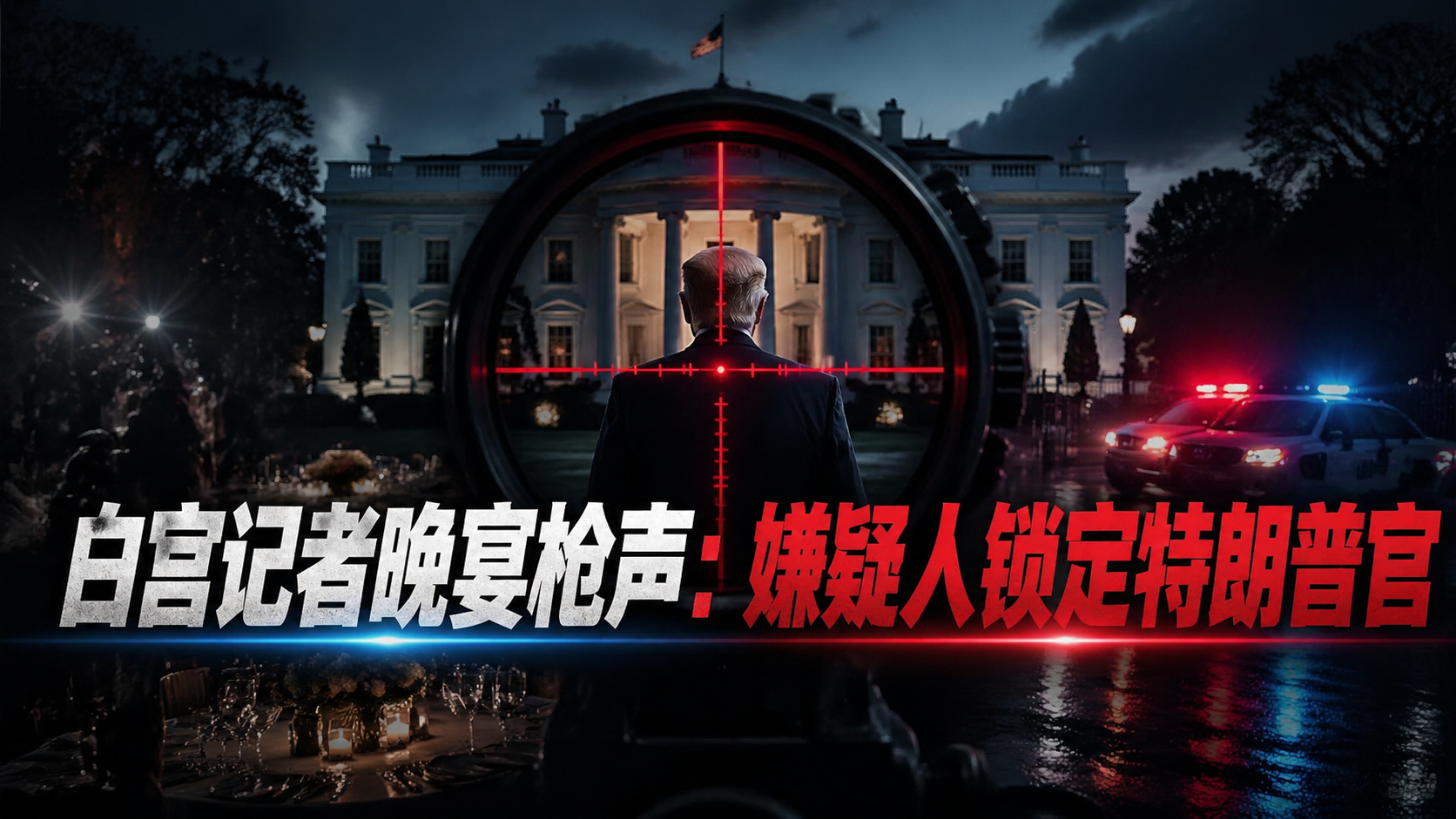
On the evening of April 25, 2026, what was originally seen as Washington's annually "safest and most lively" night was suddenly interrupted. The White House Correspondents' Association annual dinner was underway, an event that gathers politicians, media, and celebrities, surrounded by layers of security as per convention, yet was described by multiple media outlets on-site as experiencing a "gunfire or similar attack situation." The cordon was quickly established, the corridor outside the banquet hall transformed into a temporary passage for investigators and security personnel, and news about what actually happened became vague and fragmented for a time.
Almost immediately after the event occurred, Donald Trump appeared in the White House press briefing room. Standing at the familiar podium, he did not beat around the bush, starting with the line, "The presidency is a dangerous job." This statement seemed to articulate a cold historical fact and characterize the recently occurred night. He immediately added, "I don't want to live in fear," deliberately distancing himself from the role of "victim," trying to shift the narrative from panic back to a stance of "moving forward despite risks." According to a single source, he also half-joked that if Secretary of State Rubio had clearly outlined these violence risks from the start, he "might not have run for president"—the laughter was not loud, but sufficient to remind those present that this position has always been tied to danger.
Meanwhile, investigation procedures outside the White House had already begun. Officials emphasized that the current investigation is still in its early stages, and many key details are still being verified. According to preliminary assessments from several sources, this incident was classified as a "lone wolf" attack; according to a single source, the suspect was described as a hotel guest, and their room was sealed for searching and evidence collection. However, under the dual obscurity of cameras and cordons, the precise information available to the public is extremely limited—motives of the suspect are still undetermined, identity details have not been disclosed, and suspected weapons and specific casualty figures have similarly not been confirmed by officials.
All of this made that phrase "dangerous job" no longer just a dramatic expression from Trump but intertwined with the personal risks faced by the U.S. president for a long time, the security system of the Secret Service aimed at preventing potential attacks, and the increasingly frequent "lone wolf" extremist actions in recent years, all entangled in the narrative of the same night. As for what this security incident at the dinner truly signifies, that can only be answered by the subsequent slow and silent investigative process.
Gunshots Interrupt Washington's Annual Social Stage
In Washington's political calendar, the White House Correspondents' Dinner is more akin to a ritual than just a meal. Every spring, politicians, media, and celebrities check in at the same banquet hall at the same time, sizing each other up, teasing one another, packaging the relationship between power and public opinion into a glamorous social night. It is seen as a mirror of the American political and public opinion ecology: on stage are jokes and self-deprecation, while offstage is the flow of connections and information, appearing frivolous yet symbolically heavy—a symbol of media freedom, a hub of political socializing, and a temporary stage where the power center "drops its guard."
Because of this, it has always been a focus for security systems. The concentration of the U.S. president, dignitaries, and key media figures in the same space is exactly the kind of scene that security agencies are most unwilling to see yet must prepare for. The White House Correspondents' Dinner has long been regarded as a model occasion for high security levels: security checks, access control, on-site defense, layered together, all to ensure that this annual social showcase runs within a controllable scope.
On the night of April 25, 2026, however, this illusion of "controllability" was shattered. In the abrupt incident described by multiple media outlets as a gunfire or similar attack, the planned punchlines and applause were forcefully severed by the sudden unusual sounds. This symbolically strong public scene of the White House Correspondents' Dinner instantly transformed into the site of a security event—it was no longer just a breeding ground for political gossip but the entrance through which real risk intruded into the "theater of the institution."
The irony is that this incident did not occur in some remote, poorly secured corner but rather on an annual social stage that was supposed to be "watertight." The once-demonstrated security arrangements now revealed new vulnerabilities: even under extensive scrutiny, as long as there is a link from within the system—such as a guest already staying at the hotel—it could become the starting point of risk. According to information from a single source, the suspect was described as a hotel guest whose room was subsequently sealed for investigation, and the area originally seen as a "logistics space" between the banquet hall and the hotel was suddenly re-included in the narrative of the security event.
After the event occurred, security forces quickly intervened, and investigation processes were promptly initiated, transitioning the venue from a social stage to a controlled state. However, unlike previous incidents where narratives were rapidly pieced together through the media, this time, the publicly available information deliberately left large gaps: as of now, there have been no verified casualty figures released, nor has the detailed process on-site been completely disclosed, and critical operational details remain locked in the unified phrasing of "under investigation." For attendees of the dinner that night, what remained was the abrupt interruption of lights and sound, forced stalling of laughter, and unfinished conversations; for the public far from the scene, this interrupted annual social showcase revealed the unguardable gaps in the public activity security system in the face of "lone wolf" risks.
Trump's Crisis Address: Dangerous Job and Refusal of Fear
Just hours earlier, the annual dinner, filled with laughter and clinking glasses, shifted to the White House press briefing room, where only neatly arranged chairs and hushed whispers remained. Donald Trump approached the podium, using the phrase "the presidency is a dangerous job" to bring the sudden event back to the historical track of the position itself. He did not shy away from the word "danger," but rather placed it on the table, acknowledging that this job comes with high risks—not just this time, but a long-standing reality throughout U.S. presidential history, resonating with his previous experiences of facing security threats.
He then delivered the other half of the sentence: "I don't want to live in fear." This was not a simple emotional outburst but a deliberate pose—while acknowledging that threats truly exist, he refused to let "fear" become the overarching subject. The rhythm of his words stopped at this duality: danger was recognized, but fear was rejected. Through this, he conveyed a calculated message of fearlessness to the public—not denying risk, but asserting he would not let risk dominate his daily decision-making and life rhythm.
In specific wording, he constantly switched between "security threats" and "professional responsibility," embedding the recently occurred gunfire into a larger narrative: U.S. presidents have always been targets for extreme actions, and the existence of the Secret Service and security systems is to set up defenses for such nights in advance. Through this rhetoric, he both reduced his personal experience to "part of the job" and shifted attention to structural issues—the long-standing shadow of potential attacks and assassination attempts surrounding the U.S. presidency, with the recent characteristics of extreme events being marked by "lone wolf" actions further complicating prevention efforts.
According to a single source, he inserted a joke into the serious tone: if Secretary of State Rubio had clearly explained the potential for violence risks from the very beginning, he "might not have run for president." This half-truth quip, on one hand, used exaggeration to diffuse tension, framing "dangerous job" akin to a workplace hazard warning; on the other hand, it humorously acknowledged that this job has always meant stepping into a high-risk area. Through this self-deprecating humor, he crafted an image of bravery that embraced whimsy—aware yet seemingly unafraid.
From "dangerous job" to "refusal of fear," and then to joking about Rubio, Trump completed a carefully controlled balance in the briefing room: he did not deny the security fissures reflected in this incident nor allow himself to appear passive or fearful in public. On a night when the investigation was still in its early stages and many details remained unpublished, this balance itself became the first layer of political response provided by the White House.
Shockwave of Major Event Security Under the Lone Wolf Shadow
Initial classification of the event as a "lone wolf" attack detached it from traditional conspiracy narrative meanings and returned it to an increasingly familiar trajectory in recent years in the U.S.: one person, one thought, an unnoticed planning process, followed by tearing open a gap in a highly controlled situation. The investigation is still in its early stages, the motive of the suspect remains unclear, and there is no public evidence pointing to an organized conspiracy or specific political motive, which ironically aligns more closely with the unsettling "lone action" template—no stable organizational chain, no clear political declaration to interpret, leaving behind an individual that is difficult to lock down in advance.
In recent years, multiple extremist incidents domestically have presented this profile of individual action: not affiliated with formal organizations, not publicly pledging allegiance, with behavioral tracks that at times are indistinguishable from ordinary citizens. This "de-organized" extremism has rendered the preventive systems, traditionally relying on intelligence infiltration, communication monitoring, and community screening, ineffective—security agencies are accustomed to contending with "networks" but must increasingly confront the specter of "individuals."
The White House Correspondents' Dinner has always had a high-security level, as it is a major annual gathering thick with symbolic significance regarding media freedom and a venue for political socializing interwoven with media, politics, and celebrities. By common sense deduction, such events are already under multiple layers of protection: the Secret Service has long been tasked with protecting the president and prominent figures, and various security forces are defined by the core objective of "preventing potential attacks," repeatedly rehearsing processes and reinforcing peripheries. However, this sudden event still occurred, and even though many details have yet to be disclosed, it has reminded people in an extremely straightforward way: faced with unpredictable individual behavior, even the thickest institutional dam may present gaps.
Under the "lone wolf" threat, the difficulties faced by the Secret Service and related security agencies are not merely technical. First, there is the challenge of identification: when a potential assailant is not a member of an underground organization but a regular guest at a hotel, and when they have no public outlet for grievances and are not on any existing risk lists, traditional monitoring methods find it exceedingly difficult to deliver clear alerts before an incident occurs. In this case, according to a single source, the suspect was described as a hotel guest whose room was sealed off for investigation, and this overlap of "normal identity" and "high-risk behavior" is precisely what makes the lone wolf threat so perplexing.
Second is the challenge of setting: an occasion like the White House Correspondents' Dinner is fundamentally a crossroads of political power and public opinion space; it cannot be completely militarized in management. Excessive closure and martial law would directly contravene the event's inherent symbolism of "openness" and "exchange"; yet under the shadow of lone wolf threats, any seemingly normal entrance, room, or corridor may be re-evaluated as a potential risk point. How to find a balance between the political stance of "not wanting to live in fear" and increasing security defenses is an unavoidable reality that the security system must grapple with.
The investigative body has preliminarily classified this incident as a "lone wolf" attack, yet must continuously emphasize that "the investigation is still in its early stages," which is not only a procedural caution but also a forewarning of institutional pressure: once this assessment is confirmed in subsequent investigations, it will be difficult for the White House and Secret Service to placate the public by calling it an "isolated incident." It can be anticipated that the White House and various levels of agencies responsible for securing large events will have to reassess existing security protocols—from how to define "high-risk individuals," to how to manage security collaboration in semi-public spaces like hotels and banquet halls, and further adjustments to overall risk assessment models for similar events.
This reassessment does not mean that an immediately effective new script can be applied. The cruelty of the lone wolf threat is in its compulsion of the system to acknowledge: there is no absolute safety, especially in situations that require maintaining an open image and rituals of political symbolism. The security event of the evening of April 25, 2026, laid this contradiction bare—on one hand, the President of the United States describes his role as a "dangerous job," and on the other, the national machinery must demonstrate that it still has the capability to precariously uphold an acceptable median between danger and freedom.
From Historical Scars to the Present: The Cost of Presidential Security
When Trump described the title of "President of the United States" as a "dangerous job" in the White House briefing room, he was not crafting a new legend for himself but was stepping into a long narrative already filled with blood and alarm signals. Historically, the position of U.S. president has repeatedly become a target for attacks and assassination attempts; this role has never just been a symbol of power but also a coordinated aiming point. Every occupant of this office, in a certain sense, inherits the shadows of those before them: lethal strikes, thwarted attempts, meticulously dismantled plans in archives, all of which together constitute the "invisible clauses" of this profession.
Because of this, presidential security has long been a core issue of the American political system. Every incident, whether successful or not, is translated into a new regulation, an additional layer of scrutiny, a new piece of equipment—systems and technologies are continually layered, forming a seemingly thicker line of defense. The Secret Service stands at the forefront of this line of defense, prioritizing the prevention of potential attacks while formulating security strategies around the White House and significant events. However, this historical line has never concluded with the designation of "absolute safety," only depicting a reality marked by tug-of-war: security systems and intelligence warnings can continue to upgrade, but the forms of threats are also transforming, especially with the increasing frequency of "lone wolf" actions in recent years, making prevention a chase after the unknown.
Trump himself is a conspicuous node in this chain of risks. Whether during or after his presidency, he has repeatedly become a target of security threats, and this incident only adds another nail to this already extended timeline. On the evening of April 25, 2026, the White House Correspondents' Association annual dinner was originally meant to be a social stage for Washington's political and media ecology, embodying both the symbolic meaning of media freedom and a sense of political ritual; the security level had always been relatively high, yet it was still ripped apart by an unexpected security incident. The official preliminary classification of this as a "lone wolf" attack described the suspect as a hotel guest, with their room sealed for investigation, the inquiry just commencing, motives and details still undisclosed—this information itself serves as a reminder to the public: no matter how sophisticated the preparations, the possibility of an individual losing control at a given moment cannot be entirely eliminated.
In this continuation of history, Trump's remarks reflect both personal stance and a microcosm of institutional dilemma. On one hand, he acknowledges that being the President of the United States is a "dangerous job," placing himself back into that long narrative filled with attacks and defenses; on the other hand, he emphasizes that he "does not want to live in fear," as if trying to counterbalance the weight of that danger with a position of refusal to retreat. This tension precisely reflects the fragile balance between presidential security and the symbolic nature of democracy: one end is a thickening security system, while the other faces pressures to maintain an open image, uphold the sense of political ritual, and retain public visibility.
The White House Correspondents' Dinner itself exemplifies this balance: the president walks into the light, approaches the media, accepts laughter and questions, presenting to the nation a "democratic image where power can be scrutinized." Now that gunfire or similar attacks have invaded this scene, it forces everyone to recalculate where that boundary should be drawn. Does increasing security measures push the president further away, pushing them behind an iron curtain? And if security is not intensified, how do we explain the risks that have already occurred to the public? In the long lens of history, the events of April 25 will undoubtedly not be the end; they are more like a reminder: this "dangerous job" has never been a personal adventure story but rather a continuous process of a nation paying for security and openness, yet the extent of that price remains unanswered.
After the Crisis: How Fear Narratives Shape American Politics
After April 25, the American public will remember two phrases: one is "the presidency is a dangerous job," and the other is "I don't want to live in fear." They are like a pair of tugging clues connecting the sudden incident at the White House Correspondents' Dinner to a longer political narrative—reinforcing the collective awareness of the risks inherent in the presidential position, while simultaneously providing a dramatic on-site backdrop for the posture of "refusing fear."
In public imagination, presidential security has always carried historical shadows. The position of U.S. president has repeatedly become a target for attacks and assassination attempts; the work of the Secret Service is to compress uncertainty to the lowest level within this structural risk. When an event described by multiple media outlets as a "gunfire or similar attack situation" occurs at a gathering usually marked by high security levels like the White House Correspondents' Dinner, the impression of a "dangerous job" is again struck—no longer just abstract history but the specific sound of that evening, April 25, 2026 (local time).
However, at almost the same time, Trump's statements in the White House press briefing room pulled the narrative's focus toward another end. He acknowledges that it is a dangerous job, yet emphasizes his desire "not to live in fear," even reportedly joking, "If I had known there was going to be such a large risk of violence, I might not have run," lightly glossing over personal costs. Danger and non-fear become intertwined in a bundle of discourse that normalizes danger while transforming "refusal to be scared" into a script for political courage—making it difficult for either supporters or critics to bypass this language in the future.
This incident serves as a cruel pressure test for the White House Correspondents' Dinner itself. This major annual social event has always combined the symbolic significance of media freedom with political social function, with laughter mingling among journalists, politicians, and celebrities inside, while the Secret Service established layers of security boundaries outside. Now, with an unexpected security incident occurring even in an environment that "should be high security," this will force discussions on whether such events should step back further towards security or hold firm to openness. If future measures include increased physical separation, reduced on-site scale, and stricter participant screening, will it remain a symbolic dinner representing media freedom or merely become a highly controlled ritual? And if security is not heightened, how do we explain the risks that have arisen?
This dilemma does not belong to just one night. In recent years, multiple extremist incidents within the U.S. have showcased a pattern of "lone wolf" actions, increasing the difficulty of prevention; this preliminary investigation is also described as a "lone wolf" attack by multiple parties, but officials simultaneously emphasize that the investigation is still in its early stages, and the suspect's motives remain undetermined, with tools, detailed processes, and casualty figures still undisclosed or pending further verification. In spaces of incomplete information, narratives often complete before facts, and the danger lies in: fear can be quickly amplified, while courage can also be rapidly packaged.
In the near future, the political and media tussle in America is likely to unfold across two tension sets. One is "security vs. openness": advocating for tightened security, limited contact, and higher thresholds for speaking using "dangerous job" as justification; on the other hand, emphasizing the symbolic significance of the White House Correspondents' Dinner, insisting that gunfire cannot determine the shape of public spaces. The second is "fear vs. courage": some will use this incident to prove that threats are omnipresent, thus endorsing tougher security policies; others will view "I don't want to live in fear" as a signal, attempting to uphold a political posture unaffected by fear-driven policy choices.
It needs to be reiterated that the investigation has yet to provide clear motives and accountability recognition, and any judgments about political consequences must remain restrained under the premise of "incomplete information." The domestic discourse around security, freedom, and fear has already accumulated over many years; this is merely a new reference point, not a starting line. The true watershed moment may not be what transpired on the evening of April 25, but rather how various parties narrate this incident moving forward—whether it becomes a fear narrative demanding extreme tightening of security or a political declaration advocating for maintaining an open stance amidst dangerous realities.
In this sense, the president's declaration of a "dangerous job" and his rejection of "living in fear" will resonate in the echoes of American politics for a long time. How the White House Correspondents' Dinner will continue to exist, how the Secret Service will adjust that invisible boundary of security, and how the media will find a balance between reporting and incitement are all still unanswered questions. However, it is certain that narratives surrounding fear will continue to shape how this nation understands power, risk, and courage, and April 25 has quietly been written into the middle of this long story.
Join our community, let's discuss and become stronger together!
Official Telegram group: https://t.me/aicoincn
AiCoin Chinese Twitter: https://x.com/AiCoinzh
OKX Benefits group: https://aicoin.com/link/chat?cid=l61eM4owQ
Binance Benefits group: https://aicoin.com/link/chat?cid=ynr7d1P6Z
免责声明:本文章仅代表作者个人观点,不代表本平台的立场和观点。本文章仅供信息分享,不构成对任何人的任何投资建议。用户与作者之间的任何争议,与本平台无关。如网页中刊载的文章或图片涉及侵权,请提供相关的权利证明和身份证明发送邮件到support@aicoin.com,本平台相关工作人员将会进行核查。