Author: Yang Qi
Cross-border wealth management is entering the second half; the entry point is just the beginning, and the structure is the moat.
In the past decade, the speed of change in the wealth landscape of Asia has far outpaced any other region globally.
From the IPO frenzy of China's tech newcomers, to the generational transitions of Southeast Asian family businesses, and the cross-border capital flows in India, South Korea, and the Middle East—there is a common wealth management demand emerging: how to manage and pass on assets across borders, generations, and markets under the premises of safety, compliance, and efficiency?
Family trusts, as a classic answer to this problem, are being increasingly accepted by high-net-worth clients in Asia. However, a real issue lies ahead for service providers:
Is merely holding a Hong Kong trust license sufficient to support global trust services for the entire Asian market?
The answer may not be optimistic.
1. The Value Boundaries of the Hong Kong Trust License: Strong Entry Point, But Difficult to Independently Support "Full Structure"
The Hong Kong trust license (Trust or Company Service Provider license issued by TCSP) undoubtedly holds a core position in the Asian market. Its advantages are very clear:
Mature regulation and high client trust: Hong Kong's legal system is sound, and its financial infrastructure is complete, making it one of the top choices for high-net-worth clients to establish trusts.
Geographical convenience and cultural alignment: Especially for clients from mainland China, Hong Kong is the most direct and convenient "first stop abroad."
Friendly tax environment: Hong Kong has no capital gains tax, no value-added tax, and no estate tax, providing an excellent environment for trust asset appreciation.
However, in the practice of real cross-border business, relying solely on the Hong Kong license will often face three significant structural bottlenecks:
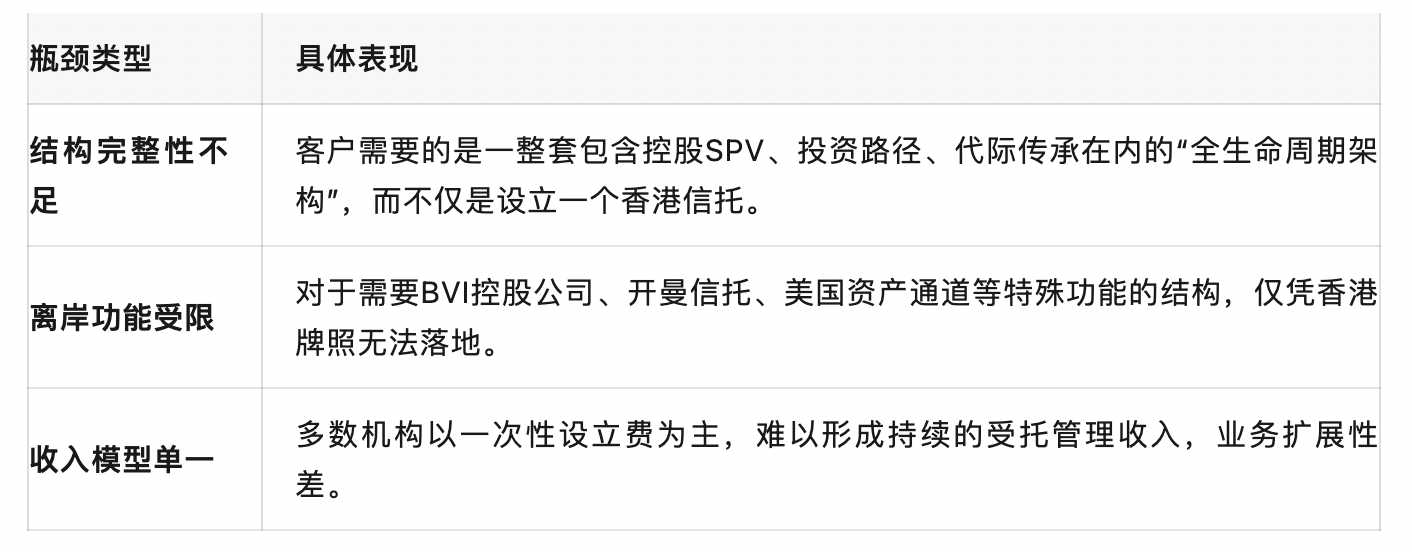
Ultimately, the Hong Kong trust license addresses the "client entry" issue, rather than the "asset structural layer" issue.
The core demand of global high-net-worth clients is precisely the latter.
2. The Standard Answer from Global Leading Institutions: Multi-Jurisdictional Combinations + Clear Division of Labor
Opening the architecture manuals of global leading trust service providers like Vistra, IQ-EQ, and Trident Trust reveals a strikingly similar layout logic:
They do not rely on any single jurisdiction's license but build a complementary, clearly layered combination of licenses.
A typical multi-jurisdictional global trust structure is illustrated as follows:
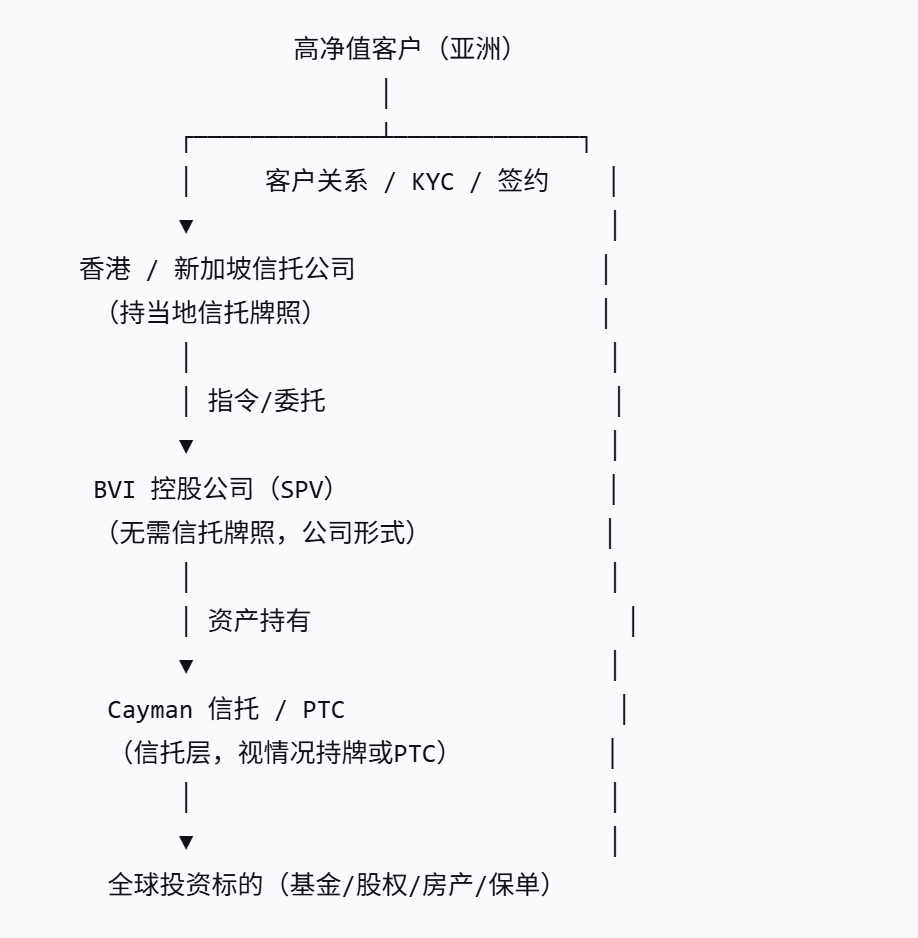
So, what roles do each jurisdiction play in this structure? Let's break it down:
3. The Division of Labor and Irreplaceability of Core Jurisdictions
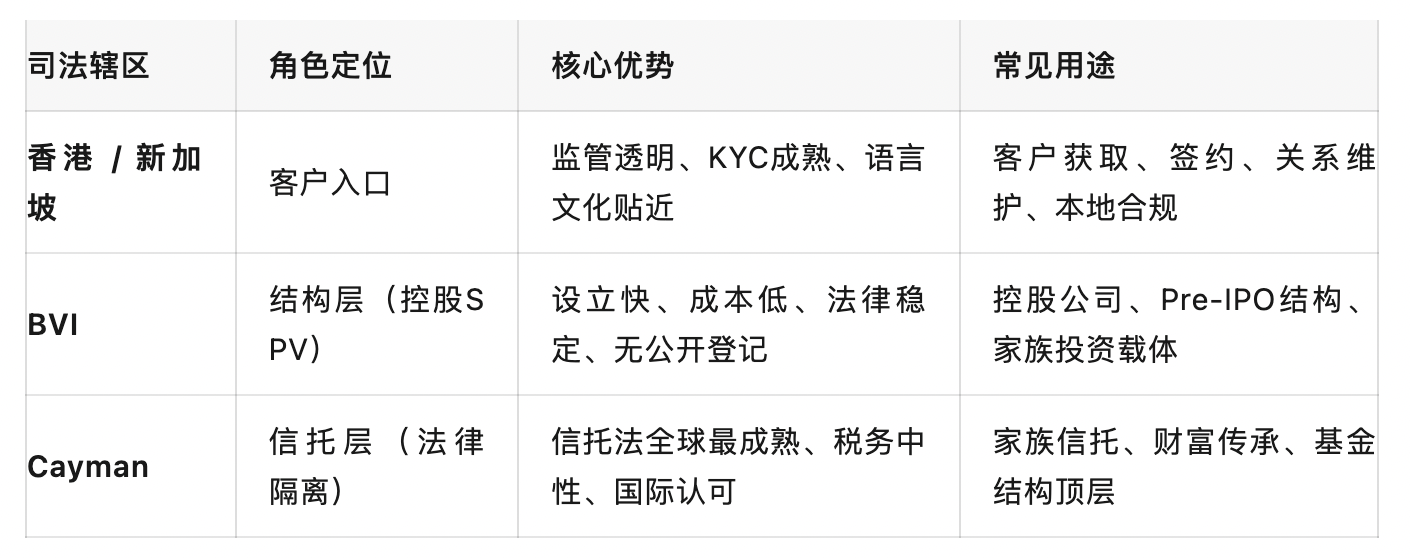
Specifically, in this structure, BVI companies typically do not hold trust licenses but are used as SPVs in the form of private companies. The actual trust legal relationship is established at the Cayman level, fully isolating the operational risks of the BVI company layer.
4. Why is the Cayman the "Preferred Layer for Trusts," Yet There is No Need to Apply for a Complete Trust License?
Many organizations, upon hearing "Cayman Trust," immediately think: the cost of applying for a license is high, the cycle is long, and the regulation is strict.
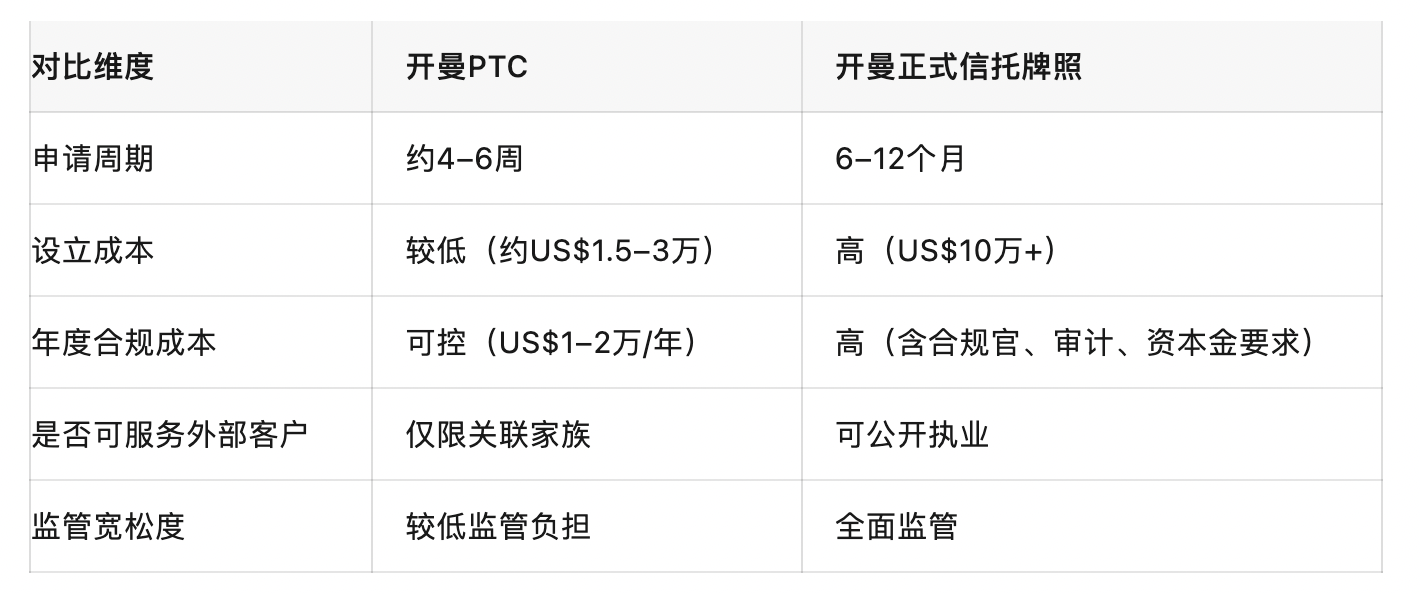
However, in reality, a Private Trust Company (PTC) established for a single family or specific clients provides a highly cost-effective alternative.
What is a PTC?
A PTC is a company established for one or a few associated families, specifically acting as the trustee for that family's trust. It does not need to operate publicly like a licensed trust company.
PTC vs Complete Trust License Comparison
Typical Use Cases for PTC
A Southeast Asian family wishes to set up a long-term trust for three generations of members but does not want external institutions involved in management.
A mainland Chinese entrepreneur builds a BVI+Cayman PTC structure through the Hong Kong entry point, with family members serving as PTC directors.
Multiple families jointly establish a PTC to share costs while maintaining independent beneficiary rights.
The Core Logic: Use the design wisdom of legal structures to replace unnecessary regulatory costs.
5. Practical Case of "Standard Structure" for High-Net-Worth Clients in Asia
We take a typical client profile as an example:
Client: A 55-year-old entrepreneur in the manufacturing industry from mainland China, with children studying abroad. The business plans to go public within 5 years, aiming to achieve: asset isolation (to prevent business operational risks), wealth transfer to children (to avoid marital and squandering risks), cross-border investment channels (capable of investing in overseas funds/technology stocks), and tax neutrality (not increasing tax burdens).
The designed plan is as follows:
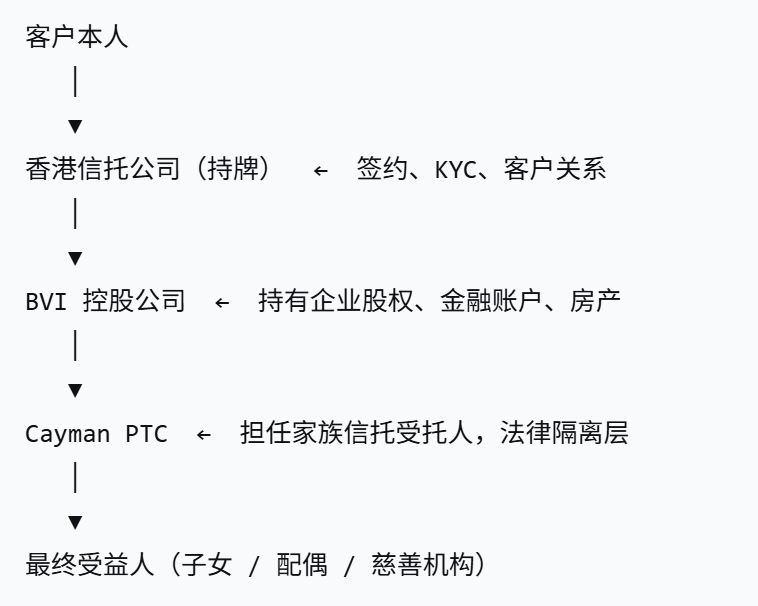
This structure achieves:
Legal isolation: Operational risks at the BVI company level are isolated from family assets.
Tax neutrality: Cayman has no tax, and Hong Kong has no capital gains tax.
Cross-border investment: Able to directly open overseas brokerage/fund accounts.
Control in succession: The PTC directors can be trusted individuals (lawyers, children) of the client, retaining substantial influence.
6. How to Upgrade from "Service Provider" to "Global Platform"?—Three-Stage Path
For organizations that already hold a Hong Kong trust license and wish to expand their global business, we recommend the following roadmap:
First Stage: Fill in Structural Capabilities (0–6 Months)
Introduce BVI companies as partners.
Train the team to master "Hong Kong+BVI" dual structure design.
Establish 2-3 client structure cases as a first batch.
Source of income: Structural setup service fees.
Second Stage: Enter the Trust Layer (6–18 Months)
Assist clients in setting up PTC in Cayman.
Provide administrative management, director services, and compliance support for PTC.
Form a full product line of "Hong Kong Entry + BVI Holding + Cayman Trust."
Source of income: Setup fees + Annual PTC maintenance fees + Management fees.
Third Stage: Brand Upgrade and Scaling (18–36 Months)
Decide whether to apply for a formal Cayman trust license based on business volume.
Connect with family offices, private banks, brokers, and other institutional channels.
Expand to more jurisdictions such as Singapore, Dubai, and Luxembourg.
Source of income: Ongoing management fees based on AUM + Custom structural design fees.
7. What is the Real Competitive Barrier?
Many organizations mistakenly believe that the core barrier of trust business is "having more licenses."
But the reality is quite the opposite:
A license itself is not a barrier.
The number of registrations is not competitiveness.
The real barrier lies in the integration of three capabilities:
Structural design capability: Can it design the optimal multi-jurisdictional combination plan based on the client's family structure, asset types, and tax status?
Execution capability: Can it simultaneously complete company establishment, account opening, compliance reporting, and annual audits in Hong Kong, BVI, and Cayman?
Continuous service capability: Can it continuously provide compliance, accounting, investment, modification of terms, and other services over 10 or 20 years during the trust's existence?
In summary: The license determines what you can do, the structure determines how well you can do it, and the service determines whether the client stays.
免责声明:本文章仅代表作者个人观点,不代表本平台的立场和观点。本文章仅供信息分享,不构成对任何人的任何投资建议。用户与作者之间的任何争议,与本平台无关。如网页中刊载的文章或图片涉及侵权,请提供相关的权利证明和身份证明发送邮件到support@aicoin.com,本平台相关工作人员将会进行核查。


