

Author: Jae, PANews
When users no longer need "cross-chain," true interoperability has just begun.
Dune data shows that the number of daily active addresses (DAU) for cross-chain bridges has been declining for several months. Since October 2025, the DAU for cross-chain bridges has continued to drop from a peak of 30,000 to 35,000 to the current approximately 13,000.
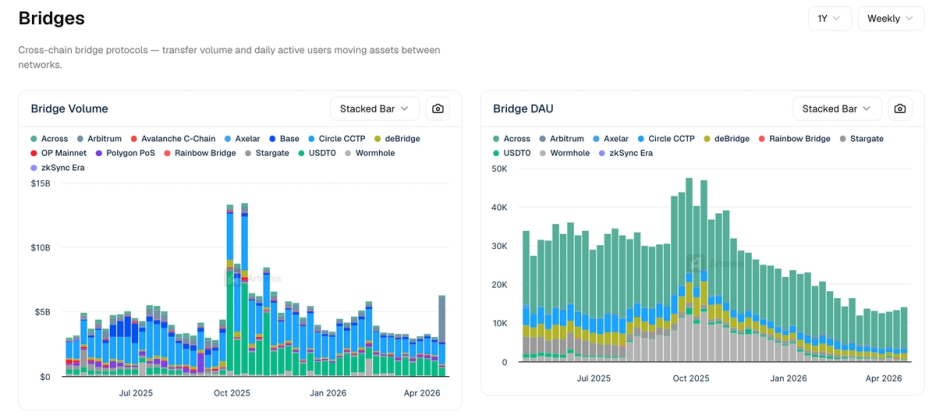
For a crypto circle accustomed to a "multi-chain universe" narrative, cross-chain bridges were once the arteries connecting islands, and their activity often interpreted as a thermometer for ecological prosperity.
Now, the mercury in this thermometer is falling; is it user loss or the retreat of cross-chain enthusiasm? The answer is far more complex than it appears.
The shrinkage in the DAU metric essentially represents a technical evolution of cross-chain bridges from "explicit C-end interaction" to "implicit B-end infrastructure." They are being "folded" into wallets, DEXs, and aggregators' underlying systems, still silently driving each asset flow in the multi-chain world.
Frequent security disasters combined with a liquidity downturn have plunged cross-chain bridges into a winter of trust
The drop in DAU for cross-chain bridges results from the collapse of security trust coupled with the market's deflation.
Security has always been the sword of Damocles hanging over cross-chain bridges.
In 2025, losses from hacks related to cross-chain bridges totaled $2.8 billion, accounting for about 40% of all losses in Web3.
Just this month, the crypto industry faced a brutal "hacker wave," with losses soaring to $620 million in a single month, highly concentrated in cross-chain infrastructure and management permission vulnerabilities.
The most typical case is Kelp DAO. Due to a weak configuration with a single validator, hackers contaminated the validation node, faking a withdrawal instruction for $292 million worth of rsETH, directly triggering nearly $200 million in bad debts for Aave, creating a chain of credit risks.
Related reading: KelpDAO cross-chain explosion, AAVE becomes the "payer," industry calls for risk repricing
This incident severely damaged market confidence in LayerZero. When users witnessed even top-valued star protocols could face disastrous consequences due to improper configuration, their trust in third-party cross-chain bridges plummeted to freezing point.
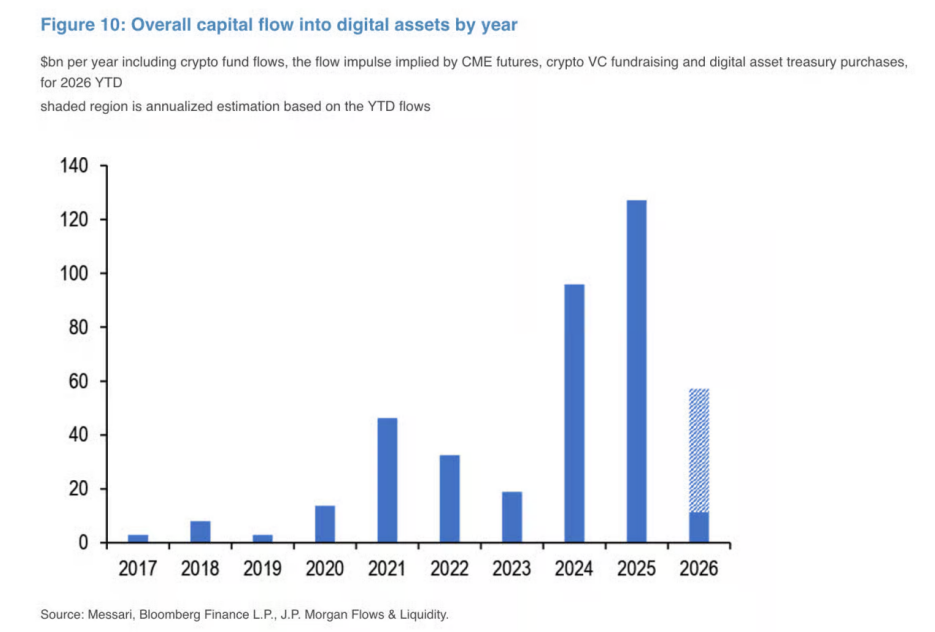
Another variable that cannot be ignored is liquidity cooling. JPMorgan pointed out that in the first quarter of 2026, the net inflow of digital assets was only $11 billion, which is one-third of the same period in 2025.
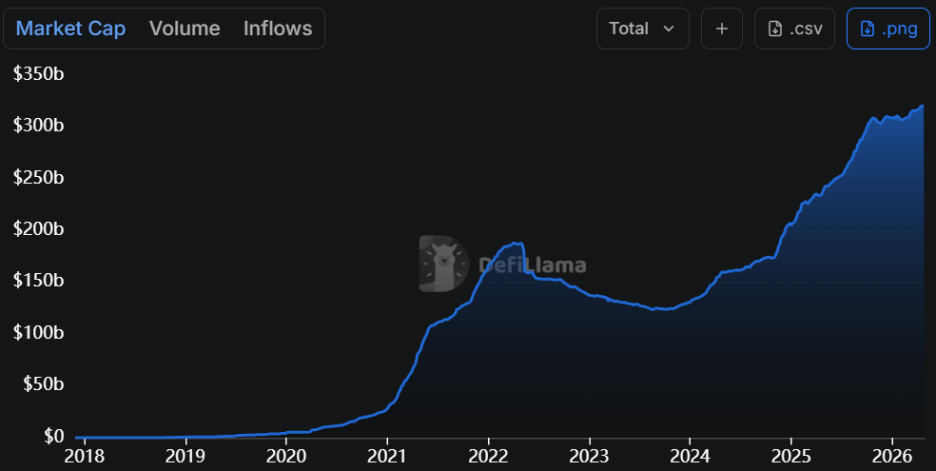
More representative is that despite the market value of stablecoins reaching a historic high of $320 billion, the funds behaved particularly "calm." A large amount of liquidity gave up cross-chain arbitrage, curling up in relatively safe asset pools.
This shift from "high-frequency movement" to "low-frequency reserve" has led to the shrinkage of DAU for cross-chain bridges.
The decline in data is just a surface phenomenon; cross-chain bridges are retreating to the background
On the surface, the decline in activity for cross-chain bridges seems to be a direct signal of waning user enthusiasm and slowed growth in the sector, but the deeper reason is that the technical architecture itself is moving cross-chain bridges from independent entry points to invisible underlying systems, gradually pushing them out of the forefront of user visibility.
For example, the chain abstraction concept proposed by NEAR has gained widespread practice, simultaneously changing the development trajectory of the cross-chain bridge sector.
Relying on chain signatures and MPC technology, users can operate assets on Bitcoin, Solana, or EVM chains with just one main account, without sensing any cross-chain process.
Cross-chain bridges have transformed from front-end applications that users had to actively access into underlying infrastructure called automatically in the background. Just like internet users do not need to understand the TCP/IP protocol but are constantly using it.
Cross-chain operations are still happening; they just won’t be reflected in the official DAU of cross-chain bridges.
If the chain abstraction protocol diverts on-chain players, then CEX (centralized exchanges) has intercepted a majority of ordinary users.
As of now, leading CEXs like Binance and Coinbase have covered almost all mainstream public chains. For ordinary users, the path with the lowest operational hurdle and the most familiarity to move assets from Ethereum to Base is: first depositing assets into CEX (like Ethereum network), and then withdrawing to a wallet (like Base network).
In short, CEX is the most convenient "cross-chain bridge," and this part of the activity is also outside the statistical scope of cross-chain bridges.
Additionally, a significant portion of the former DAU prosperity of cross-chain bridges was supported by users seeking to exploit airdrops. Once a large amount of new protocols completes their token distribution, vast amounts of witch addresses and short-term speculative traffic will retreat. DappRadar research points out that the retention rate after airdrops has always been a weak point for new protocols, and their activity declines to about 20% to 40% of pre-airdrop levels within an average of a few weeks.
Furthermore, with project teams optimizing anti-witch algorithms, meaningless interactions have been significantly reduced, and the DAU data has been cleaned, returning protocol utility to real demand.
The new battlefield for cross-chain bridges is stepping into the B-end infrastructure phase
The business model of cross-chain bridges is also being restructured. Leading protocols have shifted their business focus from C-end traffic to B-end infrastructure.
The main players in cross-chain are transitioning from retail investors to institutions. In 2025, Fireblocks processed over $6 trillion in stablecoin transactions, averaging $200 billion per month. Such a scale of transactions is mostly completed within enterprise-level wallets via cross-chain communication standards.

Institutional-level cross-chain features are high amounts, low DAU: a single cross-chain transfer from an institutional address may equate to the funding scale of 100,000 retail addresses.
Therefore, measuring the prosperity of cross-chain bridges only by DAU may no longer be timely.
It is noteworthy that the cross-chain ecosystem is forming a clearly defined three-tier architecture.
- Rails Layer (Rails): Such as Circle CCTP, LayerZero OFT, and Wormhole NTT. They are the underlying message movers, similar to the TCP/IP protocol.
- Orchestration Layer (Layers): Such as Across, Eco Route, and LiFi, responsible for routing optimization and risk management.
- Application Layer (Apps): Such as MetaMask, Coinbase, and various financial aggregators, accommodating all user DAU.

In this layered architecture, all DAUs are settled in the application layer. A click by users at the front end of the application layer will call the API of the orchestration layer, ultimately transmitted via the rails layer.
Rails layer protocols usually charge based on the number of calls or value. For them, DAU is no longer an effective KPI; system throughput and value capture capability are what matter.
The so-called loss of DAU is, in fact, flowing towards a more unnoticed, more efficient backend.
The web front end of cross-chain bridges is retreating, but the vitality of the cross-chain ecosystem is quietly growing in the code's underlying layers.
免责声明:本文章仅代表作者个人观点,不代表本平台的立场和观点。本文章仅供信息分享,不构成对任何人的任何投资建议。用户与作者之间的任何争议,与本平台无关。如网页中刊载的文章或图片涉及侵权,请提供相关的权利证明和身份证明发送邮件到support@aicoin.com,本平台相关工作人员将会进行核查。


