In terms of products, Delphi products are highly decentralized, with a rich gameplay, but relatively low liquidity.
Written by: TVBee
Many friends are writing about this project, and Brother Bee is also joining the fun.
A16Z is also personally promoting it:
https://x.com/a16zcrypto/status/2047021037259518369?s=46
Introduction
Gensyn is a decentralized AI infrastructure that has both breadth and depth:
- It includes both the technological infrastructure layer and AI products;
- It involves decentralized training of AI models as well as inference and application of AI models;
- Its users include ordinary traders, mining enthusiasts, various programmers, gamers, and enterprise-level AI service infrastructure providers.
Infrastructure Layer of Gensyn
This part is a bit abstract, so Brother Bee will briefly write about it.
(AXL)Agent eXchange Layer
The exchange layer is a point-to-point communication layer, similar to BitTorrent.
AI Agents, computational nodes, etc., can decentralize and exchange some AI data, such as model weights and gradients.
Gensyn Chain
Ethereum Rollup Layer2, compatible with EVM.
All on-chain identities, reputations, histories, stakings of participants, models, and AI Agents will be recorded on the Gensyn Chain.
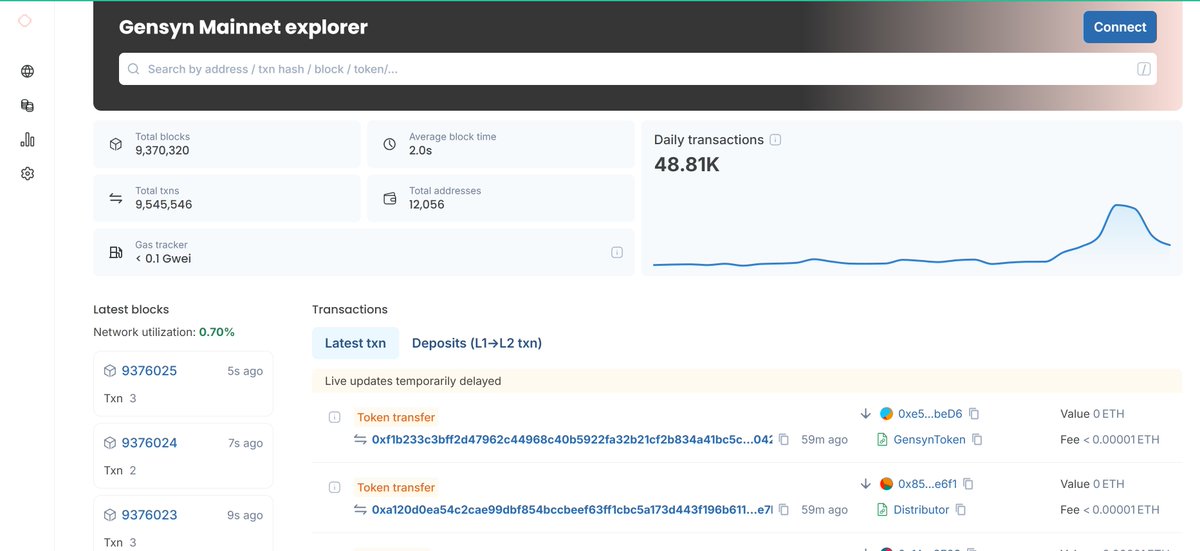
The block explorer shows that Gensyn Chain has a certain level of ecosystem activity.
Currently, Gensyn Chain has nearly ten million blocks and transaction numbers, with an average block time of 2 seconds.
A total of 12056 addresses participate in the Gensyn Chain with different roles.
REE(Reproducible Execution Environment)
The Reproducible Execution Environment is a cryptographic verification layer.
REE packages the process of exporting, compiling, inferring, and decoding outputs of AI models, making the differences during GPU computation uniform.
This is crucial for the integration of Web3 and AI.
Product Layer
Users and markets are more concerned about products.
Decentralized Prediction Market Delphi
The characteristics of Delphi are decentralization:
First, anyone has the opportunity to add predictive events, rather than a centralized party.
Adding predictive events is called "creators" in the Delphi ecosystem, and "creators" need to pay a market creation fee of 1 USDC and inject initial liquidity, earning a 1.5% commission income from subsequent participant transactions.
Second, participants in predictions include both humans and AI Agents, enriching the participants, where humans and AI can be competitors.
Predictors pay a 2% fee, of which 1.5% goes to the "creator," and the remaining 0.5% is used for repurchasing $AI.
Third, the final adjudication is performed by AI, executed by a verifiable AI verifier via REE, leading to decentralized adjudication.
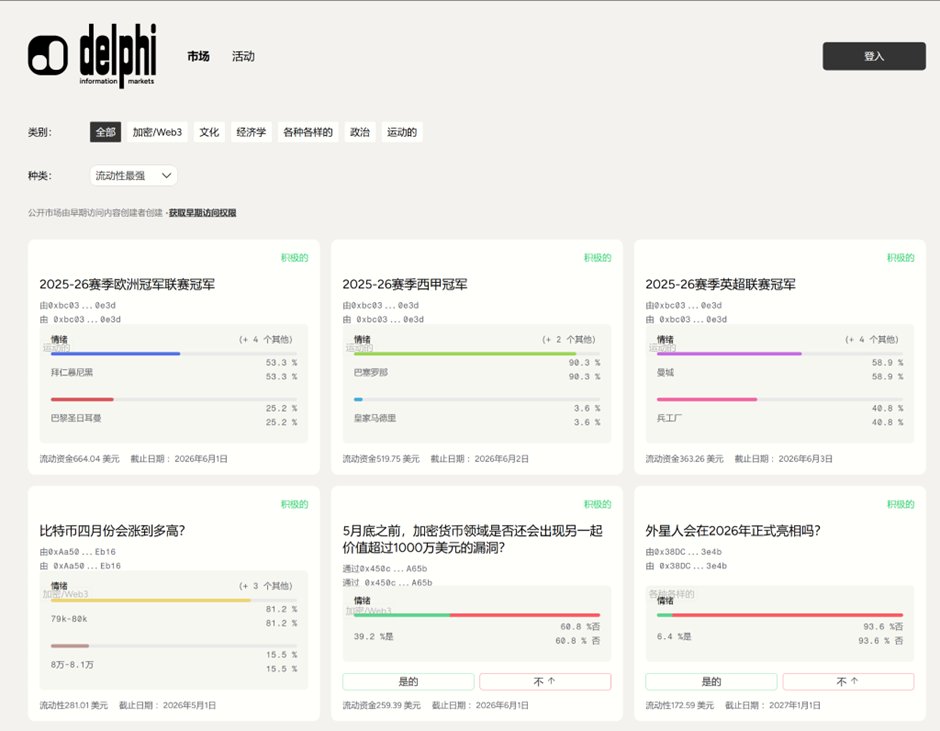
With Delphi's mainnet launched for about a week, there are already at least 40 prediction markets. Possibly due to its short launch time and decentralization, the liquidity of the prediction markets is generally low, with the most liquid prediction market being less than 700 dollars.
Other Products
Gensyn has three other products in suspended or delisted status, likely because the project team has focused their development resources on the Delphi project.
◆RL Swarm: A peer-to-peer reinforcement learning framework that allows consumers with GPUs and data center GPUs to join and participate in AI training model collaboration.
This product targets users including ordinary mining enthusiasts and enterprise-level AI service infrastructure.
◆CodeAssist: An AI coding assistant that runs locally and helps users write code. When users are coding in programming environments like VS Code and get stuck or make mistakes, CodeAssist can help complete or modify the code.
This product primarily targets various programmers, with programmers of different skill levels being able to use it.
◆BlockAssist: A gaming assistant. Currently, it can only assist players of the block-building game Minecraft.
This product is naturally aimed at gamers.
Github
The open-source code repository of Gensyn shows:
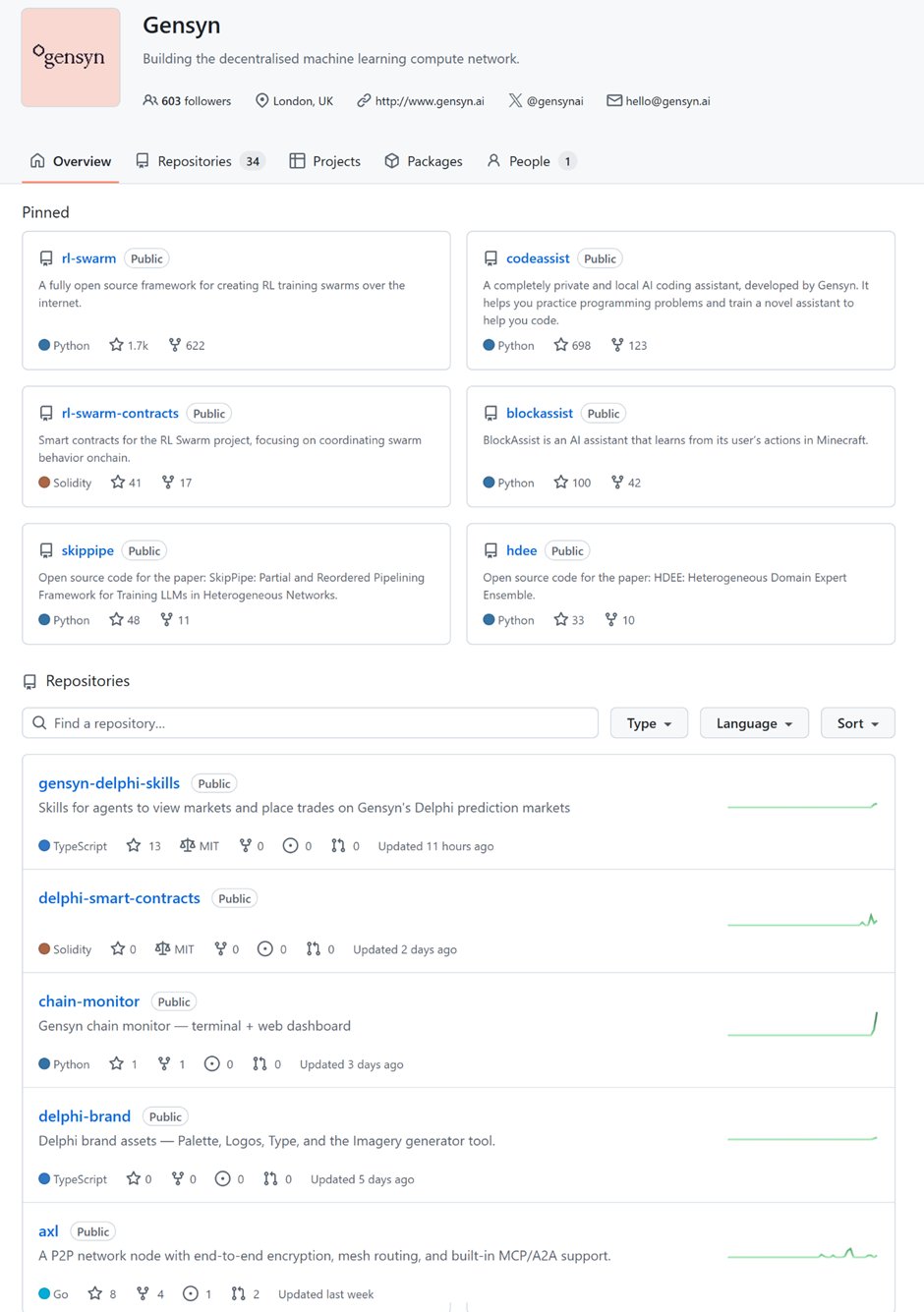
- First, the project has 603 developers following it, indicating a relatively strong technical foundation.
- Second, the project is located in London, UK.
- Third, the project has a total of 34 code repositories, indicating a considerable scale.
- Fourth, the most recent code submissions were 11 hours ago, 2 days ago, 3 days ago, 5 days ago, and last week; this frequency is not high, but it is still solid given the bear market environment.
- Fifth, the four pinned repositories are rl-swarm, codeassist, rl-swarm-contact, and Blockassist. This indicates that after Delphi, the main products being developed are RL Swarm, followed by CodeAssist and BlockAssist.
Among them, rl-swarm has 1.7K stars and 622 forks, indicating high interest in the RL Swarm product.
Gensyn's Financing Background
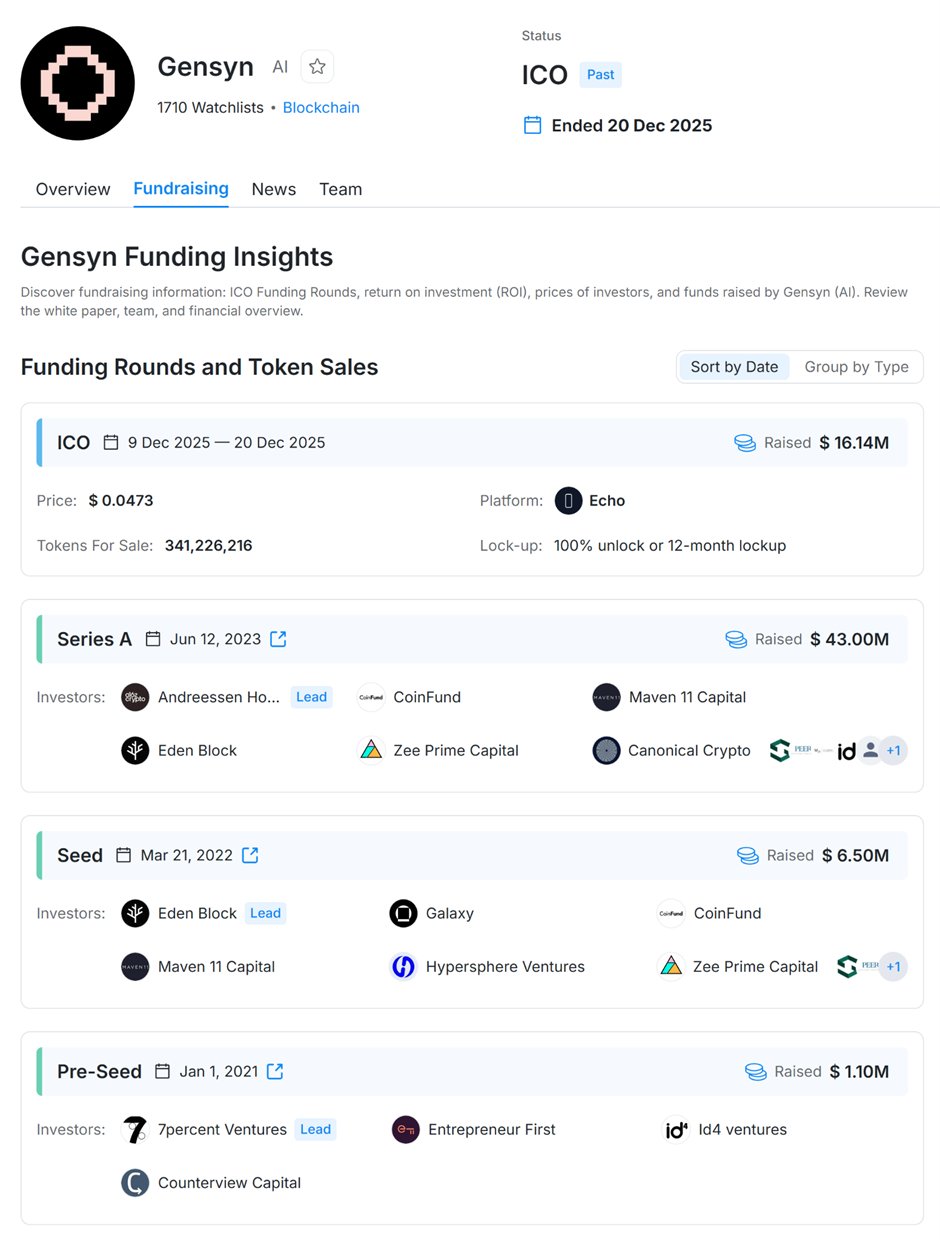
The total financing amount is at least 66.74 million; besides the ICO, Gensyn has gone through at least three rounds of financing:
- 2021: Pre-seed financing of 1.1 million.
- 2022: Seed round financing of 6.5 million.
- 2023: Series A financing of 43 million.
- 2025: ICO, raising 16.14 million at a price of $0.0473.
From the perspective of financing rounds, this project can be said to continuously attract the attention of VCs.
Particularly the Series A financing in June 2023, which occurred almost at the peak of the Federal Reserve's interest rates. The lead investor, Andreessen Horowitz, is A16Z.
Conclusion
Shortcomings of Gensyn
Perhaps as time goes by and market conditions improve, the liquidity of Delphi can expand. But for now, the liquidity of Delphi is still low.
As 0.5% of Delphi's transaction volume will be used for repurchasing $AI, greater liquidity is always better.
Highlights of Gensyn
First, A16Z's investment; projects invested by A16Z tend to have a better reputation compared to other VC-backed projects. Moreover, this investment was made during a period of liquidity crunch, and the investment amount is relatively significant.
Second, the decentralized prediction market product that retail investors can participate in—Delphi.
Compared to platforms like Polymarket, retail investors can create markets in Delphi and have opportunities to profit, as well as participate in trading through AI Agents, providing a richer gameplay experience.
Relative to similar AI products, Delphi's narrative is clearer for retail investors.
Potential of Gensyn
◆In terms of exchanges
$AI is currently listed on exchanges including Binance Alpha, Bitget, KuCoin, Uniswap, etc. XT and MEXC have also launched pre-market trading.
CoinBase and Kraken have joined the roadmap, but they are not yet listed, and the specific listing time is uncertain.
OKX, Gate, Bybit, and Upbit have not expressed any intentions yet.
In terms of exchanges, there can be some follow-up expectations in the short term.
◆In terms of products
In terms of products, Delphi's products are highly decentralized, with rich gameplay, allowing retail investors to create a market and then promote that market for opportunities to earn trading fees.
The GitHub code repository shows that products like RL Swarm also have high expectations.
The liquidity of Delphi and the ecosystem of other products provide some support for the mid- to long-term potential of Gensyn.
免责声明:本文章仅代表作者个人观点,不代表本平台的立场和观点。本文章仅供信息分享,不构成对任何人的任何投资建议。用户与作者之间的任何争议,与本平台无关。如网页中刊载的文章或图片涉及侵权,请提供相关的权利证明和身份证明发送邮件到support@aicoin.com,本平台相关工作人员将会进行核查。


