Author: Jae, PANews
As the leading DeFi lending platform Aave is caught in the Kelp DAO theft incident, another veteran protocol, Sky, not only attracted the attention of huge whales with real money, with a TVL increase of over 25% in the past two weeks, but also took the opportunity to roll out two major initiatives aimed at paving the way for its institutional strategy through governance reform:
Internally, the protocol proposed to simplify the treasury management mechanism, shifting the spending model from human governance voting to rigid rule constraints;
Externally, it is creating an institutional-level on-chain capital allocation infrastructure called Laniakea, aiming to capture the liquidity cake of $300 billion in idle stablecoins.
Sky is accelerating its position in the new infrastructure of DeFi.
From Community "Rule by Man" to Rule "Rule by Law"
On April 25, Sky founder Rune Christensen stated in a governance forum post that Genesis Capital’s asset transfer to Grove has been completed, marking the official end of the protocol’s genesis phase.
During the genesis phase, Sky followed a decision-making route driven by human governance: community votes determined expenditures, and discretionary fund allocations provided sufficient flexibility for the early expansion of the ecosystem. However, as the asset scale broke through $10 billion, the resulting uncertainties and high governance costs gradually evolved into shackles on protocol credibility.
The most intuitive signal is that S&P Global rated Sky’s credit at B-. S&P Global pointed out the key issues with Sky: governance risks are uncontrollable and capital positions are opaque.
For a protocol carrying the trust of billions in stablecoins, governance uncertainty itself poses a significant systemic risk.
In response, Sky proposed a governance solution to streamline the treasury management function (TMF). The protocol reduced the complex five-step waterfall structure to a four-step fixed framework.
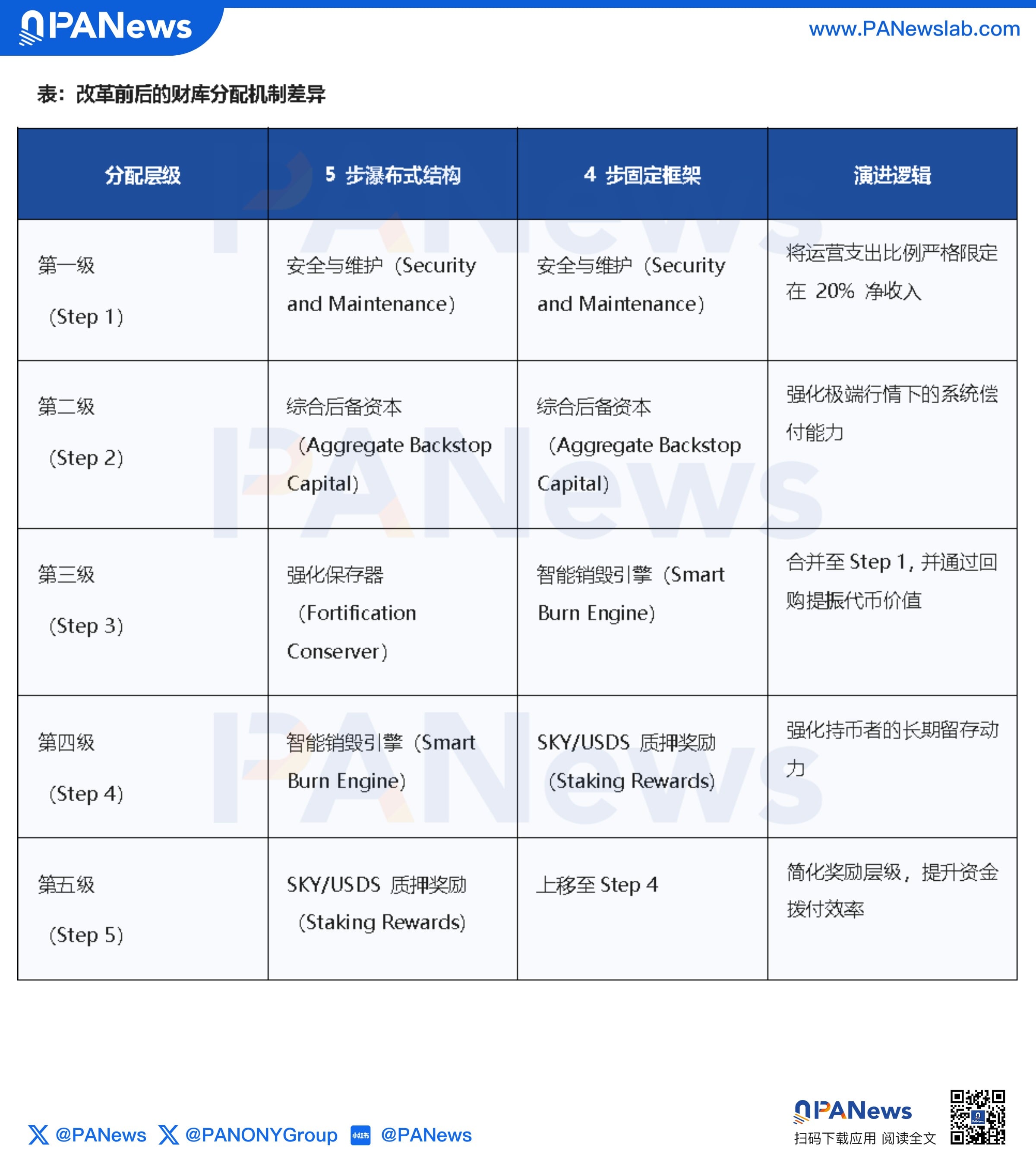
The most important constraint is the protocol's hard cap on operational expenditure. Sky is transitioning from rule by man to rule by law, locking treasury powers into the confines of code.
In the old system, the community’s discretionary limit for Step 1 was as high as 21% during the genesis phase, while it was originally set to be within the 4-10% range post-genesis.
However, if the proportion is variable, every adjustment would require complex governance voting.
Therefore, the new proposal directly overturned the entire old system, permanently locking the spending ratio at 20%. This means that governance friction will be greatly reduced, and at least 80% of the protocol's net revenue will be retained within the system for reserve accumulation, token burn, or distribution to holders.
For SKY holders and ecosystem partners, a fixed expenditure ratio will be more predictable than highly uncertain governance decisions. The rigid 20% spending will make the treasury's cash flow direction more transparent and less manipulable by governance.
It can be said that while Sky actively reduced governance power, it also handed over a token of "certainty".
Building an Institutional-Level On-Chain Capital Operating System
While internally amending the governance, Sky is also welcoming external partners.
On April 28, Sky announced that it is building Laniakea, a standardized infrastructure framework aimed at institutional-level capital deployment for its Sky Agent Network, intended to address the issue of over $300 billion in idle funds in the stablecoin market.
It is important to note that this Agent is not the same as the usual Agent. Sky Agent refers to a Capital Agent, not the commonly referred AI Agent.
The Sky team believes that institutional capital has long been reluctant to participate mainly due to the lack of five key elements: shared infrastructure, standardized smart contracts, risk assessment, data systems, and legal frameworks.
Laniakea attempts to bridge the gaps in the infrastructure layer through standardization across four dimensions:
- Standardization of smart contracts: template-based deployment to eliminate the cost of institutions reinventing the wheel;
- Standardization of risk governance: unified risk metrics, with losses shared in order;
- Standardization of data infrastructure: protocol coding will be stored in a machine-readable format, supporting real-time AI risk control;
- Standardization of legal compliance: providing pluggable identity and KYC registration systems, a shared legal framework across product lines, and establishing collateral-backed accountability mechanisms at each operational level.
Under the Laniakea framework, Sky will no longer be a "lender" but a capital agent network platform.
- Primes: These are primary agents (Sky Agents) that resemble on-chain fund managers, competing for capital allocation quotas, developing investment strategies according to Laniakea’s unified standards, such as Spark, which is responsible for DeFi lending, and Grove, which handles private credit and RWAs;
- Halos: These are specific financial products incubated based on Laniakea’s shared infrastructure, covering various income streams from government bonds and RWAs to private credit.
This layered architecture allows Sky to integrate the professional skills of different agents for diversified asset allocation while maintaining a unified framework, significantly enhancing the ecosystem's scalability.
In other words, based on Laniakea, Sky's role will shift from a "direct operator" to a standardized on-chain operating system prepared for institutional capital.
PANews believes that the protocol's main revenue will come from stability fees, interest spreads, and taxes.
Stability fees are Sky's most traditional and robust profit-making method. As long as the Halos managed by Primes want to be used as collateral to mint USDS in Sky, they need to pay interest to Sky, which is the stability fee. Laniakea lowers the threshold for institutional access, meaning more institutional assets will enter the system. As the total minted amount of USDS increases, the total stability fees received by the protocol will also subsequently rise.
Primes, as professional asset managers, are responsible for bringing yield strategies into Sky. The protocol will provide liquidity for assets at a lower cost through USDS. Here, Sky earns the net interest spread between the "strategy yield - USDS funding cost (like deposit rates)". Laniakea’s standardization allows Sky to manage hundreds of interest spread channels simultaneously, forming scale effects.
Each individual Prime is essentially a "franchised store" of Sky. Generally, Primes will issue their own tokens, needing to pay a certain percentage of their tokens or a part of the revenue generated to Sky. Even if the protocol does not directly engage in the issuance of a specific product, as long as Primes issue Halos based on Laniakea, Sky can earn revenue through taxation.
It is worth mentioning that since the protocol's status is machine-readable, AI will assume roles in capital allocation and liquidation management.
By reading Laniakea’s standardized data interface, AI can achieve real-time monitoring of cross-asset exposure, collateral quality, and liquidity depth. When certain underlying collateral signals anomalies in spreads, AI can automatically adjust the credit limits or liquidation thresholds of the corresponding Halos based on preset "machine rules", providing algorithm-level capital safety for institutions.
Moreover, machine readability also turns Halos into "standardized Legos" that can be tuned by AI models. AI can automatically switch capital allocations between different risk levels based on market interest rates and volatility, seeking optimal Sharpe ratios.
Overall, the AI compatibility of Laniakea will empower institutional capital or Primes in risk management and investment decision-making.
Positioning in the Infrastructure Layer, but Transformation Hides Triple Concerns
Sky's two moves are not independent but rather part of a combined strategy. The regulated treasury management mechanism provides governance certainty for institutional capital, while Laniakea offers technical certainty.
Sky's actions also reflect a logical transformation occurring throughout the DeFi market: shifting from competition in the "frontend-heavy" application layer to competition in the "backend-heavy" infrastructure layer.
The development trajectory of DeFi lending protocols is evolving from a single liquidity pool to a layered architecture. The launch of Laniakea essentially positions Sky at the forefront of the infrastructure layer. Once Laniakea becomes the preferred entry point for $300 billion in idle stablecoins, Sky will also upgrade to a central node for on-chain capital allocation.
It is worth noting that Sky's path of transformation is fraught with risks:
- Secondary contest of governance rights: Although the rules will lock the spending ratio, the modification rights for the "rules themselves" still rest with the governance vote. If governance attacks occur, the long-term validity of the rules may be called into question;
- Increased technical complexity: Building machine-readable infrastructure that supports real-time AI monitoring poses significant challenges. Any vulnerabilities may be amplified in the case of scaled deployment;
- Agent delegation risks: Primes hold significant capital allocation powers. Although there are accountability mechanisms for losses, in special situations, the profit distribution between agents and the protocol may face dual legal and technical challenges.
- From stablecoin issuer to constructing the on-chain capital hub Laniakea, Sky is about to complete a transformation from a single DeFi protocol to an institutional-level operating system.
As institutional capital flows in through standardized interfaces, Sky will embark on the next chapter of its journey.
免责声明:本文章仅代表作者个人观点,不代表本平台的立场和观点。本文章仅供信息分享,不构成对任何人的任何投资建议。用户与作者之间的任何争议,与本平台无关。如网页中刊载的文章或图片涉及侵权,请提供相关的权利证明和身份证明发送邮件到support@aicoin.com,本平台相关工作人员将会进行核查。


