Original title: AI Has Made Memory Chips One of the World’s Most Profitable Products
Original author: Jiyoung Sohn, Andrew Barnett, the Wall Street Journal
Original translation: Peggy, BlockBeats
Editor's note: Nvidia was once the most prominent winner in the AI infrastructure cycle, but the latest round of chip market conditions indicates that the bottleneck in AI lies not only in GPUs but also in storage.
Over the past year, global capital expenditure has continuously flowed into AI, first driving up demand for high-bandwidth memory like HBM, and then squeezing the supply of traditional DRAM and NAND flash memory. When large model training requires GPUs and HBM, and when inference demand drives the expansion of general servers, storage chips have transitioned from a cyclical industry to one of the most scarce and profitable links in the AI industry chain.
This is also the reason for the collective explosion in performance of Samsung, SK Hynix, and Micron. The price of storage chips rose nearly 100% in the first quarter, resulting in Samsung's net profit exceeding $30 billion in the first quarter, with its semiconductor business contributing the vast majority of profits; storage chip prices are expected to rise nearly twice compared to the previous quarter in the first three months of 2026, far exceeding market expectations. More importantly, this is not just a temporary price increase but a repricing of supply and demand structure: the construction cycle of new fabs is long, HBM occupies more capacity, and traditional storage supply is further compressed.
In this context, storage chips are transforming from "supporting components" to "strategic resources." Server, PC, and smartphone manufacturers have begun to pay a premium to lock in capacity and even accept five-year contracts, advance payments, and joint investment to build factories. The supply relationships that relied on handshake agreements are shifting to stronger binding long-term contracts. In other words, AI competition has evolved from competition among models, computing power, and cloud platforms to a struggle for the underlying supply chain.
What is most noteworthy is not how much money storage chip companies have earned this year, but that the bottleneck in AI infrastructure is spreading from a single computing power to a broader hardware system. GPUs determine whether models can be trained, HBM determines whether data can be exchanged at high speeds, and DRAM and NAND affect the cost structure of inference and server expansion. As more and more companies believe that "whoever controls storage supply can control AI," the lucrative cycle of storage chips is, in fact, a signal that AI infrastructure is entering a resource competition stage.
Below is the original text:
Ranked by net profit, entering the top 20 global chip manufacturers.
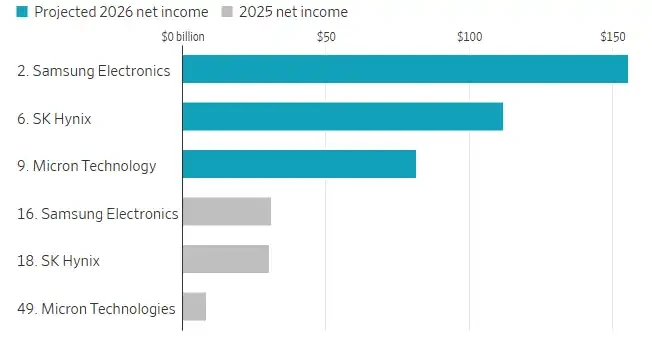
By the end of last year, global investment in artificial intelligence had pushed the storage chip industry into a "super boom cycle." Profit margins are breaking records, and prices are expected to rise another 50% in the first three months of 2026 compared to the previous quarter.
But the development of things hasn’t stopped there. The actual situation is even better, significantly better.
On Thursday, Samsung Electronics reported a net profit of over $30 billion in the first quarter. This not only far exceeds its previous single-quarter profit record but also nearly approaches the annual profit peak that this Korean company previously set. Approximately 94% of Samsung's operating profit in the first quarter came from its semiconductor business.
Samsung's main competitors in the storage chip field—South Korea's SK Hynix and the U.S. company Micron Technology—have recently also delivered equally surprising performances. These three companies dominate the global storage market, and storage chips are being used for AI computing alongside Nvidia's processor chips.
Annual net profits of semiconductor companies
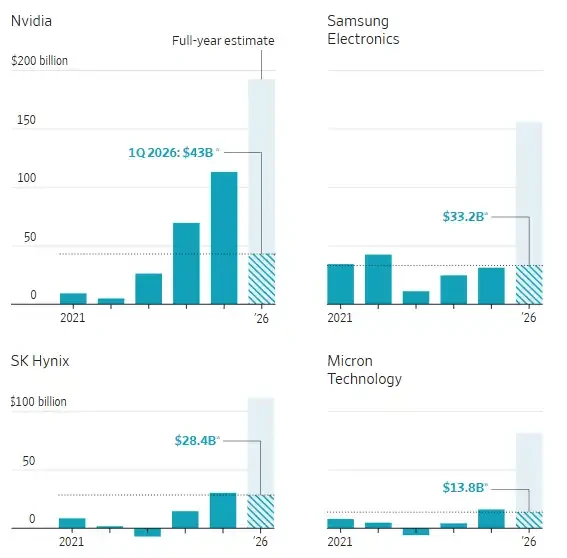
In the first-quarter data, Samsung and SK Hynix correspond to the financial quarter ending in March 2026 (actual performance); Micron corresponds to the financial quarter ending in February 2025 (actual performance); Nvidia corresponds to the financial quarter ending in April 2026 (estimated performance).
Note: Samsung data includes all its businesses, but the semiconductor business contributed the majority of profits. The exchange rate is calculated at 1 USD to 1421.22 KRW. Source: FactSet Andrew Barnett / The Wall Street Journal
Though the market increasingly worries about whether AI services can truly bring substantial profits, companies involved in related infrastructure construction have already reaped an epic round of dividends.
This historic market trend seems to show no signs of ending in the near term. Samsung's vice president of memory business Jaejune Kim stated during Thursday's earnings call that, based on the orders already booked by Samsung, supply shortages are expected to further intensify next year. He said, "The current available capacity is far from meeting customer demand."
This year so far, Samsung's stock price has risen by 72%. SK Hynix's stock price has risen by 90%, while Micron has increased by 65%.
Company market share
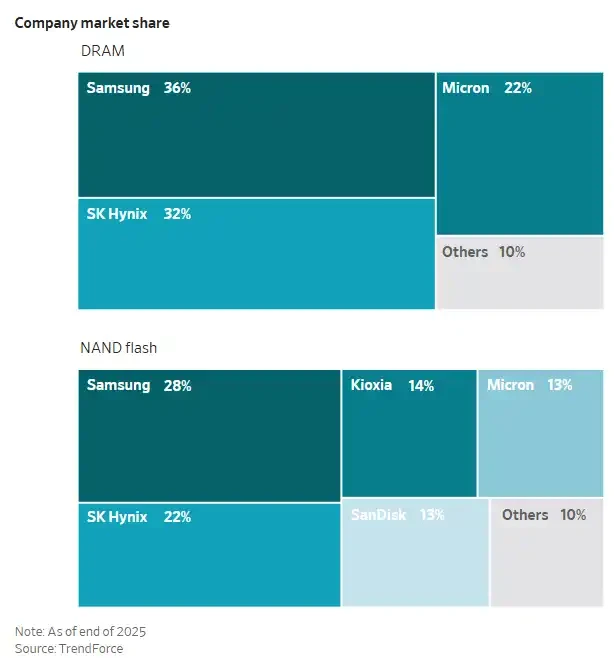
According to data from tech market research firm TrendForce, in the first three months of 2026, storage chip prices increased by nearly 100% compared to the previous quarter, approximately double the initially expected increase.
In recent years, storage chip manufacturers have prioritized the production of dedicated storage chips needed for AI, specifically high-bandwidth memory (HBM). This, in turn, has limited the supply of traditional storage chips used in smartphones, personal computers, and general servers. Training large language models typically requires pairing Nvidia's graphics processing units (GPUs) with HBM.
More recently, inference demand has begun to rise. Inference refers to the computational process required for AI models that have already been trained to respond to user inquiries. This has driven an increase in the demand for general servers, which use traditional storage chips, thereby pushing the profitability of Samsung, SK Hynix, and Micron to a new level.
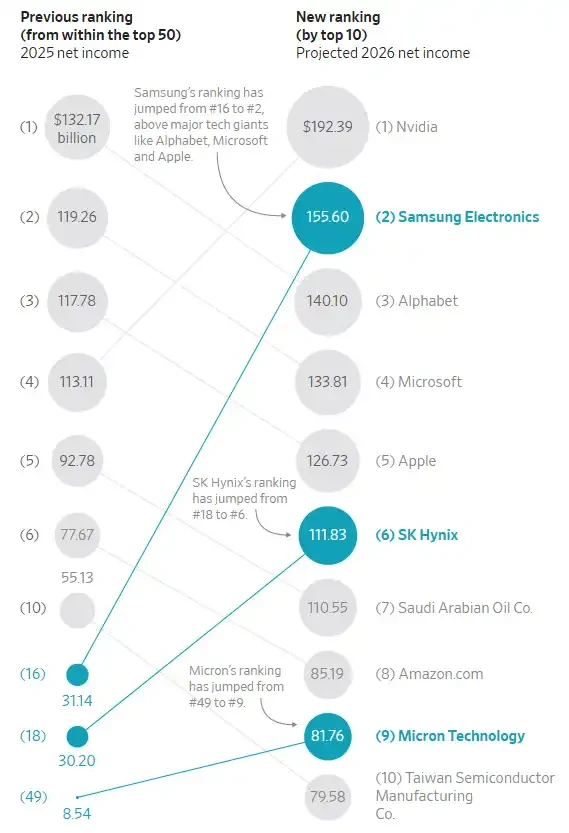
According to estimates from FactSet, these three companies are expected to achieve a total net profit of about $350 billion in 2026. Each is poised to enter the top ten most profitable publicly traded companies in the world, with Samsung expected to surpass Alphabet, Microsoft, and Apple, climbing to second place. A year ago, none of these storage chip manufacturers had made it into the top ten.
Some chip manufacturing companies ranked by net profit
A chip manufacturing plant, or fab, may cost over $20 billion and take several years to build. Industry analysts say that Samsung, SK Hynix, and Micron are all building new factories, but capacity is likely to be fully released only by the end of 2027 or 2028. Meanwhile, many production lines have already been allocated to HBM, which occupies more capacity compared to traditional storage chips.
Storage chips are mainly divided into two categories: one is DRAM, used for temporary storage in servers, personal computers, and other electronic devices, aiding quicker data processing; the other is NAND flash memory, used for long-term data storage, such as photo storage in mobile phones.
HBM is made by stacking DRAM chips layer upon layer, then packaging them together with processors produced by companies like Nvidia to accelerate AI calculations. Nvidia has close collaborations with Samsung, SK Hynix, and Micron.
Counterpoint semiconductor research analyst MS Hwang stated that the profit margins of both categories of storage chips have approximately doubled compared to usual levels, with DRAM achieving a profit margin of about 80%, while NAND flash may reach up to 60%.
Contract prices of storage chips
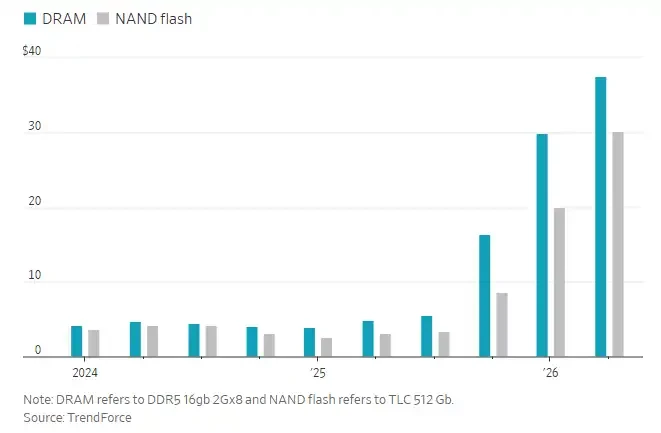
Counterpoint's Hwang added that many large companies in the server, PC, and smartphone fields are paying premiums and purchasing large volumes of storage chips to lock in more supplies and limit the capacities their competitors can obtain. He said, "The logic behind this is that whoever can control storage supply can dominate AI."
Marcus Chen, executive vice president of global electronic component distributor Fusion Worldwide, stated, "What we are seeing today is the most severe storage shortage ever in the market." Most clients served by Chen can currently secure only 30% to 50% of the storage chips they need. "Some clients even get less," he said.
For a long time, clients and storage chip manufacturers primarily relied on "handshake agreements" to ensure long-term supply; however, now, in some cases, both parties are transitioning to binding formal contracts. Citi semiconductor analyst Peter Lee stated that some contracts last up to five years and require clients to prepay about 30% of the costs or share the investment costs of building new storage chip factories. Lee said, "We have already seen clients willing to go to such lengths."
免责声明:本文章仅代表作者个人观点,不代表本平台的立场和观点。本文章仅供信息分享,不构成对任何人的任何投资建议。用户与作者之间的任何争议,与本平台无关。如网页中刊载的文章或图片涉及侵权,请提供相关的权利证明和身份证明发送邮件到support@aicoin.com,本平台相关工作人员将会进行核查。


