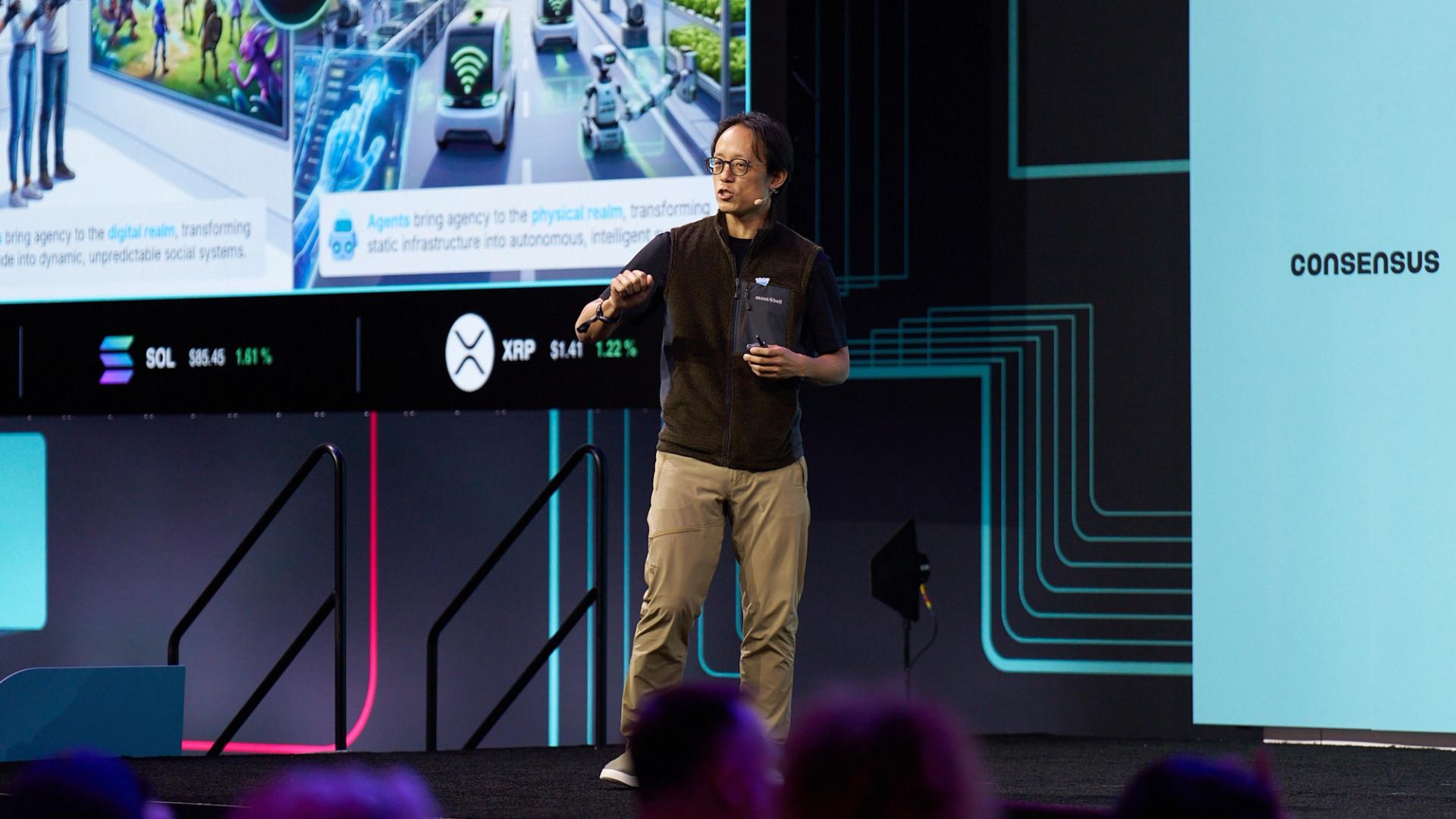
What to know : Animoca Brands chairman Yat Siu argued that the metaverse’s next phase will be driven by fleets of AI agents transacting on blockchains rather than humans in immersive virtual worlds. Siu predicted tens of billions of autonomous AI agents will handle bookings, payments, and online transactions in the background, using blockchain as their financial and identity infrastructure. He said this “agent economy” could solve crypto’s user-onboarding problem and announced a $10 million Animoca Minds initiative to fund developers building AI agent applications.
The crypto industry may have fundamentally misunderstood the metaverse, according to Animoca Brands chairman Yat Siu, who argues that the next phase of virtual economies would arrive not through VR headsets or immersive digital worlds, but through fleets of AI agents transacting across blockchain networks behind the scenes.
Siu said the metaverse maybe coming to us rather than being a place that humans go to, during his keynote at Consensus Miami 2026.
For Animoca, this marked a distinct pivot from the pandemic-era vision of the metaverse it once championed, in which users were expected to spend increasing amounts of their social and economic lives in immersive virtual worlds.
Siu now says the more consequential shift may be AI systems operating in the physical world on behalf of humans, handling transactions, bookings, coordination and commerce in the background while blockchain networks function as the infrastructure connecting those agents.
Instead, Siu argued the next phase of the internet may revolve around AI systems operating continuously in the background of everyday life, handling tasks such as bookings, payments, scheduling, and online transactions on behalf of users.
He said consumers could eventually rely on dozens, or even hundreds, of AI agents to coordinate their digital activities, with blockchain networks serving as the financial and identity infrastructure connecting those systems.
“I think the point is that it’s going to be more agents than humans,” Siu said, predicting there could eventually be “50 to 100 billion agents roaming essentially on the internet.”
That shift, he argued, could also solve one of crypto’s longest-running problems: onboarding ordinary users.
While an estimated 700 million to 800 million people globally now own some form of cryptocurrency, Siu noted that fewer than 70 million actively use blockchain applications because crypto remains technically intimidating for mainstream consumers.
“My mom’s not going to be using MetaMask,” he said. “It’s hard for her.”
AI agents, however, may interact naturally with wallets, smart contracts, and decentralized finance systems because they operate directly through code, he argued.
Unlike humans, agents would not need traditional banking infrastructure and could transact autonomously on-chain.
“Blockchain technology is the ideal financial system for machines,” Siu said. “We, the humans, were basically the guinea pigs.”
The broader argument reflected a growing narrative within parts of the crypto industry that blockchain’s most scalable users may ultimately be autonomous software agents rather than humans.
In that framework, wallets, tokens, decentralized identity systems, and on-chain payments become machine infrastructure powering an emerging “agent economy.”
As part of that push, Animoca announced a $10 million investment initiative for developers building AI agent applications through its Animoca Minds platform.
If Siu’s vision materializes, the next major wave of blockchain adoption may not come from millions of new human users learning to navigate crypto wallets, but from billions of AI agents transacting autonomously with one another behind the scenes.
免责声明:本文章仅代表作者个人观点,不代表本平台的立场和观点。本文章仅供信息分享,不构成对任何人的任何投资建议。用户与作者之间的任何争议,与本平台无关。如网页中刊载的文章或图片涉及侵权,请提供相关的权利证明和身份证明发送邮件到support@aicoin.com,本平台相关工作人员将会进行核查。


