Original | Odaily Planet Daily (@OdailyChina)
Author | Wensen (@wenser 2010)
A new "hard currency" has recently emerged in the South Korean matchmaking market—SK Hynix employees.
A certain official from the South Korean matchmaking company Gayeon, Kang Eun-sun, admitted: "In the past, the matching partners for SK Hynix employees were about B+ level, but now they are unconditionally A level." There are even anonymous SK Hynix employees who stated: "During matchmaking, we generally pretend to work at Samsung Electronics; only when we meet someone with good character do we confess that we actually work at Hynix."
The hierarchy of disdain in the South Korean and even global dating market has quietly been rewritten.
If in the past the most sought-after were "Samsung employees," finance men, and civil servants, now, after the global AI bull market, those truly being revalued by the market have changed to:
NVIDIA employees;
SK Hynix engineers;
Researchers at OpenAI and Anthropic;
Members of the AI teams at DeepSeek and ByteDance.
The primary market revalues companies, the secondary market reprices stocks, and now the market is beginning to reprice "dating men."
In light of this, Odaily Planet Daily will compile a list of "Hot Ranking of Dating Men in the AI Era" from multiple dimensions such as company valuation, employee income, industry status, and wealth imagination for everyone's reference during tea breaks.
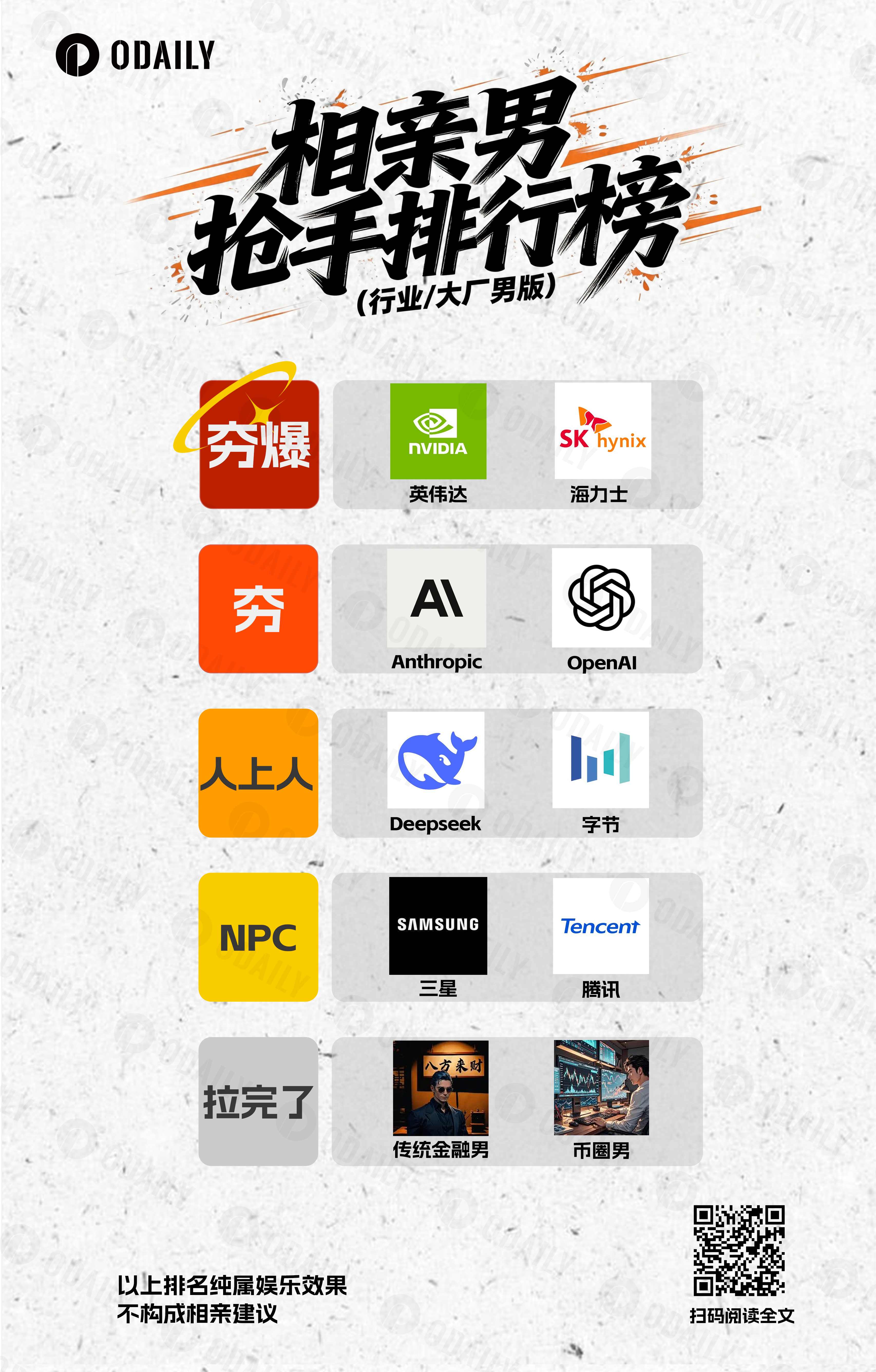
Exploding: NVIDIA & SK Hynix
If there is currently a "version T0" in the dating market, it undoubtedly belongs to NVIDIA and SK Hynix.
The former is the largest "money printer" in the AI world.
As the demand for AI computing power continues to explode, NVIDIA has become one of the biggest beneficiaries of the global AI wave. After the U.S. stock market opened yesterday, NVIDIA's stock price reached a new historical high; at the same time, Wells Fargo also raised its target price again and maintained an "overweight" rating.
The capital market has gradually formed a consensus: in today's era, GPUs are no longer just chips but "oil" in the AI world.
On the other hand, what has truly driven the South Korean dating market crazy is the almost outrageous scale of bonuses for SK Hynix employees.
Last year, SK Hynix modified the "Excess Profit Distribution (PS)" system, agreeing to allocate 10% of operating profits directly to the bonus pool while removing the cap on bonuses.
The result is:
With the demand for HBM (High Bandwidth Memory) skyrocketing, Hynix employees' bonuses have begun to enter the "hundred million won era."
Last year, SK Hynix revised the distribution method of the "Excess Profit Distribution (PS)," agreeing to allocate 10% of operating profits to the bonus pool and eliminating the annual salary cap.
The company's operating profit for the fiscal year 2025 reached 47.2 trillion won, which means that over 30,000 Hynix employees can expect an average bonus of 140 million won (approximately 650,000 RMB) based on 10%.
In the first quarter of this year, the average bonus for its employees had already reached 107 million won, equivalent to about 500,000 RMB. Furthermore, according to forecasts by international investment bank Macquarie, the operating profit of SK Hynix is expected to soar to 447 trillion won by 2027, with an average employee bonus reaching 1.29 billion won, roughly 6.1 million RMB.
With such generous rewards, Hynix employees are not only extremely sought after in the dating market, but they are also beginning to seriously consider "internal digestion."
An anonymous employee stated: "Recently, mutual attention among unmarried employees has noticeably increased. After all, the economic synergy of marrying a colleague is too great; office romances are now being seriously viewed as a strategic choice."
Once bonuses start being calculated in "hundreds of millions of won," "office romance" suddenly shifts from being the biggest headache for HR to a form of family asset allocation. Due to the close linkage between performance bonuses and attendance, many employees have even begun to actively avoid taking maternity leave. Workplace couples have even remarked: "With hundreds of millions of won in bonuses at stake, who can afford to take time off?"
SK Hynix employees are no longer just engineers; they resemble AI concept stocks in the South Korean dating market.
Therefore, NVIDIA, with the halo of being "the company with the highest market value globally," and SK Hynix, the "bonus myth maker," undoubtedly occupy the top tier of this ranking, rated as "exploding."

A clip from the South Korean variety show SNL: "Hynix work clothes as a luxury brand pass."
Hot: Anthropic, OpenAI
If NVIDIA and Hynix represent AI infrastructure, then OpenAI and Anthropic symbolize the hottest "new aristocrats" of the AI era.
In the past year, the valuations of the two companies have skyrocketed. At the same time, employee wealth has begun to enter a true "monetization phase."
In October last year, OpenAI completed an astonishing round of employee stock cashing. According to The Wall Street Journal, over 600 current and former employees collectively cashed out 6.6 billion dollars (approximately 48 billion RMB) in this transaction. About 75 individuals hit the cap, with each obtaining 30 million dollars. Following this year's 852 billion dollar valuation after a 122 billion dollar financing, recently OpenAI even lifted the restrictions on employee stock sales. After completing a new round of financing in April this year, OpenAI has further relaxed the restrictions on employee stock sales.
Anthropic's situation is similar.
In April this year, Anthropic conducted another round of employee equity sales at a valuation of 350 billion dollars, but due to employees' reluctance to sell, many investors were unable to purchase the expected shares.
Unlike the "paper options" stories from the previous round of the internet era, these AI companies have truly begun to allow employees to cash out their "equity wealth" for safe keeping.
In other words: the actual wealth levels of these AI company employees have far surpassed those of most large company employees from the traditional Internet era.
However, compared to the "stable cash flow money printers" like NVIDIA and Hynix, OpenAI and Anthropic are more akin to "high volatility high growth assets."
Thus, we temporarily assign them a "hot" rating.

Superior People: Deepseek, ByteDance
One of the biggest changes in the bull market is that global internet companies have begun to realize: the most valuable assets are no longer GPUs, but people, especially AI talent.
In December last year, ByteDance was reported to plan a significant increase in AI investment; this year, with the upgrade of its AI strategy, its investment in AI has reached an astonishing level of 200 billion RMB.
At the same time, ByteDance's valuation has also continued to rise. According to recent market news, ByteDance's valuation has now exceeded 600 billion dollars, up 50 billion dollars from three months ago.
In April this year, it launched a new round of employee stock repurchase, with the repurchase price for employees set at 229.5 dollars, appreciating 14.52% from the last price; the repurchase price for former employees is 201.96 dollars per share, appreciating about 11.97% from the previous round, thus significantly increasing employee wealth.
On the other side, DeepSeek is also launching its own "AI talent defense war."
As some core personnel leave successively, Liang Wenfeng from DeepSeek needs to use equity to retain his core team.
In May, there was initially news that Deepseek sought financing at a valuation of 45 billion dollars; subsequently, the news of Deepseek planning to raise 50 billion RMB officially became public.
It is worth mentioning that there are reports stating that the external financing for Deepseek's 50 billion target is only 30 billion RMB, with Liang Wenfeng covering the remaining 20 billion RMB through internal fundraising. As the owner of the quantitative fund Huansquare, Liang Wenfeng undoubtedly has the strength to do so, and the 70 billion RMB from Huansquare, with a 58.5% annualized return, gives him great confidence.
Clearly, while OpenAI and Anthropic use dollars to retain talent, Chinese AI companies are beginning to wage their own AI talent war using RMB.
In today's market, those who can sit at the AI main table are already extremely scarce high-level players.
Therefore, whether it is ByteDance or DeepSeek, their employees in the dating market are rated as "superior people."
NPC: Samsung, Tencent
If the companies mentioned earlier have boarded the AI high-speed train, then Samsung Electronics and Tencent are more like players still struggling to find "AI tickets."
Let's start with Samsung.
For decades, "Samsung people" have been one of the strongest professional halos in South Korean society. However, in the AI era, Samsung has unexpectedly become a subject of reevaluation by the market.
Due to missed initial layouts in HBM, wrong technological route choices, and product certification issues, Samsung has gradually been suppressed by Hynix in the AI memory competition.
At the same time, Samsung employees have also started to "look towards Hynix." Recently, the national union of Samsung even planned to initiate a large-scale strike, demanding the company raise the bonus proportion and cancel the cap on bonuses. If these conditions are not met, Samsung's union will launch a large-scale 18-day strike starting May 21. According to Morgan Stanley's estimates, this could result in a loss of 40 trillion won, and cause a decline in the output of DRAM and NAND chips.
It must be said that it is understandable why SK Hynix employees in the dating market "pretend" to be Samsung employees.
Negotiation breakdown, Samsung's large-scale strike might become inevitable.
On the other hand, Tencent's situation is also not easy.
Compared to ByteDance's aggressive AI investments, Tencent appears much more cautious. Previously, Tencent's president Liu Chuangping had stated that the company's AI investment in new products last year was about 18 billion RMB, which is expected to double this year; however, compared to the thousands of billions invested by ByteDance in AI, the gap remains clear.
At the same time, Tencent also faces the problem of slowing growth in traditional business.
On May 13, Tencent released its Q1 2026 financial report, showing revenue of 196.458 billion RMB, a year-on-year growth of 9%; Non-IFRS operating profit of 75.63 billion RMB, also a year-on-year growth of 9%. Overall, the revenue and profit growth rate has slowed to single digits, and AI investment has dragged down short-term gross margins; in terms of game performance, domestic market game revenue was 45.4 billion RMB, a year-on-year increase of 6%, with revenue growth lagging behind the growth in local market game receipts.
This is also an important reason why Tencent did not take a proactive stance in Deepseek's financing earlier. Previously, there was media news stating that Tencent proposed to subscribe to no more than 20% of DeepSeek's shares, but DeepSeek did not want to relinquish a large percentage of control.
This has also sparked increasing discussions in the market: Does Tencent really have the genuine "ticket" to the AI era?
After all, Tencent once created the most expensive "Noah's Ark" of the mobile internet era—WeChat; but in the AI era, no one knows who will ultimately secure the new ticket.
Therefore, we temporarily rate the employees of Samsung and Tencent as—"NPC."
Played Out: Traditional Finance Men, Crypto Circle Men
Lastly, compared to the employees of the above AI giants, traditional finance men and crypto circle men are gradually losing the rewards of this era.
The reason is quite simple: the most sought-after professions of an era often represent that era's core wealth distribution rights.
In the past few decades: the finance industry represents capital, the internet industry represents traffic; the crypto circle represents getting rich overnight.
But AI has begun to redefine everything.
Compared to the AI giants with bonuses in the hundreds of thousands and stock cash-outs in the hundreds of millions, traditional finance men and crypto circle men suddenly appear to be somewhat "out of sync" with the times.
Especially against the backdrop of sustained AI development in the U.S. stock market, structural market conditions in the A-share, and the loss of newfound wealth effects in the crypto circle, the aura of "financial elites" and "crypto circle gods" has faded.
Based on the current dating market conditions and elder judgment standards, the above two groups can only be rated as "played out" in the dating market.

Iconic profile of a traditional finance man.

Current status of crypto circle men.
Do you think this rating is reasonable? Do you have any other rating references? Feel free to leave your thoughts and views in the comments.
Also attached is the rating generator from "Hot" to "Played Out": https://tool.dayun.cool/ranking
免责声明:本文章仅代表作者个人观点,不代表本平台的立场和观点。本文章仅供信息分享,不构成对任何人的任何投资建议。用户与作者之间的任何争议,与本平台无关。如网页中刊载的文章或图片涉及侵权,请提供相关的权利证明和身份证明发送邮件到support@aicoin.com,本平台相关工作人员将会进行核查。


