Author: Chloe, ChainCatcher
SpaceX will be listed on Nasdaq today, raising approximately $75 billion with a valuation of over $1.8 trillion, and has already been severely oversubscribed. This massive IPO, which merges rockets, Starlink, the social platform X, and xAI, brings forth an old issue: nearly all of the offering price allocation is reserved for institutions, while retail investors are only able to chase higher prices after the listing, and non-U.S. retail investors often lack the qualifications to subscribe.
Regarding this IPO, there are at least three mechanisms allowing retail investors to enter the market ahead of or simultaneously with other investors: TradeXYZ, xStocks, and Alpaca, corresponding to synthetic perpetual contracts, tokenized equity, and real stocks from regulated brokers. All three companies carry the name SpaceX, but the rights they offer are completely different. This article uses this IPO as a reference point to analyze each mechanism's structure, regulation, and risks, while assessing their actual significance for retail investors in Asia.
The “first day gap” of the IPO is where retail investors are truly blocked
The scarcity of an IPO does not lie in the inability to purchase stocks, but in the inability to buy “stocks at the offering price.” The allotment at the offering price is determined by the underwriting syndicate, prioritized for institutions and large clients. Retail investors must wait to enter the secondary market after the listing, while hot IPOs often experience significant gaps on their first day, and this price difference is the invisible bonus of institutional quotas.
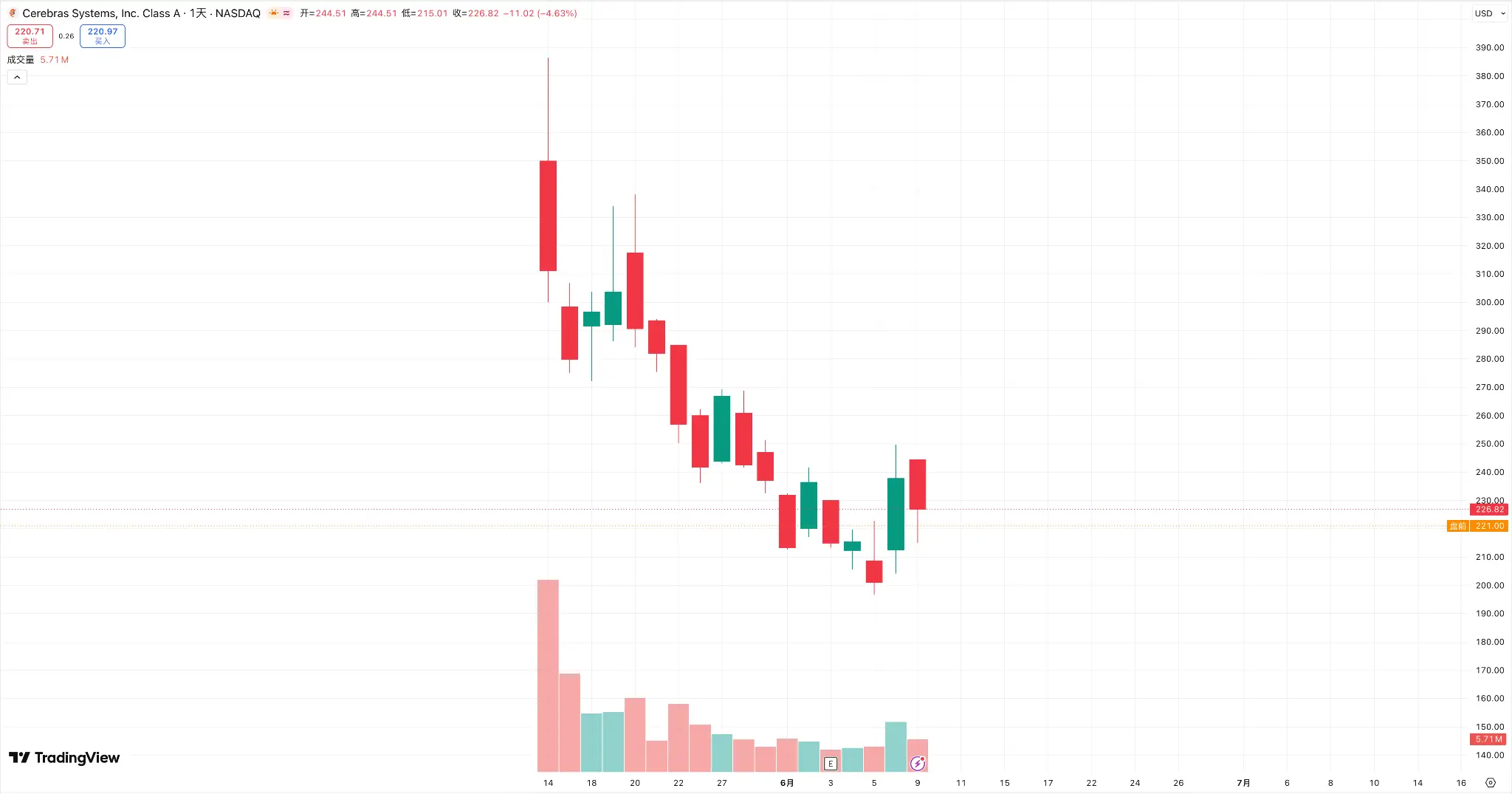
A clear example of this is AI chip maker Cerebras, which just listed on May 2026. Its offering price was raised twice, ultimately set at $185 per share, selling 30 million shares and raising $5.55 billion, making it the largest tech IPO in the U.S. since Uber in 2019.
However, those who obtained the offering price earned more than just the $185 price; the stock opened at $350 and at one point soared to $385 (over double the offering price), closing its first day at $311 with an increase of about 68%. In other words, institutions that received quotas at $185 and retail investors who could only buy on the secondary market at $350 find themselves at completely different starting lines at the moment of listing.
This structure becomes even more evident in bull market years. According to data cited by Alpaca, there were 1,331 global IPOs in 2025, raising $177 billion, a 44% year-on-year growth, with 216 companies listed in the U.S., raising $47.4 billion, with AI, crypto, space, and defense being the hottest themes.
After SpaceX, the market is also awaiting potential follow-up listings from OpenAI, Anthropic, and others. For cryptocurrency exchanges, this is a market that was previously out of reach but might be pried open with blockchain, leading to the emergence of three completely different entry mechanisms almost simultaneously.
The same SpaceX has been broken down into three completely different products
Products in the market under the name SpaceX actually belong to three different tracks; they overlap in name only, with differing rights.
The first is Pre-IPO perpetual contracts, represented by TradeXYZ, which also includes Coinbase, turning the expected listing price directly into a perpetual market for long and short positions, with investors holding synthetic positions backed by no actual stock.
The second is tokenized IPO subscriptions, represented by xStocks, used by Kraken and Bybit, allowing users to subscribe at the offering price before stocks are listed and receive tokens supported 1:1 by actual shares after the listing, gaining price exposure but not shareholder status.
The third is real broker subscriptions, represented by Alpaca, which allows investors to acquire registered real stocks in their own names at the offering price through a regulated brokerage and underwriting channel.
These three representative and distinct platforms: TradeXYZ in the perpetual track, xStocks in the tokenized subscription track, and Alpaca which provides real stock settlement for all of this. They form a spectrum from the “most synthetic” to the “most real”, breaking the same SpaceX down into contracts, tokens, and stocks.
Exchanges are the “facade”, mechanisms are the “tracks”
Before delving deeper, there is a layer that needs clarification to avoid confusion: TradeXYZ, xStocks, and Alpaca are not three parallel exchanges but rather three different levels of roles.
xStocks is a framework for issuing and settling tokens, Alpaca is the underlying infrastructure for brokers, both of which are not directly facing retail investors but rather serve exchanges or apps, functioning more like “tracks”; TradeXYZ, on the other hand, is a perpetual contract product running on Hyperliquid, more like “a vehicle running on a certain track.” The exchanges that truly face users, like Kraken, Bybit, and Coinbase, are the “facade.”
After clarifying this point, one can understand "why multiple mechanisms can be presented on the same exchange." The most typical example is Kraken, which offers xStocks for non-U.S. users allowing tokenized subscriptions, while for U.S. users, it shifts to Alpaca combined with ClickIPO to facilitate access to real stocks through its traditional brokerage, Kraken Securities, since xStocks is not registered in the U.S. under the Securities Act and is not open to U.S. investors.
In other words, the same SpaceX circulates internationally in the form of tokens or perpetual contracts but must return to Alpaca's most traditional track in the U.S. market, reverting to a regular stock for settlement. For Alpaca, no matter how the outer packaging changes, the underlying real stock always requires a regulated entity to hold and settle, and that is its gamble.
A comparison of the three mechanisms: a spectrum from synthetic to real
What investors actually hold
The greatest difference lies in what investors hold.
TradeXYZ provides a perpetual contract position, with no underlying stock, offering pure synthetic price exposure
xStocks offers a token, each backed 1:1 by a real share, but holders only gain price exposure without legal ownership
Alpaca provides real stocks registered in the investor's name
For the same SpaceX, it corresponds to a contract, a token, and a stock on these three tracks after listing.
Entry timing and regional thresholds
All three can enter before or on the day of the listing, but the scope of access varies greatly.
TradeXYZ requires no permission and trades directly on-chain with no regional whitelist
xStocks opens to over 110 countries, including the European Economic Area, but excludes the U.S., U.K., Canada, and Australia
Alpaca follows the traditional broker market, and U.S. users must rely on this route to participate
In terms of trading hours, both TradeXYZ and xStocks operate 24 hours, while Alpaca is limited to traditional trading hours.
Regulation, protection, and risk
The hierarchy of regulatory intensity is exactly the opposite of the previous two points.
Alpaca is regulated by the SEC and FINRA, with SIPC protection; its main risk is that the quotas from traditional IPOs are not guaranteed, and investors must bear price fluctuations after listing.
The underlying stocks of xStocks are held by regulated custodians, but the tokens themselves are not registered under U.S. securities laws, exposing investors to counterparty risks from issuers and custodians, as well as the inability to exercise shareholder rights.
TradeXYZ operates as a decentralized contract without corresponding investor protections, additionally compounding leverage, funding rates, and liquidation risks.
The value of tokenized products ultimately depends on whether the underlying legal structure holds up, not just on the price displayed on the interface. When these factors are layered together, a spectrum from synthetic to real emerges: the closer to the native design of crypto, the fewer regional and temporal limits, the quicker the entry, but the thinner the assets held by investors and the protection; the more towards traditional brokers, the more complete the holdings and protections, yet flexibility becomes restricted.
When “owning a company” starts to have three versions
Putting the three together reveals that the real change is not just whether “retail investors can enter the market,” but that the act of “entering the market” itself is being disassembled. In the past, IPOs were a moment, a one-time allocation determined by the underwriting syndicate who could enter at the offering price; now TradeXYZ allows people to trade expectations before listing, xStocks allows continuous buying and selling during the weekend of listing day, and Alpaca compresses subscriptions into a single API call, turning an IPO from a singular event into a continuously traded exposure curve with varying rights.
This also continues the main trajectory of convergence between crypto and Wall Street over the past year. Traditional finance has gradually brought advantages such as trading hours, settlement speeds, and fractional shares onto the chain, while crypto platforms have turned back to address custody, compliance, and underwriting relationships that were previously deliberately avoided, with Kraken's dual-track approach of xStocks and Alpaca being the most concrete reflection of this convergence.
In the short term, there will likely not be a single winner among these three mechanisms; instead, each may occupy a segment on the spectrum. Those seeking extreme flexibility and leverage will participate in perpetual contracts; those who seek price exposure without regard to ownership will hold tokens, while those who want real equity and protections will return to brokers. The listing of SpaceX on June 12 will be the first test of these three mechanisms competing on the same large asset, warranting our ongoing observation.
免责声明:本文章仅代表作者个人观点,不代表本平台的立场和观点。本文章仅供信息分享,不构成对任何人的任何投资建议。用户与作者之间的任何争议,与本平台无关。如网页中刊载的文章或图片涉及侵权,请提供相关的权利证明和身份证明发送邮件到support@aicoin.com,本平台相关工作人员将会进行核查。


