
Author: @hiiinternet
Translation: Peggy
Editor's Note: The outside world often imagines Anthropic as an AI laboratory composed of PhDs, researchers, and cutting-edge model experts, but the breakdown of the resumes of 1,680 engineers provides a more realistic answer: the core of Anthropic is not just "research," but "building."
This article analyzes 5,306 LinkedIn profiles that list Anthropic as their current employer and further filters out 1,680 engineers' resumes, arriving at a counterintuitive conclusion: the most core talent profile at Anthropic is not the "researchers" imagined by the outside world, but a group of experienced "builders" (people who can actually put together, run, and scale large systems).
Data shows that Anthropic's engineering team has rapidly formed in the past 18 months: currently, more than half of the engineers have been employed for less than a year, but new hires are generally very seasoned, with a median of 12.2 years of work experience prior to joining, and many coming from companies known for engineering capabilities and infrastructure such as Google, Meta, Amazon, Microsoft, Stripe, Databricks, Snowflake, Palantir.
This also explains the real focus of Anthropic's engineering organization: compared to the model research that the outside world is concerned about, it resembles a highly engineered infrastructure company. The backgrounds of its engineers are mainly concentrated in infrastructure, backend, distributed systems, databases, and security; PhDs account for only 13.7%, with most being experienced engineers with undergraduate or master's degrees.
Early career talents are not completely without opportunities, but the threshold is equally high: internships at top tech companies, competition results, published papers, or experience in AI safety/alignment projects often serve as filtering signals in place of years of work experience.
The author's final suggestion is also very direct: if you want to join Anthropic, do not write your resume as if applying to a research lab, but highlight the large-scale systems you have truly built, scaled, and maintained. The underlying competition in cutting-edge AI is increasingly approaching a competition of engineering capability and infrastructure capacity.
The following is the original text:
Builders, Not Researchers
I scraped all LinkedIn profiles that list Anthropic as their current employer, totaling 5,306 people. I then filtered out 1,680 who were actually in engineering positions and further examined 7,986 records in their past job descriptions to analyze what they were doing before joining Anthropic.
Here are the results.
Expanded the Organization Almost Overnight
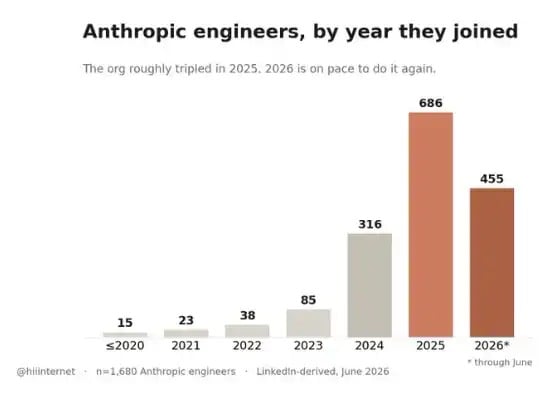
Only 15 engineers joined Anthropic before 2021 and are still employed there. By 2025, the engineering team of the organization had nearly tripled, adding 686 engineers that year; the hiring rate for 2026 is expected to be comparable, with 455 added by June.
Currently, half of the engineering team has been with Anthropic for less than a year. 53% joined within the past 12 months. Median tenure: 10 months.
This is a large organization that has almost been built in about 18 months.
Almost Exclusively Hiring Senior Engineers
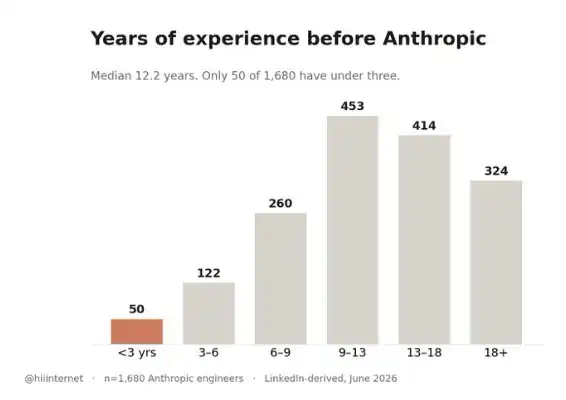
The median prior work experience before joining Anthropic is 12.2 years. The middle 50% have 8.8 to 16.5 years of experience. Among these 1,680 people, only 50 have less than 3 years of work experience. 44% have 13 years or more of work experience. There is virtually no recruitment for fresh graduates.
In other words, a typical new hire at Anthropic is an engineer with 12 years of experience, who has been at Anthropic for only 10 months.
Clearly More Focused on Infrastructure Than Traditional Research
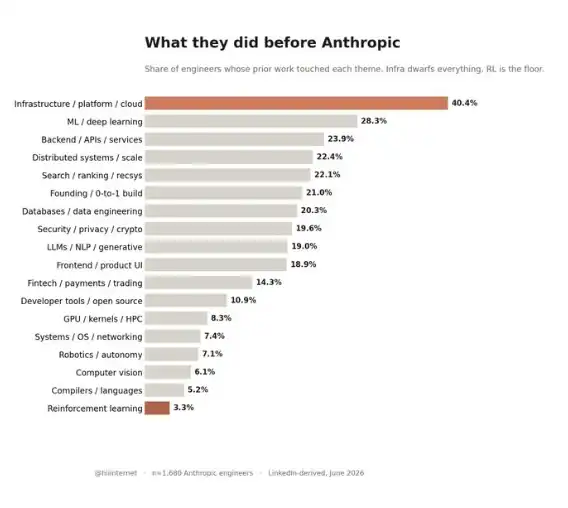
Infrastructure backgrounds appear in 40% of engineers' resumes. Backend, distributed systems, databases, and security each account for about 20%. Reinforcement learning, the "RL" in RLHF, appears in only 3.3% of resumes.
A typical Anthropic engineer usually spends the past decade building large-scale production systems at either a massive cloud provider or an infrastructure-heavy startup.
The skills they list also illustrate the same point: Python 585 people, Java 566 people, C++ 443 people, JavaScript 376 people, SQL 302 people, Linux 230 people, distributed systems 189 people, AWS 154 people. Those jobs that sound more "exciting" in model training certainly exist, but they account for a very low percentage.
The Largest Talent Source Is Not Labs, but Google
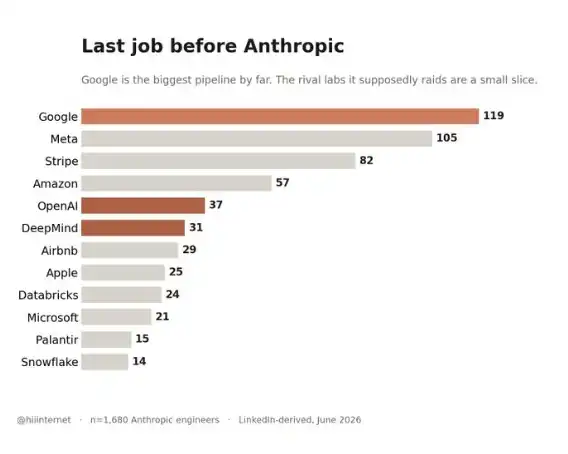
Everyone thinks that Anthropic primarily recruits from OpenAI and DeepMind. But its largest talent pipeline, by far, is Google. Those competing labs are just small columns in the middle of the chart.
Anthropic clearly prefers companies known for their engineering rigor: Stripe, Databricks, Snowflake, Palantir, Airbnb.
If we look at where these engineers have historically worked, the ranking is: Google 405 people, Meta 273 people, Amazon 197 people, Microsoft 171 people, Stripe 124 people, Apple 87 people, Stanford 68 people, DeepMind 62 people, Airbnb 51 people, OpenAI 48 people. In the current engineering team, half of the people, or 50%, have at least one mention of FAANG in their resumes.
Of course, they also recruit from other AI labs. OpenAI is one of the top five direct sources, DeepMind is one of the top six direct sources. About 94 engineers have directly transitioned from other cutting-edge AI labs to Anthropic.
The Myth of the PhD
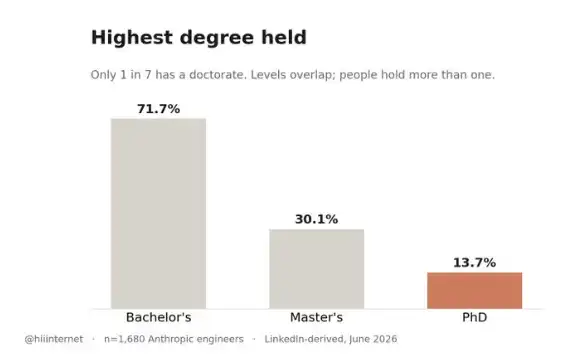
Only 13.7% of people hold a PhD. About one in seven.
The typical recruitment target for Anthropic is not research scientists, but experienced engineers with undergraduate or master's degrees. The notion that "the entire lab is PhDs" is fundamentally wrong at the engineering team level.
The distribution of professional backgrounds also aligns perfectly with the profile of a "building organization": computer science 819 people, followed by mathematics 78 people, physics 70 people, computer engineering 69 people. Philosophy also makes the top 20, with 13 people, possibly related to the safety direction.
Stanford Clearly Leads in Recruitment Sources
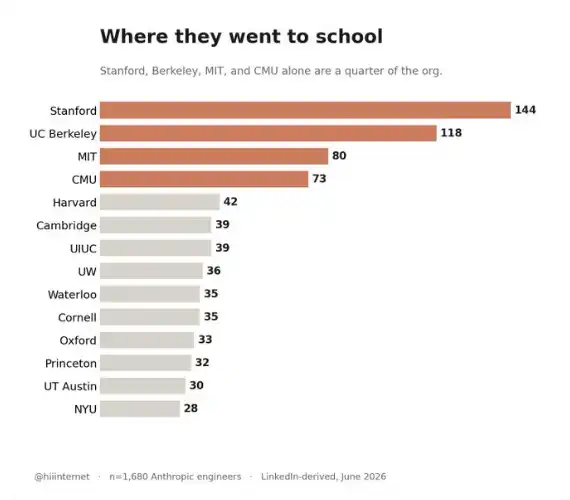
From a school perspective, the historical cumulative ranking is: Stanford 144 people, Berkeley 118 people, MIT 80 people, CMU 73 people, Harvard 42 people, Cambridge 39 people, UW 36 people, Waterloo and Cornell each 35 people, Oxford 33 people, Princeton 32 people. The top four schools together account for a quarter of the entire engineering team.
80% of people hold the same job title.
"Member of Technical Staff."
A former Instagram CTO, several former founders of Adept, and Stanford faculty, all hold the title of "MoTS" at Anthropic. This flattening of job titles is clearly intentional. Qualifications and specific functions are deliberately obscured.
Where Should Early Career Individuals Look to Enter Anthropic?
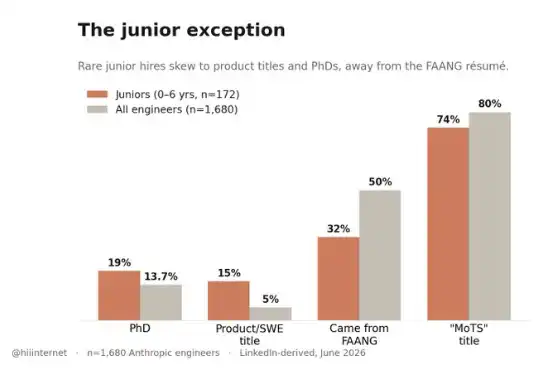
There are 172 engineers with less than 6 years of work experience, among them 50 have less than 3 years. But they are not ordinary fresh graduates. They can be roughly divided into two categories, with almost no ordinary mid-level engineers in between.
Compared to the entire engineering team, they present distinctly different characteristics: the proportion of PhDs is higher, at 19%, while the overall is 13.7%; the proportion of product/SWE titles is three times that of the overall, at 15%, while the overall is only 5%; their probability of having a FAANG background is also much lower, at only 32%, while the overall is 50%.
What replaces work experience for them is another form of prestige capital:
Internship pipelines. 50% of them listed internships from the following companies: Meta 16 people, Google 10 people, DeepMind 6 people, Microsoft 5 people, Amazon 5 people, as well as Jane Street, Two Sigma, HRT, Optiver, Nvidia.
From quantitative trading to AI labs. 9% have worked at top trading firms, including Jane Street, Two Sigma, Five Rings, HRT, Optiver, Citadel. This is a group of young talents from math/computer competitions who enter AI labs through the high-frequency trading industry.
Alignment-oriented fellowships. 6% of them have been involved with MATS, SERI, Redwood, or ARC. This is an entry point that is almost exclusively open to early talents and is nearly nonexistent in senior groups.
A very clear profile is: MIT, IOI silver medalist, Codeforces score over 2900, directly entering research in reinforcement learning and safety after four years of work. Their screening criteria are not work experience, but competition rankings and paper publications.
These young engineers are also more international than their senior counterparts. The school sources of lower seniority engineers include: Berkeley 15 people, Stanford 14 people, Cambridge 10 people, MIT 7 people, Tsinghua 7 people, Oxford 6 people, along with Imperial, NUS, Shanghai Jiao Tong University, ETH Zurich.
So, how should you interpret this information?
If you want to join Anthropic as an engineer, do not write your resume as if applying to a research lab, but write it as if applying to an infrastructure company. Showcase the systems you have truly built and scaled. That is the kind of resume that is getting hired.
The early career stage is the only exception. At this stage, the threshold is not ordinary work experience, but top internships, competition rankings, or papers.
If you are competing with Anthropic for talent, your target audience is not "PhDs" or "lab backgrounds" per se, but seasoned builders from massive cloud providers or companies with strong engineering reputations: they generally have about 12 years of experience and may come from Stripe, Databricks, Snowflake, Palantir. Anthropic is already fishing vigorously in this talent pool.
免责声明:本文章仅代表作者个人观点,不代表本平台的立场和观点。本文章仅供信息分享,不构成对任何人的任何投资建议。用户与作者之间的任何争议,与本平台无关。如网页中刊载的文章或图片涉及侵权,请提供相关的权利证明和身份证明发送邮件到support@aicoin.com,本平台相关工作人员将会进行核查。


