
Author: Axiom Investment, founder of Liquid Capital (formerly LD Capital) Yi Lihua and his team established or led AI investment funds.
By the end of 2025 to the first half of 2026, as other sectors (some overvalued growth, cyclical, purely narrative themes) fade, while AI Capex continues to be raised above expectations, semiconductor and data center-related stocks significantly outperform, market consensus is truly formed — "AI is no longer one of the themes but has become the absolute main line of the global capital market." With research on undervalued AI companies in the US stock market, Axe Compute has become a key focus for us this year. Recently, on July 22, the announcement of an additional $1.3 billion in AI computing power contracts greatly strengthened our confidence in Axe’s investment. If the contracts can be implemented in an orderly manner and the data can truly reflect in the financial reports, we believe that "Axe Compute, currently valued at less than $100 million, may become the most undervalued GPU computing entry in the US stock market."
1. A Glamorous Turn from Pharmaceuticals to AI Computing Power
Before rebranding in December 2025, Axe Compute was formerly known as Predictive Oncology Inc. (NASDAQ: POAI), a typical small-cap biotech company in the US stock market. As a typical “small-cap biotech stock,” POAI’s performance during the pharmaceutical stage was mediocre: revenue long stagnated at hundreds of thousands of dollars, continuous losses, market capitalization hovering in the tens of millions of dollars, and extremely low capital market attention.
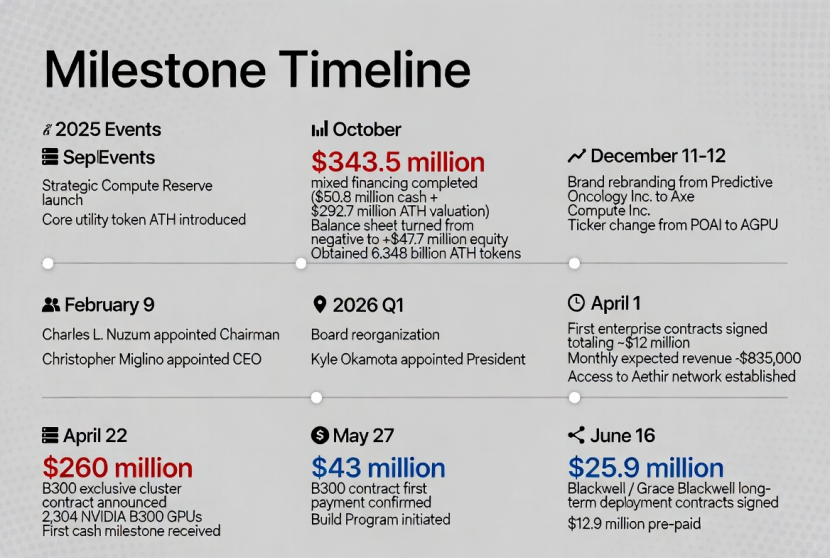
In September 2025, the company suddenly launched the Strategic Compute Reserve, explicitly stating that the core is the Aethir native utility token (ATH), continuing the Crypto Treasury strategy narrative, suggesting a shift towards AI narrative and computing power business.
In October 2025, the company completed two simultaneous PIPE financings, totaling $343.5 million, consisting of $50.8 million in cash + $292.7 million nominal value of ATH for a mixed financing method. Through this financing, the company's balance sheet shifted from negative equity to a positive $47.7 million gain, acquiring 6.348 billion ATH and formally establishing a deep binding with the Aethir network, allowing a capital operation model that combines AI computing narrative + treasury company. From then on, the company entered the observation horizon.
On December 11-12, 2025, the company rebranded, changing its name from Predictive Oncology Inc. to Axe Compute Inc., and its ticker from POAI to AGPU, continuing to trade on Nasdaq.
At the end of the first quarter of 2026, Axe Compute officially began operating as a new cloud service provider, with the related party of the crypto project Aethir potentially becoming the largest shareholder, conveying a signal of comprehensive transformation to the financial market.
On February 9, Charles L. Nuzum was appointed as chairman, Christopher Miglino (who previously participated in the ATH transaction structure design) was appointed as CEO, and in March, the board was restructured, with Kyle Okamoto (former Aethir CTO/GM) as President.
On April 1, the company completed enterprise-level commercial access to the Aethir distributed GPU network (over 400,000 GPU containers, more than 200 locations, 93 countries), signing the first batch of contracts worth approximately $12 million. The contracts mainly pertain to the Immediate Access Program, contributing an expected revenue of approximately $835,000/month, with payment methods being prepaid + monthly prepayment, which has begun to contribute a small amount of compute revenue (actual recognition of approximately $7,000 in Q1).
On April 22, 2026, the company disclosed a $260 million exclusive cluster contract (Build Program first order), with core contract terms: a 36-month take-or-pay agreement, delivering 2,304 NVIDIA B300 GPUs + AI high-speed storage (US Tier-3 data center, 4.8 MW dedicated power). Structured deposit + prepayment + monthly prepayment, with quarterly revenue expected to be approximately $21 million after going live in Q3 2026.
On May 27, 2026: confirmed receipt of a $43 million first payment for the B300 contract, marking the first true cash milestone for contracts, confirming that the Build model has been initiated as planned, with hardware procurement and deployment in progress.
On June 16, 2026: executed a $25.9 million Blackwell / Grace Blackwell long-term deployment contract (12 months + 24 months, with renewals possible), of which $12.9 million has been prepaid.
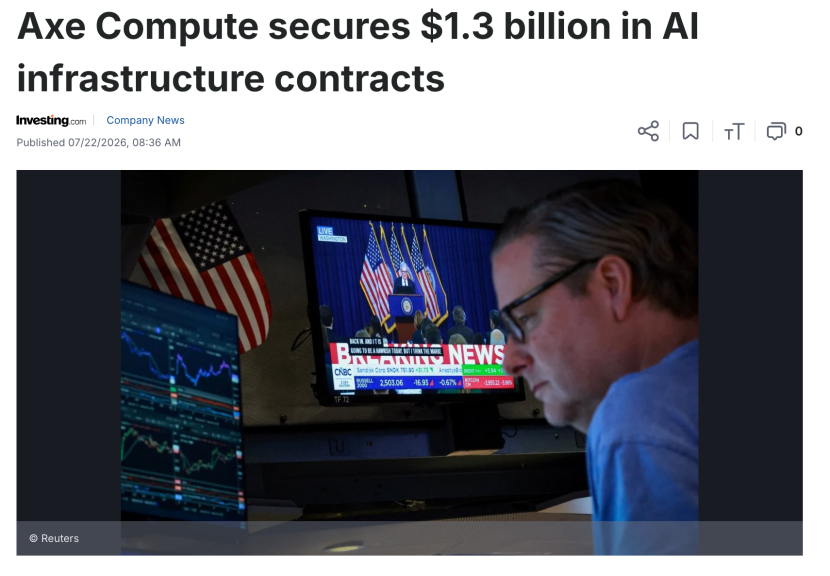
On July 22, 2026: announced an additional $1.3 billion AI infrastructure customer contract, based on five-year agreements, with the option to renew, requiring a substantial upfront payment, while including provisions for continuous upgrading of GPUs with the launch of a new generation. Revenue is expected to begin accruing at the end of Q4 2026, with upfront payments due in Q3 2026, at which point the annual recurring revenue (ARR) will exceed $384 million, this $1.3 billion order should mark the true starting point for the market to reconsider Axe.
2. Multiple AI Computing Solutions, Highly Flexible "Coreweave": Dissecting Axe's Business Model
Axe Compute Inc. is a technology company focused on providing high-performance computing infrastructure for artificial intelligence (AI) workloads. By obtaining large-scale GPU capacity from hardware manufacturers and infrastructure providers, it deploys this to enterprise customers through long-term service agreements; service scope includes hardware procurement, data center hosting, networking, storage, and financing. Axe also retains its tumor drug research and development solutions business, but this is not currently the company's main business.
1. Axe's business is divided into two product lines:
(1) Immediate Access Program
Targeted at clients who require rapid go-live and flexible scaling. Leveraging existing GPU inventory of the Aethir distributed network, deployment can be completed in as fast as 48 hours, covering over 200 global nodes. Suitable for inference, fine-tuning, and small to medium scale training scenarios, charged monthly based on reserved capacity.
(2) Build Program / AI Factory
Designed for ultra-large scale, long-term dedicated computing power needs. Axe is responsible for overall architecture design, data center site selection and power negotiation, hardware financing arrangements, and the final enterprise-level Service Level Agreement (SLA) operations, "design-deploy-own-operate."
The $260 million three-year mega contract landed in April 2026 is a landmark case for this model. The company plans to procure a dedicated cluster composed of 2,304 NVIDIA B300 graphics cards from a tier three data center facility in the US, alongside AI-specific high-speed storage infrastructure with 4.8 megawatts of dedicated redundancy power, specified deployment locations, and service standards, with deployment work scheduled to complete in Q3 2026. Utilizing structured payment arrangements, an initial $43 million has been received. Over the 36-month service period, the company is expected to recognize approximately $21 million in revenue quarterly.
In June 2026, the company also signed a $25.9 million long-term deployment contract with Blackwell and Grace Blackwell, covering two major scenarios: inference infrastructure and simulation platforms. $12.9 million has been received as a prepayment.
In July 2026, the Build business line secured an additional more than $1.3 billion in five-year long-term AI infrastructure contracts in the US and Europe, significantly exceeding the annual signing target of $1 billion. Project prepayments are expected to be received in Q3 2026, with sustained revenue confirmed starting at the end of Q4 2026, and once all clusters are operationally stable, corresponding annual recurring revenue will exceed $384 million. Management has stated that current market demand is robust and related revenue will be counted in the annual recurring revenue (ARR) for 2027, continuously opening up medium to long-term growth space.
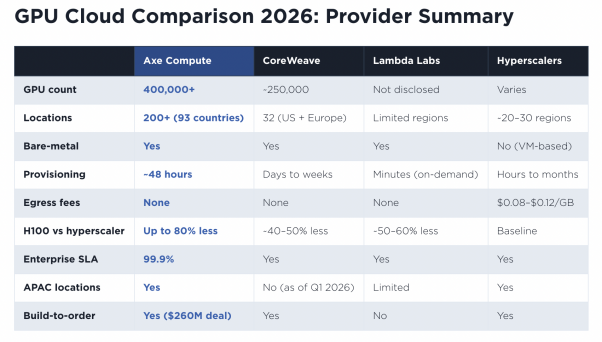
2. Reinterpreting Axe’s Build computing power business, the best comparison is with Coreweave, one being the leading centralized training entity, the other a new global mixed computing power force:
CoreWeave follows a heavy asset, centralized, deeply entrenched training scenario route, operating 49 large AI data centers across North America and Europe, with approximately 250,000 high-end GPUs, utilizing InfiniBand high-speed interconnect networks and Kubernetes-native orchestration to create mega cluster training capabilities at a single site, with ultra-large scale distributed training performance ideal for the billion parameter training of leading AI labs like OpenAI, Meta, and Microsoft. It went public on Nasdaq in March 2025, and in January 2026 secured an additional $2 billion strategic investment from NVIDIA, already becoming a benchmark enterprise for dedicated AI compute clouds (Neo-Cloud). However, due to all data centers being concentrated in North America and Europe, the intercontinental transmission causing network latency of 80~150 milliseconds, coupled with various countries' data residency compliance requirements, has barred CoreWeave from many regional markets in Asia-Pacific, the Middle East, and Latin America.
Axe Compute follows a mixed model, distributed, globally covered path. On one hand, it integrates global third-party data center resources through the Aethir distributed computing network, deploying over 200 computing nodes across 93 countries, providing access to over 435,000 GPUs in total. On the other hand, it is vigorously expanding a new cloud business worth over $1 billion focused on assets. This allows it to penetrate the large-scale customized computing power market, serving all types of GPU buyers and AI companies.
3. Financial Analysis:
Axe Compute’s financial performance for the first quarter ending March 31, 2026.
Press enter or click to view image in full size
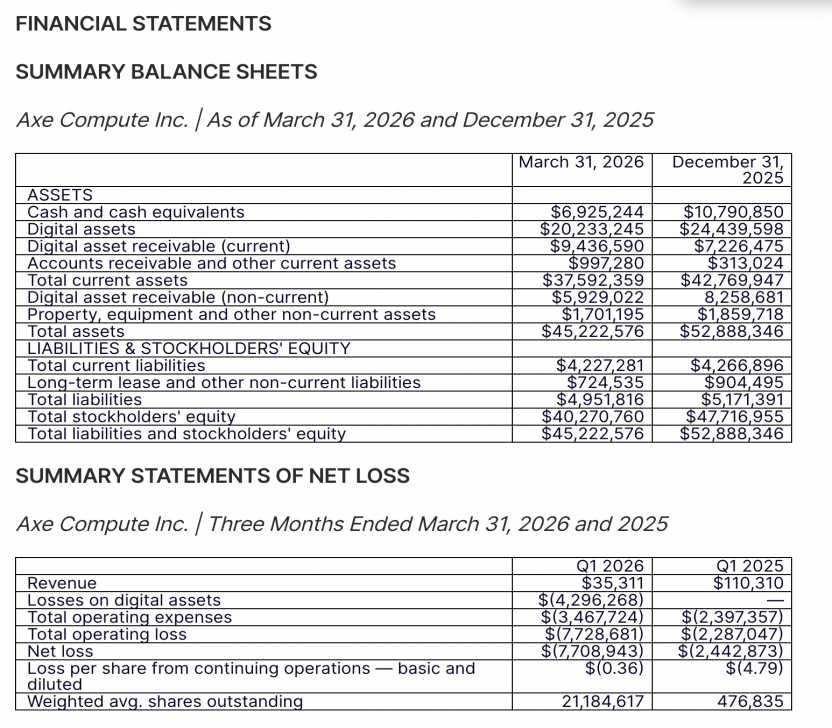
As of March 31, 2026, the company held $6.9 million in cash and cash equivalents, $20.2 million in ATH digital asset holdings (approximately 2.83 billion tokens), and $9.4 million in current digital asset receivables, totaling approximately $36.5 million in liquidity pool. Management believes this is sufficient to support operations through the fiscal year 2026 and beyond.
Q1 2026 revenues were $35,000, compared to $110,000 in Q1 2025. Sales in Q1 2026 mainly came from the traditional drug discovery services sector, with the computing services sector contributing only $7,000. According to the company, the $43 million B300 mega order’s initial payment was received in May, and in June a $25.9 million Blackwell series long-term contract was newly added, both have not yet been converted into revenue in the profit and loss statement.
Once the $260 million exclusive cluster goes live in Q3, approximately $21 million in computing power revenue can be recognized in a single quarter, equivalent to 600 times the total revenue of the first quarter. Assuming the $1.3 billion order officially goes live in Q4, quarterly revenue could increase by an additional $65 million to $86 million, representing a quarterly growth of over 400%, the company is standing at the exploding tipping point from quarterly revenue in the hundreds of thousands to millions.
Q1 2026 net loss was $7.7 million. The net loss includes a non-cash mark-to-market loss of $4.3 million from the company's ATH digital asset holdings. Accounts receivable as of March 31, 2026, were $659,000, compared to $32,000 as of December 31, 2025. Accounts receivable and contract liabilities both significantly increased this quarter, reflecting the monthly prepayments that Compute Services customers need to pay after project launches at the end of Q1.
Axe Compute CEO Christopher Miglino stated, "Our goal this year is to sign contracts worth $1 billion, and the contracts signed in July have far exceeded that target... We believe signing contracts valued at $2 billion this year is not out of reach, which will help enhance next year's annual recurring revenue (ARR)." Combined with his public statements in the first half of the year, Axe Compute currently has potential business orders exceeding $4 billion and has signed contracts over $1 billion, targeting a total of $3 billion in contracts this year.
4. Valuation Analysis:
Model 1: FY2026E Forward Price-to-Sales (P/S)
Annual revenue estimate
Below are the confirmed orders released by the official, based on these contracts, the certain revenue for FY2026 is approximately $125 million.
Press enter or click to view image in full size
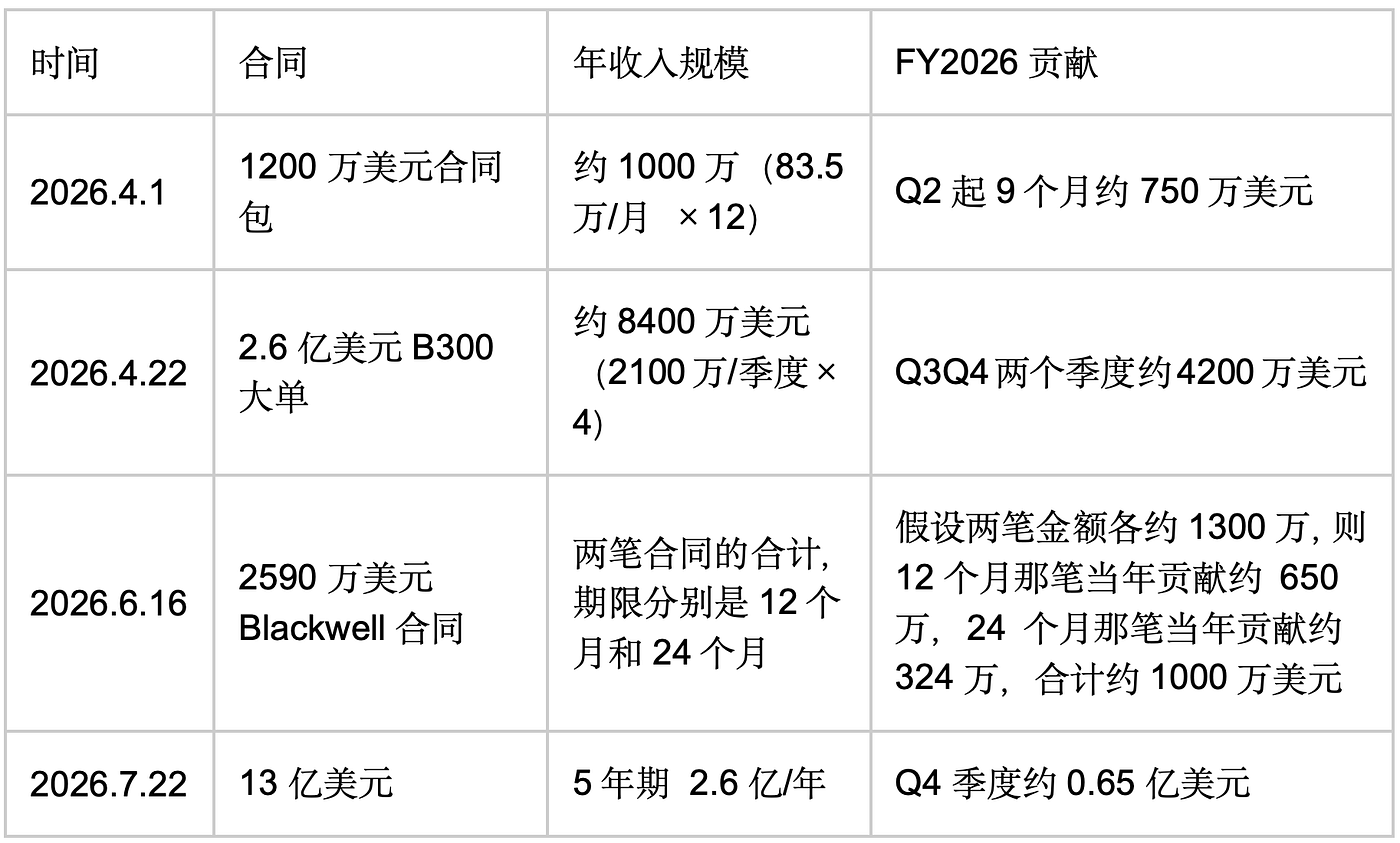
Three Wall Street analysts predict average revenue for AGPU in 2026 at $163,935,524, with a minimum estimate of $157,505,455 and a maximum estimate of $168,752,872. This value reaches $254,372,663 in 2027, with a minimum income forecast of $244,405,017 and a maximum income forecast of $261,853,600. Currently, we conservatively estimate that the confirmed revenue will be around $125 million.
CoreWeave's Forward PS is approximately 3.88 times, and Axe Compute’s actual confirmed revenue for 2026 is approximately $125 million, with total shares at 11.385 million and a current price of $6.85.
Axe’s market value = $125 million × 3.88 = $485 million
Corresponding stock price: $485 million ÷ 11.385 million shares ≈ $42.60/share
Relative increase multiple from current price: $42.60 ÷ $6.85 ≈ 6.21 times
Model 2: P/ARR (Forward Scenario Estimation)
The ratio of total market capitalization to annual recurring revenue (ARR) is a commonly used steady-state valuation metric in the computing infrastructure sector, better reflecting the inherent value of a company’s long-term stable cash flow, adapted to business models centered around multi-year locked computing contracts. This time we refer to the industry leader CoreWeave's July 2026 P/ARR valuation center at about 2.4x as a fair pricing benchmark for mature computing service providers.
As of now, the entire long-term order backlog of Build business can reach an annualized steady-state recurring revenue (ARR) of $384 million.
Axe’s reasonable total future market value = $384 million × 2.4 = $921.6 million
Corresponding target stock price = $921.6 million ÷ 11.385 million shares ≈ $80.94/share
Relative upside space from the current price: $80.94 ÷ $6.85 ≈ 11.8 times
Overall assessment indicates that Axe’s stock price has an upside potential of 6–11 times, and the current market value is severely undervalued. The above assessment does not set valuation discounts for the differences in business scale and maturity of the two companies, actual reasonable valuation centers may exist downwards.
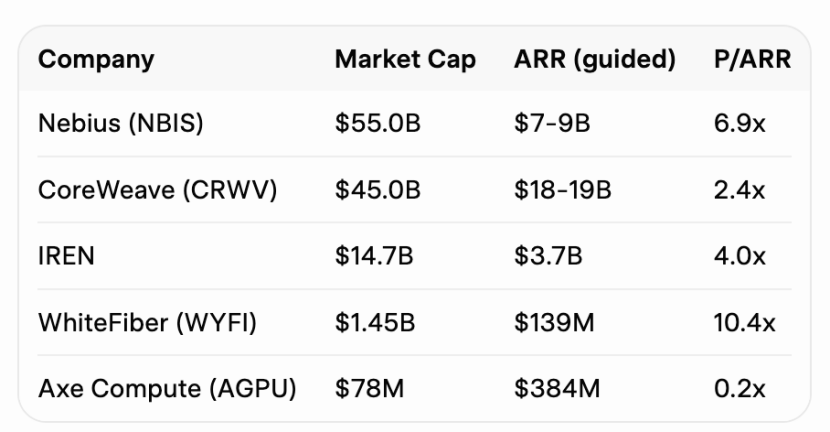
From horizontal comparisons with peers, AGPU’s current market pricing shows significant mismatches with its business scale and growth potential. As of now, the company's market value is only about $8 million, while based on the long-term contracts already landed, it guides an ARR of $384 million, corresponding to a P/ARR of only 0.2 times. In comparison, peers like Nebius, CoreWeave, IREN, and WhiteFiber have P/S on ARR of 6.9 times, 2.4 times, 4.0 times, and 10.4 times respectively. Even considering that AGPU is still in the early commercialization stage, and revenue recognition pace has not fully released, its valuation level is still far below the industry average. As the B300 exclusive cluster and subsequent contracts exceeding $1 billion contribute revenue in the second half of 2026, the company's ARR is expected to be quickly realized next year, providing significant safety margins and flexibility for investors with the currently very low valuation multiples.
Press enter or click to view image in full size
3. Capital Model Design of AI x Crypto: “Compute + Treasury” Dual-Driven Model
In addition to the expectation of astonishing data from the Compute business, AGPU also features an imaginative flywheel model, namely the ATH Treasury strategy. Unlike the purely coin-hoarding BTC and ETH treasury companies, ATH is housed within a business that generates positive cash flow. Compute orders directly drive ATH demand and settlement, Treasury value adds back to Compute expansion, creating a self-reinforcing positive flywheel.
1. What are ATH and Aethir?
The Aethir network is a decentralized physical infrastructure network developed by Panama foundation DCI Foundation (referred to as "DCI"). The Aethir network aggregates enterprise-grade GPUs contributed by independent data centers, enterprises, and other hardware owners into a globally distributed network. This network is aimed at providing immediate GPU computing resources for AI training and inference, cloud gaming, and other virtualized computing workloads, often at prices lower than centralized cloud providers. Within the network, three roles jointly ensure the availability, applicability, and quality of computing resources: "container," which is the actual container executing the computation; "checker," used for testing and monitoring the containers to verify their integrity and performance; and "indexer," which matches computing resource users with suitable containers. Buyers of computing resources use the network's computational resources.
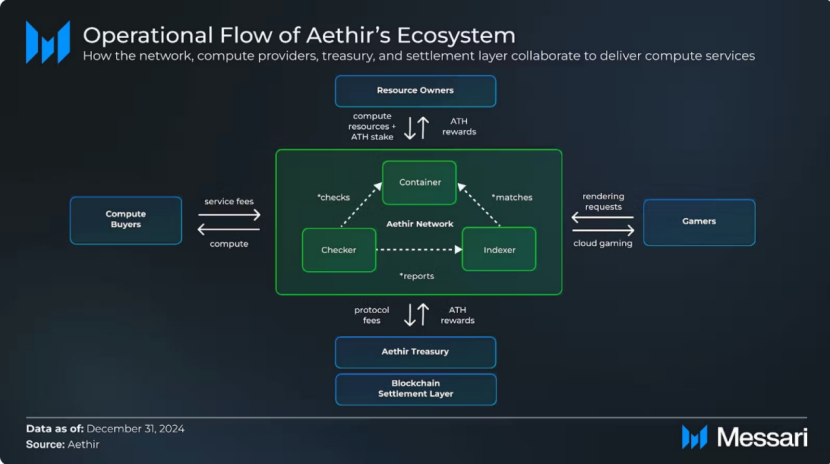
ATH, as the unit of GPU computing capacity, serves as the trading medium and incentive unit for participants in the Aethir network. To become a supplier of computing resources, network participants need to acquire ATH and stake it as collateral to contribute GPU resources and qualify for handling computation requests. After computing resources are delivered and verified, ATH flows from users of the computing resources to the resource providers as payment and rewards. Providers earn ATH through "capacity proof" rewards (to maintain availability and readiness) and "delivery proof" rewards (for completing workloads), along with service fees paid by users of computing resources. Service providers can re-stake, hold, lend, or sell the received ATH. Aethir's treasury manages protocol fees and allocates ATH for protocol development, while the blockchain settlement layer is responsible for recording transactions and facilitating the transfer of ATH.
2. Axe and ATH's Capital Design
The capital structure of ATH Treasury is not a simple "buy and hold" model; rather, through a two-layer design, it deeply binds Axe Compute's business entity with the Aethir (ATH) ecosystem, forming a business-capital-token Trinity closed loop. The core advantage of this design is that each Compute order, once landed, will translate into incremental demand and value capture for ATH in the future, rather than relying solely on external market liquidity and sentiment like traditional treasury companies.
(1) Axe's Access business is conducted within the Aethir network.
The Access model (Immediate Access) is the core of AGPU's light asset expansion, and its fundamentals completely rely on the Aethir distributed GPU network (over 400,000 GPU containers, over 200 locations, covering 93 countries). Once enterprise customers place orders through AGPU's Access platform, computational tasks are executed directly in the Aethir network. Each invocation of an order consumes or stakes ATH, creating real demand.
Each Access order = directly drives ATH demand + generates positive cash flow (prepaid revenue). This design makes AGPU's Access business a "natural demand engine for ATH." It ties business growth to ATH prices — more orders lead to more ATH consumption/staking, providing stronger price support.
(2) Axe's treasury strategy: Hold ATH and form strategic reserves.
AGPU's Treasury strategy is an upgraded version of BTC/ETH treasuries; companies like MicroStrategy passively hold BTC as "digital gold," depending on external Bitcoin halvings and market cycles for returns, lacking inherent cash flow support. AGPU's ATH, however, is "embedded" within a Compute business that produces positive cash flow. ATH is not just a reserve; the Aethir network uses ATH for staking and settlement, while Axe’s Access business operates on it, naturally forming a closed loop.
3. How AGPU and ATH's Positive Flywheel Operates
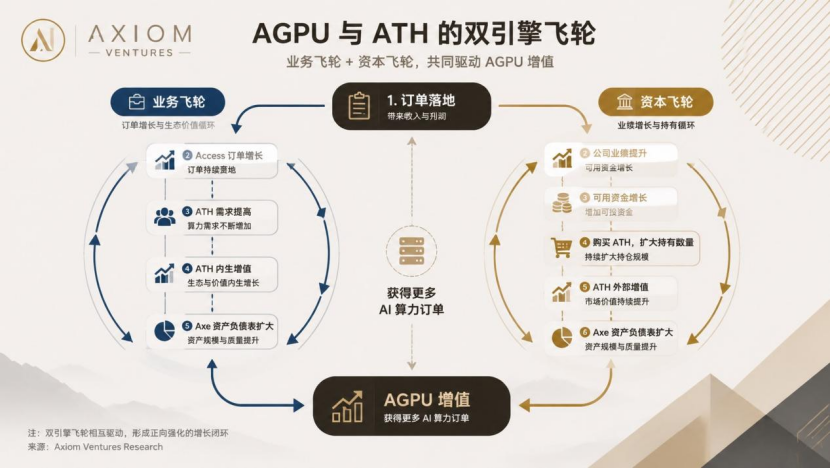
(1) AGPU and ATH's business flywheel: A "demand-order-appreciation" loop driven by the Access model.
Order landing, Access order growth — increased ATH demand — endogenous value appreciation of ATH — expansion of Axe's balance sheet — value appreciation of AGPU — acquiring more AI computing orders.
(2) AGPU and ATH's capital flywheel: “Performance-Funds-Enhanced Acquisition” cycle driven by Treasury value appreciation.
Order landing — improvement in company performance, increased available funds — purchase of ATH, increasing ATH holdings — external appreciation of ATH — expansion of Axe's balance sheet — value appreciation of AGPU — acquiring more AI computing orders.
The business flywheel provides endogenous demand and cash flow (Access orders directly feed ATH demand). The capital flywheel provides leveraged appreciation and asset expansion (Treasury increases amplifying ATH price effects), forming two deeply nested driving models — performance and ATH price jointly drive AGPU price growth and performance expansion. This model may become a new paradigm of the “AI x Crypto” capital model.
4. Potential Risk Variables for Axe
The story of Axe Compute (AGPU) holds significant imagination, and current market pricing does not reflect optimistic expectations for future contract landing and ATH reserve value. However, as with any high-elasticity growth target, the story is ahead of financial realization, and valuations are more based on future GPU contract delivery and ATH price performance, rather than confirmed revenue and profit. Historical revenue remains at an extremely low base, and the real conversion of large orders and verification in financial reports requires time. Below are the main risk variables that investors need to carefully assess.
1. Contract Execution and Delivery Risks
The Build Program is key for AGPU's transition from light asset Access to semi-heavy asset customized clusters. The $260 million exclusive B300 cluster (approximately $21 million in quarterly revenue post Q3 2026 launch) and subsequent $1.3 billion global customer contracts have been signed. However, execution risks still exist concerning hardware procurement, data center coordination, power deployment, and enterprise-level SLA landing. If the launch cannot be completed on time or client acceptance is delayed, revenue recognition may be postponed, affecting cash flow and market confidence.
2. Revenue Conversion and Financial Report Validation Risks
Q1 2026 revenue was only $35,000 (with very minimal contribution from Compute services), while nearly $1.6 billion orders signed have not yet significantly converted into revenue. Wall Street analysts project an average revenue expectation of approximately $164 million for 2026, but these predictions include assumptions about conversions in the second half of the year. If order landing is slower than expected, actual revenues may fall well below consensus. Non-cash mark-to-market losses on ATH will continue to fluctuate, and increases in accounts receivable and contract liabilities also reflect potential bad debt risks under the prepayment model.
3. Macro and Market Valuation Risks
If AI Capex is downgraded due to economic slowdown or technological iteration, order demand may be affected; tightening GPU supply, energy costs, and data center compliance requirements may increase execution costs. Forward P/S and P/ARR projections are both based on assumptions that financial data can be realized; actual reasonable valuation centers may be discounted due to differences in scale and maturity, and current high elasticity also implies amplified volatility.
Overall, the story of Axe Compute is ahead of financial realization, with the pace of revenue recognition and the next season or half-year financial reports being key validation windows. The above risk variables are not exhaustive; investors should conduct their own due diligence, fully understand the relevant risks, and make independent decisions based on their own risk tolerance.
In summary, AGPU has completed a remarkable transformation from traditional biotechnology to an AI GPU Compute entry in less than a year, with a business model that covers a hybrid AI computing solution of light asset "Access model" + massive cluster construction and leasing "Build model," and has achieved an impressive $1.6 billion in order contracts. Coupled with the "Compute + Treasury" dual-driven model, combined with the business model, asset reserves, and unpriced valuation assessments, relative to the current stock price, AGPU holds considerable growth potential 6–11 times, making it a high-elastic target worth focusing on in the wave of assetization in AI computing power.
免责声明:本文章仅代表作者个人观点,不代表本平台的立场和观点。本文章仅供信息分享,不构成对任何人的任何投资建议。用户与作者之间的任何争议,与本平台无关。如网页中刊载的文章或图片涉及侵权,请提供相关的权利证明和身份证明发送邮件到support@aicoin.com,本平台相关工作人员将会进行核查。


