Author: Claude, Deep Tide TechFlow
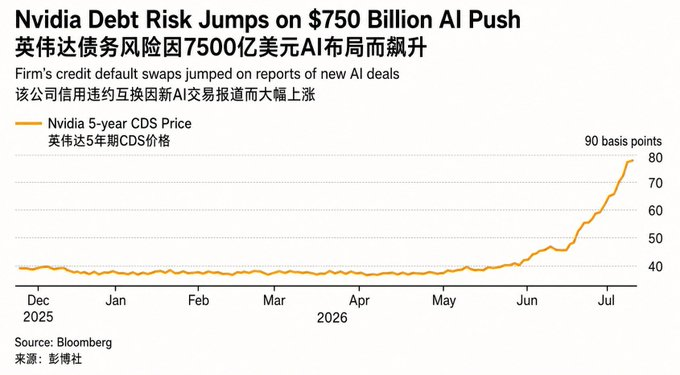
Deep Tide Overview: On July 27, the cost of five-year default insurance for Nvidia briefly surged around 14 basis points to 82 basis points during the day, marking the largest intraday increase since the contract began active trading in November 2025. The trigger point was a report by the Wall Street Journal disclosing that Nvidia is negotiating approximately $250 billion in guarantees for OpenAI to lease a 10-gigawatt data center in Ohio, coupled with a $500 billion letter of intent from South Korea's SK Group last week, creating an exposure of over $750 billion within a week. On that day, Nvidia fell 4.99%, yielding the title of the world's most valuable company to Apple.
On July 27, US stocks closed with Nvidia down 4.99% at $196.51, bringing its market value down to approximately $4.77 trillion. Apple rose about 1% that day, with a market capitalization nearing $4.95 trillion, reclaiming the title of the world's most valuable company. Nvidia had held this position since June 2025 when it overtook Microsoft, and its market value briefly surpassed $5 trillion in October of last year.
What is more worth watching than stock prices is the reaction of the credit market. According to Bloomberg, data from ICE Data Services indicated that the cost of buying five-year default protection for Nvidia's debt rose about 14 basis points during the day, peaking at approximately 82 basis points annually, marking the largest intraday increase since the contract's active trading began in November 2025.
An Intraday Jump of 14 Basis Points: The First Indication from the Debt Market on Nvidia’s Signing
CDS (Credit Default Swaps) are insurance purchased by bondholders to prevent default by the issuer; the higher the quote, the more the market believes the probability of default is increasing, or at least demands more compensation to bear this risk. An 82 basis points cost means that purchasing five-year protection for $100 million of Nvidia's debt would cost $820,000 annually.
Nvidia's CDS only began active trading in November 2022, which is a short history; therefore, the term "record" should be taken with caution. Michael Kramer from Mott Capital Management calculated last week that a quote of 65 basis points roughly corresponds to a cumulative five-year default probability of about 5%, which is not a high absolute level. He also mentioned an unusual phenomenon: while Nvidia's CDS widened, the stock price continued to rise. This divergence ended on Monday, with both stocks and bonds moving downwards.
Nvidia's credit rating remains near the highest tier. The debt on June had a rating of Aa1 (outlook positive) from Moody's and AA from S&P.
$250 Billion Guarantee: OpenAI is Borrowing Against Nvidia’s Balance Sheet
On July 26, the Wall Street Journal reported that Nvidia is negotiating to provide about $250 billion in financing guarantees for OpenAI to lease a 10-gigawatt data center park being developed by SB Energy, a SoftBank subsidiary, in Pickerington, Ohio. The guarantee covers the lease and construction debts but does not include the Nvidia chips within the park. The financing for chip procurement is another negotiation, potentially reaching $350 billion. The total cost of the entire project, including chips, exceeds $500 billion, with the first phase of approximately 800 megawatts expected to be operational by 2028.
The function of this guarantee is very direct. OpenAI is valued at $852 billion but does not have an investment-grade credit rating and is still operating at a loss. Lenders are unwilling to provide such long-term funding based on OpenAI’s credit alone, but with Nvidia's AA-rated balance sheet, SB Energy can borrow based on Nvidia’s credit rather than the tenant's credit.
Scale is a concern. Nvidia disclosed in its Q1 10-Q for fiscal 2027 that the maximum total exposure limit for guarantees of partner facilities is $3.5 billion, of which $712 million is held in a custodial account. The company accounts for these guarantees as credit derivatives and states that their fair value is not significant. The $250 billion is about 70 times this number, close to Nvidia's total assets of $259.5 billion at the end of April.
The difference between guarantees and investments lies in the revenue structure. If OpenAI pays on time, Nvidia earns nothing; if OpenAI cannot pay, Nvidia is liable up to the guarantee amount. This is a liability that only has downside, with no upside.
Along with SK Group's $500 Billion, Accumulated $750 Billion in One Week
On July 24, Nvidia and South Korea's SK Group announced the signing of a letter of intent with a collaboration scope exceeding $500 billion. The contents include SK Telecom building a 2-gigawatt AI factory using Nvidia's Vera Rubin DSX platform and SK Hynix's HBM4 memory, with the first facility expected to start production in 2027; Nvidia is establishing a long-term memory supply and joint development relationship with SK Hynix. Jensen Huang announced this number while meeting with South Korean President Yoon Suk-yeol in San Francisco, without specifying the method of calculation or the execution timeline.
Combining the two amounts exceeds $750 billion. Bloomberg attributed the spike in CDS on Monday directly to this total, stating that the market is concerned that Nvidia is assuming more and more obligations.
The external dependencies of the Ohio project also need to be noted. The park is built on federal land, which is the former site of a uranium enrichment plant from 1954 to 2001. SB Energy is leasing rather than purchasing the land, circumventing the usual site selection approval cycle. Power supply relies on 9.2 gigawatts of new gas-fired generation, plus a $4.2 billion transmission project with AEP Ohio, funded by a $33.3 billion commitment from Japan under the US-Japan trade agreement. Secretary of Commerce Gina Raimondo holds the power distribution rights for this land, and Anthropic, Microsoft, and Google have all approached her in recent weeks. This means that the realization of this guarantee has variables outside of Nvidia and OpenAI’s control.
Oracle is Already at 196 Basis Points, Nvidia's 82 Basis Points Are Not Expensive
Using competitors from the same space as a reference, Nvidia's position is still quite favorable. Oracle's five-year CDS rose to 196.6 basis points on July 20, reaching a historical high for the company, exceeding levels during the 2008 financial crisis, with its stock price dropping about 37% year-to-date. Kramer calculated that Oracle's CDS implies a default probability of about 16%, whereas this figure was only 3.5% in September of last year.
The primary market was also not tense six weeks ago. On June 15, Nvidia priced a $25 billion investment-grade bond, the first issuance since 2021, with orders reaching $85 billion at one point, with seven tranches extending to 2056, and a coupon rate of 4.250% to 5.625%, with spreads over US Treasuries of 20 to 65 basis points.
What has been truly sold is the stock. The iShares Semiconductor ETF has fallen by 14% in the past month, while Nvidia has only risen about 4% year-to-date, and Apple has risen about 24% during the same period. Apple's strategy of avoiding heavy capital expenditures and relying on leased computing power has outperformed companies that opt for self-building this year.
For those holding Nvidia, the 82 basis points itself does not constitute a signal; the speed does. It took one trading day to rise from 68 basis points to 82 basis points, while Oracle took over half a year to reach 196 basis points.
Circular Financing Changed Shells: From Buying Equity to Signing Guarantees
Nvidia has been supporting downstream demand with its own money, which is not a new practice. In January 2026, it invested an additional $2 billion in CoreWeave at $87.20 per share; in February, the original $100 billion commitment to OpenAI was canceled, replaced with a $30 billion investment in OpenAI's $110 billion financing round for equity; in March, it invested $2 billion in Nebius and participated in a $2 billion financing for Thinking Machines. Huang stated at that time that the $30 billion for OpenAI and $10 billion for Anthropic could be the end of the largest equity checks.
Four months later, the same structure has been transformed into guarantees.
Matthew Bryson from Wedbush stated that Nvidia's investments and constructions are "completely falling into" the circular investment theme that raises market concerns about sustainability, while also asserting that if executed properly, this strategy can build competitive barriers. Mizuho chip analyst Jordan Klein said it more straightforwardly: "It sounds like you are prepaying for your own GPUs." Nvidia has consistently denied that any contract requires partners to use this money to buy its chips.
The difference in accounting treatment explains why the debt market reacted first this time. Equity investments go into the balance sheet, while guarantees are accounted for at fair value as derivatives, turning into real cash outlays only when triggered. Such contingent liabilities do not appear in the current financial statements’ liabilities but will impact the CDS quotes. Monday was this process.
免责声明:本文章仅代表作者个人观点,不代表本平台的立场和观点。本文章仅供信息分享,不构成对任何人的任何投资建议。用户与作者之间的任何争议,与本平台无关。如网页中刊载的文章或图片涉及侵权,请提供相关的权利证明和身份证明发送邮件到support@aicoin.com,本平台相关工作人员将会进行核查。


