Why they are starting to favor the use of cryptocurrency as a backend, and the role of cryptocurrency companies in this upgrade.
Written by: Prathik Desai
Translated by: Block unicorn
Last year, a company's securities trading volume was about $47 trillion, which is more than 35 times the global GDP. This month, that company—the Depository Trust & Clearing Corporation (DTCC)—began using blockchain technology to process these transactions.
One of the largest upgrades in the global financial sector currently involves the replacement of infrastructure. Clearinghouses are not the only ones. Information cooperatives connecting over 10,000 banks worldwide and card organizations covering 200 million merchants are rebuilding their asset transfer infrastructure, with blockchain at the core of this upgrade.
Some industries that have long held a disdain for cryptocurrency are now rapidly adopting cryptocurrency infrastructure.
In today’s article, I will explain why they are starting to favor the use of cryptocurrency as a backend, and the role of cryptocurrency companies in this upgrade.
Cost Issues
Today, if you buy Microsoft stock on the New York Stock Exchange (NYSE), it still takes an entire day for it to be legally transferred to your name. This is because the infrastructure for stock ownership transfer was designed for the paper stock era. It took humanity over 60 years to achieve the dematerialization of stocks and speed up the entire operation of the stock market. However, the infrastructure for the transfer of funds and assets still follows the design from the paper stock era.
If you think this is just a convenience issue, you are being too naïve. Any delay in the processing of asset and cash flow can lead to economic losses.
Take cross-border bank payments as an example. Most global banks pre-fund accounts in different countries and currencies so that payments can settle across different time zones. They use local deposits and central bank reserves to settle cross-border transactions without waiting for real-time arrivals in different time zones.
Even when stock traders have put up margin, those funds are idle and cannot generate any returns. Settlements stop on Friday night and resume after work on Monday, while people continue their lives over the weekend. While this was not initially intended to cause inconvenience, we still have to pay for using this infrastructure even when there have been faster and cheaper alternatives.
Meanwhile, major exchanges are extending trading hours to cope with market changes. The London Stock Exchange just announced the launch of the LSE 24 trading platform, which will start in the first half of 2027 and offer 23.5 hours of trading service from Monday to Friday. The Chicago Mercantile Exchange (CME) switched its cryptocurrency futures trading to operate 24 hours a day in May. Nasdaq also plans to launch a 23-hour trading day later this year.
Despite extended hours in trading departments, trade settlement still lags. This further hinders trading and leads to funds being frozen.
This tax has grown to account for more than one-fifth of global GDP.
Last year, global corporate cross-border payment amounts exceeded $30 trillion, with annual transaction costs exceeding $120 billion.
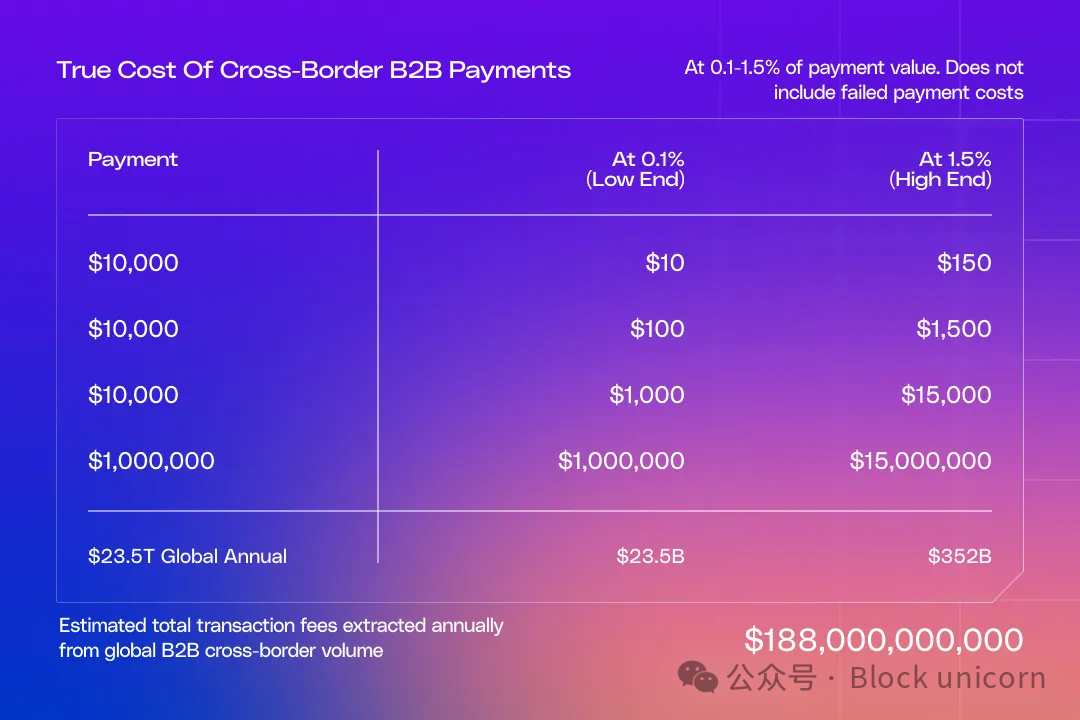
This is the cost that traditional financial infrastructure operators have begun to notice from this issue.
In July 2026, they started to take concrete steps to replace traditional infrastructure with cryptocurrency rails.
Infrastructure Switch
On July 15, DTCC, a pillar of the U.S. financial market, conducted its first live trading of tokenized securities. These transactions involved tokenized versions of original listed company stocks, treasury bonds, and ETFs.
As part of DTCC's first on-chain transactions, JPMorgan converted its holdings of the Invesco QQQ Trust (QQQ, one of the most actively traded and liquid ETFs in the world) into tokenized form and deposited it as margin with the Chicago Mercantile Exchange (CME). Over 30 companies, including Goldman Sachs, BlackRock, Vanguard, and the New York Stock Exchange, participated in this transaction. These tokens were traded on production infrastructure through methods such as repurchase, collateral, securities lending, and clearinghouse margin.
Only a few months remain before DTCC's tokenization services are set to launch in October 2026.
This infrastructure improvement allows us to quantify the economic benefits that a more efficient system can bring to capital markets. In May 2024, the U.S. stock settlement cycle was shortened from two days to one day. The one-day reduction in the settlement cycle reduced the margin that members must hold at the clearinghouse by $3 billion, a decrease of 23%, from an average of $12.8 billion in the T+2 cycle to $9.8 billion in the T+1 cycle.
If a country's stock market can release $3 billion in collateral by saving a day, then shortening the settlement time for stocks, treasury bonds, repurchases, and foreign exchanges to a few minutes—whether for cross-border transactions or over the weekend—could potentially yield exponential value.
This is the commercialization of blockchain. Stablecoin transfers cost only a few cents, settlements can be completed in seconds, and transactions can occur anytime and anywhere. On the other hand, tokenized securities can be traded at any time and can serve as collateral without having to wait until traditional infrastructure opens on Monday.
This is why traditional infrastructure operators are gradually accepting the use of cryptocurrency rails as backend services. Because if they do not, they risk handing their business over to competitors who provide the same services to customers at lower prices and faster speeds.
Cryptocurrency infrastructure enables clients to utilize their funds more efficiently by eliminating idle time. Securities that are not settled until tomorrow cannot be used as collateral today. In contrast, tokenized securities can complete pledges and lending in just a few minutes and operate around the clock. The liquidity of collateral determines whether capital operates intermittently or continuously.
Just nine days ago, SWIFT, which coordinates payment information among over 11,500 institutions, indicated that 17 banks from six continents, including Citibank, HSBC, UBS Group, Standard Chartered, and MUFG, are preparing to pilot tokenized deposits on its new shared ledger.
Tokenized deposits are a type of bank deposit that is not time-restricted. Blockchain technology allows for rapid transfers of funds overnight or even over weekends while still retaining the bank's claim on the funds. For users who avoid using bank-issued stablecoins due to the lack of Federal Deposit Insurance Corporation (FDIC) protection, tokenized deposits are the ideal alternative. Tokenized deposits offer users the same convenience as stablecoins while ensuring the safety of users' funds without regulatory oversight.
I previously wrote about this in my article "Defending Deposits."
Even credit card networks like Visa are adopting cryptocurrency infrastructure.
On July 16, Cuy Sheffield, head of Visa Crypto Labs, announced the launch of a platform that allows banks to mint, transfer, and redeem stablecoins within their existing treasury systems while hiding each key, gas fees, and chains from customers.
The biggest attraction for traditional financial giants to adopt cryptocurrency infrastructure as a backend lies in their ability to pass cost and time savings on to their vast customer base. Currently, approximately 15,000 financial institutions and over 200 million merchants are connected to the Visa network.
Its competitor Mastercard has expanded its bank stablecoin settlement options for six regulated stablecoins based on its early pilots and initial deployments.
Mastercard now supports settlement using Circle's USDC, Paxos's PYUSD, USDG and USDP, Ripple's RLUSD, and SoFi's SoFiUSD. These stablecoins will be enabled on a range of supported blockchain networks, including Arbitrum, Base, Canton, Ethereum, Polygon, Solana, Tempo, and XRPL.
Internally, banks have proven that this kind of infrastructure can operate on a large scale. JPMorgan's Kinexys system has processed over $40 trillion in total transaction volume and now handles over $7 billion in funds daily, even on days when other financial institutions are closed.
Those still skeptical of cryptocurrency infrastructure need only to look at how money market funds are adopting blockchain. BlackRock's BUIDL, a tokenized treasury fund with assets around $2.5 billion, is now accepted by various exchanges as collateral for derivatives. Standard Chartered and the fintech and cryptocurrency trading platform OKX have teamed up to build this framework.
This is where the practical application value of adopting cryptocurrency as backend technology lies. It allows collateral to earn treasury yields while serving as margin.
If someone asks me "Why should anyone choose cryptocurrency rails?", I will give the most compelling answer.
The most important mission of any new financial innovation should be to help you transfer, appreciate, and store funds more efficiently.
By promoting these innovations, existing cryptocurrency companies are finding new roles.
Join Them, Not Fight Them
Many cryptocurrency advocates once envisioned that cryptocurrency companies would replace traditional financial institutions, but that is not the case; cryptocurrency companies are becoming the builders of the infrastructure that traditional companies need.
Six cryptocurrency companies joined forces to make DTCC's activities in July a reality. Chainlink is responsible for connecting various networks; Digital Asset's Canton network houses treasury bonds; Fireblocks and BitGo provide custodial support; Circle and Ondo designed the services for the entire working group.
Some of these companies spent a decade building a parallel financial system, but are now helping traditional finance companies build faster and cheaper infrastructure for moving funds and assets. Their revenue model has also shifted from replacing Wall Street to charging the companies they serve.
These invoices even cross halfway around the globe.
On July 16, the world’s largest tokenization company, Ondo Finance, announced a partnership with Japan’s SBI Group to achieve the tokenization of Japanese stocks. Tokenized stocks will be distributed within SBI's ecosystem and settled using SBI's yen stablecoin JPYSC.
Assets managed by SBI exceed $250 billion. If they were to build tokenization capabilities from scratch, they would have to start from zero. But they did not do that; instead, they sourced the relevant technology directly from a supplier already operating blockchain technology and paid for the expertise. Ondo now holds over 70% of the tokenized equity issuance market and has established a distribution partnership with Clearstream, part of the Deutsche Börse, in Europe.
Securitize has played a similar role by supporting BlackRock's BUIDL issuance.
What Happens Next?
What happens next has precedents.
In 1956, a truck driver named Malcolm McLean loaded goods into standard metal containers. This reduced loading costs from $5.86 per ton to $0.16 per ton. World trade was reorganized around containers. Ironically, the carriers with ships hardly profited from it. This is because containers became commodities and freight became a price war. Wealth flowed to companies that rebuilt their businesses around cheap, reliable modes of transport. The biggest beneficiaries of the container innovation were retail giants like Walmart, not logistics giants like Maersk.
A similar pattern may emerge in the fintech space.
For container innovation to fundamentally change the logistics industry, the entire ecosystem consisting of cranes, ports, chassis, and customs had to be rebuilt around it. Similarly, tokenization can only take effect after areas such as custody, compliance, and interoperability have been rebuilt as well. As banks and financial institutions commodify the settlement layer, value accumulates. Companies like Chainlink, Fireblocks, and Digital Asset currently aim at this ecosystem.
Tokens or blockchains will no longer occupy significant value. Instead, value will coalesce in two places.
免责声明:本文章仅代表作者个人观点,不代表本平台的立场和观点。本文章仅供信息分享,不构成对任何人的任何投资建议。用户与作者之间的任何争议,与本平台无关。如网页中刊载的文章或图片涉及侵权,请提供相关的权利证明和身份证明发送邮件到support@aicoin.com,本平台相关工作人员将会进行核查。


