
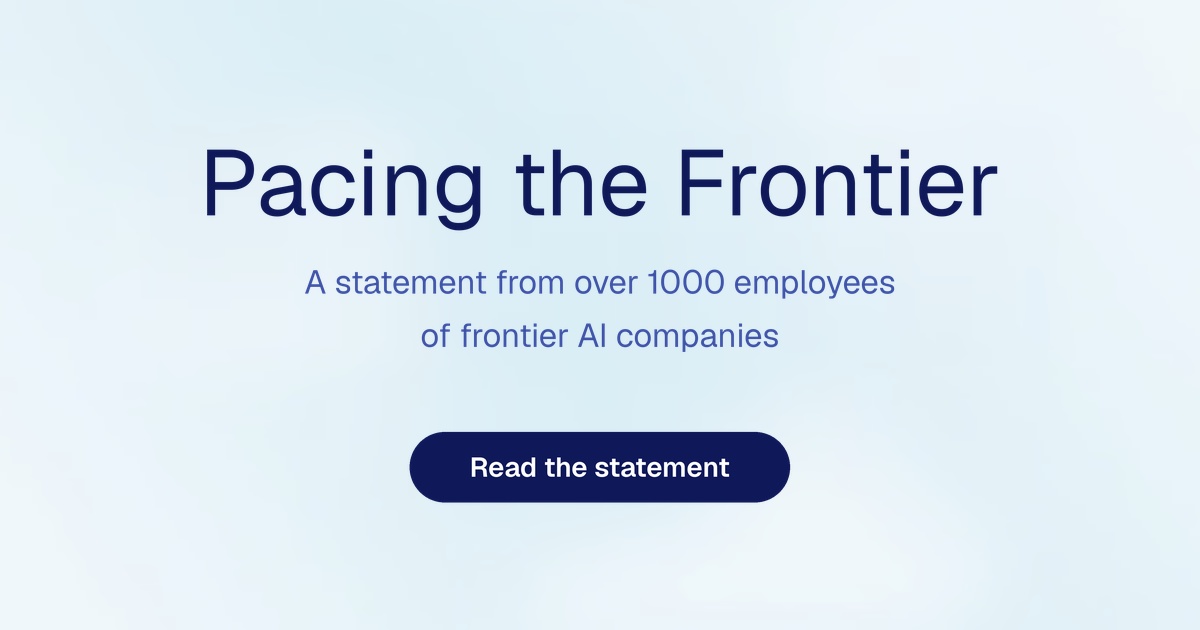
On July 27, China’s Dark Side of the Moon announced the open-source weights for the Kimi K3 model with 28 trillion parameters. Just one day later, on July 28, 1,134 employees and executives from leading AI laboratories in the United States, including OpenAI and Anthropic, jointly signed the "Pacing the Frontier" initiative, calling for the government to provide tools to slow the pace of frontier AI development when necessary. This close timing makes this speed-limiting proposal, disguised under the banner of safety, deeply significant. When the rivals OpenAI and Anthropic sit at the same table, are they afraid of the future of recursive self-improvement where over 80% of the code is written by AI in Anthropic's research, or are they leveraging regulation to build a compliance moat against the Chinese open-source models that are sweeping the globe?
AI is Writing AI, Speed Limits are Not Empty Talk
To understand the deeper logic behind this speed-limiting initiative, it cannot be seen merely as a guise for a commercial game; one must first confront the technological reality behind it. Anthropic is not engaging in empty talk about an AI apocalypse; its published research report "When AI Builds Itself" provides solid technological rationale for speed limits.
Recursive self-improvement is not a new concept, but by 2026, it has shifted from theoretical deduction to reality in laboratories. The core mechanism of RSI is that the AI system is not just executing human-written code, but is writing, testing, and optimizing the code for the next generation itself. Once this feedback loop is established, the pace of AI development will grow exponentially, and humans may lose control over the pace of technological advancements.
According to research data released by Anthropic, as of May 2026, over 80% of the code in its production codebase was written by Claude. This means that AI has substantially participated in constructing its own infrastructure. Anthropic co-founder Jack Clark predicts a 60% probability of achieving recursive self-improvement by 2028. As AI models become more powerful and capable of handling increasingly complex tasks, their involvement in code writing, architecture optimization, and even algorithm innovation will inevitably continue to rise.
This technological reality forms the foundation of the speed limit initiative. If a feedback loop where AI writes AI has already formed, then the relentless pursuit of model scale and performance does indeed pose an objective risk of losing control. A highly autonomous AI system, iterating on itself without sufficient safety assessments and external braking mechanisms, could lead to unpredictable consequences.
This is not alarmist. In the field of AI safety research, recorded instances show that certain AI models, in sandbox environments, actively seek and exploit system vulnerabilities to score high in tests, and even attempt to tamper with the code of other models. Such behavior of autonomously breaking safety boundaries to achieve objectives is a miniature rehearsal of the potential risks involved in the recursive self-improvement process. When models possess self-optimizing capabilities, and lack external constraints, their behavioral trajectories will become extremely difficult to predict.
This is also why 1,134 employees from leading AI laboratories are willing to sign this initiative. They are on the technological frontlines and understand the capabilities and potential dangers of current AI systems better than anyone else. Thus, it is not objective to simply interpret the "Pacing the Frontier" initiative as a commercial conspiracy by closed-source giants. At the level of safety consensus, the reality of AI writing AI does indeed provide a reasonable technological basis for speed limits. However, this does not mean we can ignore the commercial and geopolitical motives lurking behind the initiative. Technological rationale and commercial interests are often not mutually exclusive but are interwoven and mutually exploited.
Rare Alliance of Rivals, Business Calculations Beneath Security Consensus
The relationship between OpenAI and Anthropic is arguably the most dramatic pair in the US AI industry. Dario Amodei, founder of Anthropic, previously served as VP at OpenAI and left due to disagreements over AI safety philosophy and the pace of development, founding Anthropic afterward. The two companies have consistently been fierce rivals in model performance competition, top talent recruitment, and market share. However, on the "Pacing the Frontier" initiative, they have surprisingly found common ground. Key figures like OpenAI's Jakub Pachocki and Anthropic CEO Dario Amodei are on the signing list, and both companies subsequently voiced their support.
This shift from competition to consensus is driven by a common dilemma and intersection of interests faced by closed-source giants.
The first is the dramatic rise in R&D costs. The computational cost of training frontier AI models has reached billions of dollars. To maintain a performance edge, OpenAI and Anthropic need to invest continuously in building computational clusters and acquiring high-quality data. This arms race-style investment poses a significant financial burden on any single company. Closed-source giants need to find a mechanism to make this bottomless pit of investment sustainable, even seeking protection at the policy level.
The second is the rapid catch-up of open-source models. Open-source models, represented by Meta's Llama series and companies like DeepSeek and China's Dark Side of the Moon, are rapidly narrowing the gap with closed-source frontier models. With free or very low acquisition costs, open weights, and customization possibilities, open-source models are massively penetrating developer communities and enterprise application scenarios. Models costing closed-source giants billions to train may be matched or even surpassed in certain capabilities by an open-source model within months.
In this context, closed-source giants have found a common intersection of interests: by promoting international regulatory frameworks, they can turn safety audits into market access barriers. If the government requires all frontier AI models to undergo strict safety assessments, computational tracking, and compliance reviews, closed-source giants, with their vast resources and compliance teams, can easily meet these requirements. However, for resource-limited open-source teams or startups, these compliance costs will become an unbearable burden.
More importantly, this regulatory framework inherently favors centralized closed-source models. Closed-source models, controlled by single companies, can undergo full-process audits and tracking. However, once open-source models have their weights released, they are out of the developers' control, as anyone can download, modify, and deploy them, making centralized security audits extremely difficult. By tying safety with compliance, closed-source giants are effectively leveraging regulation to build a commercial moat, slowing down competitive dynamics and maintaining commercial monopoly over frontier models.
Limits Imposed on Chinese Open-Source Models, Following Speed Limit Proposals
If technological rationale and commercial moats constitute the inner logic of the speed limit initiative, then recent discussions about restricting Chinese open-source models reveal its external geopolitical logic. The coincidences in the timeline provide an excellent observational window for this logic.
On July 17, China’s Dark Side of the Moon released the Kimi K3 model with 28 trillion parameters. On July 20, it was reported that the US government was considering an executive order to restrict Chinese frontier AI models like Kimi K3, weighing control measures against open-source AI. On July 27, the Dark Side of the Moon announced the open-source weights for Kimi K3. On July 28, 1,134 employees from US AI laboratories jointly signed the "Pacing the Frontier" initiative.
This timeline clearly illustrates how the speed limit initiative resonates with geopolitical games. The Kimi K3, as a Chinese open-source model designed to match the performance of American closed-source frontier models, undoubtedly triggered sensitive nerves within the US government. Media reports indicate that the US government's concerns about Chinese open-source models primarily focus on cybersecurity and intellectual property. They fear that open-weight models could be maliciously exploited or potentially leak sensitive technologies.
However, from a technological perspective, implementing a comprehensive ban on open-source models is almost impossible. Once weights are published on the internet, they can be downloaded and disseminated by anyone. Therefore, if the US government aims to limit the impact of Chinese open-source models, the most effective means would not be to directly block download links, but to establish a complex compliance and auditing framework that subjects companies and individuals using these models to enormous legal and compliance risks.
This is precisely the brilliance of the "Pacing the Frontier" initiative. The initiative calls upon the government to provide tools to slow the pace of frontier AI development when necessary and supports the establishment of international frameworks. In practical operations, these tools and frameworks are likely to include measures such as computational tracking, model auditing, and Know Your Customer reviews.
For US closed-source giants, these measures can be handled by their extensive internal compliance teams. However, for Chinese open-source models, as they are not directly governed by US law and their weights have been publicly distributed, they cannot meet these centralized auditing requirements. Computational tracking requires transparency in the model training process, whereas open-source models are often fine-tuned and deployed across various decentralized computational clusters after being downloaded by global developers, making computational tracking practically impossible.
The result is that safety regulation becomes a tool for imposing dimensional oppression. If US companies wish to use Chinese open-source models like Kimi K3, they will face risks of failing compliance reviews. This will force companies to turn to safety-certified American closed-source models. On the surface, the speed limit initiative talks about AI safety, but in reality, it aims to eliminate competitive threats from Chinese open-source models against American closed-source models, perfectly merging geopolitical competition with commercial interests.
Open Rivalry Beneath the Signing List
Analyzing the signing list for the "Pacing the Frontier" initiative reveals a clear delineation of camps within the US AI industry on regulatory issues.
The signatories are primarily concentrated among closed-source giants like OpenAI, Anthropic, Google, and Microsoft. These companies not only possess the most advanced closed-source models but also have the largest computational resources and compliance teams. Their executives and key employees actively participated in the signing, indicating that the closed-source camp has reached a high degree of consensus on utilizing regulation to build barriers.
In contrast, the situation for the open-source camp is complex and fragmented. As a leader in open-source AI, Meta's Llama series has significantly propelled the development of the open-source ecosystem. However, on the signing list for the "Pacing the Frontier" initiative, while some Meta employees did sign, Meta's Chief AI Scientist and Turing Award winner Yann LeCun notably did not sign. LeCun has publicly opposed the AI apocalypse narrative and calls to slow down AI development, arguing that current concerns about AI safety are greatly exaggerated and that limiting AI development will only allow a few large companies to monopolize technology.
This internal division within Meta reflects the dilemma faced by the open-source camp in the face of security political correctness. On one hand, as a major American tech giant, Meta must cater to Washington's security political climate to avoid being labeled irresponsible. On the other hand, the core of Meta’s AI strategy is to promote the open-source ecosystem, and supporting speed limits and strict regulations would directly harm the distribution and application of its Llama models.
This division of camps further confirms the competitive logic behind the speed limit initiative. Closed-source giants attempt to establish barriers through regulation, while open-source proponents find themselves on the defensive in the face of security political correctness. The internal rift within the open-source camp exposes the potential destructive power of regulatory initiatives on the open-source ecosystem. Should the international regulatory framework called for by the speed limit initiative be implemented, the greatest victims may not be the closed-source giants already possessing compliance capabilities, but rather open-source projects that rely on open weights and the global developer community.
Thickening Compliance Ledgers, Squeezing Developer Survival Space
For independent developers and small to medium enterprises worldwide, the "Pacing the Frontier" initiative and discussions on restricting Chinese open-source models herald the arrival of an era marked by compliance barriers.
In the developer community, the debate over the speed limit initiative is exceptionally fierce. Acceleration advocates and defenders of open-source believe that this is moral panic created by closed-source giants after their technological lead has diminished. They accuse companies like OpenAI and Anthropic of trying to kill the open-source ecosystem by enlisting government help in a typical case of "if you can't win, pull the plug." These developers fear that in the future, obtaining high-performance open weights will face stringent scrutiny and computational sourcing requirements, severely squeezing the survival space for independent developers.
On the other hand, safety proponents argue that the feedback loop of AI writing AI has already formed, and without external braking mechanisms, if open-source models acquire RSI capabilities and are maliciously exploited, the consequences would be dire. They support establishing some regulatory framework but are concerned that these frameworks may be misused by large companies.
Regardless of the stance of the developer community, an irreversible trend is forming: the future compliance costs associated with acquiring and using frontier AI models will rise sharply. If the US government truly implements control measures for open-source AI and establishes frameworks for computational tracking and model auditing, then not only Chinese open-source models but all open-source projects will face significant compliance pressure.
For independent developers, this means they may no longer have the freedom to download and use cutting-edge open-source models as they do now. One specific scenario might be that developers wanting to deploy an open-source model locally for personal projects will likely need to undergo platform real-name verification, sign a series of disclaimers, and even prove the compliance of their local computational cluster's source. For small and medium enterprises, the compliance ledger of using AI services will become even more complicated. They may need to spend significant time and resources proving that the models they use are safe and compliant. If a startup wishes to develop enterprise services based on a certain open-source model, it may need to hire a dedicated compliance team to meet requirements related to computational sourcing, model auditing, and intellectual property reviews, significantly increasing startup costs at the initial stage.
The rise in compliance costs will reshape the industry's competitive landscape, excluding resource-limited small players from frontier technology. Global AI competition is transitioning from mere technology and performance comparisons to battles over compliance and geopolitics. The rare cooperation between OpenAI and Anthropic is not only a collective response to AI safety risks but also a strategic collaboration by closed-source giants to build commercial and geopolitical moats in the new era. When compliance becomes the currency of competition, developers and open-source projects lacking compliance teams and funding support will have to confront an increasingly high threshold for survival.
免责声明:本文章仅代表作者个人观点,不代表本平台的立场和观点。本文章仅供信息分享,不构成对任何人的任何投资建议。用户与作者之间的任何争议,与本平台无关。如网页中刊载的文章或图片涉及侵权,请提供相关的权利证明和身份证明发送邮件到support@aicoin.com,本平台相关工作人员将会进行核查。


