Original | Odaily Planet Daily (@OdailyChina)
Author|jk

The "Digital Asset Market Clarity Act" (known as the CLARITY Act) was passed in the House of Representatives on July 17, 2025, with a vote of 294 to 134, and has been stalled in the Senate for over a year. The Senate Banking Committee voted on May 14, 2026, to advance the bill to the legislative agenda with a vote of 15 to 9, but as of now, the bill has not received a vote from the full Senate nor has it been signed by the President.
Where is it currently stuck? Regarding this matter, Odaily Planet Daily has conducted a specific analysis, interested readers can see "What is Holding Up the CLARITY Act?"
The core of this bill is to classify and define crypto assets: Clearly determine whether tokens are securities or commodities, and accordingly delineate the regulatory authority of the SEC and CFTC, while covering regulations regarding users' self-custody of private keys, stablecoin yield mechanisms, and offshore exchange registration. Currently, the main controversy hindering the Senate vote is the ethical review clause regarding conflicts of interest related to government officials holding crypto assets.
On July 27, Senate Majority Leader John Thune confirmed that the Senate will prioritize handling bills on sanctions against Russia and personnel appointments, which may delay the voting window for the CLARITY Act until September. The industry and various parties in Congress had previously generally viewed August 7 as the last realistic window for the bill to pass in 2026; if missed, most analytical agencies believe the chances of the bill being enacted this year would significantly decrease.
At present, Polymarket data shows that the probability of the CLARITY Act being signed into law this year is only 35%. In February, this figure was still 82%.
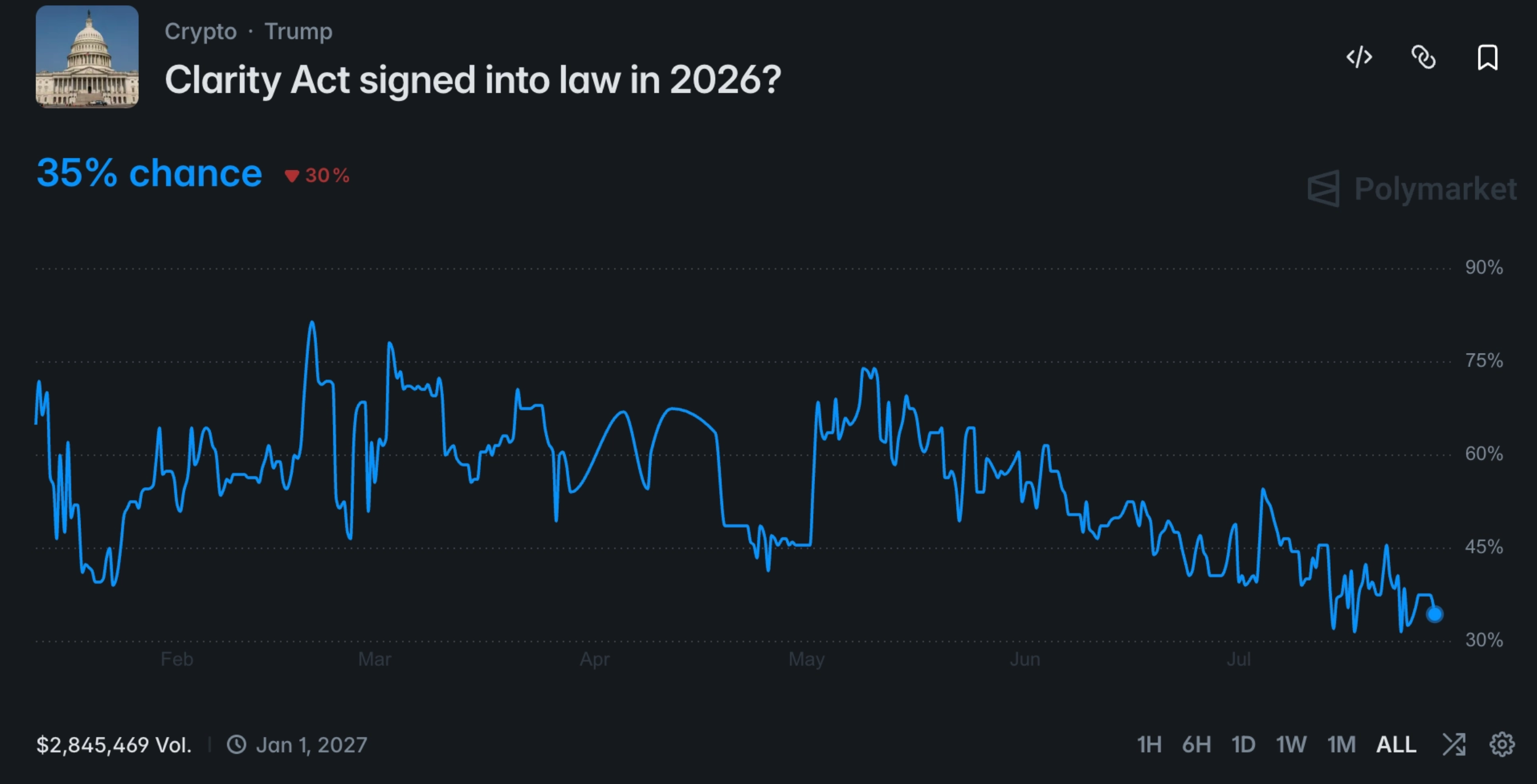
The probability of Clarity passing this year has been declining. Source: Polymarket
So, if the Clarity Act does not pass, how will the crypto market react, what will happen to Bitcoin? How will related US stocks be impacted? What changes will occur in the political landscape of Washington? Odaily Planet Daily will examine these three aspects to see what the industry may face if the CLARITY Act ultimately does not pass in the Senate.
1. Crypto Market: Analysts Generally Believe Impact is Limited and the Market Has Already Reacted
From the current price behavior, market pessimism regarding the CLARITY Act is gradually becoming apparent. First and foremost is the drop in Polymarket's probability from 82% to the current 35%. In terms of movement, this probability rose above 70% multiple times between February and May but has been continuously declining since June, indicating a significant loss of confidence. The cumulative trading volume has now reached $2.845 million.
Bitcoin's price has recently come under pressure, fluctuating near the range of $65,000 to $66,000 in late July, with the market generally linking this to macro liquidity factors rather than the bill itself.
From an institutional perspective, most analysts are reserved about the view that "a failure of the bill equals an industry crisis." Compass Point Research & Trading analyst Ed Engel maintains a sell rating on Coinbase but simultaneously points out that even if the CLARITY Act fails to pass, there will still be sufficient industry events in the second half of the year to maintain market attention, and the blockchain industry still has a chance to prove its practical application value in the next two to three years.
It should be noted that there are significant discrepancies regarding the specific clauses of the bill; their implications vary greatly across different subfields. For instance, regarding the stablecoin yield provision, a draft of the CLARITY Act proposed in March banned any arrangements that are "substantially equivalent to interest" on stablecoin holdings. This news caused Circle's stock to plummet 20% in a single day, and Coinbase's stock fell nearly 10% on the same day. This means that the bill's failure will largely depend on the final details of the provisions rather than whether the bill itself passes.
2. US Stock Market: Will Coinbase and Circle Crash?
Coinbase
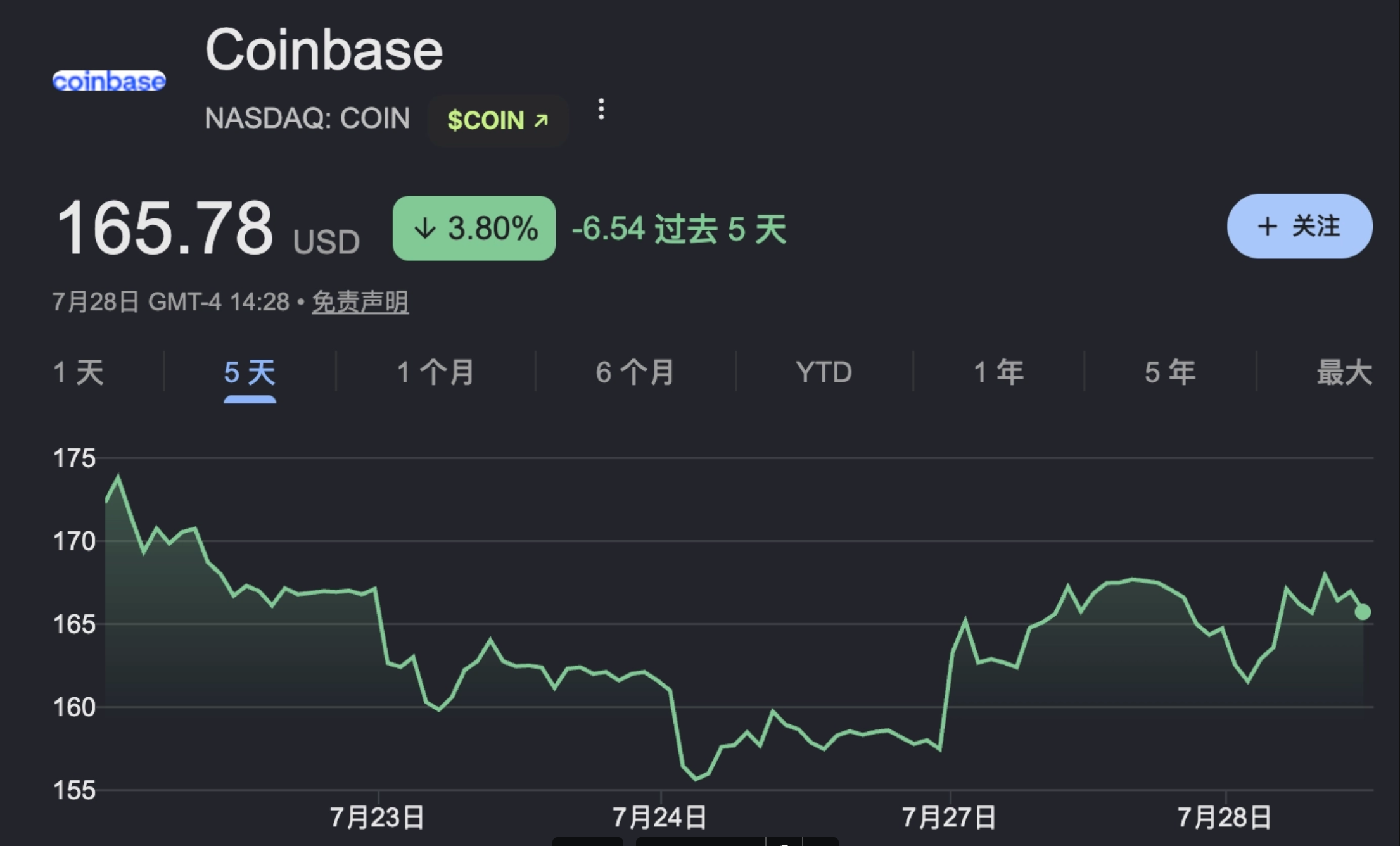
Coinbase's stock trend over the past week. Source: Google
Coinbase's stock price has recently come under pressure as the probability of passing the bill declines. On July 28, COIN closed at $165, down 3.8% over the past five days, attributed to selling pressure from the weakening outlook of the bill. Previously, during the week of July 24, COIN once fell from a quoted level of $169, with Raymond James setting a target price of $158, about 6.5% lower than the stock price at that time; Oppenheimer had previously reduced its target price to $209. Baird has cut its target price from $160 to $142, maintaining a neutral rating.
This means that institutions believe if the CLARITY Act does not pass, we will likely see Coinbase in the $140 - $160 range.
However, most analysts have not directly linked Coinbase's long-term investment logic to the success or failure of the CLARITY Act. Analysts quoted by TipRanks believe that even if the bill does not pass before August, the institutional trend towards crypto assets on Wall Street will still support Coinbase's long-term growth. Coinbase is set to release its second-quarter financial report on July 30, with the market expecting earnings per share of $0.19, a significant improvement compared to a loss of $1.49 per share in the first quarter; in the long run, even if the CLARITY Act does not pass, long-term growth could offset this failure.
Circle
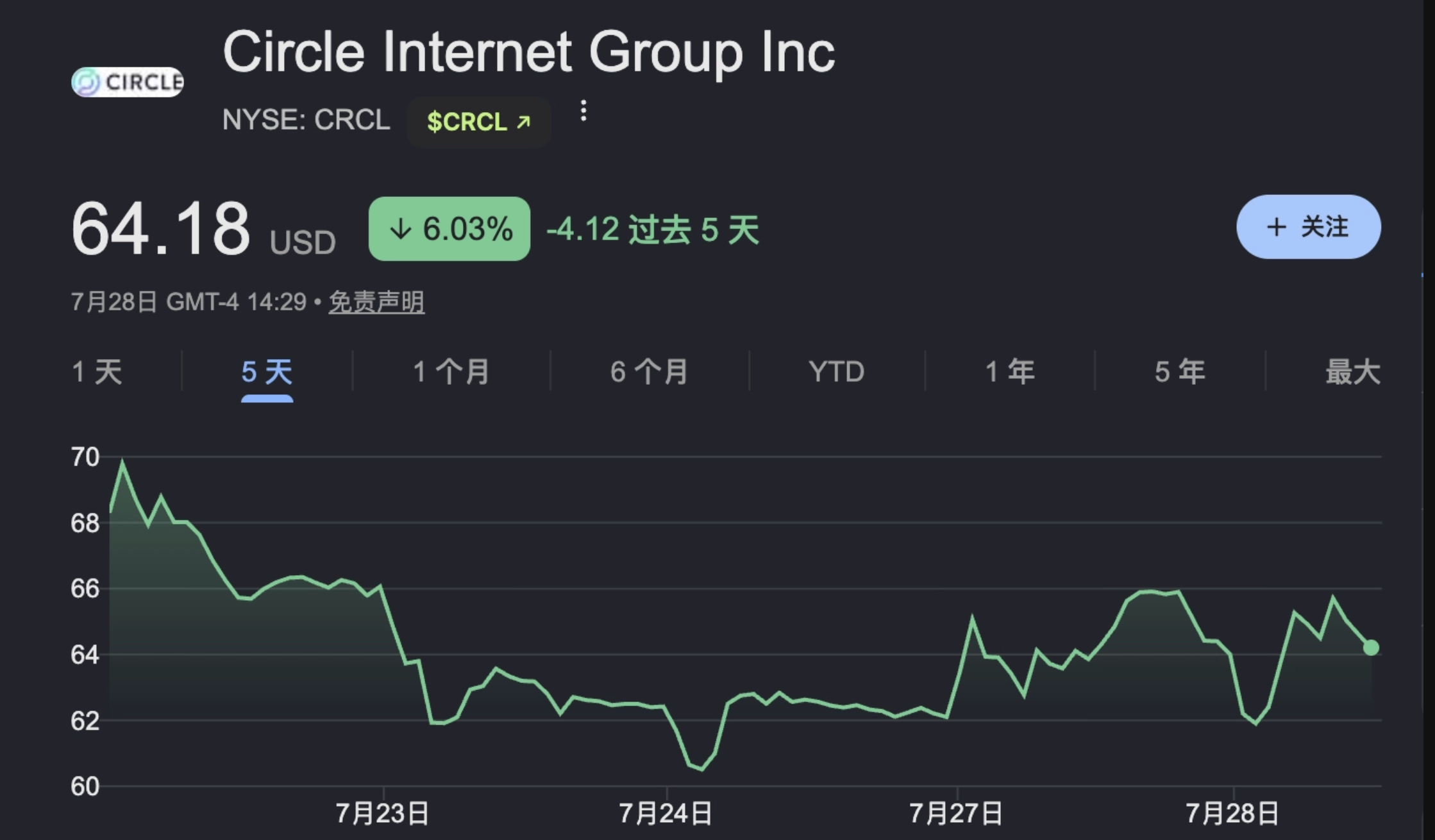
Circle's stock trend over the past week. Source: Google
The situation with Circle is relatively complex, with some analysts believing that a failure of the bill may not necessarily be bad for Circle. Mizuho analyst points out that if the CLARITY Act passes and brings a clearer regulatory framework, it could attract more competitors into the stablecoin space, accelerating homogeneity in stablecoin business, thereby reducing Circle's revenues in the long run. This year, the stablecoin space has seen the emergence of the Open USD project supported by over 140 institutions including Visa, Mastercard, Stripe, and BlackRock, posing direct competition to Circle's USDC; Mizuho previously downgraded Circle due to this project.
On the other hand, the provisions regarding restrictions on stablecoin yield in the CLARITY Act, if ultimately implemented, would weaken the high-margin income that Coinbase earns through USDC distribution agreements, thus shifting the bargaining power towards Circle in their commercial agreement renegotiation scheduled for August 2026. Morgan Stanley analyst Thielen believes that a stricter regulatory federal framework is generally beneficial for licensed issuers with compliance capabilities, asset scale, and credit backing, and Circle stands to benefit relatively in this context. Bitwise Chief Investment Officer Matt Hougan believes that the sell-off of Circle's stock due to the bill's draft has been "over-interpreted," and the bill itself does not change Circle's long-term investment logic.
This means that if the CLARITY Act truly cannot pass, it may actually be a good thing for Circle's long-term price. In the short term, if sentiment continues to weaken, several repeatedly mentioned support levels are around $61.70, and in extreme cases, the market has mentioned a possible drop to this year's low point of $49.
Crypto Treasury Companies
Crypto treasury companies represented by Strategy (formerly MicroStrategy, ticker MSTR) have a significantly higher correlation with Bitcoin prices than with the direct association to the CLARITY Act itself, and can be viewed as leveraged assets for Bitcoin.
As of July 1, affected by Bitcoin's price falling below $59,000, the MSTR stock price slid to the range of $85 to $86, marking the eleventh consecutive month of decline, down about 84% from its historical high of around $540 in November 2024. Citi analysts have linked their $100,000 benchmark judgment for Bitcoin to the anticipation of the CLARITY Act passing, believing that if the bill smoothly passes and boosts Bitcoin to $100,000, the value of Bitcoin held by Strategy would correspondingly rise to about $84 billion.
Recently, Strategy disclosed that the lower limit for the annualized return on Bitcoin calculated by its model is -11.34%; if the actual return falls below this level, the company may need to consider restructuring its debt, and two listed companies have already sold a total of 511 Bitcoins within 24 hours to repay about $31.7 million in debt. This kind of financial pressure is relatively independent of the legislative progress of the CLARITY Act but will be amplified in an environment of prolonged indecision and weak market sentiment. Strategy is set to release its second-quarter financial report in the week of July 30 to 31, and the market expects its stock price to become even more volatile during this period.
3. Washington Political Landscape: Next Legislation Will Be Difficult
From the voting structure in the Senate, whether the bill can pass depends on gaining the support of 7 to 9 Democratic senators to break the 60-vote threshold. Among Republicans, Senators Josh Hawley and Rand Paul are expected to vote against it based on substantive positions, which means that even if all 53 Republican senators are present, they cannot single-handedly push the bill through. On the Democratic side, Arizona Senator Ruben Gallego is seen as a relatively stable source of support.
It is noteworthy that resistance within the Democratic Party to the bill is not solely against the regulatory framework for the crypto industry but is largely related to the disclosure of over $1 billion in crypto asset-related investments by Trump and his family. Several Democratic senators view the ethical clause as a balancing measure for potential conflicts of interest involving the president; Senator Angela Alsobrooks previously referred to a compromise solution proposed by the White House as a "non-serious proposal." This has tied the legislative process of the CLARITY Act, to some extent, to the larger purpose of opposing Trump rather than just a technical debate on industry regulation.
If the bill ultimately fails to pass in 2026, most analytical agencies believe this will not lead to a regulatory vacuum, but will mean that the crypto industry will continue to rely on the existing two pathways in the short term: one is the GENIUS Act, which has been in effect since July 2025, this act currently specifically regulates payment-based stablecoins and their issuers; the second is the respective regulatory agendas advanced by the US Securities and Exchange Commission and the Commodity Futures Trading Commission, among which the SEC's Regulation Crypto proposal is expected to formally enter the rule-making process in the second half of 2026.
From a timing perspective, the midterm elections in November 2026 are a key variable affecting the future progress of the bill. Most analyses suggest that once the window before the August recess is missed, the likelihood of the bill resuming discussions in the fall will be greatly reduced due to disputes over appropriations bills and the approaching election cycle, substantial progress may have to wait until 2027, and 2027 itself is situated in a political reshuffling phase after the midterm elections, making it much less likely for the bill to continue the previous bipartisan consensus. Some industry lobbyists have proposed an alternative pathway, which is to integrate the core provisions of the CLARITY Act into a comprehensive bill that must pass by the end of the year, but to date, no senator has publicly confirmed that this strategy is being seriously considered.
免责声明:本文章仅代表作者个人观点,不代表本平台的立场和观点。本文章仅供信息分享,不构成对任何人的任何投资建议。用户与作者之间的任何争议,与本平台无关。如网页中刊载的文章或图片涉及侵权,请提供相关的权利证明和身份证明发送邮件到support@aicoin.com,本平台相关工作人员将会进行核查。


