Author: Zhou, ChainCatcher
Since the beginning of this month, Coinbase's leadership team has undergone a series of intensive adjustments.
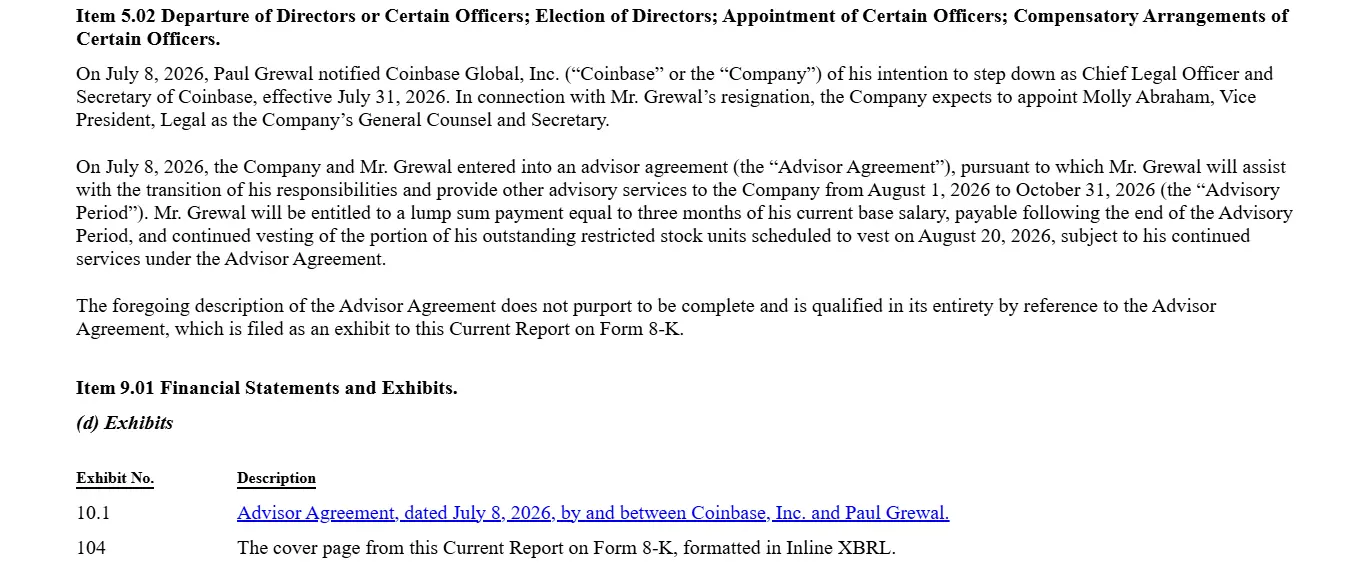
Chief Legal Officer Paul Grewal will step down on July 31 and join a startup, with internally promoted Molly Abraham taking over as General Counsel.
At the same time, a new position of Vice Chairman has been established, with Ryan VanGrack, who has a background with the SEC and the White House, taking on the role to oversee policy and corporate affairs.
Chief Human Resources Officer Lawrence Brock will move to an advisory role, while Greg Tusar, co-head of institutional business, will transfer to a policy position, and Jesse Pollak, head of Base, will step back from the front lines.
On July 28, Coinbase appointed senior employee Rob Witoff as the new Chief Technology Officer; Witoff previously served as head of the Coinbase platform.
These changes are occurring at a time when the company's fundamentals are under pressure. Benchmark reported that due to sluggish trading activity in the cryptocurrency market, the firm has lowered its revenue expectations for Coinbase for the second quarter, with spot trading volume on centralized exchanges declining by about 28%, and the company's stock price retracting by about 30% this year.
With the completion of five key positions, what kind of company is Coinbase being pushed toward?
From winning lawsuits to participating in rule-making
Grewal's departure comes as Coinbase wraps up multiple lines of conflict with regulators.
As Chief Legal Officer, his most significant battle was the SEC lawsuit against Coinbase in June 2023. The case accused the company of operating as an unregistered securities exchange, broker, and clearing agency, regarded as a critical battle for the cryptocurrency industry’s legality in the U.S., and it concluded in February 2025 with the SEC dropping the lawsuit without imposing a fine on the company.
According to the Wall Street Journal, on July 22, Coinbase reached a settlement with the SEC over a Freedom of Information Act lawsuit, with the SEC agreeing to pay $150,000 and reform its record-keeping policy. This case revealed a lack of communication records from the tenure of former chairman Gary Gensler lasting nearly a year.
Along with a similar settlement with the FDIC in February this year, these lawsuits, which questioned regulators and sought government transparency, were all concluded before his departure.
Molly Abraham, who is replacing Grewal, has been promoted from within, while the newly established Vice Chairman position has been handed to VanGrack, who will focus on policy and external affairs, with Tusar, from an institutional business background, also shifting to policy.
The composition of the new leadership reveals a shift in the company’s legal and policy focus.
According to public documents, on July 27, Coinbase Chief Policy Officer Faryar Shirzad formally wrote to the CFTC, predicting market rule-making, expressing support for the new regulations, and seeking further coordination.
However, transitioning from litigation to rule-making has not been smooth.
A highly anticipated clarity bill has stalls in the Senate, with some opinions blaming Coinbase for the delay, as the bill’s restrictions on interest payments for stablecoins directly affect Coinbase's revenue-sharing with Circle.Initially, the company publicly opposed the bill, then shifted to strongly advocate for it, but after several iterations, the new version ended up imposing stricter limits on proactive earnings, thus questioning its stance.
CEO Brian Armstrong even stated that if the bill remains stalled long-term, some of the company's operations may move outside the U.S.
Expanding trading entry, contracting on-chain narratives
Adjustments on the business level are also concentrated, directing toward Everything Exchange.
This strategy was proposed as early as December 2025, focusing on integrating multiple asset trades such as cryptocurrencies, stocks, ETFs, prediction markets, and perpetual contracts under a unified account, transforming Coinbase from a spot crypto trading platform into infrastructure connecting on-chain economics with traditional finance.
This vision made significant progress in June this year, with the company launching a large number of products in one go on June 16, including:
●Opening U.S. stock, ETF, and index trading within the main app, allowing users to transfer existing holdings from external brokers;
●Launching tokenized U.S. stocks, claimed to be 1:1 backed by real stocks for non-U.S. users, supporting 24-hour trading;
●Introducing Pre-IPO perpetuals that allow wagering on a company's valuation before it goes public, with the first target being SpaceX, followed by Anthropic and OpenAI;
●Launching index perpetuals bundling themes like AI, China, and national defense;
●Partnering with compliance platform Kalshi to integrate prediction markets covering elections, interest rate decisions, and macro events.
●Furthermore, the company also embedded what they claim to be the first SEC registered AI advisory, Coinbase Advisor.
In May this year, the CFTC approved Coinbase as the first licensed institution to offer global crypto perpetual contracts to U.S. customers, allowing previously restricted derivatives to return to the U.S. market.
Entering July, the strategy continues to ramp up. On July 21, Coinbase International Exchange launched S&P 500 index perpetual contracts supporting 24-hour trading. The following day, Coinbase’s head in Canada publicly stated that the company is advancing to create a comprehensive exchange locally, covering crypto assets, tokenized stocks, and prediction markets.
In contrast to this expansion trajectory, there is a contraction of Base. In mid-July, Pollak wrote a lengthy article transferring the daily management of the Base App back to Coinbase, handing it over to the well-known community member Cobie, while he returns to focus on the Base chain itself. He acknowledged that there has been a significant deviation in bets made in social and creator directions over the past two years, with the truly successful areas being prediction markets, perpetual contracts, and stablecoins, while social attempts have failed to achieve sustainable adoption.
Brian Armstrong also stated that Base's current core focus is sequentially on trading, payments, and AI agents, each interrelated—payments need forex trading, and AI agents will heavily involve trading and payment scenarios, with most resources currently concentrated in the trading sector.
This retreat can be seen as a phase-out of the consumer-level on-chain narrative.
External positive pressure is amplifying this urgency. According to Token Terminal data, barely ten days after the launch of the Robinhood Chain mainnet, its daily trading volume was close to Base, supported by tokenized U.S. stocks and tens of millions of brokerage users providing a more direct entry.
Restructuring operations and products with AI
Returning to the line of the CTO appointment, it can actually be seen that AI plays two roles simultaneously at Coinbase.
Internally, it serves as a tool for cost reduction and efficiency improvement. After the company laid off about 14% of its workforce in May, the organization clearly shifted to a more streamlined team model, where projects that previously required more than ten people to advance can often now be managed by just two to three individuals.
Reportedly, currently 95% to 100% of the code is being completed with AI assistance, a significant increase from about 40% in February of this year, with each engineer running an average of 5 to 10 AI agents simultaneously, yielding output comparable to about 1,200 full-time developers, with the company even setting a more distant goal of hoping to reach an equivalent workload of 100,000 employees by 2030 through AI agents.
However, this streamlining is not occurring evenly. On July 22, Coinbase's Singapore office officially opened, with plans to increase local staff from about 150 to around 200 by the end of the year, with the fastest-growing positions concentrated in engineering and institutional sales, while the team is also exploring equipping AI agents with stablecoin wallets.
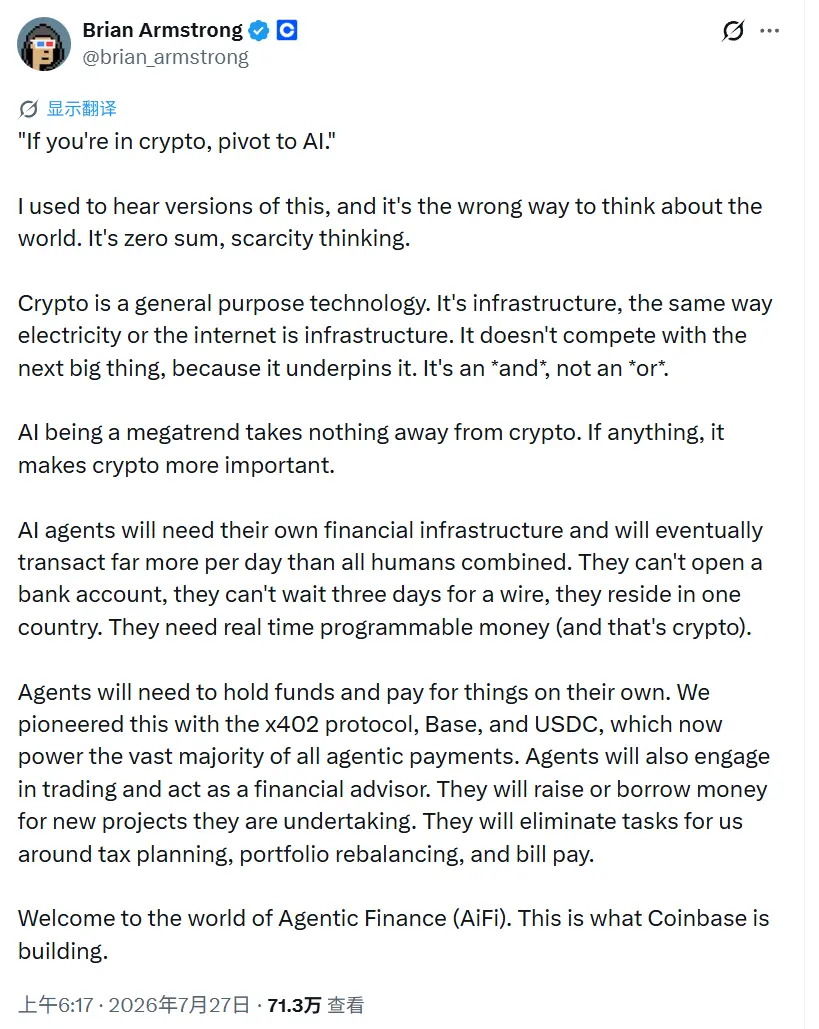
Externally, AI is treated as a new product direction. On July 27, Armstrong explicitly opposed the zero-sum thinking that if one is doing crypto, they should shift to AI. He wrote that crypto is an infrastructure, like electricity or the internet, which does not compete with the next wave of trends but supports them.
AI agents cannot open bank accounts nor can they wait days for wire transfers; they require real-time programmable currency, which is precisely what crypto can offer. He summarized the company's direction as advancing “agent finance” and noted that the future scale of transactions and payments by agents may far exceed those of humans.
In terms of delivery, the official statement stated that last month, agentic traffic on the Base documentation page first exceeded human traffic. The company simultaneously launched updates across three fronts, enabling merchants to receive USDC payments from AI agents via Coinbase Business, individuals to use natural language commands for agents to monitor the market and execute conditions, such as liquidating if BTC falls below a certain price, and developers to incorporate agent payment with just three lines of code.
Real Vision founder Raoul Pal stated that billions of AI agents are about to be launched, and they will exchange computing power, data, and services at a scale never seen by human markets, while the existing financial system is too slow and cannot bear this, with Coinbase’s agent payment track already adopted by Google and Amazon.
On both the internal and external lines, heavy bets are being placed on AI. However, both directions currently lack sufficient validation.
On the internal side, whether the efficiency gains brought by AI can genuinely offset the revenue pressure caused by declining trading volume remains unanswered, with a considerable execution distance from the current scale to the long-term goals.
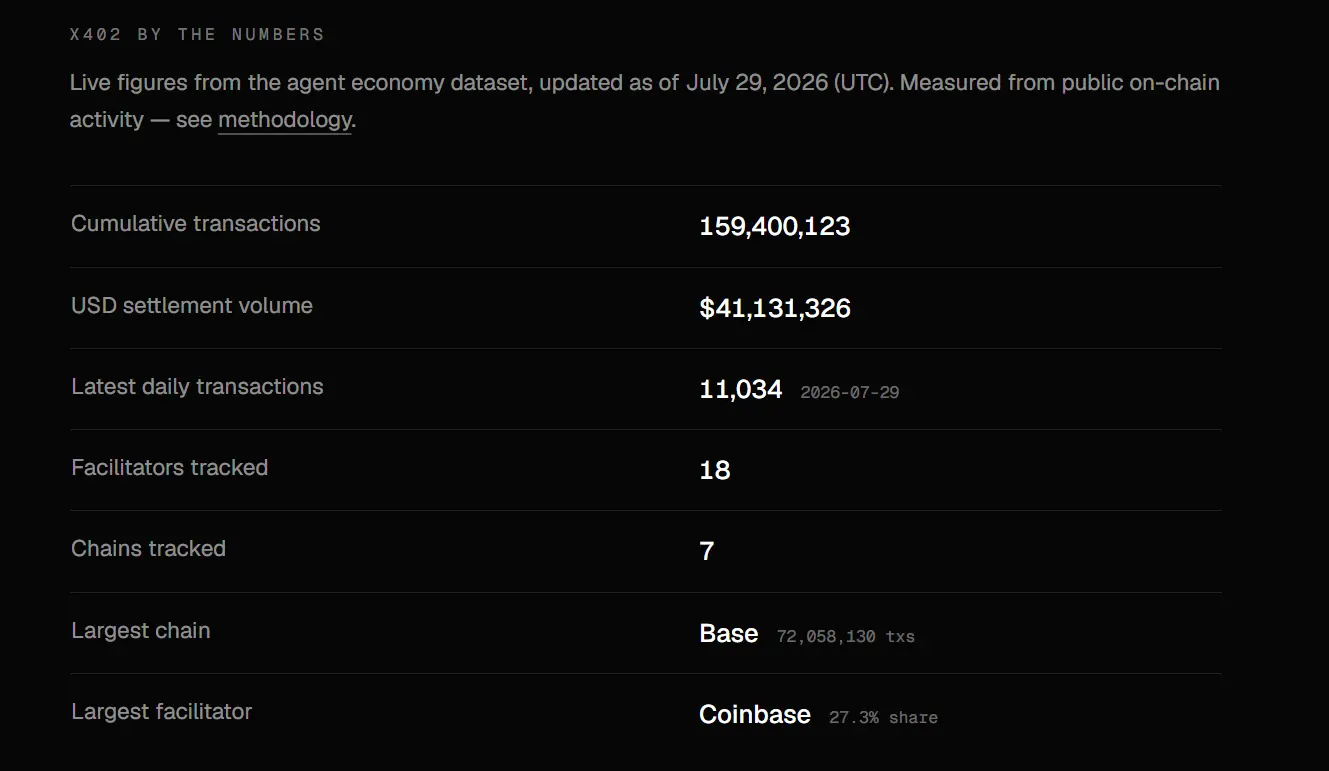
On the external side, agent financial products are still in their early stages. According to publicly available data such as agenteconomy.to, the cumulative number of transactions for x402 is approximately 1.59 billion, but the cumulative transaction amount is only around 40 million to 50 million dollars, with a significant portion of early traffic coming from meme-related tests and speculative activities, leaving a gap between real commercial scale and marketing narrative.
Conclusion
In the context of pressured trading volumes, regulatory victories, and leaps in AI capabilities, what kind of company does Coinbase aim to become? The answer is beginning to take shape.
The company’s adjustments may aim to reduce reliance on a single cryptocurrency trading cycle, using broader asset coverage and higher operational efficiency to secure a more stable fundamental base, while also positioning in advance for the payment and trading demands that AI agents may bring.
This round of leadership adjustments addresses the issues of organizational priorities and strategic focus. The real test will be whether this combination can deliver results during a downturn.
免责声明:本文章仅代表作者个人观点,不代表本平台的立场和观点。本文章仅供信息分享,不构成对任何人的任何投资建议。用户与作者之间的任何争议,与本平台无关。如网页中刊载的文章或图片涉及侵权,请提供相关的权利证明和身份证明发送邮件到support@aicoin.com,本平台相关工作人员将会进行核查。


