
If you have an idle NFT in your hands, how would you handle it? Put it on the trading market and wait? Or simply leave it in your wallet to gather dust?
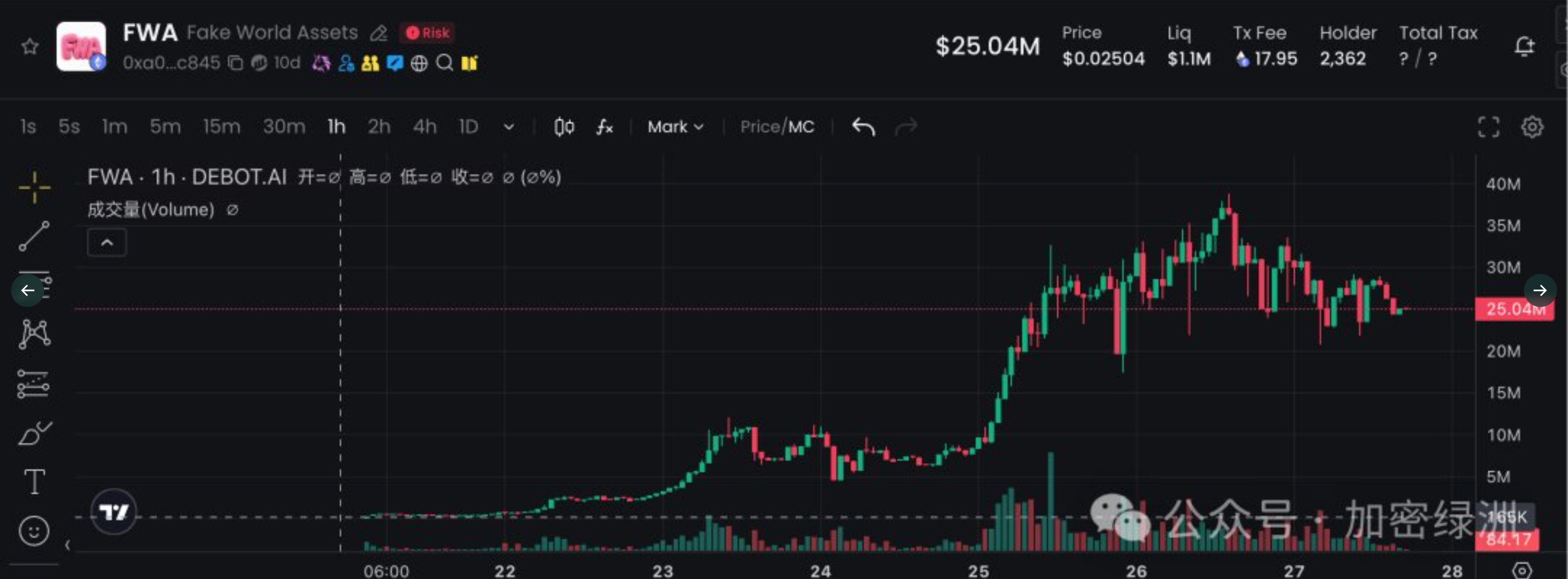
Recently, a new project called Fake World Assets (abbreviated as FWA) has appeared on the Ethereum mainnet. It is developed by the TokenWorks team, and the official website is fwa.fun. In simple terms, this project creates a fully on-chain "NFT capsule machine." Anyone can put their NFT into the capsule machine as a prize, and others can pay a uniform price to participate in the lottery.
It cleverly combines the concept of providing liquidity from Uniswap, the excitement of blind box lotteries, and token economics. Today, we will break down this project in plain language to see how it works.
1. Involved Terminology
Before delving into the mechanics, let's get on the same page with some terminology, so it won't be difficult to follow later.
Position: In FWA, having just an NFT is not sufficient to be placed in the capsule machine. You must take out an NFT and match it with some ETH; these two together constitute a complete "position."
Backing: This refers to the amount of ETH you match with your NFT. It is both your principal and determines the probability of your NFT being selected.
Standing Bid: The backing you put in is also a "constant buyback price" offered for this NFT. If someone wins your NFT but does not want it, they can directly sell the NFT back to you and take most of your backing.
Acquisition Price: The uniform price that the lottery participant must pay each time they draw. This price is calculated by the system in real-time based on all positions in the pool.
Crown: The position with the highest backing in the pool will wear a "crown" and can receive an additional share of the lottery fee.
2. Core Mechanism: How Does the Capsule Machine Work?
The depositor locks their NFT together with a chosen amount of ETH into the protocol, forming a position. This ETH is called Backing; it simultaneously carries three key responsibilities:
1. Determine Selection Probability: The weight is inversely proportional to the backing. The higher the backing, the lower the probability of being drawn; the position becomes safer and lasts longer. The lower the backing, the easier it is to be drawn.
2. Serve as Standing Bid: The backing is fully locked to support the depositor's buyback promise to the lottery participant.
3. Serve as Depositor's Principal: The Standing Bid is closely related but conceptually different from backing: Backing refers to the actual locked ETH principal, while Standing Bid is the "buyback at any time" quote issued with this principal. By default, when the lottery participant accepts the Standing Bid, they can take 85% of the backing (either in ETH or directly in the form of $FWA), with about 15% reserved as a settlement discount, defaults to the protocol. Randomness is provided by Chainlink VRF, and requests are settled strictly in submission order to prevent front-running or manipulation.
Positions in the pool are roughly divided by rarity into Common, Uncommon, Rare, Epic, and Legendary, primarily corresponding to different levels of backing.
3. Two Core Roles and Gameplay
1. Depositor - The 'Banker' Providing Liquidity
Deposit NFTs within the whitelist (currently supports dozens of collections including CryptoPunks, BAYC, Azuki, Milady, Pudgy Penguins, Ten Thousand Tokens, etc., with continuous additions) + any amount of ETH as backing (with a minimum threshold). Revenue sources: · Each time someone participates in the lottery, the fee obtained after deducting the protocol's share and the crown's portion is evenly distributed based on the number of active positions (each position receives the same amount, irrespective of backing size).
· The holder of the "crown" with the current highest backing additionally receives a small portion of each fee.
· $FWA token rewards (initially distributed based on √Backing weight).
· Can be actively withdrawn at any time (as long as the position has not been drawn, and after the current queued requests are settled or expired).
Upon being drawn: If the lottery participant keeps the NFT → The depositor retrieves almost all the backing (after deducting about 1% for protocol settlement fee), losing the NFT.If the lottery participant sells it back → The depositor retrieves the NFT but loses most of the backing.
2. Purchaser/Lottery Participant - The 'Player' Obtaining Randomly
Pay the unified acquisition price calculated by the system in real-time (the expected value of the pool, i.e., the harmonic average of all backing + about 10% additional fee + a small VRF service fee). At the same time, everyone pays the same price, and slippage protection can be set. Upon successful payment, one randomly gets a position (the probability of low backing is much higher than high backing). After being drawn, they must choose one of two options (within a limited time): - Keep the NFT. - Accept the Standing Bid, take back 85% of the backing of that position (in ETH or $FWA), and return the NFT to the original owner. There are also $FWA rewards (initially distributed based on the number of successful draws on that day).
This design makes low backing positions "common goods," maintaining a low lottery price and participation threshold; high backing positions become rare "jackpots," attracting players seeking high odds.
4. $FWA Token Economic Model
$FWA is an incentivized token with a fixed total supply, primarily designed to cold-start a bilateral market and convert protocol activity into token value.
Initial allocation: 50%: Injected into Uniswap v4 FWA/ETH liquidity pool. 30%: 15 days of early distribution (2% of the total supply each day, 1% for depositors and 1% for purchasers). 20%: Airdrop based on v1 snapshots (claimed through Merkle proof at specific block snapshots).
Early external purchases are closed, only obtainable through participation in the protocol, while selling remains always open. This reduces early sell pressure. Value support and appreciation logic:
When lottery participants choose to "sell back and settle in $FWA," the system will directly buy $FWA on the market using 85% of the backing in ETH.
This creates real and continuous buying pressure (especially stronger when a high backing position is drawn).
Protocol fees can be configured to buy back $FWA (currently defaults are off), and after buying back, 40% defaults to depositors, 40% to purchasers, and 20% is burned.
The higher the protocol activity, the stronger the fees and settlement buying pressure, with more obvious deflation and demand. Token transfers are limited, mainly conducted through official pool transactions, with a 1% transaction fee.
5. Sources of Income
1. The portion of the lottery fee (1% of the pool acquisition fee) deducted from the acquisition price the user pays. The actual price paid by the user remains unchanged, and this 1% is deducted from the additional fee part.
2. The settlement fee when the lottery participant chooses to keep the NFT (1% of the backing) only occurs when "keeping the NFT," deducted from the backing reclaimed from the depositor. No fee is incurred upon selling it back.
3. The settlement discount on selling back (15% of the backing) defaults to the protocol. This can be switched in the future to distribute to all depositors.
4. The transaction fees for $FWA token trading (1% on buys and sells) independently enters a special fee wallet, separate from the above Splitter distribution.
6. Note:
The acquisition price paid by the user = pool expected value (EV, harmonic average) + 10% additional fee + VRF service fee.
For example, if a user pays 0.1 ETH for pool acquisition fees, the complete order is as follows (assuming VRF service fee is ignored):
1. First, split the structure EV (expected value) ≈ 0.0909 ETH 10% additional fee ≈ 0.0091 ETH Total ≈ 0.1 ETH
2. The protocol first deducts a 1% protocol fee = 0.1 × 1% = 0.001 ETH (deducted from the additional fee)
At this time: The EV part remains approximately 0.0909 ETH, and the remaining additional fee is approximately 0.0081 ETH. The total distributable amount is approximately 0.099 ETH.
3. Then from the distributable fee, take the crown 5% crown reward ≈ 0.099 × 5% ≈ 0.00495 ETH (for the highest backing holder). The crown is cut from the whole distributable fee, so it will affect both the EV part and the additional fee part.
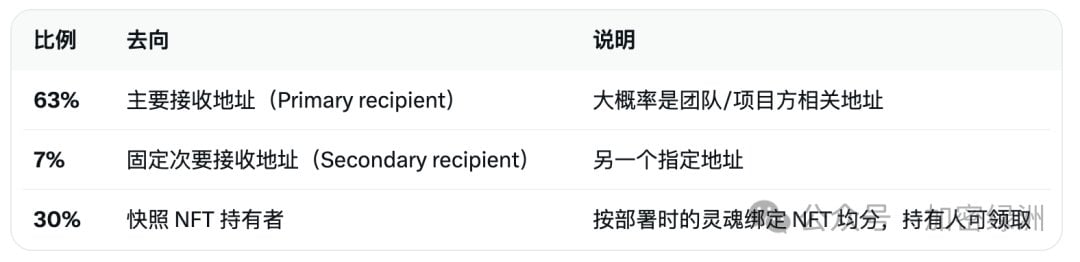
The final remaining part of the distribution (key point) deducts the protocol fee and crown. The remaining funds are handled separately based on origin: The EV part (主体, about 0.09): is evenly distributed among all active depositors, unaffected by hot or cold statuses.
The additional fee part (about 0.008): is divided into hot and cold: Hot pool → More/all goes to depositors (continues to be evenly distributed); Cold pool → More/all becomes rewards for successful lottery participants in $FWA.
Purchase quotas smooth transition between states.
Current Splitter Distribution
7. Several Important Designs
1. Clever combination of inverse weight + evenly distributed fee The higher the backing → the lower the chance of being drawn → the longer it survives → the more fees it can collect. However, each fee is evenly divided by the number of positions, regardless of backing size. The result is: small depositors are motivated to continuously provide "cheap goods," while large depositors wait to gain higher total returns through "lasting longer." Both sides have reasons to participate.
2. Harmonic average pricing
The lottery price is determined by the harmonic average of all positions' backing. The harmonic average is strongly pulled down by the lowest backings, so even if there are super high-value jackpots in the pool, the overall lottery price can remain low. This allows “low price, high frequency lotteries” and “high-value rare jackpots” to coexist without conflict.
3. Dynamic distribution of remaining additional fees based on hot and cold
The remaining additional fee is not fixed to any one party but shifts according to the pool's activity: Hot pool → More goes to depositors (encouraging continuous liquidity provision); Cold pool → More goes to lottery participants to buy $FWA (stimulating demand, cold-start). This allows the protocol to automatically adjust supply and demand, rather than relying on manual intervention.
4. Standing Bid Mechanism
The backing locked in by depositors becomes an irrevocable buyback offer. After being drawn, the lottery participants can choose one of two options: keep the NFT, or directly take 85% of the backing (which can also be exchanged for $FWA). This both protects the depositor's asset safety (the backing remains fully funded) and provides the lottery participants with an "exit for stop-loss/cash-out," while also creating genuine demand for $FWA. This design significantly lowers the psychological barrier to user participation.
5. Mandatory buying pressure converting to $FWA
When lottery participants choose to sell back and settle in $FWA, the system will use 85% of the backing in ETH to directly buy $FWA on the market. This transforms part of the principal that originally belonged to depositors into genuine demand for the token and forms a direct binding of protocol activity and token price.
6. Asymmetric buy/sell (also referred to as 'reverse PiXiu' by the community)
In the early stages, buying was not allowed, only selling. Thus, only two types of people got $FWA: one is the airdrop for existing users based on snapshots, and the other is those who genuinely participate in the protocol—depositors storing NFTs and successful lottery participants. The advantage of this design is that it aims to ensure the early circulation volume of the token flows primarily to genuine participants, rather than external speculative capital, allowing ample cold-start time for the protocol. It’s a very interesting project.
免责声明:本文章仅代表作者个人观点,不代表本平台的立场和观点。本文章仅供信息分享,不构成对任何人的任何投资建议。用户与作者之间的任何争议,与本平台无关。如网页中刊载的文章或图片涉及侵权,请提供相关的权利证明和身份证明发送邮件到support@aicoin.com,本平台相关工作人员将会进行核查。


