This Issue Highlights
This week's weekly report covers the statistical period from July 24, 2026, to July 31, 2026.
This week, the total market capitalization of RWA on-chain stabilized at $36.8 billion, with the number of holders reaching a historic high. There was a net increase of over 420,000 holders in a single month, but the monthly transfer volume of stablecoins decreased by nearly 30% consecutively. The demand for on-chain settlement remained sluggish, resulting in a stalemate in the market characterized by "capital accelerating in accumulation and on-chain activity shrinking."
On the regulatory front, South Korea is advancing legislation on stablecoins and contemplating the repeal of the crypto tax. Kenya has lowered the capital threshold for issuers to $2.32 million to attract global players, and Zimbabwe has launched a crypto sandbox, with regulatory frameworks in several countries becoming clearer.
At the project level, the Project Agorá, led by the Bank for International Settlements, completed real cross-border payment tests with six currencies and $1 million, averaging an 80-second settlement time, marking the transition of wholesale tokenization from testing to practical implementation. Ten European financial institutions have jointly established the RL1 blockchain cooperative to build tokenized asset infrastructure.
At the same time, RWA scenarios have expanded from financial assets to trade and physical assets: POSCO International in South Korea is tokenizing commercial invoices, and Brazilian farmers have raised nearly $20,000 by financing cows on-chain.
Data Insights
RWA Track Overview
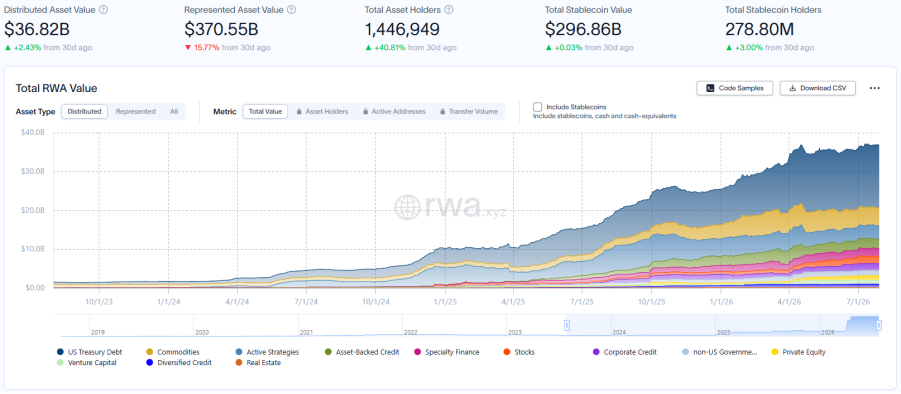
According to the latest data from RWA.xyz, as of July 31, 2026, the total on-chain market capitalization of RWA has risen to $36.82 billion, a 2.43% increase compared to the same period last month, maintaining moderate growth. The total number of asset holders skyrocketed to 1.4469 million, a substantial increase of 40.81% compared to the same period last month, marking the largest growth in history and indicating further acceleration of investor influx into the RWA track, with market participation heating up rapidly.
Stablecoin Market
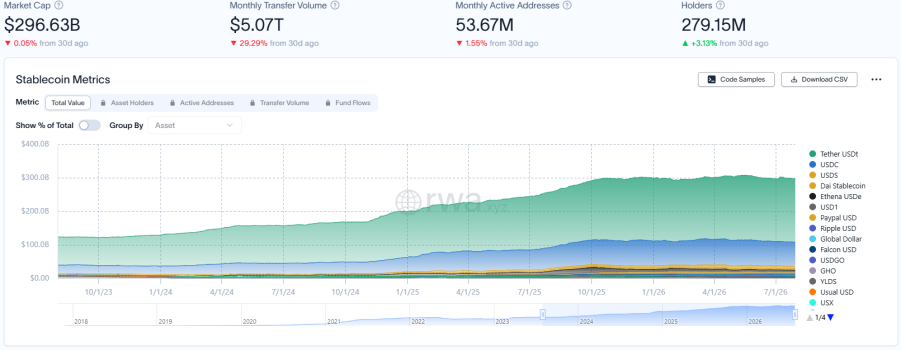
The total market capitalization of stablecoins fluctuated slightly to $296.63 billion, a slight decrease of 0.05% compared to the same period last month, with liquidity remaining stable; the monthly transfer volume fell to $5.07 trillion, a significant drop of 29.29% from the same period last month, indicating that market settlement demand remains low.
The total number of active addresses decreased to 53.67 million, down 1.55% compared to the same period last month; the total number of holders increased to 279 million, a steady expansion of 3.13% compared to the same period last month. The divergence between the two shows that retail allocation demand continues to grow, but on-chain trading participation keeps shrinking, leading the market into a stalemate of "capital accumulation and exhaustion of activity."
The leading stablecoins are USDT, USDC, and USDS, with USDT's market capitalization increasing by 1.27% compared to the same period last month; USDC's market capitalization slightly decreased by 0.28%; USDS's market capitalization plummeted by 14.56% compared to the same period last month.
Regulatory News
According to Cointelegraph, the Financial Services Commission (FSC) of South Korea plans to collaborate with the ruling party to advance a comprehensive bill on the "Basic Law for Digital Assets," covering standards for stablecoin issuance and circulation, digital asset business rules, exchange access, disclosure, internal controls, and system resilience. There are currently ten independent digital asset and stablecoin bills awaiting review in Congress. Controversial points include whether the issuer of the Korean won stablecoin should be controlled by banks, and whether major crypto exchanges should have stockholding limits.
Meanwhile, Congress's Finance and Economy Planning Committee will review a bill proposed by the opposition to repeal the cryptocurrency tax, which was introduced by National Power Party member Song Yeon-sik in March to eliminate the taxation on income from digital asset transfers or loans. This tax was set to take effect on January 1, 2027, with a 20% tax rate plus a 2% local income tax imposed on crypto income exceeding 2.5 million Korean won (approximately $1,700).
Zimbabwe Securities Regulator approves seven crypto and tokenization projects for sandbox
According to Bitcoin.com News, the Zimbabwe Securities and Exchange Commission (SECZ) has approved seven fintech companies to enter its regulatory sandbox testing framework, including the blockchain financing platform "Zimbabwe Pioneer Exchange," asset tokenization platform Ndarama Standard, synthetic trading platform Questview Brokers, crowdfunding platform Crowdaxe Capital, as well as three institutions focused on asset, infrastructure, or securities tokenization: Procode Platforms, Financial Securities Exchange, and Colmin Resources Zimbabwe. SECZ stated that the sandbox aims to promote responsible innovation, enhance financial inclusion, and foster capital market development, with participants subject to strict regulatory oversight. SECZ reserves the right to issue further guidelines or operational requirements.
Kenya lowers capital requirement for stablecoin issuers by 40% to $2.32 million
According to Bitcoin.com News, the Kenyan Treasury has announced revised regulatory rules that lower the minimum capital requirement for stablecoin issuers by 40%, from nearly $3.9 million in the previous draft to approximately $2.32 million (300 million Kenyan shillings), reducing the entry barrier for global issuers to enter the local market.
The new regulations also maintain relatively stringent regulatory requirements: the Central Bank of Kenya will implement extensive oversight of stablecoin issuers and other virtual asset service providers; stablecoins must be backed 1:1 by compliant reserve assets, and customers can redeem at face value within two business days. In terms of reserve arrangements, at least 30% of customer funds must be deposited into a segregated trust account at a Kenyan commercial bank, with the remainder invested in compliant local assets; stablecoins pegged to fiat currencies must also be supported by reserve assets in the same currency as the pegged currency.
Project Progress
According to The Block, Project Agorá led by the Bank for International Settlements (BIS) has completed real cross-border payment testing, involving five central banks and 28 commercial banks, including JPMorgan Chase, Citigroup, UBS, Deutsche Bank, and Standard Chartered. The test used tokenized central bank reserves and commercial bank deposits to complete approximately $1 million in real transactions, involving six currencies: the US dollar, euro, British pound, Japanese yen, Swiss franc, and South Korean won, with an average settlement time of about 80 seconds.
The test utilized a shared ledger, allowing banks to complete transactions on a single record and tested synchronous foreign exchange settlement to reduce counterparty risk. Project Agorá is one of several wholesale tokenization projects aimed at exploring how digital technology can modernize the infrastructure of global financial markets.
According to Cointelegraph, ten European financial institutions have jointly established the Regulated Layer One (RL1) blockchain cooperative, providing infrastructure for regulated financial markets and tokenized assets. Founding members include ING Group, Spain's Cecabank, France's Crédit Mutuel Alliance Fédérale, Germany's DekaBank, DZ BANK, LBBW, France's Natixis CIB, Standard Chartered's SC Ventures, and Seturion.
RL1 is registered as a European cooperative in Luxembourg, where all members have equal governance decision-making rights. This private permissioned chain is based on the infrastructure developed by the German fintech SWIAT, which has transferred ownership of the network to the cooperative. RL1 aims to support institutional use cases involving digital currencies, tokenized bonds, collateral, and blockchain settlement, reducing fragmentation caused by financial institutions each operating their own distributed ledger systems. Former SWIAT Managing Director Henning Vollbehr will lead RL1, with the KfW Bank and L-Bank continuing to support the initiative, and RL1 is in discussions with institutions like NatWest for potential participation.
According to Cointelegraph, London-based asset management company Aviva Investors has launched tokenized shares of its dollar liquidity fund on the XRP Ledger after receiving approval from the Central Bank of Ireland. Qualified investors can participate through digital wallets, while the underlying assets of the fund are still held by custodian BNY Mellon, with Komainu providing digital asset custody and Licuido providing tokenization infrastructure. The fund invests in high-rated short-term dollar-denominated debt securities and money market instruments, and the tokenized shares have the same investment objectives and liquidity characteristics as traditional funds.
According to Coindesk, POSCO International, South Korea's largest trading company, is collaborating with LG CNS, a technology company under the LG Group, to tokenize actual commercial invoices using the Injective network. POSCO International is tokenizing commercial invoices generated from real trades among its global subsidiaries (rather than simulated data) to accelerate cross-border payment processes. By utilizing a blockchain shared ledger, it aims to achieve a single transferable record with embedded compliance rules, reducing reconciliation time between buyers, sellers, and banks, and enhancing fund turnover efficiency.
According to CoinDesk, farmers in Paraná, Brazil, have raised nearly $20,000 of credit by financing ten cows with RWA tokenization on the B3 exchange, in response to local banks tightening loans to small agricultural enterprises. The project, led by Brazilian agtech company Cowmed, equipped each cow with AI-driven Smarty Collar smart collars that monitor health, behavior, and location in real-time, encrypting raw data to generate corresponding digital identities and recording them in the credit agreements with B3. Continuous tracking prevents the same cow from being double pledged and allows for substitution in the event of the cow's death. Cowmed is currently monitoring around 100,000 cows, with an asset value exceeding $395 million, and it is expected that up to 20% of the network will adopt this financing model, potentially releasing about $77.6 million in agricultural credit.
BNY Mellon is transferring its core transfer agency record-keeping operations to the blockchain
According to CoinDesk, one of the world's largest custodians, BNY Mellon, is moving its core transfer agency (TA) business to the blockchain, creating a single on-chain holder registry for approximately $8.6 trillion in assets and 7.6 million accounts to reduce multiple intermediaries and reconciliation costs. The initial clients include Baillie Gifford, BlackRock, and BNY's Dreyfus, with Baillie Gifford launching the first fully native, UK-regulated tokenized fund, and BlackRock and Dreyfus planning to issue more tokenized products on the system. BNY will also maintain its traditional TA system, with both traditional and on-chain architectures expected to run in parallel for a considerable time, emphasizing that cybersecurity risks such as smart contract vulnerabilities still need to be addressed.
Securitize receives SEC advisor license to expand its regulated platform
According to The Block, the tokenization company Securitize's subsidiary Securitize Capital has officially obtained registration as an investment advisor from the U.S. Securities and Exchange Commission (SEC), allowing it to collaborate more closely with asset management companies and institutional investors on tokenized investment strategies. Securitize CEO Carlos Domingo stated that this move is a significant step in the continued expansion of the platform. At this point, Securitize's U.S. platform has integrated four regulated businesses: SEC-registered investment advisor, SEC-registered broker-dealer (operating alternative trading systems - ATS), SEC-registered transfer agent, and fund administration services. Securitize went public on July 2 through a SPAC merger.
Ondo launches new execution network Ondo Network, replacing the original Ondo Chain direction
According to The Block, Ondo Finance has announced the launch of a new execution layer called Ondo Network, described as an "evolutionary version" of the prior Ondo Chain, which will no longer run in parallel with Ondo Chain. In developing the perpetual contract exchange Ondo Perps, Ondo discovered that the trading bottleneck primarily lies in execution rather than settlement. Therefore, execution is separated from settlement and validation: high-speed, default-private transaction execution is managed by secure hardware enclaves, while a decentralized attestor network verifies its running code, with asset transfers currently settled on Ethereum, and future support planned for more public chains with regular on-chain status submissions. Ondo Network serves as a general execution layer, scalable beyond perpetual contracts to spot, lending, structured products, and other applications that require fast, private, and verifiable execution, maintaining the role of the ONDO token as governance and incentive core.
Stablecoin Open USD will be deployed on the Ethereum network on its launch day
The nonprofit organization Ethereum Institutional stated on the X platform that the stablecoin Open USD will be deployed on the Ethereum network on its launch day. The project has garnered support from over 140 institutions, including Visa, Mastercard, Stripe, BlackRock, and BNY Mellon, with all reserve earnings directed to partners promoting its growth.
According to The Block, Tether's compliant stablecoin USA₮ (USAT) has officially launched on the Celo mainnet, marking its second mainnet deployment after Ethereum. The token is issued by Anchorage Digital Bank, can be minted and redeemed natively on Celo, and can be directly used for on-chain gas payments thanks to Celo's fee abstraction mechanism. USAT launched in January this year and currently has a market capitalization of approximately $185 million.
U.S. stock token trading platform Mei Tong MSX introduces a new U.S. stock contract token
The U.S. stock token trading platform Mei Tong MSX has launched contract trading for the global leader in advanced packaging and testing, $AMKR.M.
Insights Highlights
PANews Overview: Although the total scale of on-chain RWA has surpassed $32 billion, about 90% of the assets are dormant, facing a serious DeFi utilization dilemma.
Significant divergence among leading platforms: issuers like Securitize and Ondo have extremely low DeFi utilization (below 3%), while credit protocols like Maple achieve a 62% high utilization through application scenarios. The primary reasons for low utilization include: government bond assets being primarily held for yield, KYC whitelist restrictions inhibiting permissionless circulation, and lack of market-making and secondary market infrastructure.
Currently, the RWA competition is shifting from "asset issuance" to "application and channel distribution," with entry-level channels like Robinhood becoming key to breaking the deadlock. The future hinges on enhancing liquidity and regulatory ecology to make tokenized assets truly "usable."
PANews Overview: The European payment company Augustus, led by 25-year-old founder Ferdinand Dabitz, recently completed a $180 million funding round, achieving a valuation of $1 billion and receiving conditional approval for a national bank license from the U.S. OCC.
The company is transforming from an early open banking merchant checkout API to a "wholesale bank for stablecoins" covering tokenized deposits and digital asset wallets. Despite its strong funding background and high visibility, its founding team lacks experience in managing the balance sheets of regulated banks, and its proprietary platform's cost reduction capability and actual business conversion rates face severe challenges.
Stablecoin War: OUSD Challenges USDC on Three Core Fronts
PANews Overview: At the end of June 2026, the Open Standard alliance, comprising over 140 institutions including Visa and Stripe, launched a new stablecoin OUSD, breaking the model of traditional issuers like Circle monopolizing reserve interest, by reallocating government bond yields to partners, posing a structural shock to Circle's distribution channels and profit margins.
However, OUSD also faces resistance such as the long application period for independent compliance licenses (up to 18-24 months), inefficient alliance governance and collaboration, and high infrastructure construction costs. In contrast, USDC has deep network effects in open DeFi and a moat provided by CCTP cross-chain technology, while Circle could retaliate by establishing its own revenue-sharing mechanism. In the future, both sides may engage in competition in enterprise settlement and B2B payment sectors.
免责声明:本文章仅代表作者个人观点,不代表本平台的立场和观点。本文章仅供信息分享,不构成对任何人的任何投资建议。用户与作者之间的任何争议,与本平台无关。如网页中刊载的文章或图片涉及侵权,请提供相关的权利证明和身份证明发送邮件到support@aicoin.com,本平台相关工作人员将会进行核查。


