Author: insights4vc
Translated by: Deep Tide TechFlow
Deep Tide Introduction: insights4vc reviewed the global venture capital market in Q1 2026. This quarter saw total funding of about $300 billion, setting a new historical record, but 80% flowed into AI. OpenAI raised $122 billion in one go, Anthropic $30 billion, xAI $20 billion, and Waymo $16 billion, with these four deals accounting for two-thirds of global venture capital. Cryptocurrency funding saw some recovery, totaling about $8.6 billion in Q1, but two-thirds was concentrated in March, and funds mainly flowed into stablecoin payments and compliance infrastructure, while speculative projects remained tepid.
Main Text:
The venture capital market in 2026 has entered a new phase. It is no longer a financing market that broadly supports startups, but more like a late-stage capital allocation machine revolving around a few AI platforms. Behind the record-breaking numbers are extreme top concentration, weak market breadth, and a still highly selective recovery in cryptocurrency.
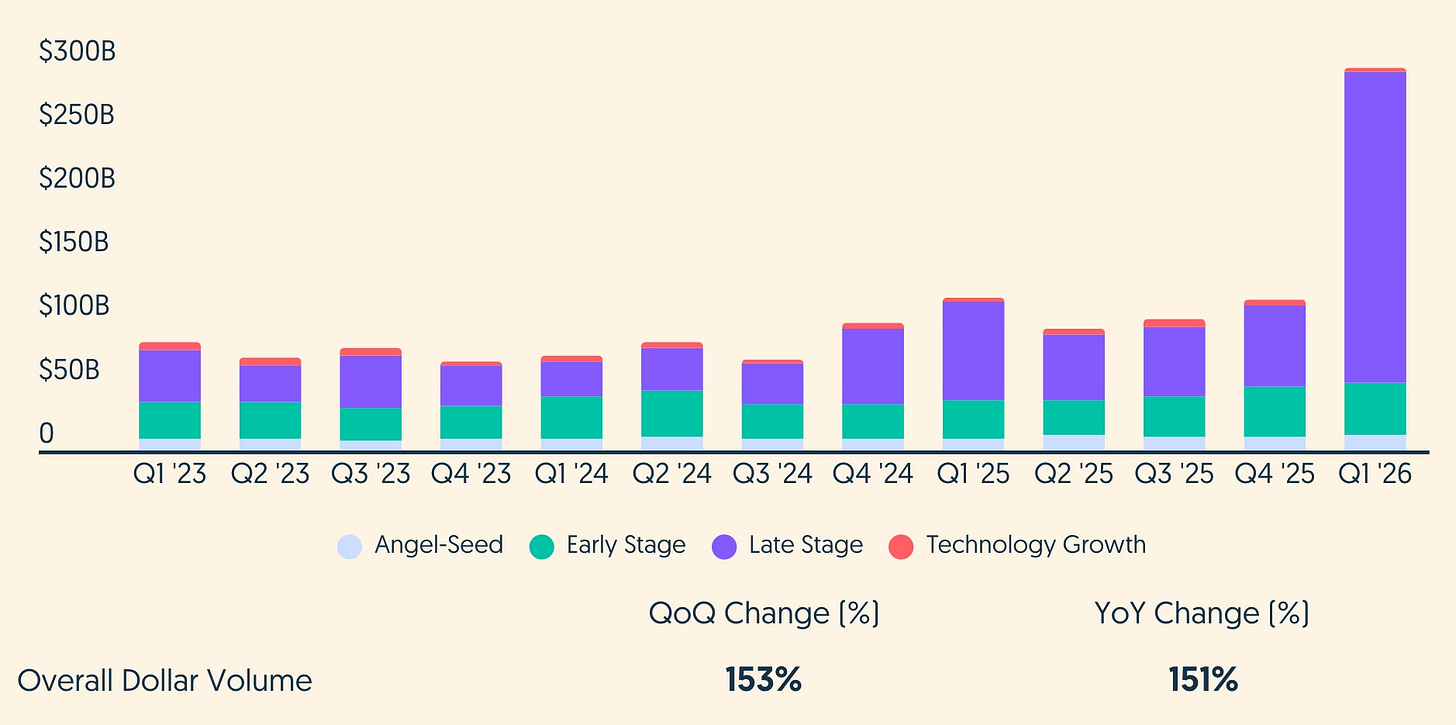
Caption: Global venture capital funding in Q1 2026 (Source: crunchbase.com)
Core Summary
- Global venture capital funding in Q1 2026 was approximately $300 billion, covering around 6,000 companies, setting a historical quarterly high. Late-stage rounds and tech growth rounds contributed the majority of the funds.
- AI took most of the capital: Crunchbase estimates about $242 billion, accounting for 80% of the quarterly total, significantly up from AI's share a year ago.
- The market presents a dumbbell structure: a few global strategic platforms secured unprecedented pools of capital, while the broader number of deals remains sluggish, with most funds facing a challenging fundraising environment.
- Crypto and digital assets showed some improvement compared to the lows, but the rebound is narrow and highly dependent on timing. In some data sources, the explosive growth in March explained most of the funding for Q1 crypto venture capital.
- Within the cryptocurrency sector, capital continues to shift towards regulated channels and practical infrastructure (stablecoin payments, custody, compliance, tokenization), consistent with the increasingly clarified policy environment in the U.S. and EU.
- Directions for capital flow outside of AI include robotics (often with AI attributes), defense technology, cybersecurity, and some fintech, but their significance is increasingly expressed through "AI adjacency" and sovereign/corporate strategic logic.
Q1 Data Overview
Crunchbase data shows that global venture capital in Q1 2026 was about $300 billion, covering around 6,000 startups, with both quarter-on-quarter and year-on-year growth exceeding 150%. This number is close to 70% of the total venture capital amount for the entire year of 2025.
However, record amounts do not mean record breadth. By stage, late-stage financing amounted to approximately $246.6 billion, corresponding to 584 deals; early-stage about $41.3 billion, corresponding to 1,800 deals; and seed rounds about $12 billion, corresponding to about 3,800 deals. Even in the seed stage, some data also show amounts rising but transaction numbers have drastically decreased year-on-year. In other words, the average round size has increased, but the transaction breadth has not expanded. Investors are concentrating time and shares on fewer targets.
A simple but useful way to differentiate is to view the "total" and "total without outliers" separately. Just four super large rounds accounted for a large portion of the Q1 global venture capital total. Removing these outliers leaves around $100 billion, which is about the same as those "strong but not record-setting" quarters of 2024-2025. The reason Q1 2026 set a record is mechanically dependent on the few transactions.
In terms of geographical distribution, U.S. companies raised about $250 billion, accounting for about 83% of global venture capital, further increasing from an already high share. The second largest market is China, with around $16.1 billion, followed by the UK, with about $7.4 billion. This aligns with the basic fact that cutting-edge AI and computing power investments are most easily realized in the U.S. due to the high density of large-scale cloud vendors, concentrated GPU supply chains, and investors willing to pay for long-term infrastructure.
AI Dominated this Quarter
The dominance of AI in Q1 2026 is undeniable. Crunchbase estimates that AI-related companies raised about $242 billion, accounting for 80% of global venture capital. For comparison: in Q1 2025, AI financing was about $59.6 billion, accounting for 53% of the total that quarter. Even considering database backfill and definition drift, the direction is clear: AI has transformed from the largest vertical in venture capital to the venture capital market itself, weighted by funds.
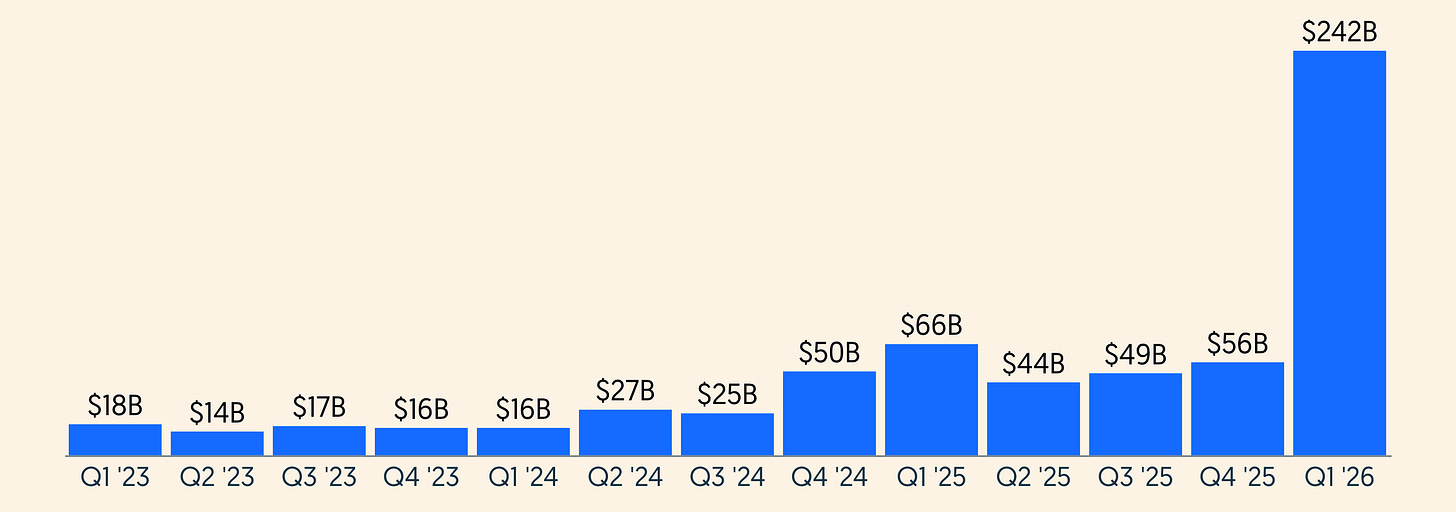
Caption: Quarterly trend of global AI financing (Source: crunchbase.com)
What has changed is not just the level of enthusiasm. The financing model itself is aligning more closely with infrastructure underwriting; the financing rounds of a few companies resemble capital market events rather than traditional venture capital. Four of the five largest venture capital rounds in history were completed in Q1 2026: OpenAI ($122 billion), Anthropic ($30 billion), xAI ($20 billion), and autonomous driving company Waymo ($16 billion), totaling $188 billion, accounting for about 65% of global venture capital.
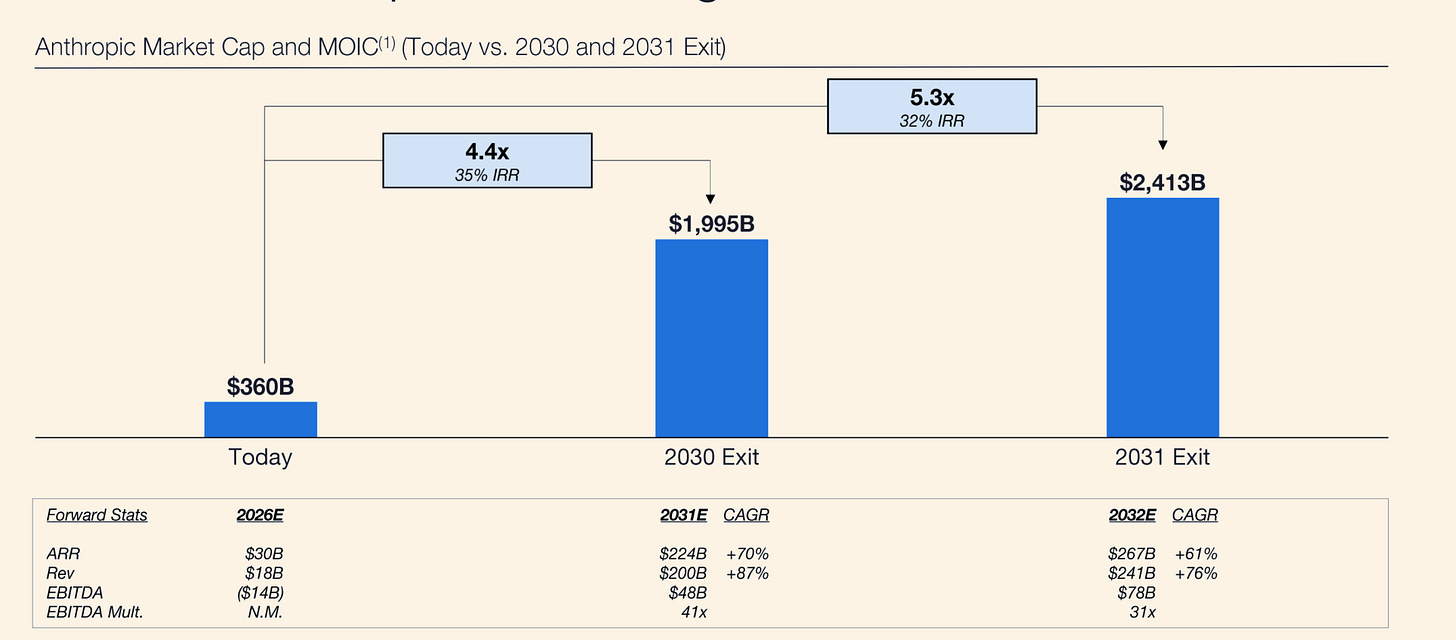
Caption: Anthropic - Coatue forecast model
An exceptional operational data supports Anthropic's valuation logic. According to Reuters, around the time of financing in February 2026, Anthropic's total annualized revenue reached about $14 billion, with annualized revenue from the Claude Code product exceeding $2.5 billion and the number of corporate subscriptions quadrupling in 2026. By early March, Reuters reported total annualized revenue further rising to about $19 billion. Investor enthusiasm stems not only from the option value of cutting-edge models but also from the accelerated realization of corporate monetization capabilities. This explains why Anthropic is increasingly seen as a cleaner exposure for commercialized AI, especially in programming and enterprise workflow infrastructure.
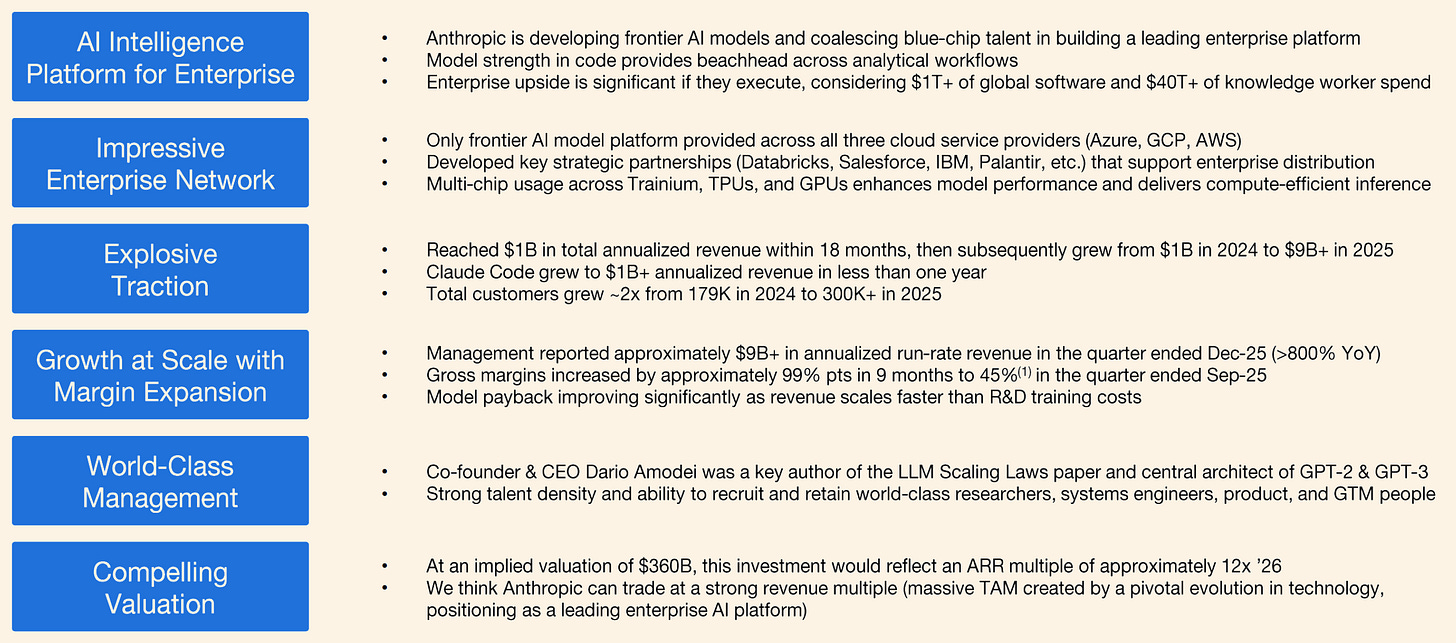
Caption: Coatue predicts Anthropic's valuation will reach $1.995 trillion in 2030
One transaction concentratedly reflects this paradigm shift. On March 31, OpenAI announced the completion of a $122 billion financing with a post-money valuation of $852 billion. The company clearly identified computing power acquisition as a core strategic bottleneck and announced an infrastructure strategy spanning multiple cloud partners and chip platforms. The other two cutting-edge labs also reinforced this same model: Anthropic announced a $30 billion Series G round in February with a post-money valuation of $380 billion, clearly earmarking the funds for cutting-edge research, product development, and infrastructure expansion; xAI announced a $20 billion expanded Series E round in January, with the core purpose being large-scale computing infrastructure construction.
OpenAI's record-breaking financing also exposed an important market tension. Although it remains the largest capital magnet in the AI field, reports indicate that its shares are no longer sought after in the secondary market, with some institutional holders struggling to find buyers, while demand for Anthropic stock is actually increasing. Bloomberg reported that investors are shifting toward Anthropic, indicating that mere scale may no longer suffice to sustain unlimited demand for OpenAI at current price levels.
This is crucial because the latest round of investors in OpenAI's structure does not resemble a traditional venture capital syndicate. It is a strategic round anchored by major suppliers and ecosystem partners, including Amazon, NVIDIA, SoftBank, and Microsoft, along with over $3 billion in individual investor funds raised through bank channels. In reality, this resembles a balance sheet mobilization of infrastructure support around a company viewed as systematically important in the AI stack, rather than an expression of pure market confidence.
This distinction is important. It suggests that the primary market financing of cutting-edge labs can continue to maintain substantial scale even as secondary market buyers become more valuation-sensitive. Anthropic's $30 billion raised at a post-money valuation of $380 billion reinforces this point: for many investors, compared to OpenAI's $852 billion valuation, Anthropic may offer a cleaner upside/price ratio. The broader implication is that late-stage AI capital is starting to differentiate—strategic capital is willing to support computing-intensive leaders at a super large scale, while financial capital seeks the next relative winner, rather than the current category leader.
From this perspective, Q1 2026 is not only a record quarter for AI financing, but also an early signal that valuation discipline is beginning to re-enter this field through the secondary market, even as primary market round sizes are still expanding.
For institutional investors, a key segmentation is that the AI financing in Q1 2026 should be broken down into several distinctly durable subclasses: cutting-edge model companies, infrastructure and data centers, chip and computing power supply chains, agent and enterprise workflow platforms, robotics and autonomous systems, defense-related deployments. Most of this quarter's funds flowed toward the most infrastructure-intensive tiers, with competitive advantages manifested through locked-in computing power, distribution channels, and regulatory positioning, rather than merely model quality.
Waymo is a typical case of the "physical AI" effect. The company raised $16 billion in February at a post-money valuation of $126 billion, with funds clearly earmarked for global expansion in automated transportation. While often categorized as autonomous driving, Waymo's positioning and investment narrative increasingly fall into the broader category of "AI entering the physical world."
The resulting second-order effect is concentration risk. When four transactions can account for two-thirds of global quarterly venture capital, record-breaking financing data is a fragile signal for startup health, job creation, and the breadth of innovation. For allocators: performance differentiation between top AI exposures and other parts of the venture capital ecosystem is more likely to widen than narrow.
The Position of Cryptocurrency in the New Venture Capital Cycle
For professional investors, crypto and digital assets are the second largest relevant theme in Q1 2026, but their absolute scale is far smaller than AI. In the crypto-specific financing tracker, Q1 2026 financing typically falls in the high single-digit billion-dollar range, with monthly fluctuations being significant. CryptoRank's data shows that there were 252 rounds of financing totaling $8.632 billion in Q1, of which about $5.95 billion (107 rounds) contributed in March alone, meaning that approximately two-thirds of Q1 crypto venture capital landed in the last month.
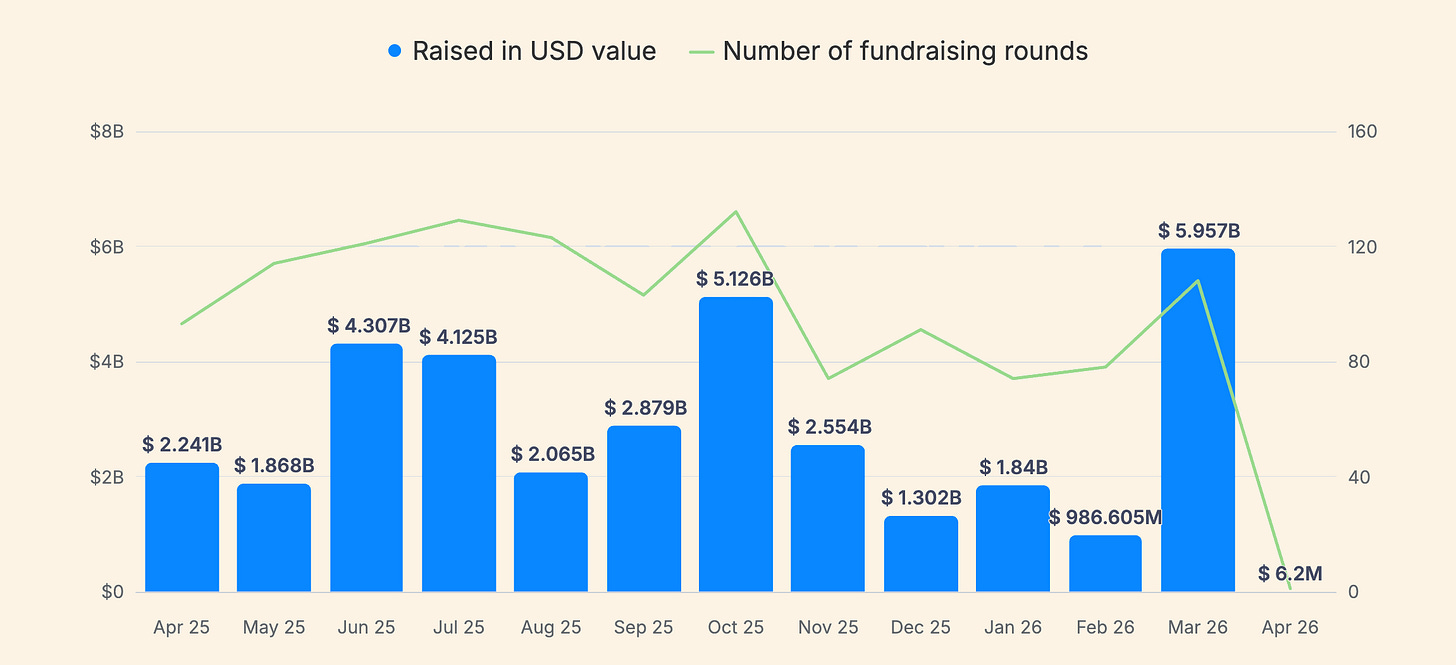
Caption: Cryptocurrency financing trends (Source: cryptorank.io)
This temporal concentration is the first reason to approach the "rebound" with caution. A quarter driven by a single month is prone to data correction risks (delayed reporting, reclassification) and narrative risks (a few transactions being misread as a broad recovery). The second warning is the discrepancies between data providers. Other widely circulated stats on early 2026 crypto financing show significant variances in amount and transaction count, attributed to different criteria (venture equity vs. debt, PIPE, post-IPO financing, treasury financing strategies, acquisitions, undisclosed rounds).
Compared to historical cycles, Q1 2026's crypto venture capital resembles a continuation of the "utility and channel" stage rather than a broad speculative boom. In Q1 2025, CryptoRank estimated crypto VC funding at $4.8 billion, explicitly stating that a single $2 billion investment drove most of the data that quarter. The scenario in Q1 2026 is similar—crypto remains highly sensitive to outliers, but the narrative focus has shifted from exchanges to stablecoin infrastructure and institutional empowerment.
Specific cases support this "channel-first" judgment. According to Reuters, the stablecoin infrastructure company Rain completed a $250 million Series C financing at a $1.95 billion valuation, focusing on stablecoin-related payment cards and wallets. Reuters also reported that OpenFX raised $94 million to expand stablecoin-based cross-border payment infrastructure, with the product positioning aimed at faster settlements and lower costs than traditional agents. These are not "token issuance" stories, but stories of payment and funding pipelines underpinned by crypto.
The macro and regulatory backdrop also helps explain why stablecoins and tokenization can still attract funds amid cryptocurrency price volatility. KPMG's "Fintech Pulse" report shows that in 2025, global total investment in the "digital assets" space (including venture capital, PE, and M&A) nearly doubled to $19.1 billion, citing key drivers: the full effectiveness of the EU MiCA, the U.S. GENIUS Act, and rising market interest in stablecoins and asset tokenization (particularly money market funds). The significance for Q1 2026 is that when crypto can access regulated financial workflows (payments, custody, compliance, tokenized cash equivalents, etc.), the investor base will widen to previously absent institutional funds.
But the rebound remains narrow. Even though Q1 2026’s crypto venture capital reached $8-9 billion in some trackers, when measuring against the global venture capital total of $300 billion, the crypto proportion is still only low single digits. This creates an important strategic trade-off: while crypto may marginally benefit from improved risk appetite, it competes for attention against larger ticket, faster-adopting AI opportunities.
The final detail is that cryptocurrency financing figures may be distorted by potential large financings from mature giants, which may not translate into broad financing for the startup ecosystem. According to Reuters, Tether downplayed the figures surrounding its potential multi-billion-dollar financing discussions after reports of investor resistance, suggesting that even large transactions reflect more of a late-stage balance sheet strategy rather than early expansion at the ecosystem level.
A Broader Market Map
Beyond AI and crypto, Q1 2026 still presents signals regarding the positioning of the next venture capital cycle, but many of these increasingly have an "AI adjacency" attribute rather than existing independently. Crunchbase's data and commentary from late 2025 and early 2026 highlight the strong financing momentum in robotics, defense technology, cybersecurity, and some fintech sectors, with a common thread of automation, sovereignty, and infrastructure.
Robotics is a good case. Crunchbase reports nearly $14 billion in robotics venture capital financing in 2025, an increase of about 70% year-on-year, surpassing the peak of 2021. For institutional investors, this is not a "robot hype" story, but more of a consequence of capital allocation in AI: as models become commoditized, investors seek defensible moats in hardware integration, deployment constraints, and regulated operating environments.
Defense and dual-use technology are also located at the intersection of geopolitical and AI capabilities. Crunchbase reports $8.5 billion in defense technology financing in 2025, marking a historical high. In Europe, the Financial Times described the increasing VC activity in AI and defense in 2025, linked to sovereign security concerns. These trends are significant for the market positioning of Q1 2026, as they support a broader argument: venture capital funding is increasingly following national capability agendas, rather than just narratives about the TAM for consumer software.
Geography remains a key differentiating factor. The U.S. occupied an exceptionally high global venture capital share in Q1 2026. Europe, while not leading in total amounts, continues to produce significant AI financing, including what the Financial Times described as the largest seed round in Europe’s history—new AI startups raising over $1 billion. China's venture capital landscape is showing a different pattern: Reuters reported that Chinese VC fundraising is expected to set a quarterly record, driven by state-led capital formation and policies promoting AI/robotics, with government and state-owned entities as the main contributors.
The implication is that the "global VC" in 2026 is not a single market, but at least three partially independent machines—the U.S. system dominated by the massive private rounds of frontier platforms, the Chinese system increasingly mediated by state capital allocation logic, and the European system maintaining innovation but limited by expansion financing gaps, able to produce selective super rounds instead of widespread late-stage depth.
Looking Ahead to the Second Half
Thinking about the remainder of 2026 is best done based on scenarios, as the Q1 totals are exceptionally sensitive to categorizations and timing.
First, the total venture capital across headlines may continue to run high even if broad transaction activity does not recover. The number of transactions remains far below historical norms, while average round sizes are increasing. Q1 2026 resembles a continuation of this pattern rather than a reversal. If super large rounds persist, allocators may see "record venture capital" coexist with emerging managers struggling to fundraise, seed funds lacking AI exposure facing difficulties, and founders outside thematic tracks finding financing tough.
Second, valuation discipline is more likely to be tested rather than relaxed. Carta's data shows that early valuations set records by Q4 2025, with the median post-money valuation for seed rounds reaching $24 million and $78.7 million for Series A, while the top 10% of U.S. startups on the platform captured about half of the funding in 2025. This combination has historically been associated with greater result differentiation: companies considered category leaders enter at higher prices, while median companies face greater shutdown or consolidation pressures.
Third, the exit environment has improved in total, but remains fragile in execution windows. Global exit activity has recovered from lows, aided by IPO recovery and continued acquisitions, but fundraising conditions remain weak, and public market volatility could close windows at any moment. Early in 2026, Crunchbase noted that market volatility delayed some IPO processes, even as private financings surged. The practical significance is that exits in 2026 may still be uneven: open to elite assets while intermittently closing for others.
Fourth, for crypto investors and founders, the core question is whether crypto benefits from an AI-driven rebound in risk appetite or gets squeezed out by it. Present evidence is mixed. On one hand, stablecoin and payment projects are attracting meaningful rounds and mainstream venture capital participation. On the other hand, the absolute scale of AI financing and its ability to attract sovereign, corporate, and strategic capital may siphon marginal funds away from medium crypto opportunities.
From insights4vc's perspective, the most noteworthy signal for the remainder of 2026 is whether crypto financing can expand from channel infrastructure to genuine consumer adoption. Can tokenization extend from pilot projects to repeatable institutional workflows? The direction is constructive, especially in payments, custody, compliance, and tokenized financial infrastructure, but regulatory and prudential thresholds may still slow actual implementation as investor interest rises.
Conclusion
Q1 2026 is less a comprehensive recovery of venture capital and more the emergence of a new financing paradigm. The record headline numbers are driven by a small group of AI and computing-intensive platforms at unprecedented scale, while the underlying breadth of deals is far weaker than the surface numbers suggest. Cryptocurrency shows improvement, but is mainly concentrated in areas related to regulated financial infrastructure rather than widespread speculative demand. For investors and founders, the signal is clear: venture capital in 2026 is increasingly defined by concentration, selectivity, and expanding differentiation, rather than uniform recovery.
免责声明:本文章仅代表作者个人观点,不代表本平台的立场和观点。本文章仅供信息分享,不构成对任何人的任何投资建议。用户与作者之间的任何争议,与本平台无关。如网页中刊载的文章或图片涉及侵权,请提供相关的权利证明和身份证明发送邮件到support@aicoin.com,本平台相关工作人员将会进行核查。


