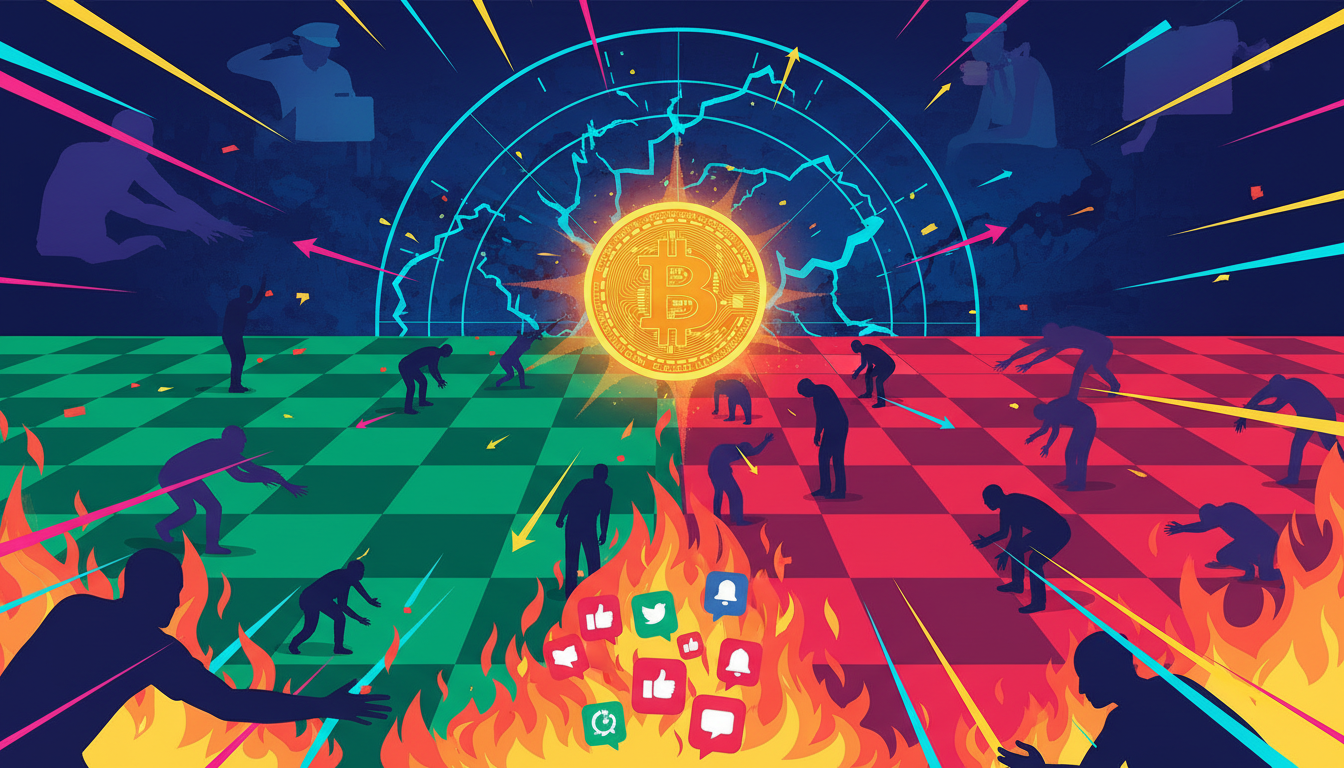
On April 5, 2026, Eastern Eight Time, the Iranian Islamic Revolutionary Guard Corps launched strikes against energy and oil refining facilities of multiple countries in the Gulf, elevating geopolitical tensions in an instant. According to publicly available information, this round of actions targeted petrochemical plants in the UAE, Kuwait, and Bahrain, as well as oil refineries in Israel and natural gas facilities in the UAE, but there is no unified assessment of damages or on-ground details. In the asset market, a direct question arises: How will attacks on Middle Eastern energy facilities affect global oil prices, thereby transmitting risks to stock markets, bond markets, and cryptocurrencies? A judgment from Garrett Jin, agent of “BTC OG insider whales,” provides a clear mainline for this transmission chain - Oil is the core driving force of the US-Iran war; other economic and financial variables, including stock markets, bonds, cryptocurrencies, Federal Reserve policy, and food prices, are downstream results of oil prices. In a moment of incomplete information, where prices have not fully reflected the impact, it is even more necessary to return to this mainline of oil to understand the relationship between conflict and the market.
Missiles Cross the Gulf: Energy Vitals Under Precise Pressure
The framework of actions disclosed on April 5 indicates that the Iranian Islamic Revolutionary Guard Corps did not choose symbolic targets but instead aimed firepower at petrochemical plants in the UAE, Kuwait, and Bahrain, as well as at Israeli oil refineries and UAE natural gas facilities, targeting key nodes in the energy and industrial lifelines of the Gulf region. Current public reports lack specific names of facilities and the extent of damage, but the type of targets itself has already released a clear signal: This is pressure directly aimed at the "blood vessels" of oil-producing countries, rather than marginal friction that can be easily overlooked.
In the realm of public opinion, Iran has also issued warnings through some channels that it "will further attack US economic interests in the region," a statement that currently has a singular source and awaits further verification from multiple parties, but is enough to serve as an amplifier of market sentiment. Whether or not a new round of strikes occurs subsequently, simply naming the "US economic interests in the Gulf" has already included energy infrastructure, shipping routes, and dollar-denominated assets in the imagined risk list.
From a geographical and shipping perspective, the Gulf region is a convergence point and radiation source for global oil and gas flows. Crude oil and liquefied natural gas produced by major oil-producing countries need to be gathered and transported through narrow waterways and dense ports. Even if there are currently no authoritative data disclosing specific traffic volume and percentage changes in prices, this geographical reality itself is sufficient to explain why localized attacks would be quickly exaggerated by the market - because any doubt regarding the security of facilities will be projected by investors onto the scenarios of "supply interruption" and "soaring insurance costs," thus preemptively factoring in the risk premium of "potential supply disruption" into the price.
Oil Becomes the Main Line of War: All Assets Queued Downstream
The judgment put forth by Garrett Jin simplifies the logic of this round of conflict from a "multivariate game" into a mainline: Oil prices are the core driving force of the US-Iran war; other assets are merely passively queuing downstream. Under this framework, oil is not a sector that stands alongside stock markets, bonds, and cryptocurrencies but rather an upstream variable that determines the tone of these sectors. An increase in oil prices implies higher input and transportation costs, which will intuitively drive up inflation; rising inflation expectations will, through interest rate paths, guide central bank policies towards tightening, compressing risk appetite; the stock market and high-leverage assets are the first to feel the squeeze, while the liquidity-sensitive cryptocurrency assets bear the intensified impact at the end of the chain.
Looking back at history, every round of Middle Eastern conflicts and spikes in oil prices has ultimately been written into global asset pricing textbooks: The surge in oil prices resulting in upward inflation forces the market to reassess interest rate paths; whether the Fed or other central banks, they must lean towards "suppressing inflation" rather than "stabilizing growth." The yield curve thus rises, financing costs rise comprehensively, risk appetite shrinks, equity asset valuations compress, and cross-border capital flows back into dollar assets. At the tail end of this path, food prices and living costs will also be pushed higher due to energy transmission, further compressing the disposable cash flow of households and weakening demand for high-risk investment products.
An important feature of this event is: There currently lacks authoritative real-time volatility data in the oil and cryptocurrency markets, leaving the market to price based on fragmented information such as "facilities attacked" and "may further attack US economic interests." The data vacuum will not bring about calm; instead, expectations and panic will amplify price fluctuations in the absence of anchor points: on one hand, traders tend to use the oil price curves from past rounds of conflicts to "preplay" this path, laying out defensive positions in advance; on the other hand, algorithms and quantitative models will rely on emotional and keyword signals to react in the absence of precise inputs, amplifying short-term volatility. The result is that, before an accurate price consensus is established, this upstream variable of oil has already begun to reshape the risk premium of downstream assets through the "expectation channel."
Gulf Game Intensifies: Iran Bets on Energy Pressure Leverage
Starting from the public warning of "further attacks on US economic interests in the region," even if we cannot confirm more detailed military action plans, we can see a clear strategic intention: By persistently applying pressure on energy infrastructure, Iran seeks to increase the costs for the US and its allies to maintain security in the Gulf. Rather than pursuing a one-time "destruction," it seems more like a repeated tapping on fragile key points, forcing the adversary to pay for security with each fluctuation in oil prices.
Without fabricating military details, we can discuss the underlying "cost imposition" idea: As long as the Gulf situation is continuously maintained in high-risk territory, the US's security commitments to its allies will become more expensive - requiring more military presence, enhanced air defense and escort capabilities, and incurring higher political and financial costs, while allies must also bear the costs of defense systems, insurance rates, and supply chain restructuring. The "cost-effectiveness" of security commitments is continuously squeezed, and the market's confidence in this commitment will be repeatedly scrutinized in each attack and every fluctuation in oil prices.
If this strategy continues to evolve, the mid-to-long term impacts on financial markets will far exceed the one or two days of oil price fluctuations. The oil futures curve may long maintain higher risk premiums, with long-dated contracts no longer easily retreating to "normal peace"; shipping insurance rates will remain high under "geopolitical risk inflation," pushing actual trade costs upward; in asset pricing models, the item "geopolitical discount" will have to be magnified - whether for global energy stocks or manufacturing and consumer industries heavily reliant on smooth shipping and low-cost fuel, their valuations will need to embed a thicker layer of "Middle Eastern risk discount." For risk assets, this means that under the same profit expectations, the multiples of valuation the market is willing to offer will decrease, placing the entire asset spectrum under a round of "chronic squeeze due to geopolitical risk repricing."
Repositioning of the Cryptocurrency Market Under the Shadow of Oil Prices
In the absence of real-time specific pricing data, past experiences from geopolitical conflict periods can only be referenced to infer potential narrative swings for assets like Bitcoin. On one hand, there is the narrative of "digital gold" and "value storage in the shadow of sanctions": when traditional financial channels and sovereign credit are in doubt, some funds might view cryptocurrency assets as an asset pool beyond sovereignty, exhibiting safe-haven properties in the short term. On the other hand, there is the reality of "high beta risk assets": in cycles of liquidity contraction and declining risk appetite, assets that are the most volatile and lack stable cash flow support are often the first to take the hit, with cryptocurrency assets typically experiencing larger declines than the stock market. Geopolitical conflicts tend to have both narratives exist concurrently, with prices swinging violently between safe-haven buying and deleveraging selling.
Rising energy prices coupled with geopolitical tensions will elevate inflation and interest rate expectations, subsequently compressing the valuation space of the cryptocurrency market through dollar liquidity and risk appetite paths. Once the market begins to bet on a more hawkish stance from central banks, dollar liquidity tightens, risk premiums for global assets generally rise, and institutional funds have to increase the weights of asset types characterized by stable cash flow and low volatility in their asset allocation. For the cryptocurrency industry, this will directly reflect in aspects such as slower total market cap growth, tightening of the primary market fundraising environment, and declining willingness of institutions to allocate to high-volatility tokens and long-duration sectors, with valuations of entrepreneurial projects and secondary market premiums simultaneously compressed.
If tensions become prolonged, the pressure on miners will become more evident. Energy prices themselves are one of the core variables for mining costs; once the central oil price rises and transmits through power generation costs, the marginal cost line for miners is pushed higher overall. For participants deploying computational power in the Middle East and surrounding areas, in addition to cost issues, they also face multiple overlaps of "physical security of facilities," "sudden policy changes," and "sanctions ripple effects," with the regional layout logic that originally relied on low electricity prices and policy dividends potentially being offset by a security premium. Meanwhile, the narrative of "computational security" will also be reexamined: concentration of computational power in geopolitically sensitive regions, potential power outages and attack risks will enter the risk list of institutional asset allocators, promoting a preference for a more decentralized and harder to be bound by single-country risks structure of computational power.
From North Korean Hackers to On-Chain Under Currents: Geopolitical Conflicts Have Long Been Embedded in Protocol Layers
Echoing missile strikes on traditional energy facilities, the on-chain world has already been penetrated by geopolitics on another dimension. On-chain investigator Tay revealed that since the DeFi Summer of 2020, North Korean IT workers have deeply participated in constructing various blockchain protocols. This means that state or quasi-state actors associated with geopolitical conflicts are not only launching attacks in the physical world but also leaving their fingerprints in protocol code, governance structures, and contract logic, becoming part of on-chain infrastructure.
If missiles over the Gulf are a direct strike against oil refineries, petrochemical plants, and natural gas facilities, then on-chain protocols being infiltrated by hackers, maliciously upgraded, or even "pre-buried backdoors" signify a different kind of "infrastructure war." The commonality between the two is that the real actors are often state or quasi-state-level entities; the selected battlefield, however, is the networks and facilities that ordinary users rely on every day - one side being the refineries and pipeline networks behind gas stations, and the other being the lending pools, cross-chain bridges, and asset pools that users are accustomed to.
In the context of heightened energy geopolitical tensions, on-chain protocols, cross-chain bridges, and large asset pools could further evolve into critical tools for evading sanctions and cyber warfare. On one hand, when cross-border funds are restricted in traditional financial channels, there will be a greater inclination to utilize on-chain infrastructure to bypass; on the other hand, attacks and infiltrations targeting these facilities will also become means to exert pressure, steal value, and undermine adversary financial stability. The result is that regulatory and security narratives are forced to advance: Regulators pay more attention to the geopolitical attributes of on-chain flows and protocol control, while security teams need to introduce geopolitical risk assessments of "the identities of developers and contributors behind the protocols" beyond code audits. Cryptocurrency infrastructure is no longer the "outsider" of geopolitics but is placed on the same plane as energy, payment systems, and communication networks, becoming a part of the new generation toolkit for sanctions and counter-sanctions.
The Domino Effect Driven by Oil Prices: Cryptomarket Finds Its Pricing Position Downstream
Overall, the Iranian strikes on regional energy facilities on April 5 have pushed oil back to the center position of global risk pricing. Whether it be stock markets, bonds, or cryptocurrency assets, they can only seek their pricing positions downstream after the main line of oil prices has been established. Oil dictates the center of inflation and interest rates, interest rates dictate liquidity and risk appetite, and risk appetite ultimately determines whether the cryptocurrency market can secure sufficient funding and valuation space, a chain that is unlikely to be rewritten in the short term.
Meanwhile, there is a plethora of uncertainties and data gaps in the current information: the specific list of attacked facilities, the extent of damages, the actual disruptions to oil supply, and the real-time feedbacks in oil prices and the cryptocurrency market have yet to form authoritative consensus. In such an environment, it is crucial to deliberately distinguish between the two layers of influence: The scale and duration of the event itself determine whether the supply-demand fundamentals will be fundamentally rewritten; while market expectations can be amplified by emotions and historical memories in the absence of information, leading to potential overreactions in prices in the short term. For traders, making extreme bets based on unverified details often involves betting on both "fact paths" and "emotional amplification" along two high-risk branches.
For cryptocurrency participants, the insights provided by this round of conflict extend beyond short-term volatility. More critically, it is to incorporate Middle Eastern energy and geopolitical dynamics into their fundamental analysis framework: Long-term tracking of oil and gas prices, interest rates, and dollar liquidity; observing on-chain fund flows and behavior patterns under sanctions and geopolitical pressures; viewing the intertwining of "energy games - macro liquidity - on-chain geopolitical games" as one of the underlying variables affecting the mid-to-long term pricing of cryptocurrency assets. The cryptocurrency market is transitioning from a "self-talking" closed system to an open era shaped by oil, interest rates, and geopolitics.
Join our community to discuss together and become stronger!
Official Telegram group: https://t.me/aicoincn
AiCoin Chinese Twitter: https://x.com/AiCoinzh
OKX Welfare Group: https://aicoin.com/link/chat?cid=l61eM4owQ
Binance Welfare Group: https://aicoin.com/link/chat?cid=ynr7d1P6Z
免责声明:本文章仅代表作者个人观点,不代表本平台的立场和观点。本文章仅供信息分享,不构成对任何人的任何投资建议。用户与作者之间的任何争议,与本平台无关。如网页中刊载的文章或图片涉及侵权,请提供相关的权利证明和身份证明发送邮件到support@aicoin.com,本平台相关工作人员将会进行核查。