Author: Techub News Editor's Compilation
Date: April 21, 2026
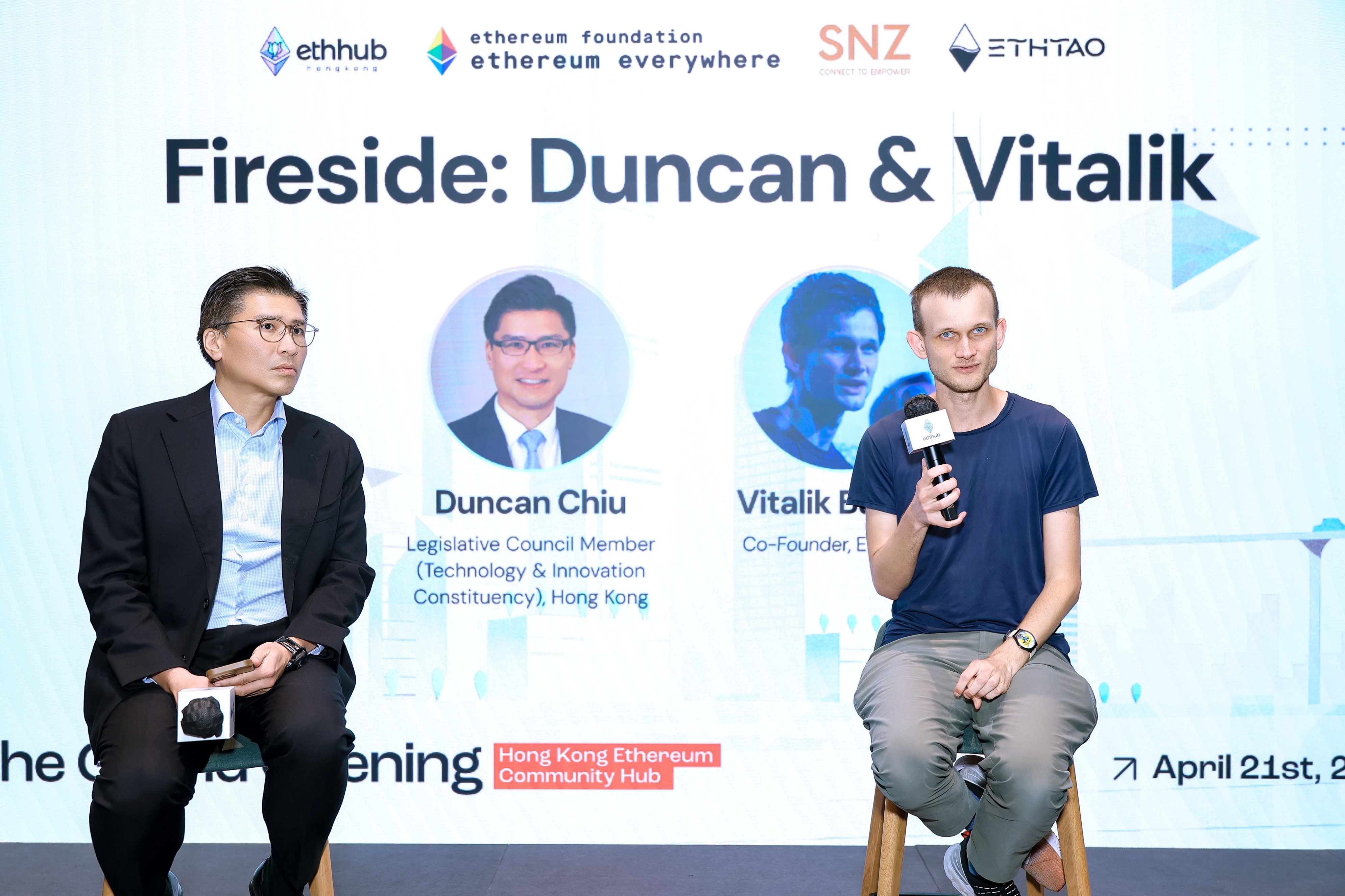
Location: Hong Kong Web3 Carnival · ETH Hong Kong Community Hub
Dialogue Guests:
•Vitalik Buterin (Ethereum Founder)
•Duncan Chiu (Legislative Councilor of Hong Kong, Technology Innovation Sector)
Back to Hong Kong, See You Chinese Community Again
Duncan: The venue is filled today, welcome Vitalik back to Hong Kong. The organizers gave me a task, saying this session should be conducted in Mandarin, which puts a lot of pressure on me because I worry many people here speak better Mandarin than I do.
These past few days, you have shared many technical details about Ethereum on various occasions. For today, I want to keep it light and discuss your personal journey—your relationship with the Chinese community over the past decade and your recent thoughts. We can touch on the technology briefly.
Let's start with some memories: from your founding of Ethereum to today, you've spent a lot of time in China, in Hong Kong, in the Chinese-speaking world. How do you view this journey with the Chinese community? What special feelings do you have about the builders and community here?
Vitalik: The first time I genuinely heard about China’s crypto community was in 2013, back when there was no Ethereum, only Bitcoin. I heard that there was already a large mining group and exchanges in China, larger in scale than those in the US, but there was almost no coverage of this world in the English media, so I was very curious.
In May 2014, I came to China for the first time, visiting Beijing, Shanghai, Hangzhou, and Shenzhen, meeting many miners and exchanges. At that time, the ecosystem here could be said to have two main parts: miners and exchanges, both very large. It left a deep impression on me that some companies already had hundreds of employees while leading companies in the US had not even reached a hundred at that time.
At the same time, here they were already thinking about smart contracts early on. Some teams proposed that each application could be its own blockchain, which could operate with one another; some developers wrote white papers researching decentralized random number generation methods, which later became part of the Ethereum protocol, like the mechanism for selecting the next block producer.
After the pandemic, many changes occurred again. Starting around 2022, due to ZK technology, new generation roadmaps, and the development of L2, a large number of new developers came in. In the beginning, many focused more on L2 and DeFi, and later slowly, some began to participate in core development, engaging in EIPs, discussing when to increase gas limits, when to introduce ZK-EVM.
So to summarize in one sentence, my relationship with the Chinese community started from “miners and exchanges” and has gradually evolved to involve every layer of the tech stack today—including very deep core protocols. I think this change is very good, but there is still a long road ahead for us to walk together.
GoodL2cannot only be“a copy of Ethereum”
Duncan: From your launch of Ethereum to now, over the past decade, Ethereum has undergone many upgrades—you just mentioned ZK, and there have been different stages of EVM upgrades, one of which is even called the “Shanghai Upgrade,” showcasing your feelings towards this land.
Recently, in the past couple of days, you've also shared a lot of views on L2. You mentioned one point: L2 must not just scale up nor merely replicate an L1. Could you elaborate on how you currently observe the development of L2?
Vitalik: L2 is still very important, but I believe a good L2 cannot just be “another Ethereum” or just an EVM copy.
In my view, L2 should complement L1:
• L1 serves as the foundational security and trustless settlement layer;
• L2 should focus on the things that L1 cannot do well, such as stronger privacy, higher scalability, low latency, and complex oracle dependencies, etc.
If a team says, “I want to create an L2,” and the result is merely porting over L1 logic and using the same EVM to do the same things, then they are not fully utilizing the design space that L2 could potentially offer.
Nows, we also see that the most successful batch of L2s, while initially emphasizing EVM compatibility, have gradually started to develop features and architectures that include some “non-EVM parts,” which are their true differences and advantages.
Duncan: So simply put, L2 must have its own “purpose,” it cannot just exist for the sake of being L2; it must be designed around specific scenarios.
Vitalik: Exactly.
Ethereum's Short-term Roadmap: Data Scaling and Compute Scaling
Duncan: You recently released a new version of the roadmap, and I took a photo of it from below the stage yesterday where future developments are divided into short-term, medium-term, and long-term.
I particularly want to help everyone follow up on the two short-term key points: data scaling and compute scaling. AI is very hot right now, and everyone is also concerned about “how scaling can realistically be implemented.” Can you be more specific about what you aim to achieve in these two areas?
Vitalik: First, let’s talk about why L1 still needs to scale. Many people might say, “Since there’s L2, wouldn’t it be better to put many things on L2?” Theoretically, it is indeed possible to place much logic on L2 or even higher layers, but this leads to a problem: users must trust more intermediaries.
Some core tenets of Ethereum—reducing trust, reducing intermediaries, enabling users to verify for themselves—are difficult to fully separate from L1. Hence, L1’s own data and computational capabilities must continue to scale.
From a data perspective, our most recent upgrade has already increased data capacity. However, the current utilization rate of on-chain data is only about 25%, meaning that only one-fourth of the entire chain's “bandwidth” is being used. If needed in the future, we have space to increase the supported data amount by ten times or even more.
But data alone is not enough. If there’s only data on-chain without computation, users can write many things on-chain, but figuring out how to interpret this data, how to combine and interact across different applications, would become very difficult.
Thus, we have been seriously considering how to scale Ethereum’s computation by a factor of 1000. There are some things we can do, such as using ZK to prove the execution of each block’s EVM; however, there are many challenges:
• Not all logic can easily be scaled by 1000 times;
• Many application developers will need to change the way they write contracts. For instance, a “scalable ERC-20 token” may differ significantly from the ERC-20 writing style that everyone is used to today.
At the same time, security is a very real consideration. Ethereum is now a very complex machine; if we introduce new complexities in pursuit of scaling without ensuring sufficient security, we could be vulnerable within two to three years to an extremely clever attacker, possibly leveraging AI, who could exploit all vulnerabilities.
Duncan: It sounds like you need to maintain a very tough balance between “scaling” and “security.”
Vitalik: Yes, I can share a rather painful story. A few years ago in Shanghai, we were preparing to upgrade the network. Just a few hours before the upgrade was scheduled to start, I was asleep when suddenly I was woken up and informed that a new form of attack had been discovered in the network, and we needed to address it immediately.
A group of us locked ourselves in a room for three to four hours, figuring out how this attack worked and how to patch it. By around 8 a.m., we released a client patch, and the meeting began as scheduled at 9 a.m. At that moment, everyone felt that we had “won.”
However, two days later, a second wave of attacks emerged, five days later a third wave followed, and subsequently, there were more attacks. For about a month, the Ethereum chain was essentially in a “barely usable” state.
We still don’t know who the attacker was, but what is certain is that they explored nearly all the DoS attack surfaces in several mainstream clients. That period was painful, but it made us realize that if a system is complex enough, there will always be someone testing all boundary conditions—this “person” is likely to be AI in the future.
So now when we design, we are extra cautious, employing more formal verification and security tools to ensure our client and protocol are more “provably secure.”
AI and Quantum Computing: Threats are Manageable, But Rebuilding Must Be Done in Advance
Duncan: You have talked several times about the impact of AI and quantum computing on blockchain security. There are many claims in the media, such as “who is more vulnerable to quantum, Bitcoin or Ethereum.” Can you take this opportunity to systematically explain your views on AI and quantum as these two new variables?
Vitalik: I don’t think they will “destroy Ethereum,” but if we do nothing, the problems will certainly be very significant.
I like to use an analogy: imagine a country that has never seen rain, and people do not even know the concept of “rain.” Therefore, the houses have been designed without any consideration for rain. If one day it does start to rain heavily, perhaps 5% of the houses will leak water or collapse.
Now scientists are telling you that in five or ten years, it will start to rain, and they have a rough idea of how to build houses to be waterproof. Theoretically, we know how to do it, but the real challenge is: do you want to start renovating every house, every school, and every office building now? This will be a long and difficult social engineering project.
Quantum security is like this. We know which cryptographic methods are resistant to quantum attacks; I myself wrote a quantum-safe signature algorithm based on hash in 2017 on GitHub, although it’s hidden deeply. The issue lies in efficiency:
• Presently, signatures based on elliptic curves are 64 bytes;
• Quantum-safe signatures may require 2300 bytes.
If we change nothing and merely replace all signature algorithms with quantum-safe ones, the gas cost of each transaction will rise from about 20,000 to 200,000, leading to a tenfold reduction in transaction capacity.
Thus, we need smarter architectures, like signature aggregation: having block-producing nodes aggregate many large signatures and utilize Stark to provide a proof showing that “these signatures are all valid.” The block only needs to store this one proof, rather than all the original signatures. Even if there are thousands of transactions and 3 to 4 MB of original signature data, the chain will only retain a 200 KB proof.
Theoretically, we know the route. However, the distance from “theoretically knowing” to “operating securely on the mainnet” is significant. The forthcoming years will involve realizing these solutions.
AI follows a similar logic. Our strategy is to heavily utilize formal verification to ensure that critical ZK code and client implementations meet very stringent security specifications. L1 is relatively “centralized,” having only one protocol which is prioritized, making it easier to upgrade as everyone focuses on it; however, the application layer is highly fragmented, with each DApp having its own dependencies and off-chain components, resulting in no unified security model.
I believe over the next three to five years, the Ethereum ecosystem needs to invest significant effort to ensure AI is used to help us identify vulnerabilities and enhance security rather than being used by attackers to automatically locate attack vectors.
Duncan: If these quantum security solutions are implemented, will that increase gas? People may be concerned about this.
Vitalik: If it’s merely a “direct replacement of signature algorithms,” then gas will definitely rise and transaction capacity will decline. So, we need the aggregation and Stark proof methods previously discussed to distribute these costs. Theoretically, these proposals can keep transaction costs within an acceptable range, but require us to carry out a lot of work at the engineering and protocol levels.
A Message to Hong Kong and the Chinese Community: Don’t Repeat “A Version of the Previous Generation of Ethereum”
Duncan: Today is the official opening day of the ETH Hong Kong Community Hub. The Chinese community is quite happy to have you back, and they are looking forward to your message.
From this current time point, what would you like to say to the builders here in Hong Kong and the entire Chinese-speaking world constructing on Ethereum? What expectations do you have for this Hub?
Vitalik: I think the past two years have been a great opportunity for the Ethereum ecosystem to “rethink many things.”
On one hand, ZK has transformed from something quite “academic” into a technology that can be used in production environments; on the other hand, AI has reduced the cost of coding by about ten times, enabling many people who previously might not have coded to use AI to write HTML pages or even simple smart contracts.
This opens up more tools for us to face a more complex world. Everything is accelerating, and demands are becoming increasingly complex. Therefore, I would encourage everyone:
• Don’t just start from “what the current Ethereum ecosystem looks like,” but return to those core principles that made you interested in Ethereum in the first place;
• Ask yourself: what does the world truly need right now? Out of these questions, which require Ethereum, and which could be solved with a combination of AI, ZK, security hardware, and other technologies?
In places like Shenzhen, I've seen a lot of open-source hardware and various open-source AI projects. I think this is a worthwhile direction to combine: for example, using secure hardware to improve node and wallet security, and leveraging open-source AI to make on-chain interactions smarter and more secure.
For this Community Hub, my biggest hope is that it can become a place where everyone “starts thinking from scratch.” It’s not just about repeating the Ethereum story from three or five years ago, but rather creating something completely different using today’s new tools and technologies.
Duncan: Returning to the original intention. Every good project starts from real problems and genuine user pain points, not just for the sake of technology.
Time is almost up. Once again, thank you, Vitalik, for your insights, and thank you for your hopes for Hong Kong and the Chinese community.
免责声明:本文章仅代表作者个人观点,不代表本平台的立场和观点。本文章仅供信息分享,不构成对任何人的任何投资建议。用户与作者之间的任何争议,与本平台无关。如网页中刊载的文章或图片涉及侵权,请提供相关的权利证明和身份证明发送邮件到support@aicoin.com,本平台相关工作人员将会进行核查。


