From peptAI to Gero/Chugai: Can DeSci seize real opportunities amidst the funding cliff?
Written by: @yusufxzy
Translated by: Aididiao JP, Foresight News
AI Drug Discovery
An AI agent named peptAI was able to design a brand new ADHD peptide candidate from scratch in just 24 hours, passing through eight validation processes and eventually outputting a molecule ready for real physical testing, with laboratory validation costs of only a few thousand dollars. The BIO Protocol token that supports this platform surged by 105%, and half of the users on crypto Twitter had the word "DeSci" written in their bios within just a few hours, just as they had written "AI" six months ago.
Open-source protein folding models have now reached the level of AlphaFold3 at zero licensing costs, and public bioactivity databases cover 2.5 million compounds, with wet lab (real physical experiment) validation costs below $2,000. AI is significantly compressing the costs and time of drug discovery.
I spent the whole past week trying to figure out what is really different this time.
Passing Phase I Trials is No Big Deal
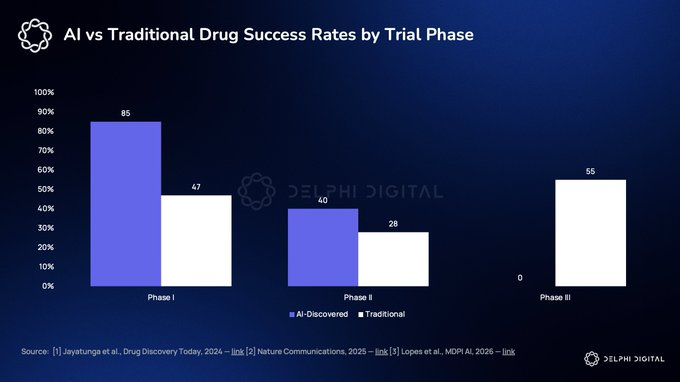
The circulating data suggests that AI-discovered drugs have an 80-90% success rate in Phase I, far higher than the traditional baseline of around 47%. However, no one points out that Phase I only tests whether the drug can cause death, not whether it can treat an illness. Passing Phase I only means that the compound is safe enough to continue research, but it must still go through all subsequent processes until it ultimately receives FDA approval.
Currently, fewer than 40 AI-discovered compounds have released Phase II data, and zero have completed Phase III. Insilico Medicine's Rentosertib is the most advanced AI-discovered compound, having announced positive results in Phase IIa for idiopathic pulmonary fibrosis in mid-2025 in Nature Medicine, and expects to launch Phase III recruitment in China in Q4 of 2025. If everything goes perfectly (recruitment completed in 2027, data readout in 2028, FDA review in 2029), you'll at least have to wait three more years. This is still the best-performing candidate in a project with 173 drug pipelines, yet multiple compounds in this project had to be shelved in 2025 for failing to meet endpoints in atopic dermatitis, schizophrenia, and cancer trials. Independent analysts estimate the probability of the first AI-designed drug receiving FDA approval by 2027 at 60%, and to date, no AI-designed drug has completed this process.
Is Crypto Twitter Suitable for True DeSci?
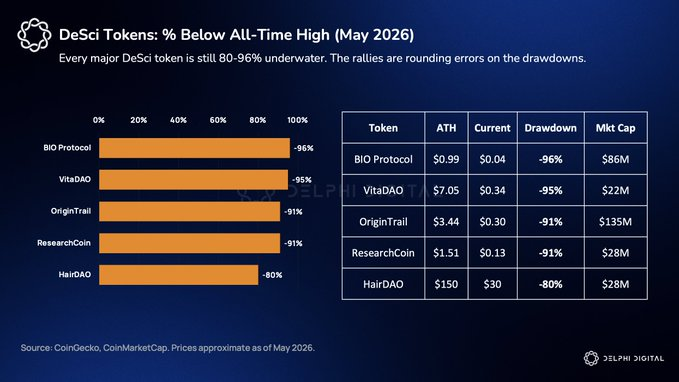
Keep these timelines in mind, and now look at the price chart of the BIO Protocol. The token fell from $0.89 to $0.018, and then surged 105% due to news of peptAI, achieving a trading volume of $720 million with a market cap of only $68 million. The entire DeSci funding logic is built on the premise that token holders will patiently wait seven to ten years for clinical trials, whereas crypto Twitter often shifts to the next narrative before the Phase I data unblinding.
Pump Science leaked its private keys on GitHub, giving rise to scam tokens (including one really called "Cocaine"), and the executability of IP-NFT has never been tested in court.
Open Source Science vs DeSci
If we do not indulge in self-deception and chronic speculation, there is a glimmer of hope to achieve DeSci through open-source science.
In October 2025, the OpenFold Alliance released OpenFold3 under the Apache 2.0 license. It is fully trainable and commercially usable, built on over 300,000 experimentally determined structures (unlike AlphaFold3, which is restricted to academic use by Google). The Boltz-2 jointly launched by MIT and Recursion can predict protein structures and binding affinities at 1,000 times the speed of physical methods. Baker Lab released RFdiffusion3 in December. ChEMBL has 2.5 million bioactive compounds with complete ADMET data available for free on any laptop. What used to cost pharmaceutical companies millions to internally build infrastructure is now available on GitHub with permissive licenses, and five pharmaceutical companies are collaborating to train their proprietary drug-protein databases through the Federated OpenFold3 program. No one on crypto Twitter discusses these because there are no tokens to trade, and I am very skeptical that the core contributors of these codebases would welcome tokenization.
Research Funding Cliff
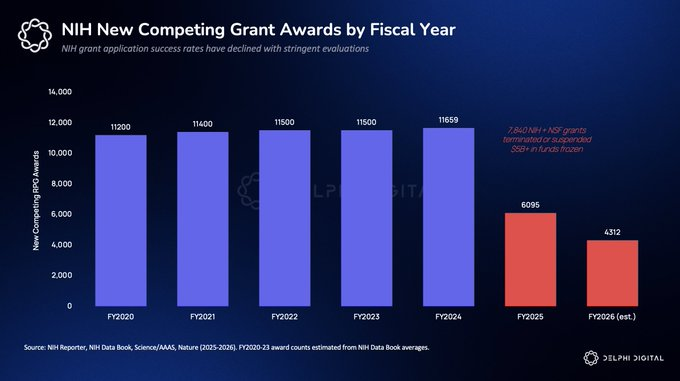
In 2025, over 7,800 NIH and NSF grants were terminated or suspended, with over $5 billion in funding frozen. As the world's largest public funding agency for biomedical research, the NIH (National Institutes of Health) has an annual budget of about $47 billion but remains flat due to administrative freezes following congressional appropriations. The number of new competitive grant applications fell from 11,659 in FY 2024 to 6,095 in FY 2025, a decrease of 48%. The success rate for researchers applying for funding dropped from 21% to 13%, with Fred Hutch losing $508 million and Harvard losing $945 million.
This funding vacuum is precisely why DeSci has an opportunity if done right. In July 2025, Gero, funded by VitaDAO, signed a research and licensing agreement with a pharmaceutical company (a Roche subsidiary with a market cap of about $100 billion, not a meme project), with milestone payments up to $250 million. This is the first instance of a DAO-funded project producing something valued in nine figures by a real pharmaceutical company. This process was completed without governance infighting or rug pulls and remains the most significant event to occur in the field to date.
Four-Year Cycles
This year, 15 to 20 AI-discovered drugs will enter Phase III, while Rentosertib's data readout won't happen until at least 2028. This means that whether all of this can truly translate into effective drugs for humans, real answers will take several more years to arrive. The open-source tech stack will continue to compress costs regardless of whether there are tokens or not, and the funding vacuum will continue to push researchers toward anyone willing to write checks. Open-source protein folding models have reached the level of AlphaFold3 at zero licensing costs, and wet lab validation costs are under $2,000, while the NIH has just posted the lowest grant success rate in twenty years. Even if AI delivers on all the promises its supporters have made, halving the drug development time, you will still need four to five years to go from discovery to approval—this is optimistic, assuming that Phase III success rates truly improve.
Four years is an eternity in the crypto industry, where portfolio beliefs rotate with quarterly earnings calls, and token holders see a six-month holding period as a life sentence.
The costs of drug discovery and innovation are getting cheaper each quarter, regardless of whether anyone purchases tokens. The funding vacuum caused by the NIH is also a reality. Between these two, there may exist a viable version: tokens provide funding for specific milestones of particular trials, while governance is left to those who truly understand the field. The Gero/Chugai deal is the first evidence that DAO-funded projects can produce something valued in nine figures by real pharmaceutical companies.
Aside from popping bubbles, I am more interested in whether anyone can build a defensible funding infrastructure for true DeSci.
免责声明:本文章仅代表作者个人观点,不代表本平台的立场和观点。本文章仅供信息分享,不构成对任何人的任何投资建议。用户与作者之间的任何争议,与本平台无关。如网页中刊载的文章或图片涉及侵权,请提供相关的权利证明和身份证明发送邮件到support@aicoin.com,本平台相关工作人员将会进行核查。


