

Author: Zen, PANews
At the beginning of this month, the crypto market witnessed two long-awaited large fundraisings.
On May 5th, Haun Ventures announced the completion of a new fund raising of 1 billion dollars; a day later, a16z crypto announced the launch of its fifth crypto fund, Crypto Fund 5, with 2.2 billion dollars.
Compared to the previous bull market that relied on high-growth narratives to support fundraising, the timing of these two large fundraisings is noteworthy. Currently, the U.S. cryptocurrency market structure bill and stablecoin regulations are still progressing, and the disagreements between the banking sector and crypto platforms regarding stablecoin yield mechanisms have not been completely resolved.
In this environment, LPs are still willing to allocate large funds to a small number of top managers, demonstrating that capital has not exited the market; it is simply redefining investment logic. As investment directions change, we can clearly see a trend where projects worthy of long-term investment are gradually shifting from prioritizing explosive growth to focusing on long-term survival capabilities under regulatory cycles.
From Bull Market Logic to Regulatory Logic
Looking back at the bull market of 2021, the primary market resembled a competition centered on growth. During that time, the valuation logic of most projects was built on rapid expansion. VCs focused on TVL (Total Value Locked), user growth, trading volume, and token price expectations. As long as a project could quickly capture the market and form a narrative, it had the opportunity to secure significant funding.
However, starting in 2022, the market began to undergo fundamental changes. The sudden collapse of FTX not only led to a rapid contraction in industry liquidity but, more importantly, it profoundly changed the regulatory agencies' attitude toward the crypto industry. The U.S. SEC, CFTC, and banking regulatory systems began to engage more deeply in the crypto market, with stablecoins, trading platforms, DeFi, and other areas entering the regulatory spotlight.
While the secondary market was sluggish, the risk appetite in the primary market also noticeably declined. Although global crypto financing has seen some recovery compared to the bear market phase by 2025, funds are increasingly concentrated in leading projects and mature infrastructure sectors, making flourishing diversity and extensive innovation a thing of the past.
This signifies that VC focus has shifted. In the past, capital was willing to pay for "potential future growth," whereas now, more institutions begin to prioritize whether projects can exist long-term under future regulatory frameworks. As a result, factors such as compliance capability, compatibility with traditional financial systems, and institutionalization—previously neglected by the market—are starting to re-enter the valuation system.
This change is particularly evident in the stablecoin sector.
Stablecoins Are Becoming Core Assets Again
Over the past year, stablecoins have almost become one of the most active directions for fundraising in the primary market. Compared to most crypto projects that rely on market sentiment, stablecoins have gradually developed a real income model and financial infrastructure attributes. Tether's profitability essentially comes from interest income generated by its large U.S. Treasury reserves; meanwhile, Circle is attempting to shift from a single stablecoin issuer to a more complete payment and on-chain dollar network infrastructure.
More critically, the U.S. regulatory stance on stablecoins is also changing. Stablecoins have long been in a vague state lacking a clear regulatory framework. However, as we approach 2025, discussions on stablecoin legislation in the U.S. have clearly accelerated, formally beginning to explore integrating them into the financial system.
Against this backdrop, stablecoins are beginning to display a market positioning that is entirely different from before. They are no longer just a medium of exchange for the crypto community but are increasingly regarded by more institutions as part of the next generation of dollar settlement infrastructure. Traditional payment companies, including Visa, Mastercard, and Stripe, are continuously expanding their stablecoin-related layouts.
This is also why stablecoins have re-emerged as one of the directions where VCs are most willing to bet. For the primary market, a track that can simultaneously satisfy real income, regulatory certainty, institutional demand, and the imaginative space of a "global payment network" is inherently very rare.
Haun: More Like "Crypto Finance" Investment Logic
The changes in investment logic are crystal clear to those VCs who have weathered years of trials but remain standing strong. In the current crypto primary market, a16z and Haun Ventures, which just secured substantial funding, happen to represent two different but gradually converging paths.
Compared to traditional Crypto VCs, Haun Ventures has maintained a uniquely special style. Founder Katie Haun served as a federal prosecutor in the U.S. for many years and participated in numerous investigations of crypto-related cases. In 2018, Haun joined a16z, becoming one of the early core partners of a16z crypto. In 2022, she left a16z to found Haun Ventures and swiftly completed fundraising for what was then the largest female founder fund in the crypto industry.

Her background has endowed Haun Ventures with a stronger regulatory perspective from its inception. Haun continues to focus on directions such as stablecoins, payments, custody, and on-chain financial infrastructure, with a core logic of betting on crypto infrastructure capable of entering the mainstream financial system. Their main investments include stablecoin infrastructure company Bridge and digital asset custody platform BitGo, among others.
For the deployment of the new fund, Haun Ventures announced three key areas of focus: next-generation financial infrastructure, asset tokenization expansions, and the "agent economy," where AI systems begin representing humans in transaction scenarios.
It is evident that Haun does not completely avoid risky projects, but compared to high-volatility narratives, it is more focused on which infrastructures can genuinely become part of the future financial system. This investment philosophy is closer to "long-term financial infrastructure building," rather than short-cycle market speculation. Particularly as regulation gradually takes shape, projects that can genuinely exist long-term will likely no longer be merely platforms relying on token incentives for rapid expansion but rather those infrastructures that can form synergistic relationships with regulatory frameworks, banking systems, and traditional financial markets.
a16z Is Still Betting on the "Next Generation Internet"
In contrast to Haun's more regulatory-friendly financial infrastructure focus, a16z crypto's fundraising logic for this Fund 5 reflects the top Crypto VCs' reassessment of changes in the industry phase.
In the announcement for the latest fund, a16z crypto did not emphasize the "Web3 explosion" or rapid user growth like in the previous cycle but repeatedly mentioned another key term: after market bubbles burst, which products continue to be used. The core investment direction of Fund 5 clearly spans seven tracks: stablecoins, payments, on-chain finance, asset tokenization (RWA), perpetual futures, prediction markets, and AI agents.
Chris Dixon and others wrote in the announcement that crypto cycles are often accompanied by significant speculation and capital influx, but what truly matters is the infrastructure and real demand that remain after the noise fades away. Compared to the last round, which emphasized token narratives and application explosions, this time a16z is noticeably more focused on areas that have already begun to form actual use cases.
One of the most critical examples is stablecoins. a16z mentioned in the announcement that even as the market experiences a downward cycle, stablecoin usage continues to grow, as people genuinely use them for cross-border transfers, dollar savings, and payment settlements—needs that in turn expose the "slow, expensive, and inefficient" issues of traditional payment networks.
Compared to the market in 2021, which was enthusiastic about NFTs, GameFi, and high-yield DeFi, a16z now emphasizes on-chain finance, stablecoin payments, asset tokenization, prediction markets, and the on-chain payment and collaboration capabilities of AI agents. The common characteristic of these directions is that they no longer solely rely on market sentiment; instead, they are beginning to attempt entering real financial and internet infrastructure scenarios.
Guy Wuollet, a partner at a16z Crypto, mentioned in the first podcast after the establishment of Fund 5: "The entire field has transitioned from ‘we are in mom's basement wearing hoodies and flip-flops writing smart contracts’ to ‘we’re putting on collared shirts and ties to meet with large banks seriously considering replacing their core ledgers with blockchain.’”
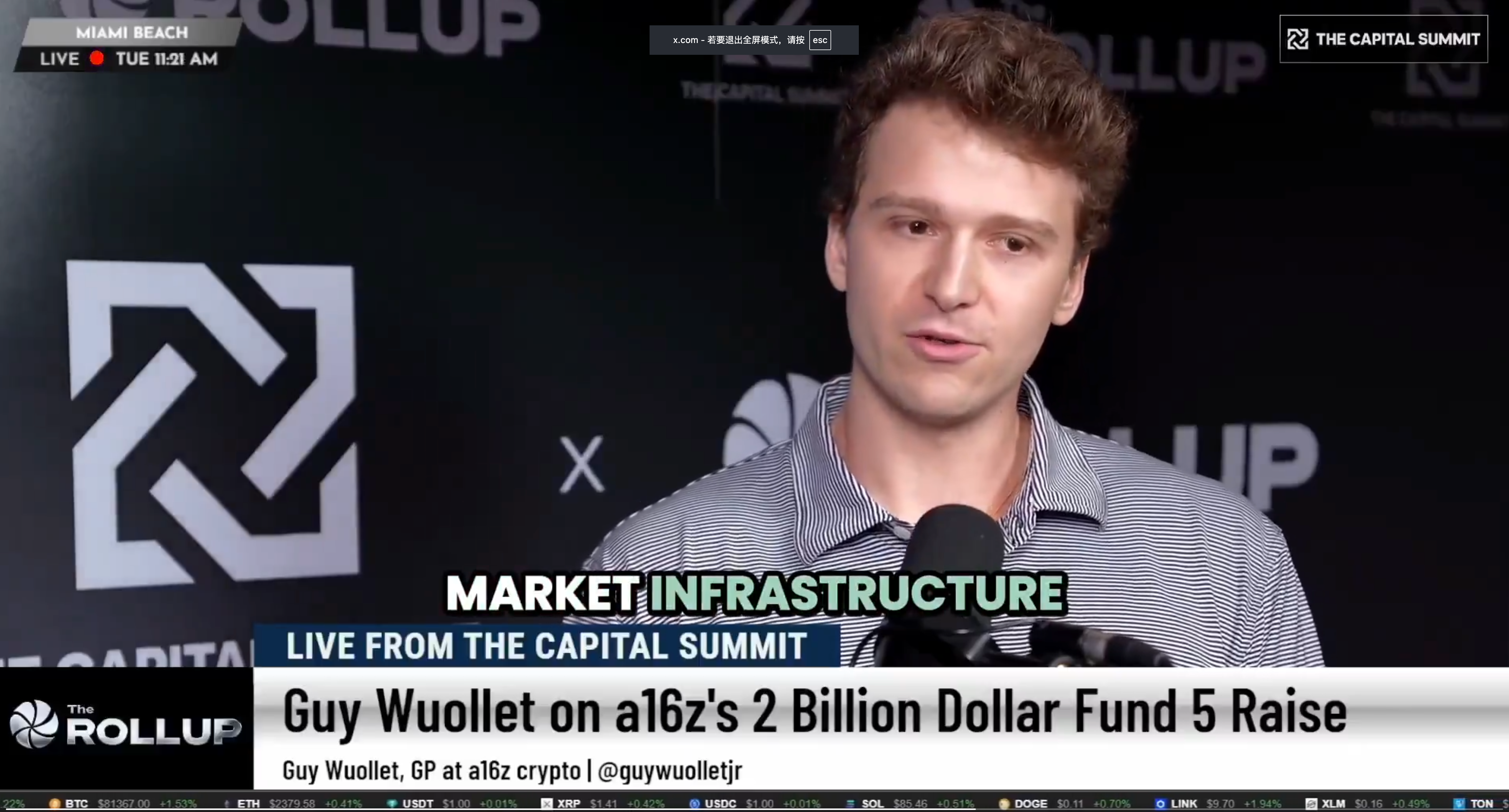
This change reflects a16z's reassessment of the stage of the industry, where the truly important question has become which infrastructures can exist sustainably over the next decade and genuinely integrate into global financial and internet systems as regulation gradually takes shape and the industry enters a long-term development phase.
To some extent, this is also why a16z, despite having a style completely different from Haun, ultimately completed substantial fundraising at the same time. Because both are, in fact, answering the same question: who has the greater ability to navigate the longer regulatory cycle ahead.
From a broader perspective of industry evolution, the current primary market is experiencing a severe bifurcation of funds: late-stage financing (Series C and beyond) has seen significant year-on-year growth, while early-stage financing has dramatically contracted. Capital is accelerating toward top-tier institutions with full-cycle investment capabilities.
The crypto industry is transitioning from its "wildly growing adolescence" into its "coming-of-age ceremony within the mainstream financial system." And at this turning point, those who can find certainty within the regulatory cycle will define the next decade.
免责声明:本文章仅代表作者个人观点,不代表本平台的立场和观点。本文章仅供信息分享,不构成对任何人的任何投资建议。用户与作者之间的任何争议,与本平台无关。如网页中刊载的文章或图片涉及侵权,请提供相关的权利证明和身份证明发送邮件到support@aicoin.com,本平台相关工作人员将会进行核查。


