
Author: Jeff, IOSG
Abstract
The core data of bot panic in prediction markets is quite intuitive: 5% of wallets that seem to be bots on Polymarket contributed 75% of the platform's trading volume. Since January 2025, 823 wallets have each netted over $100,000, collectively withdrawing $131 million in profits from Polymarket. Among the top 20 wallets in terms of profit, 14 are classified as bots (Stacy Muur leaderboard inspection). A study by the University of Toronto (covering 2.4 million users and $67 billion in trading volume since 2022) found that 68.8% of users are at a loss, while the top 1% of users have earned 76.5% of all profits.
The narrative derived from this is that prediction markets are a wealth transfer machine, with bots as their operators. The data is accurate, but the framework has a bias.
Core Points
1. The core flaw of the bot narrative lies in equating "trading volume concentration" with "capital exploitation." The 5% of wallets contributing 75% of the trading volume on Polymarket only indicates the distribution of account activity and does not directly imply that retail funds are extracted by bots.
2. Data at the group level is more persuasive. AI agent wallets have an approximate yield of 37%, while human wallets only range from 7%-13%; a 3-4 times group-level disparity is real evidence of structural advantages. Moreover, among the top 20 on the profit leaderboard, 14 are bots (Stacy Muur leaderboard inspection), representing a right-tail projection of this distribution, not independent evidence.
3. The advantage of bots lies in structural dimensions rather than judgment dimensions. The three types of markets dominated by bots—price delay arbitrage, automation of real-time sports game states, and cross-platform portfolio arbitrage—share the common aspect that they do not require judgments about real-world events themselves. Once market outcomes depend on the synthesis of multi-source information, the advantage of bots weakens systematically.
4. The category structure of Polymarket has shifted from "politics 42%" to "sports 50%" over the past 12 months, with the fastest-growing category being long-cycle event markets, where bots do not hold a structural advantage, clearly indicating an overall trend towards retail participation on the platform.
5. Forward-looking judgment: The share of bots will continue to rise as deployment costs decline, but the scale at which bots extract capital from humans will peak before the share of bots does—because the speed at which bots eat into each other is faster than their speed in eroding human accounts.
6. Investment strategy: Equity opportunities at the platform level (a combined 97%+ share for Kalshi + Polymarket) are basically closed; value opportunities are migrating to the L2 agent infrastructure layer (Olas / Valory model) and the venue-agnostic middle layer, while C-end bot products and L3 data/pricing layers do not have venture-fit potential.
1. The scale of the track exceeds bot panic
Three quantitative anchors define the discussion scope of this report.
First, Bernstein revised the scale of the prediction market track to $240 billion for 2026E on April 14, 2026, with a consensus on the sell-side path towards $1 trillion by 2030.
Second, the combined YTD trading volume of Kalshi and Polymarket broke $60 billion in mid-April 2026, exceeding the total of $51 billion for the entire year of 2025 on the track.
Third, Robinhood launched over 1,000 Kalshi contracts, with more than 1 million platform customers cumulatively trading 9 billion contracts. The annual recurring revenue (ARR) of Robinhood's prediction market business is approximately $350 million, projecting $150 million for the entire year of 2025 and $586 million for 2026E, making it the fastest-growing product line in the company.
The above data collectively points to one conclusion: Prediction markets are no longer a singular crypto-native track; their attributes are more akin to a TradFi distribution problem. The "retail investors being exploited" group assumed in the bot narrative is not crypto users, but retail investors entering through traditional brokerage channels.
This leads to the contextual bias of bot panic: the track is not stripped of value by automation but is injected with traffic at a pace far exceeding any automated extraction speed by mainstream finance.
2. The truly important data: 37% vs. 10%
The most frequently cited data point in the bot narrative suffers from sample selection bias.
The source data for "14 bots in the top 20 profit leaderboard" is premised on a small sample sorted by profitability. This sample can only reflect the presence of bots at the right tail of the distribution and cannot be used to infer the superiority relationship at the group level.
Group-level data (source: Polystrat / Valory disclosures, cross-verified with multiple Polymarket on-chain analysis data):
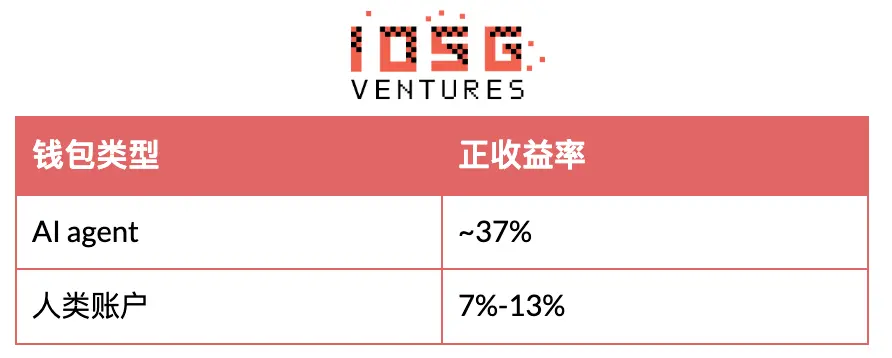
A 3-4 times win rate difference at the group level is a real manifestation of the structural advantage of bots. The statistic of 14/20 on the profit leaderboard should be understood as a downstream performance of this win rate distribution, rather than independent causal evidence.
3. In which markets do bots succeed
The scale of withdrawals by bots is highly concentrated in the following three types of markets. The commonality of these three is that they do not require subjective judgments on real-world outcomes but instead rely on delays or pricing advantages associated with the platform's matching engine.
Price feed delay arbitrage
Representative case: Wallet 0x8dxd made $313 into $437,600 in January 2026, trading only 15 minutes of BTC rise and fall contracts, with a win rate of 98%.
Strategy principle: Monitor the spot prices on Binance and Coinbase, establishing positions when Polymarket quotes lag behind CEX. Polymarket introduced a taker fee of (around 3% near a 50% probability peak) on January 7, 2026, specifically to neutralize this strategy. The cumulative win rate of this wallet has since decreased to 54.7%.
Conclusion: The advantage of bots in feed markets genuinely exists but is limited to very narrow time windows and is significantly compressed with the introduction of friction costs by the platform.
Automation of game state in real-time sports
Data source: Polymarket wallet classification by the cancun2026 team (Dune query 6648075, https://dune.com/queries/6648075, past 7 days, as of May 11, 2026).
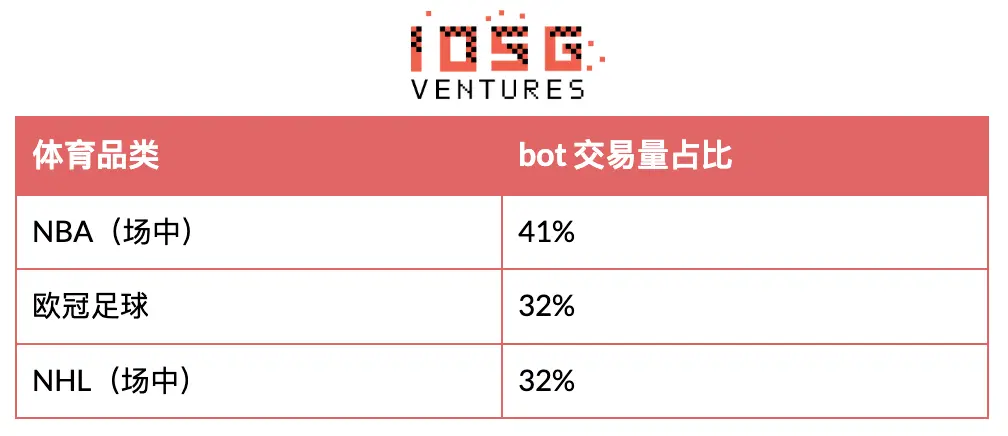
Source of advantage: Bots react to match events significantly faster than retail investors who use live streams (30 seconds delay). Additionally, trading terminals like Kreo, PolyCop, etc., through copy-trade and auto-follow functions, open this advantage to non-programmer users, hence the measured bot share includes human funds routed through bots.
Cross-platform portfolio arbitrage
Data source: IMDEA Networks paper "Unravelling the Probabilistic Forest: Arbitrage in Prediction Markets" (AFT 2025, dspace.networks.imdea.org/handle/20.500.12761/1941).
This research covers approximately $40 million in arbitrage extraction on Polymarket between April 2024 and April 2025, mainly consisting of two models: one is the rebalancing of YES/NO shares within the same market; the other is cross-platform portfolio trading (buying YES on Polymarket, buying NO on Kalshi, entering when the combined implied probabilities are less than $1). This model has rigid requirements for multi-platform infrastructure and compresses with the convergence of matching engines across platforms.
4. Areas where human accounts win and their limiting conditions
The categories with the lowest bot share do not stem from "retail being more accurate," but rather that "the profitability of this type of market depends on the ability to synthesize multiple sources of real-world information," which reflects the continued structural disadvantage of automation over humans.
Two independent studies validate this judgment.
Joshua Della Vedova’s on-chain behavior research (University of San Diego) (jdellavedova.com) indicates that retail investors select winning outcomes more frequently than bots; bots excel in execution—while a retail investor buys YES at $0.72, the bot has already entered at $0.55, gaining a floating profit of $0.17 per share.
Working paper from the University of Toronto / HEC Montréal / ESSEC (Akey et al., SSRN 6443103, March 18, 2026) points out: 56% of losing users place their orders at extreme prices (10¢ or > 90¢), whereas only 28% of the top 0.1% of profitable users place their orders at extreme prices. Typical behavior of losing users is "chasing a small probability at $0.05 for a 20x payout" or "chasing certainty at $0.95," while typical behavior of profitable users is to enter in the middle of the probability curve.
Both studies point to: the judgment ability of retail investors is generally underestimated, but their timing and order structuring systematically lag behind.
5. Forward path: Four forces determining the bot/human landscape
The key variable in the next 12-24 months is not the current share of bots/humans but rather the direction of its evolution. This report identifies four forces, which do not move in the same direction.
Further collapse of bot deployment costs
Coding agents such as Claude Code, Codex, and open-source frameworks like Hermes, as well as Polymarket's own open-sourced Polymarket Agents framework under MIT license, have collectively lowered the engineering threshold of strategies like 0x8dxd from "serious projects" to "weekend prototypes." Copy-trade services further connect human capital to the bot infrastructure, mechanically amplifying the measured bot share.
Bot individual yield being eroded by peers
The 823 profitable bot wallets are the right tail of a larger group of losing bots. An increase in the number of wallets using similar strategies implies a narrowing profit window for each bot. The 98% win rate of 0x8dxd is structurally non-replicable—not because of disappearing inefficiency but due to competitive similar strategies and adjustments in platform fees. The scale of capital extraction from humans by bots will likely peak before the bot share does.
Platform category structure tilting towards retail
Polymarket's category composition in April 2026 was: sports 50%, crypto 24%, politics 16%, other 10%. In April 2025, the composition was: sports 29%, crypto 12%, politics 42%.
The absolute trading volume in sports grew 11-fold year-on-year. The new volume mainly lies in long-cycle event markets, where retail investors have an absolute advantage. Bernstein forecasts that the share of sports in track trading volume will fall from the current 62% to 31% by 2030, filled by economic, political, and corporate event contracts—this structural shift will further expand the exposure of non-bot advantageous categories.
Different platforms naturally divert by category
Hyperliquid’s HIP-4 launched on May 2, 2026, offering daily BTC binary contracts with no opening fees, USDH collateral, and unified perpetual/spot mechanisms with validator-slashable deployment (1 million HYPE per slot, approximately $42.76 million at current prices).
This is a typical market type dominated by bot advantages being treated as a standalone launch. Day-1 trading volume is mainly from arbitrage funds, consistent with the historical distribution of BTC binary contracts. If HIP-4 later expands to sports and political markets and integrates reliable oracles, its bot share may converge to Polymarket levels; at the current stage, it serves to isolate bot-friendly traffic to an independent platform, further shifting the category structure of Polymarket toward retail.
6. Platform landscape and valuation snapshot (mid-2026)
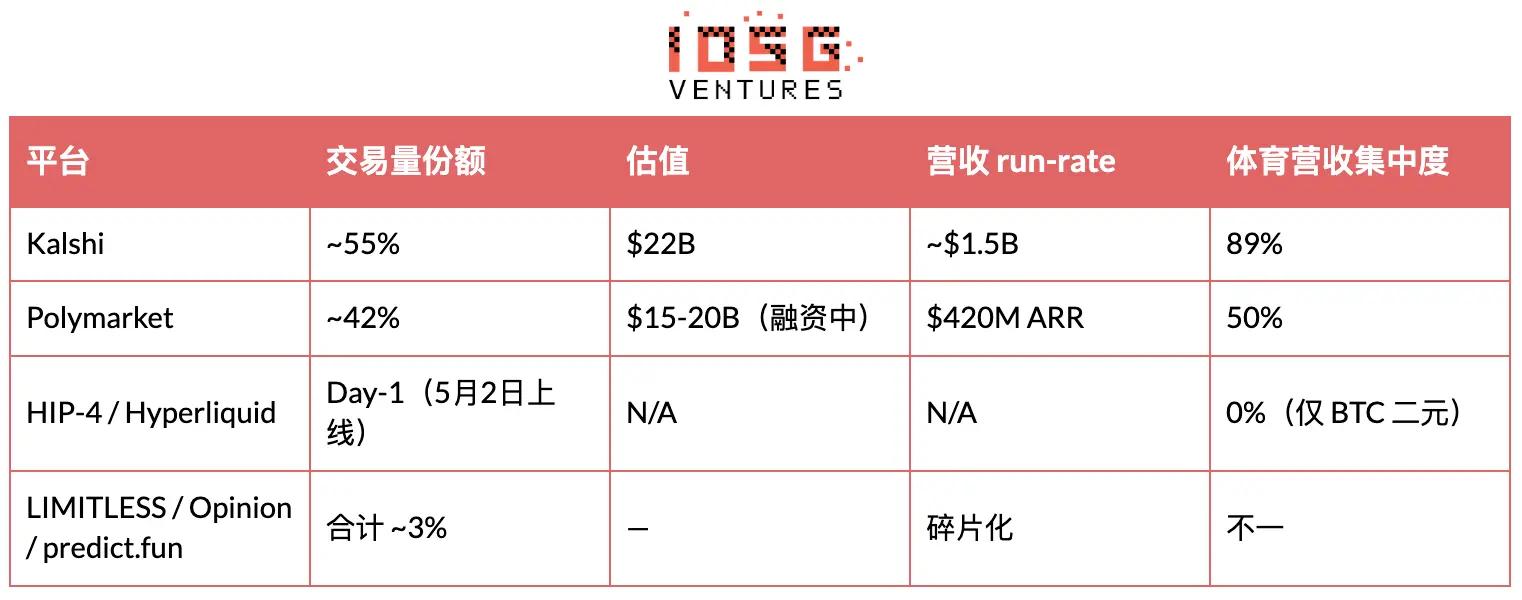
▲ Source: Bernstein note (April 14, 2026), Polymarket / Kalshi public disclosure, HIP-4 launch announcement
Conclusion: The combined share of Kalshi + Polymarket exceeds 97%; equity opportunities at the platform level are essentially closed regarding venture check size. Investable value is migrating to layers above the platform (trading terminal, quantitative strategy services, agent infrastructure) and below it (capital efficiency, arbitration, oracle).
7. Risk warnings
Risk 1: Regulatory tailwindrisk. The three bills submitted by Schiff (DEATH BETS Act, Public Integrity Act, Prediction Markets Are Gambling Act), Nevada's TRO against Kalshi, and Arizona's criminal charges in March 2026 constitute a tug-of-war between federal and state levels. Kalshi's 89% concentration of revenues in sports represents the most exposed business line, with realistic probabilities of an overall ban on sports or war/death-related contracts.
Risk 2: Oracle and arbitration failure risk. Polymarket integrated Chainlink in 2025 to handle price-related markets, but subjective markets still rely on UMA. The current token economy of UMA generates only about $600,000 annually in economic flow, corresponding to an FDV of $37 million; after MOOV2, proposer rewards were narrowed to about 37 whitelisted addresses, most of which are associated with Polymarket. Any highly exposed contentious ruling may trigger a re-evaluation of trust in the entire track.
Risk 3: Reversal risk in the share of sports. Polymarket's growth in sports for 2026 is seasonal (driven by NBA, NFL Super Bowl). If the share of sports retracts, the overall dynamic of "rising bot share + retail expansion" may reverse.
8. Implications for builders and investors
The bot dispute is essentially one question: in the $240 billion track predicted by Bernstein for 2026, which layer captures value? There are four layers, each with differing value densities.
L1 — Agent trading products. Strategy advantages are diminishing, and C-end automated trading carries compliance risks. This layer is not recommended for standalone bets.
L2 — Agent infrastructure (Olas / Valory model). An economic model that charges tolls, allowing any winning agent to earn fees. This layer is the cleanest investable option.
L3 — AI native data, pricing, and market creation. Most are digested by internal platform teams or taken by existing Web2 incumbents (Kensho, Bloomberg, Dataminr). The remaining investable window is narrow.
L4 — Arbitration and resolution. Current economic flow is real but small in scale. To become a Tier 1 venture target, a redesign of the token model is required, which is currently not on the public roadmap.
Marginal layers worth tracking:
PM-DeFi composability (Morpho collateralizing PM positions, currently 2x leverage, roadmap 4-5x, affecting capital efficiency)
Trading terminals and copy-trade services (Kreo, etc.)
PM-native quantitative institutions
New market primitives (impact markets, futarchy, conditional markets)
Conclusion: Bots win categories, humans win markets, platforms win structures
Bots have not taken over prediction markets. The saturation of bots is in specific market types; the ratio of bot to human trading volume on any platform is essentially a downstream result of that platform's market type composition. The headline data of "5% wallets / 75% trading volume" confuses trading volume concentration with capital exploitation. The primary drivers of Polymarket's growth in 2026 come from sports markets where bots do not hold a structural advantage, and the $131 million captured by bots primarily occurs in short-window crypto markets where retail participation is low.
The platforms that succeed in the future will possess three capabilities: accommodating multiple types of markets under credible arbitration conditions, appropriately absorbing both bot and human traffic, and retaining cross-category users. Polymarket currently occupies this position: Bitget's Q1 2026 research shows an organic growth trend in multi-category users, with the average number of categories per user increasing from 1.45 to 2.34 and active days rising from 2.5 to 9.9.
Bots remain within their structural advantage range; the human capital operating bots will continue to migrate to the next event; ultimately, those platforms that can accommodate both types of traffic across the most market types, at appropriate ratios, will prevail.
免责声明:本文章仅代表作者个人观点,不代表本平台的立场和观点。本文章仅供信息分享,不构成对任何人的任何投资建议。用户与作者之间的任何争议,与本平台无关。如网页中刊载的文章或图片涉及侵权,请提供相关的权利证明和身份证明发送邮件到support@aicoin.com,本平台相关工作人员将会进行核查。


