Whenever people mention ZEC, they always sigh that it is a divine coin.
By the end of September 2025, ZEC was still at 53 dollars. At that time, it was a privacy coin forgotten by the market for four years. It fell from 290 dollars in 2021 all the way below 30 dollars, and no one mentioned it. Another privacy coin, Monero, was continuously delisted by dozens of trading platforms, and ZEC was silently assumed to be the "next." Everyone was waiting for it to die.
Then, starting that month, ZEC soared 12 times.
In 8 months, ZEC rose from 53 dollars to 600 dollars, peaking at 740 dollars. Its market value surged from less than 1 billion to nearly 10 billion, re-entering the top 15 of cryptocurrencies.
Everyone saw ZEC rising, but most believed it was due to the "privacy narrative" or the public teams of figures like Naval, Arthur Hayes, Mert Mumtaz, Balaji, and Cobie.
However, I believe the more important background and factor for ZEC's rise is that the Bitcoin miners are collectively supporting ZEC.
ZEC's Major Surges Coincide with BTC's Mid-Cycle Peaks
The first to notice the pattern of "ZEC surging every time just happens to coincide with BTC's mid-cycle peak" were some veteran BTC traders on Twitter.
Every time ZEC experiences a significant rise, BTC always reaches a mid-cycle high at the same time. Once or twice might be coincidence, but what if it happens four times?
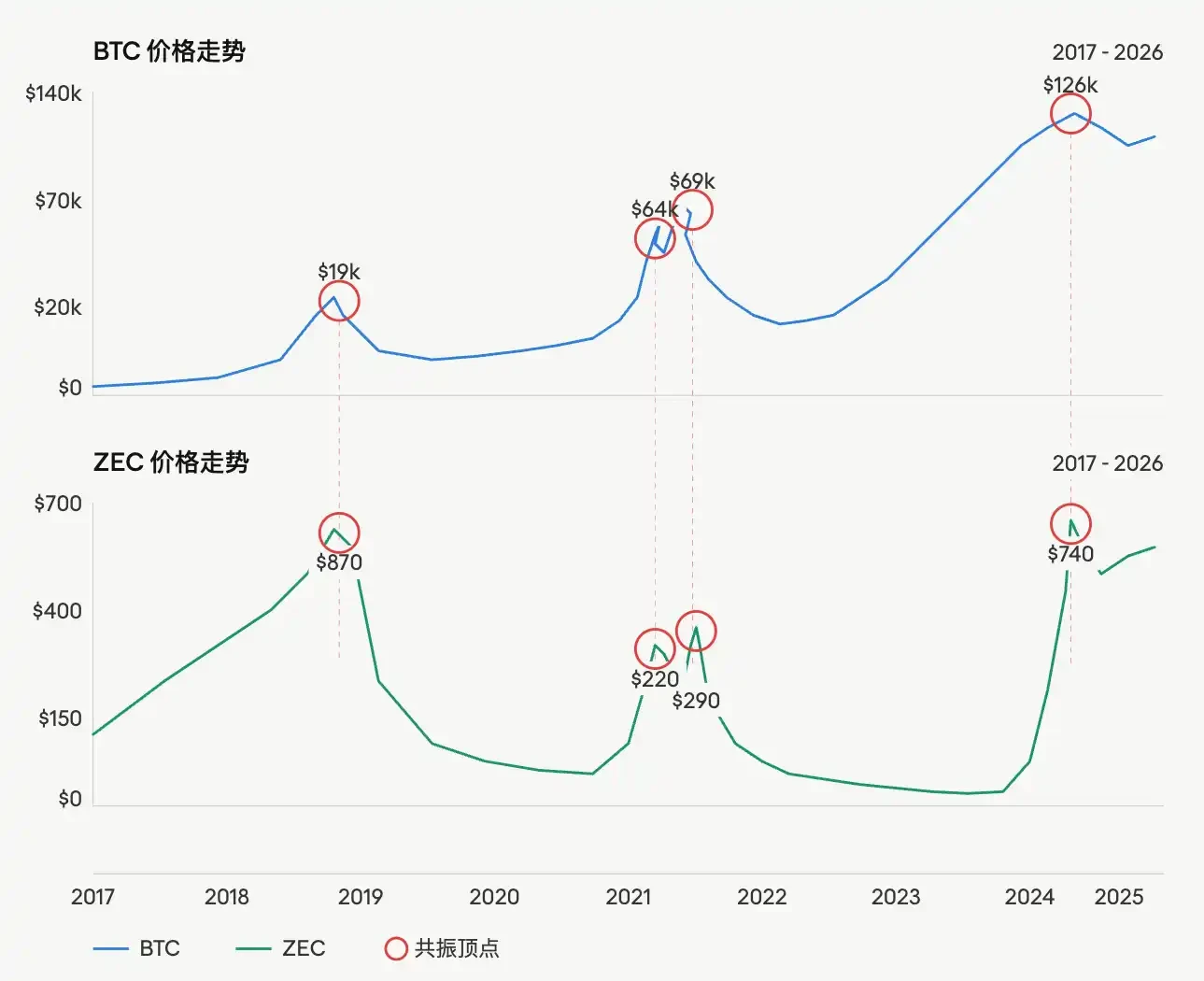
At the end of 2017, ZEC rose from 200 dollars to 870 dollars. In the same month, BTC peaked at 19,000 dollars. Both peaked almost simultaneously at the end of December and then entered a year's bear market together.
From the end of 2020 to the beginning of 2021, ZEC rose from 50 dollars to 220 dollars. During this time, BTC reached its mid-cycle peak of 64,000 dollars for the first time. BTC pulled back to 30,000, and ZEC returned to 100.
In the fourth quarter of 2021, ZEC again rose from 100 dollars to 290 dollars. That wave of BTC eventually peaked at 69,000. Afterwards, both entered a bear market that lasted three years.
Now in this round, ZEC has risen from 53 to over 600, while BTC is repeatedly testing resistance levels around 125,000 to 127,000.
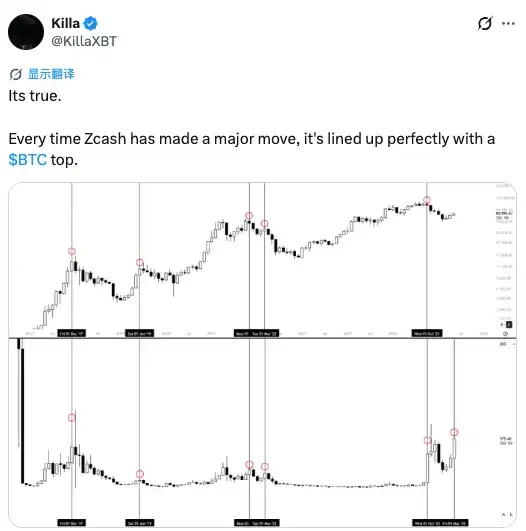
Technical analyst Killa (@KillaXBT) also discovered and pointed out this perspective.
What’s more noteworthy is that this pattern does not seem to hold for other mainstream coins. The peaks of ETH and BTC do not synchronize as accurately. As for SOL, AVAX, and these emerging coins, they don’t even come close. ZEC is almost the only one that manages to "time" with the BTC cycle peaks.
ZEC's price rise seems to be synchronized with BTC's rhythm. As BTC approaches its peak, ZEC is activated. After BTC peaks, ZEC also enters a correction.
Back to the present.
ZEC's daily upward trend line has now been broken. BTC is fluctuating around 75,000 dollars. If BTC breaks below 75,000, the market generally believes that the mid-cycle peak of this bull market is basically confirmed.
If historical patterns continue to hold, now is the time window for the fourth ZEC-BTC resonance peak.
So the question becomes, why is there such a pattern? Why ZEC and not other coins?
The answer may be hidden in the mining pool rankings.
ZEC Mining Pools: Another Setup by BTC OGs
Opening the ZEC block explorer and looking at the hash rate distribution over the past 7 days: ViaBTC 34.2%. Foundry 27.74%. F2Pool 12.82%. 2Miners 7.58%. Antpool 6.8%.
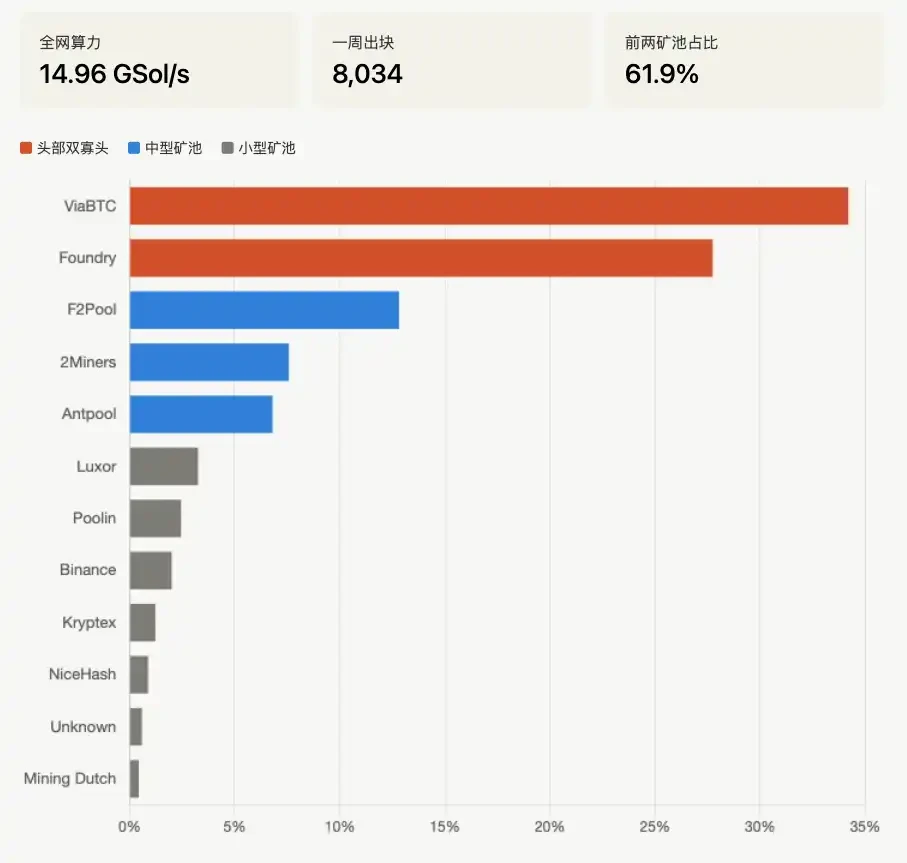
The top 5 mining pools account for 89.14%. Among them, 4: ViaBTC, Foundry, F2Pool, and Antpool collectively account for 81.6% of the hash rate.
All four of these mining pools share a common identity as traditional mining pools ranked in the top 10 by total hash rate in the BTC network. Let’s introduce them one by one.
ViaBTC, which holds 34.2% of the hash rate, was founded in May 2016 by a former Bitmain employee, Yang Haipo, in Shenzhen.
After leaving Bitmain, Yang Haipo started his own venture. He was one of the staunchest supporters during the BCH fork in 2017 and mined the first BCH block. After this, Yang Haipo and Roger Ver were seen as representatives of the BCH camp. ViaBTC has consistently been among the top 5 mining pools globally for BTC. Besides the mining pool business, Yang Haipo also founded the CoinEx trading platform in 2017, along with the later ViaWallet wallet, ViaBTC Capital fund, and CoinEx Smart Chain public chain, creating a complete crypto ecosystem.
Foundry, holding 27.74% of the hash rate, is the mining arm of the DCG empire and might play the most crucial role in this entire story.
Foundry Digital is a wholly-owned subsidiary of Digital Currency Group (DCG). DCG is a crypto group founded by Barry Silbert, which also owns Grayscale, Genesis Trading, and CoinDesk.
Foundry USA Pool is the world's largest Bitcoin mining pool, consistently accounting for 28% to 32% of BTC's total hash rate. Its clients include almost all listed mining companies in North America, such as Marathon, Riot, CleanSpark, Hut 8, and Core Scientific. These companies cannot use Chinese mining pools due to regulatory requirements, making Foundry their only option. One could say that Foundry is not selling hash rate; it’s selling "compliance." SOC 1 Type 2 certification, institutional-level reporting, SLA support—these are the mining infrastructure services that listed mining companies can purchase.
Next, we look at Foundry’s layout in ZEC. On March 11, 2026, Foundry announced its plans to establish a ZEC mining pool. It officially launched on April 13.
In just one month, its hash rate share rose from 0 to 27.74%. This can be termed as the fastest hash rate migration in the history of ZEC mining.
Before Foundry entered, ViaBTC alone held a whopping 68% of the hash rate. After Foundry stepped in, ViaBTC's share dropped to 34%. The additional 28% was almost entirely claimed by Foundry. This North American institutional capital officially took control of a significant portion of ZEC mining infrastructure. The entire process took just one month.
F2Pool, with 12.82% share, was originally called "Fish Pool" and is the first Bitcoin mining pool in China. Its influence is well known in the domestic community, as it was founded in April 2013 by Wang Chun and Shen Yu and is the oldest mining pool still in operation globally.
F2Pool remains one of the top 5 globally for BTC, and it was also one of the earliest pools to support mining when the ZEC mainnet launched in October 2016. If you trace the history of ZEC mining, F2Pool is almost consistently involved.
Then, there’s Antpool, which holds 6.8%, a proprietary mining pool operated by Bitmain.
Antpool was launched by Bitmain in 2014. It vertically integrates "mining machine manufacturer + mining pool operator." Within the BTC network, Antpool ranks as the 2nd or 3rd largest mining pool. Although its 6.8% share on ZEC is not the highest, it represents direct benefits for the mining machine supplier.
This brings us to an often-overlooked fact about the ZEC mining ecosystem: ZEC mining machine supply is almost entirely monopolized by Bitmain.
ZEC uses the Equihash algorithm, and the mainstream mining machine that supports this algorithm is only one: the Bitmain Antminer Z15 Pro, which achieves approximately 860 kSol/s. In other words, other manufacturers such as MicroBT and Canaan Avalon have virtually no products on the ZEC road.
Almost the entire ASIC mining machine supply for the ZEC network is controlled by Bitmain.
With the current total network hash rate at 13 to 15 GSol/s, based on the Z15 Pro’s single machine hash rate, it is equivalent to having about 15,000 to 17,000 Z15 Pro machines running. The daily net profit per machine is approximately 55 to 56 dollars (0.07 dollars per kWh).
In a sense, the price of ZEC mining machines, second-hand machine prices, and the supply rhythm of new machines are all in Bitmain's hands.
If the mining pool rankings still provide indirect evidence of "they are mining coins," then the story behind the holding rankings is more direct. Because the largest miners of ZEC and the largest holders of ZEC are fundamentally not two different groups.
The most typical example is Foundry and Grayscale.
According to on-chain data from Arkm, Grayscale Zcash Trust holds about 390,298 ZEC, accounting for approximately 2.34% of the circulating supply. This trust is applying to the SEC to convert to a spot ETF, planning to be listed on NYSE Arca under the code ZCSH.
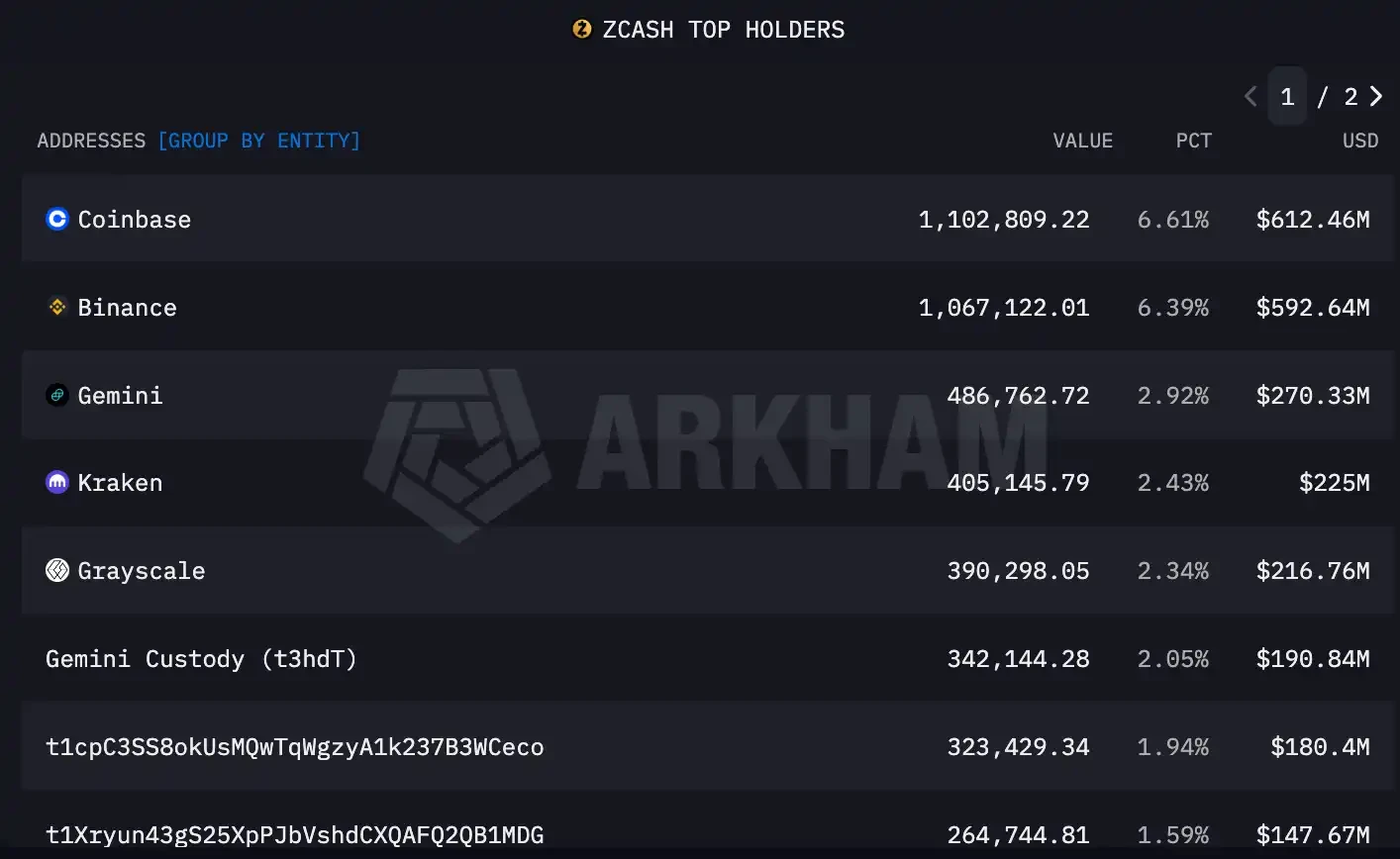
As previously stated, Foundry Digital, which holds 27.74% of ZEC, is a wholly-owned subsidiary of DCG, and Grayscale Investments is also a wholly-owned subsidiary of DCG. The parent companies of both are DCG.
Mining, holding, selling. A single company, DCG, has completed the entire chain from ZEC mining to institutional compliance channels.
Following DCG, the largest holder of ZEC is Gemini, backed by twin brothers Tyler Winklevoss.
As a custodian, the majority of ZEC held by Gemini actually comes from Cypherpunk Technologies, Nasdaq code CYPH, which was originally a biotechnology company called Leap Therapeutics, focused on cancer drug research. In 2025, it laid off 75% of its employees and its main business basically ceased operations.
On November 12, 2025, this company announced a transformation, rebranding as Cypherpunk Technologies, with a new focus as a "digital asset treasury company" (DAT), dedicated to one task: buying ZEC and holding ZEC.
The private financing scale on the transformation day was 58.88 million dollars, with Winklevoss Capital being the only institutional investor. This venture capital was founded by Tyler and Cameron Winklevoss in 2012. "Most of the capital" from the entire financing round came from this one firm.
Winklevoss Capital also placed its principal, Will McEvoy, on Cypherpunk’s board and appointed him CIO. The first purchase of 203,000 ZEC made on the day of transformation was also managed by Gemini.
The Winklevoss brothers have a history in the Bitcoin circle almost equal to that of DCG. Both of them entered the market in 2013 to 2014, being early Wall Street entrants. The names Gemini and Grayscale are two core nodes of compliance crypto routes on Wall Street over the past decade.
As coin prices rise, the demand for mining machines increases, the prices of mining machines go up, and new machines sell out. When coin prices fall, mining reduces output and second-hand machines are sold off. The rhythm of the entire supply chain is coordinated by the mining pools in league with the mining machine manufacturers.
This is quite a good business.
After all, the most valuable aspect of a PoW cryptocurrency is never technology. It’s the distribution of industrial利益 along the supply chain.
The mining pools are the largest natural sellers in the ZEC spot market. The ZEC mined each day (based on the current 1.25 ZEC × 1150 blocks = 1437 ZEC per day) directly belongs to the mining pools. Over a year, this totals approximately 520,000 ZEC. These coins are not taken away by the miners after being mined; most are first received by the mining pools and then distributed to the miners. In this process, the mining pools have full control over the timing of sales, allowing concentrated sales when market liquidity is high and holding off on sales when it's low.
The mining pools have complete "coin reserves." For example, ViaBTC has its own CoinEx trading platform, where it can directly sell the mined coins. F2Pool has Stakefish under its wing. Antpool is supported by Bitmain's financial services. Foundry is backed by the entire financial ecosystem of DCG (Grayscale + Genesis Trading + Foundry). They are both suppliers at the mining end and distributors at the trading platform end, controlling the entire industry chain from mining to selling.
The mining pools have ten years of "collaborative experience." In the BTC network, there have already been multiple instances of collaborative behavior among mining pools at critical moments (the most typical being the BCH fork in 2017 and the SegWit dispute in 2017). For the same group of people, engaging in collaborative behavior on ZEC is second nature.
ViaBTC, Foundry, F2Pool, and Antpool, which together control 81.6% of ZEC's hash rate, have founders and parent companies that are all the most familiar with cycles in the past decade of BTC.
The rhythmic editor has also pulled the on-chain payout addresses from the four leading mining pools. These addresses are publicly marked by Zcashinfo (the official block explorer operated by Foundry), eliminating any speculation.
Foundry's main receiving address is t1SqwRAAdSig6dE4EBPLonAait219VmkUjP. Since its launch in March 2026, this address has received a total of 22,696 ZEC—this is Foundry's total earnings from mining in over a month. On-chain data shows that almost all of these coins have been sent to the Orchard pool, which is the latest generation of privacy pools for ZEC, using Halo 2 zero-knowledge proofs, and is completely untraceable once entered.
ViaBTC's main receiving address t1at7nVNsv6taLRrNRvnQdtfLNRDfsGc3Ak has received a total of 1.73 million ZEC, which, at the current price, exceeds 1 billion dollars. The destination is directly into the Sapling privacy pool (the previous generation of privacy pools for Zcash). The transaction pattern of this address is very consistent, transferring a sum to the Sapling pool after every 5 to 8 blocks mined, with almost no stock left over.
F2Pool's three main receiving addresses have received a total of 5.87 million ZEC. Two of the addresses currently have a balance of 0. The distribution method is mixed, with part going into transparent addresses and part into the Sapling privacy pool.
Antpool has the lowest distribution frequency, holding more coins in its possession, with virtually no distribution movements recently.
ZEC offers optional privacy, allowing users to decide whether to use the shielding function for each transaction. It is this "optional" design that has allowed ZEC to survive at the regulatory level. Among these four main mining pools, the core distribution actions of three are conducted within privacy pools.
In the BTC network, we can count how much each mining pool has transferred to Coinbase, Binance daily, trace every large transfer, and piece together the inventory cycles of each mining pool—with analysts specifically tasked with this job. But on ZEC, on-chain data is practically invisible.
Once coins enter the privacy pool, how they transact within it, who they ultimately go to, on which trading platform, and at what price they are sold, is mostly hidden. The level of secrecy that mining pools enjoy on ZEC has increased significantly compared to the BTC era.
This token, ZEC, is inherently more suitable for institutional control than BTC. And how could the leading miners of Bitcoin miss the opportunity to control this divine coin, ZEC?
免责声明:本文章仅代表作者个人观点,不代表本平台的立场和观点。本文章仅供信息分享,不构成对任何人的任何投资建议。用户与作者之间的任何争议,与本平台无关。如网页中刊载的文章或图片涉及侵权,请提供相关的权利证明和身份证明发送邮件到support@aicoin.com,本平台相关工作人员将会进行核查。


