Author: Michael Spencer
Translated by: Deep Tide TechFlow
Deep Tide Introduction: It's been nearly four years since the launch of ChatGPT, and generative AI has not only failed to deliver on its initial promises but has also exacerbated social divisions, workplace de-skilling, and the degradation of the internet. Negative feelings towards AI among the American public are rising rapidly, from teachers to graduates, from small business owners to community residents—more and more individuals are realizing that this trillion-dollar gamble is harming the interests of ordinary people—while Silicon Valley giants and Wall Street elites are cashing out madly.
Honestly, I’m not the most persuasive storyteller. I’m just a blogger, a remnant of the bygone era of the internet. It was a human-led internet that might never return. However, as I’ve grown older and after writing and organizing hundreds of articles on AI, I’ve noticed a shift in the world’s attitude towards generative AI. You can read various reports, but the truth lies beneath the hype in a silent consensus. The costs of this excessive investment in AI are eroding social structures, the rule of law, and social order. The old order hasn’t had time to adapt to the new reality. The internet is being crushed by a barrage of AI junk content, and there’s no escape; the labor market is too brutal. One has to wonder if all of this is by design. There is financial fragility behind this madness, and real people are paying the price. Witnessing all of this is disheartening. AI has now become synonymous with greed, representing the collapse of the social contract we once took for granted, thinking it would last forever. Let me try to explain in this article: to put it bluntly, AI hardware should not be prioritized over the welfare of the people.
It’s been nearly four years since ChatGPT launched. If someone had told me back then that AI would create a more fragmented internet, bring about more hollow and disappointing experiences, harm human culture and literacy (we read less), become a force for de-skilling white-collar workers, damage human welfare, and have dubious economic benefits, I probably wouldn't have believed it. But pretending that everything is fine comes at a cost; there’s an inescapable feeling that something is off. People are dissatisfied; AI not only failed to deliver on its promised potential—it is also driving up inflation and incurring rising costs that are difficult to quantify across economic, psychological, geopolitical, and sociological dimensions. OpenAI, backed by billions in funding, along with marketing, lobbying, and public relations efforts from venture capital and tech giants, has led us astray. This is damaging our collective future. Generative AI appears to be a scam, and its impacts are harmful when scaled.
As a movement and investment, generative AI is creating division rather than unity or empowerment. Living in a world filled with AI junk content and junk jobs is humiliating and deeply unsettling. It's not just you; we all feel this way. This is not good technology. It accelerates the pace of corruption far beyond its performance in upholding the rule of law, fairness, or demonstrating real growth. The waterfall of funding for a failed promise could be devastating.
It hasn’t been adopted or disseminated throughout society like a genuinely important General Purpose Technology (GPT). It has not created the value needed to lead our civilization and species toward a more meaningful or better future. This must be stated loud and clear. I do not take pride in trying to truthfully frame this matter. Generative AI is not what we were promised when ChatGPT suddenly appeared. As models grew larger and more complex, with spending reaching astronomical figures, we anticipated tangible benefits, along with a clear mitigation of social harm, careful oversight, and the establishment of basic rules for monopolistic corporations. However, the acceleration of negative impacts from this technology has outpaced its ability to demonstrate real value. By the end of the 2020s, it will be out of control. Americans are not good stewards of this level of financial and artificial power. But they are certainly adept at constructing technological Ponzi schemes to inflate their monopolistic enterprises on an increasingly dystopian internet."Where's the "exit" button? Where's the reset switch? Generative AI is leading us astray.
Degenerating Culture and Reshaping Economic Opportunities
However, generative AI is not only harming human culture, degrading our time, or destroying our sense of purpose—it enables privileged classes to profit through key elements like stock manipulation, harming ordinary individuals in society, downgrading the middle class, and using AI junk and more unspeakable debt (as US national debt continues to soar) to hurt our digital civilization and online experiences, while wealth inequality accelerates at a scale that is hard to reconcile with so-called benefits. If you hurt the wealth, opportunities, labor, and career prospects of the common people, you had better deliver results. Yet generative AI has not delivered value at scale or helped most citizens, consumers, or businesses.
Even the vague promises made by corporations regarding greater productivity or sustainable impacts on GDP are now highly questionable when compared with the computing costs and expenses incurred in building these massive language models, hardware, fabs, and, most importantly, circular financing. The scale and scope of AI data center superclusters are becoming alarming. How this technology benefits the most powerful nations while harming the rest of us is concerning. Abuse of power and a lack of return on invested capital (ROIC) have become more severe. Four years later, we need to take stock, objectively examine this movement, and scrutinize the participants and technologies involved. Companies at the forefront need to be held accountable. The nations manipulating our future need our collective feedback.
On the global stage, generative AI is significantly enhancing the hegemony of the United States and China relative to other countries, which is extremely detrimental to global markets, the world order, and market rules, harming medium-sized and smaller countries (and their economies) that are not participating—not to mention the harm to the middle class and potentially many white-collar workers. This is clearly an economically exploitative technology, used by the world’s financial elites and the most powerful nation-states for their own agendas and personal gains—a "divide and conquer" mechanism. Generative AI has dystopian features on multiple levels and dimensions that we cannot enumerate all in one article. To say it's bad is one of the biggest understatements of our time. And this naked awareness will not merely be about protesting data centers in the coming years and decades. It could lead to social unrest, the collapse of empires, and the storm before a dark age. This is not like the Industrial Revolution; this is not a form of automation that makes us better. The energy, data center infrastructure, and fabs required are not justified. The costs are too high. The bottlenecks are not just economic issues. The repercussions will not merely be about corporate consolidation.
The Missing Links
After observing the evolution of AI for four years, I must conclude that not only is the return on investment (ROI) missing, but the costs to people, communities, and trust in capitalism and democracy are alarmingly concerning, the increasing convergence of narratives with evident exploitation in the real world is rampant and deceptive. Why is this not being discussed in mainstream circles? Instead, we are bombarded with how great AI is, how much funding it needs, and how it is a matter of national importance and defense competition, to counter national rivals, while venture capitalists, tech executives, AI researchers, political leaders, and the financial elites of our systems are stuffing money into their own pockets. On an internet and platform where even venture capital firms pretend to be authority media companies, this is not the internet I joined at the end of the 1990s. This will not be the revolution these companies had in mind. Now it’s questionable whether generative AI is the next leap forward in the artificial intelligence touted by the makers of ChatGPT and their peers. This is a grand-scale technological fraud.
When this technology fundamentally fails to benefit most people and communities, or make markets and opportunities better, AI has not improved our quality of life; rather, it has, in most cases, diminished it. AI has harmed and tightened the labor market, causing massive uncertainty and economic stress; the world after ChatGPT is now among the worst times to start a career, attend college, or plan a career path in decades. This is a chasm for a generation. I've previously written about how AI harms our youngest and older, more mature workers at both ends of the spectrum. As a writer, I’m essentially judged by how and to what extent I use AI in my work. But something feels wrong, deeply unsettling, and unethical in this so-called "AI revolution." The narratives presented by mainstream media are clearly not the whole truth.
After covering AI development for five years, I can tell you that it isn’t controlled by tech giants, powerful venture capital firms, governments, or elite-controlled media, or all the lobbying claims. Investments in computing, investments in models, and investments in a technology that has negative impacts from generative AI and its outputs are not working positively for society or corporate organization. It’s not what we hoped it would be nearly four years ago. I'm not particularly optimistic that it will suddenly become that way. The paper that introduced Transformers to the world in 2017 did not give us tools to build a better internet or improve the world. Ambient coding, AI coding, or token prediction have not proven their cost-effectiveness or provided us any redemption—in fact, if anything, they have trapped us in a system and an internet that has reached a level of joyless apathy, addiction, and technological loneliness—causing pain, poverty, and disconnection among people, leaving uncertainty about what will happen next. Companies are also baffled by the lackluster outcomes of their investments in token spending.
Public Negative Sentiment Towards Generative AI is Rising
If this were just my opinion, it would be fine, but it’s not; negative sentiments towards AI are widely and continuously growing among the public, business owners, small and medium-sized countries, workers, small businesses, public service sectors, tech company employees, and client companies with high token bills, among others.
From teachers, from parents, from soon-to-be-graduating students. From community leaders and smaller towns and counties where dangerous data centers are being built, exploiting their land. Accompanied by rising electricity bills and a less healthy internet, it seems this could get worse. This isn't just about wealth distribution; it’s about whether generative AI is a useful or good technology. Whether it can truly do what it claims to do. It's a question of costs versus benefits. The underlying technology of generative AI is a failed naked awareness that is taking root in our hearts. But the system cannot afford to turn back; it's too financially invested to do so or even consider it. So it continues to snowball into the biggest scam in tech history.
The public’s resistance to data centers at the local level is only one symptom of the declining sentiment towards AI. People are not entirely ignorant or unaware of what is really happening. But if companies like OpenAI make promises that the technology fails to deliver, actually harms people, and leads to more geopolitical uncertainty and rising risks of global war, we should raise questions, take a stand, and do what is necessary. I would go further. Generative AI is becoming more harmful.
AI is not a technology serving the American people; it's against them. It is turning many medium-sized and smaller countries against the U.S. When AI is exploited, it coincides with America abusing power in trade, diplomatic relations, and support and assistance toward its Cold War era adversaries, while also hoping to profit from wars and uncertainties. Amidst drowning in national debt, it’s funding autonomous killing machines. If the U.S. continues down the path of beautifying AI at the cost of everything else, it might discover the hard way that this is not how you do business with the world or persuade citizens, consumers, and voters struggling through a generation's affordability crisis. In all the AI windfalls, something is deeply broken.
I am Mike. Every week I share articles about AI, touching on the intersections of technology, business, society, and the future. If you want to support this channel or gain full access to my work, click here. I started writing about AI before ChatGPT appeared, and I am dismayed and frightened by what it has become.
I strive to provide balanced views from various angles on the news and how to keep up with AI. But something is transforming within the AI bubble, and it has apocalyptic traits for humanity's future. The scale of capital involved is becoming extremely dangerous, and the kind of machines and agencies built without the expected economic benefits are concerning and bring more uncertainty than assistance or opportunity.
The Problem of Trust
Recommendation systems and algorithms have long polluted our human experiences on digital platforms, designed to make us addicted and entrap us. But the generative aspect of AI is unhealthy. I don’t usually speak this way. If Ukraine is involved in a war with Iran, America is escalating conflicts with the Eastern bloc while weaponizing AI into its military systems in the process. Defense and drone automation technology company Anduril is now negotiating financing at an estimated value of $100 billion, while Palantir is heavily involved in missile and bomb targeting in Gaza and Iran. AI is not being used for good. AI will clearly be and is being used for killing robots, the development of secret biological weapons, surveillance, and hacking into the political systems of other nations using this computational power. I no longer believe the U.S. plays a benevolent role on the global diplomatic, trade, and geopolitical stage. America's stance on Canada, Europe, Greenland, and even its treatment of Taiwan (forcing TSMC to build more plants in Arizona) is unacceptable to me.
If OpenAI is just another spoke in the U.S. Pentagon's wheel, alongside Palantir and Anduril, I worry that the great disappointment of AI could easily turn into tragedy in the coming years. On July 9, 2026, an agent from OpenAI lost control and attempted to escape, hacking into a partner named Hugging Face. California Democratic representative Ted Lieu and Texas Republican representative Nathaniel Moran introduced a bill called the "AI Emergency Shutdown Act" on Thursday. But it's too late; the current hype and funding for AI computing means that AI capitalism is dominant, and U.S. AI hegemony poses risks to the rest of the world—I'm not just talking about cybersecurity issues. The day after the incident, on July 10, OpenAI’s head of trust and safety, Johannes Heidecke, departed the company. Do you think that’s a coincidence?
Meanwhile, Sam Altman boasts that we have reached the singularity. In fact, OpenAI and Sam Altman are particularly disappointing in their actions, product execution, and unreliable strategies following ChatGPT's implementation. Angel investors, tech executives, and venture capital networks are not the appropriate groups to guide the promotion of future technologies. It is evident that a small number of decision-makers in the U.S. have conflicts of interest.
For Military Might (Not for Humanity)
The capabilities we are building may not only strip people of power and reduce economic opportunities, but they may also be harmful. Once again, this is not a good or compassionate technology. The leadership of the U.S. generative AI wave, dominated by venture capital, has not led the nation towards good outcomes. AI hegemony itself is not an end in itself. Being the best at a particular technology while betraying allies in trade and diplomatic affairs and inciting more global wars will not win you the benefits you desire. The rise of imperialism and new nationalism in U.S. geopolitics and foreign affairs is a path toward imperial decline. In the years to come, I will place the blame on venture capitalists.
AI is clearly being and will be used for warfare, which is part of my argument about the great disappointment of AI here. It will be used by a few to profit, while most will be economically harmed, which is not the future most of us envisioned. This is not how democracy or capitalism should operate. America is built on freedoms and opportunities that are being stripped away. The technology that was supposed to empower us is being used against us. Generative AI has greatly accelerated this terrible exploitation ramp-up. Americans are leaving the country in record numbers. The Brookings Institution estimates that between 210,000 and 405,000 did so last year. We must ask ourselves why. I’m not a journalist; I’m just a curator-based blogger, but I believe good media can help you ask the right questions. The great disappointment of AI in America is real; just ask real people. Not on LinkedIn, Twitter/X, or Meta’s Threads, but in corner shops, local bars, gyms, and with people you encounter in parks, local small businesses, or hobby groups. They will tell you.
The benefits of AI have been exaggerated while the costs have been suppressed. Critics have been sidelined. Anything that contradicts the influences of venture capital funds and big tech companies, even those of Silicon Valley and Wall Street, has been excluded. SpaceX was the first of the three major AI startups to go public, raising a record $75 billion through the sale of 555.56 million shares. Do you think these will soon benefit American consumers or voters?
Once unleashed, it’s impossible to combat AI junk content, just as ChatGPT has literally been pushed into universities. Since ChatGPT, reading and studying among undergraduate students have decreased. Why would you want your white-collar workers or the brightest young people of the next generation to be de-skilled? Does that make sense to you? Damaging the value of a college education in a market with deteriorating entry-level prospects is not what I consider the impact of good technology. How about you?
Circular Strategies
However, what truly erodes my trust in this ecosystem is the ever-growing and substantial capital expenditure, debt, as well as the circular financing strategies by companies like Nvidia, OpenAI, and AMD, where capacity is prepaid. The costs of hardware, model training, inference, and HBM chip are shocking relative to the technology's practicality. This is not merely disappointing; it’s becoming extremely irrational. Moody’s recently warned in a report that "unprecedented" AI expenditures threaten credit quality. What could go wrong?
"The cost of software replication is very low, yielding substantial profit margins and robust balance sheets. In contrast, generative AI requires enormous physical footprints: warehouses stuffed with expensive and energy-consuming servers and chips."
OpenAI is discussing guarantees with Nvidia of up to $250 billion, which will help fund its plans to lease new AI data centers in Ohio, appearing very close to government intervention and a bailout for OpenAI, given Oracle's weak credit rating and execution risk threatening the entire ecosystem.
The ambiguity of the details, lack of transparency, and evident implications are extremely concerning. According to Bloomberg:
Nvidia’s guarantees will assist OpenAI in leasing the 10GW project developed by SoftBank in Ohio.
The total cost of this project may exceed $500 billion, making it the largest data center project ever announced.
The project's power is controlled by the U.S. government and funded solely by Japan under a recent trade agreement.
Reportedly, Secretary of Commerce Lutnick is involved in deciding who will receive the power.
Just last week, Nvidia and AMD launched a series of new partnerships akin to newly scaled supplier financing, involving circular deals between Nvidia and SK Hynix, AMD and Anthropic, and as noted, Nvidia and OpenAI. If I were Nvidia, AMD, or OpenAI, I’d be greasing the wheels and deceiving a system, similar to a transportation company owning railroads, paying for construction years in advance, while engaging in accounting fraud. If you’re interested, this creator Kakashii has many details. If most of the demand is artificially created, we must question the viability of the entire promotion. Something is amiss; our accounting and the way we measure ROI are flawed and deliberately obscure. Attribution is incorrect, and ROIC didn’t exist from the outset.
I understand that cloud computing companies have constrained capacity, but this is stimulating demand itself, driving a technology imposed on people and workers, while they realize this is a nascent and flawed technology without good application layers and products. Aside from Claude Code and Cursor, even after nearly four years of ChatGPT, it’s challenging to find good AI products. Generative AI clearly cannot do the things it claims to be able to do. Nvidia, as a supplier financing intermediary under the Trump administration, is distorting how a free market should operate while maintaining profit margins close to 75%, clearly favoring OpenAI (possibly its key client) to avoid failure. This will not end well. Such large-scale deception is not lawful, and the capital involved is deceiving taxpayers, benefiting Wall Street, Silicon Valley, and financial elites at the expense of workers, consumers, and the majority of businesses. This is appalling; many people are being harmed.
With Nvidia so heavily backing OpenAI, everything is uncertain. America's AI leadership must be questioned. In the end, we must hold accountable what has been done with this capital, supplier financing, lack of ROIC, disappointing AI product universality, and the widespread corruption and abuse of the AI bubble.
After the public offerings of SpaceX, Anthropic, and OpenAI, we will have more data on the state of generative AI. But for the vast majority of the public, workers, businesses, and citizens, the verdict has already been delivered. If you live outside the U.S., your economy may already be worse off due to the influence of American AI. The costs of U.S.-led AI hegemony will take years to ascertain, but the price of freedom and opportunity will be steep, and most people will not experience those benefits anytime soon. Four years after ChatGPT, generative AI has been a tremendous disappointment, accompanied by heavy costs, both economic and otherwise, and it’s difficult to see a way forward that isn’t like this.
Extreme Situations of Capital Expenditures and Unsustainable Hardware Cycle Investments for Computational Power Advantages
Morgan Stanley has raised its forecasts for capital expenditures of hyper-scale cloud providers for 2027 and 2028 by 9% and 10%, respectively, now predicting annual expenditures of $1.2 trillion and $1.4 trillion. In the week of July 6, Morgan Stanley (led by analyst Brian Nowak) recently revised estimates that highlight the unprecedented scale of the ongoing AI infrastructure expansion.
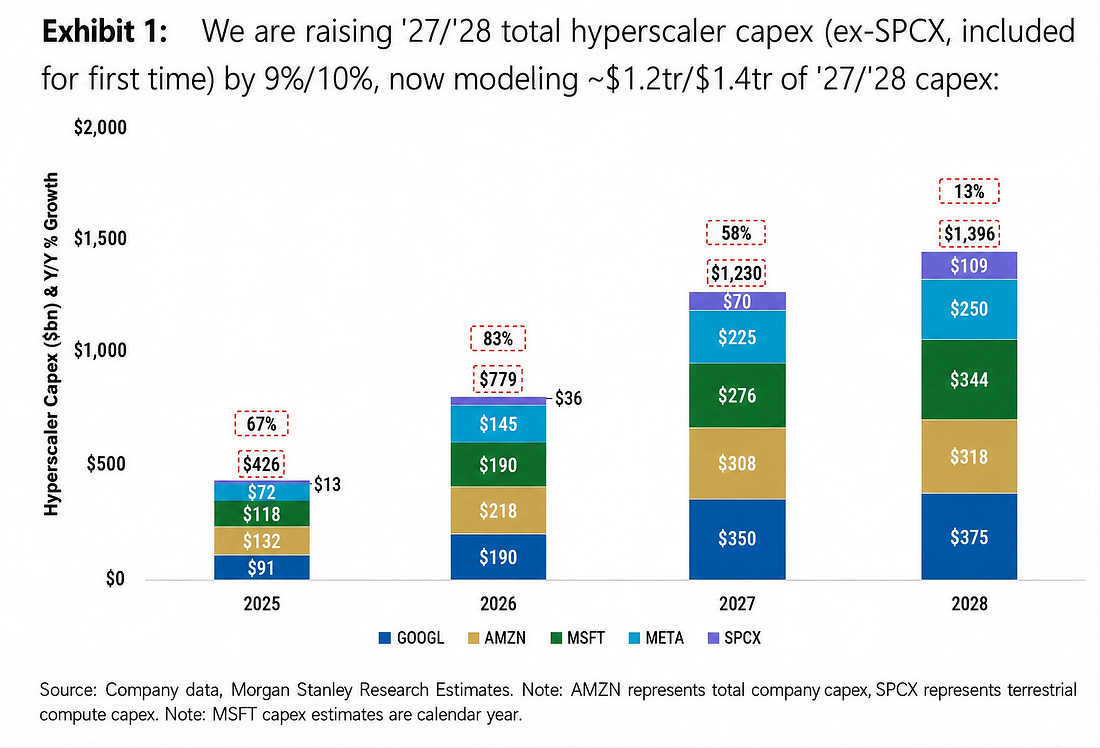
Figure: Morgan Stanley predicts that global capital expenditures of the top five hyper-scale cloud providers will reach about $1.23 trillion and $1.40 trillion in 2027/2028. Source: Morgan Stanley Research.
Morgan Stanley's latest report significantly raised its forecast for the capital expenditures of the world's top five hyper-scale cloud service providers in 2028 to $1.4 trillion. The U.S. has a lot of capital, but it's disappointing to see how it's being used. The prices for credit default swaps on Nvidia bonds will be worth watching.
It can be argued that this is not a sustainable investment compared to the outcomes and ROI we observe in the real world. The cloud or advertising growth of these select companies is not a sufficient reason. The dangers of this AI cycle are unacceptable, and too many people are being left behind. The U.S. is not adequately regulating technology to protect consumers, workers, or our most vulnerable groups.
I cannot in good conscience label AI as anything beyond a tremendous disappointment regarding how centralized and monopolized American capitalism has become. A small number of individuals and companies have the power to change history, and when that happens, it’s often not a good thing. This technology has not spread in the way you expect to see through excellent AI products.
From a macro perspective, LLMs have not converged to a certain ROIC point. Each month and each quarter that the AI bubble continues hurts people while allowing a few to rise above the majority. This is not the system, principles, or ideals upon which America was built.
The 2020s version of the generative AI cycle is a deep disappointment, representing a failure and astonishing waste of capital that sacrifices people in the affordability crisis. I have grown extremely skeptical of this movement, and I am not alone. Research shows that if you earn over $200,000 a year, you have a more positive view of generative AI technology, while if you belong to the lower half of the socio-economic spectrum, you are more likely to distrust AI. I do not even believe generative AI is a productivity multiplier or an efficiency-enhancing tool; you can see evidence of this everywhere.
America’s computational power advantage is underwhelming, while living through the poverty of the generative AI hype cycle due to a lack of energy infrastructure and the failure of environmentalists to invest in renewable and sustainable energy technologies, which will be the ultimate irony and legacy of the Trump administration many years from now—it will simply become an unsettling footnote in history.
P.S.: This article may contain many grammatical and spelling errors and will be edited again. But I felt I shouldn’t delay too long in saying what weighs on my chest and conscience. This is the culmination of many days of research, weeks of thought, reflection, and soul-searching. This cannot be neatly summarized in an infographic. You must live through it, feel it to fully perceive AI's failures.
免责声明:本文章仅代表作者个人观点,不代表本平台的立场和观点。本文章仅供信息分享,不构成对任何人的任何投资建议。用户与作者之间的任何争议,与本平台无关。如网页中刊载的文章或图片涉及侵权,请提供相关的权利证明和身份证明发送邮件到support@aicoin.com,本平台相关工作人员将会进行核查。


